Today is Sunday 10th November, and a day we’ve been looking forward to for a long time. We’ll be meeting up with a family friend Sophie Moore who works as a missionary for Elim Church here in Phnom Penh.
We meet Sophie in our hotel foyer at 9am, and head via tuktuk to church. The driver is called Sok and he’ll be with us for the full day. Sophie has kindly offered to take us round some of the city’s landmarks.

Sok is one of the nicest people you will meet, always smiling and with an infectiously funny laugh. Sophie had paid him for the whole day and he was happy to be at our disposal!

Due to our own arrangements, we had to cancel the organised city tour for today, so somewhere out there in Phnom Penh is a tour guide who’s been paid to have a day off!
The church is quite far out of town. The tuktuk chugs away, carrying 5 bodies, but copes admirably. As it does so, Sophie is filling us in on what’s been happening here.

When we arrive, we are greeted by two girls at the gate. The customary greeting seems to be hands together in a praying gesture and bow the head. This isn’t just in church circles, nearly everyone in Phnom Penh has greeted us in the same way.

The church is very small and very basic. It is a tiled courtyard underneath a house propped up by pillars. A (recently added) metal canopy adds shelter during the rainy season which has just passed.
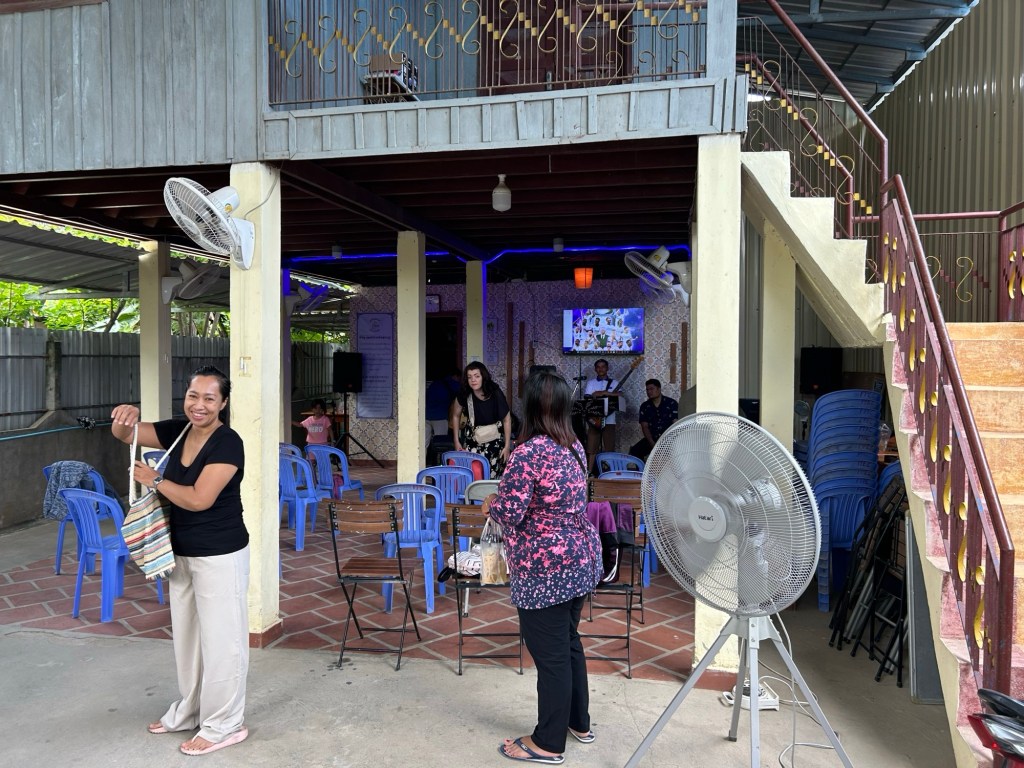
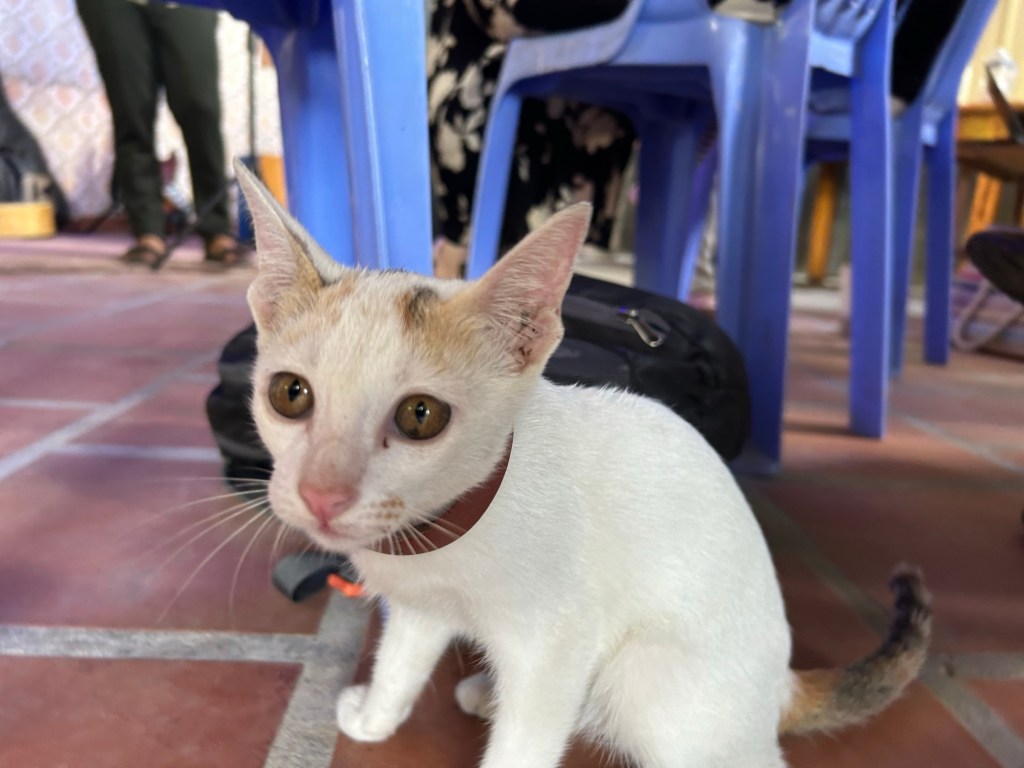
As we are introduced to some of the congregation, the worship band are warming up, kids running around, and a very small cat fondling our legs.
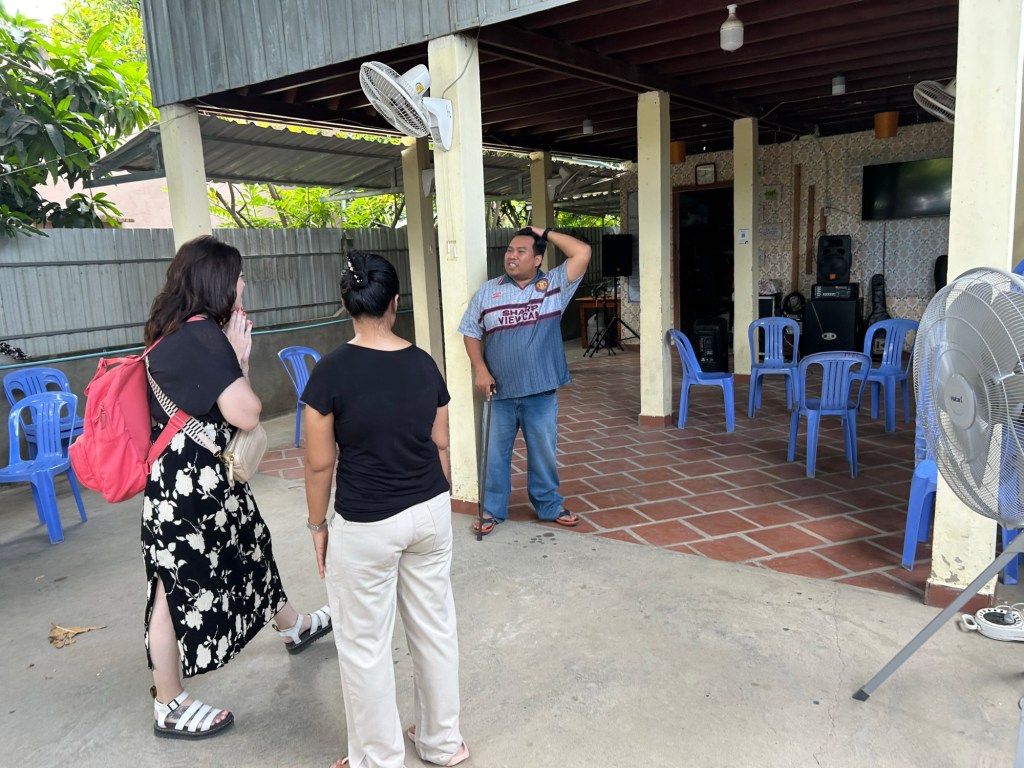
The pastor – known as Chamnap is wearing an old Manchester United shirt, and carrying a walking stick.
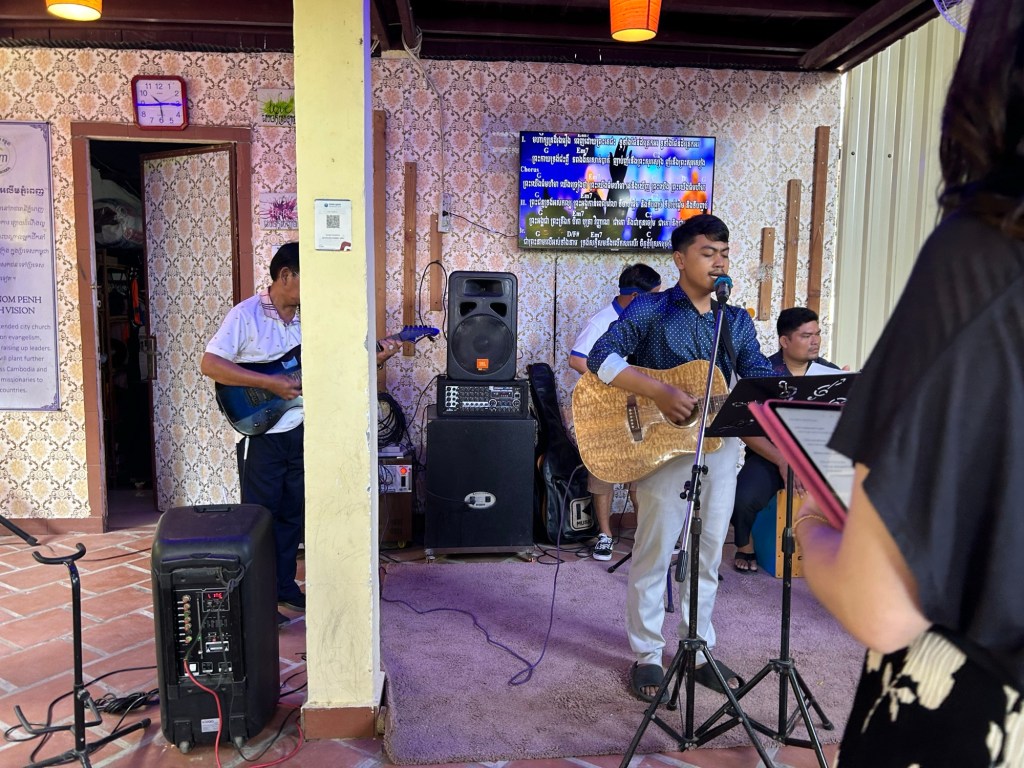
After Sophie opens the meeting (and we introduce ourselves in the most excruciatingly awkward way possible), the band strike up. All of the songs were in the local tongue (Khmer), so it was a blessed relief to get one we knew well for the last song.
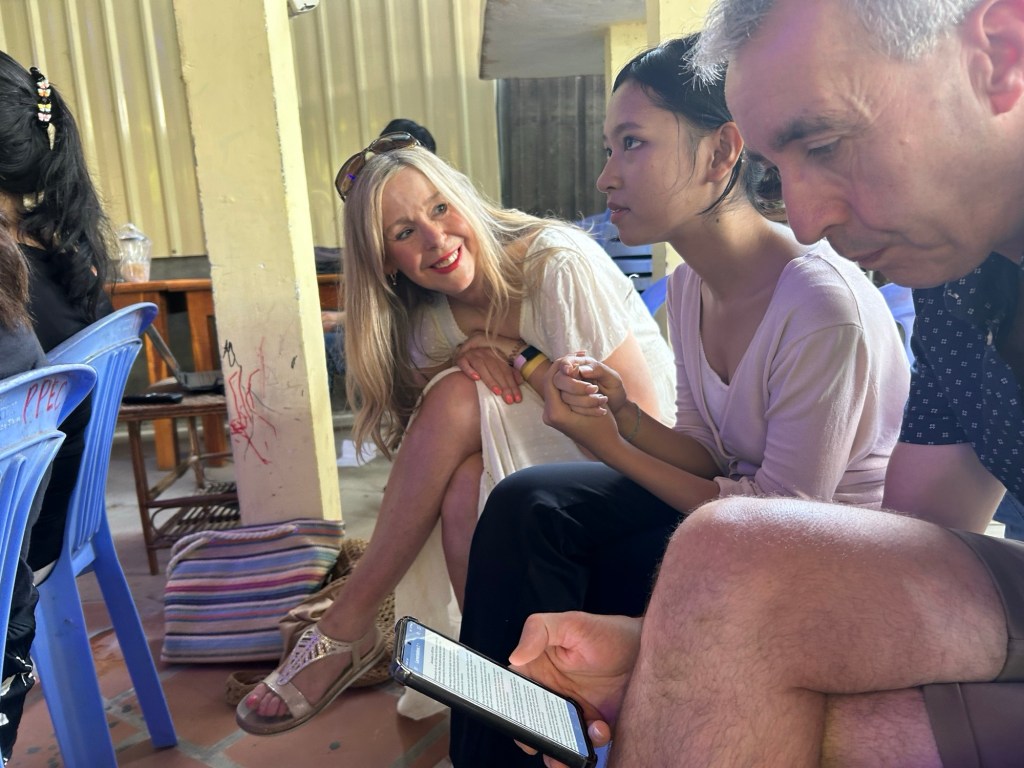
The speaker was a man named Visal, again in Khmer. In between us, a young girl called Ganaka was translating as he spoke. Her English was impeccable!
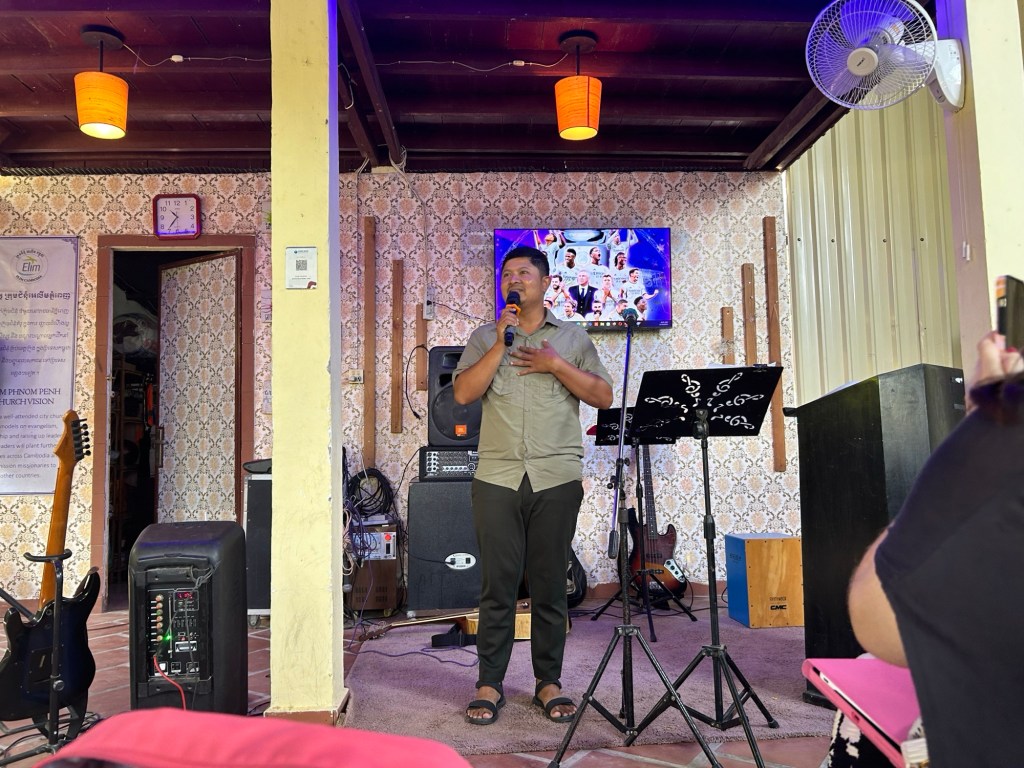
Behind Visal was a screen with a Real Madrid team photo as the wallpaper. I did wonder if passers by thought we were worshipping Carlo Ancelotti and the Champions League trophy, because that’s certainly how it looked!
After the service, we talked a bit with Chamnap and his wife. The church was planted by missionaries from Bangor almost 20 years ago, and receives financial & pastoral support from Bangor Elim back home, where I go. This church plays a pivotal role in the neighbouring community, and we’re already quite familiar with some of the the ways they do so: English classes, an early learning centre (nursery), anti-trafficking programmes, jobs through a salon, plus of course provision for those most in need.
Living conditions here are brutal. Many don’t have beds / mattresses and sleep on a hard floor. Their houses are old and in need of repair, so when heavy rain hits, there’s nowhere for the rain to go, but through cracks in the roof. The church are making a big difference in this community, and bit by bit, improving quality of life. As Chamnap speaks, I’m amazed that there’s a hint of a Northern Irish accent in certain words. He’s never lived in Northern Ireland, but most of the English speakers he works with are from there. He’s planning on coming over early next year and is looking forward to a Mauds Pooh Bear ice cream.
After church, we say our goodbyes, and then, its back to the Tuktuk with Sophie for lunch. Here I have my first hint of a jippy tummy and diarrhoea was certainly not welcome. Fortunately most of the toilets here have a bum gun (a pressure hose) for cleaning up any mess. They say it’s more hygienic that toilet paper. Airing on the side of caution – I used both.
Following lunch, we visit the Killing Fields of Choeung Ek. This is likely to be the most grim place we’ll visit on this holiday.
In killing fields like this, some 2-3 million people were brutally murdered in total in the late 1970s by the Khmer Rouge, headed up by Pol Pot. That’s some 25% of Cambodia’s population at that time. At one point around 300,000 people were killed in one day.
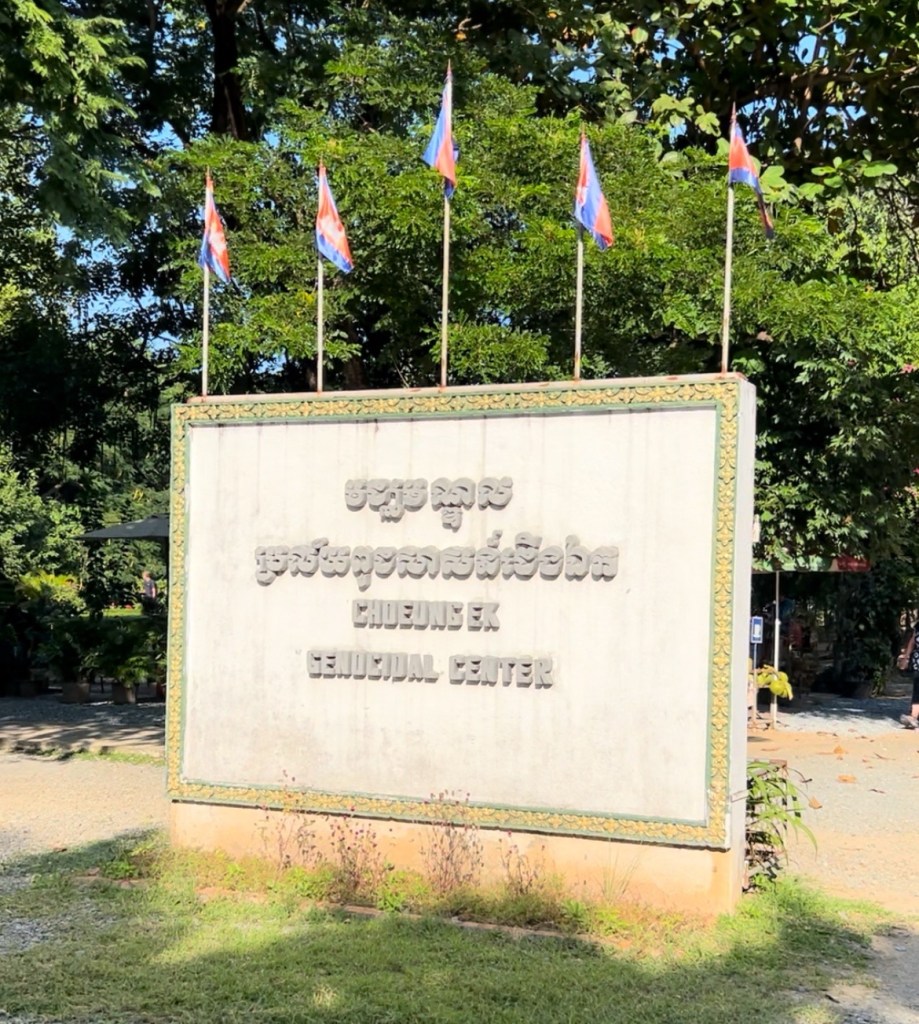
This brutal regime came to power in 1975 (by force not vote). They had a radical set of communist policies, and would execute anyone who opposed them without any trial or mercy. The bodies were then dumped in a mass grave on the same grounds.
It’s believed that around 20,000 people were killed at this particular location.
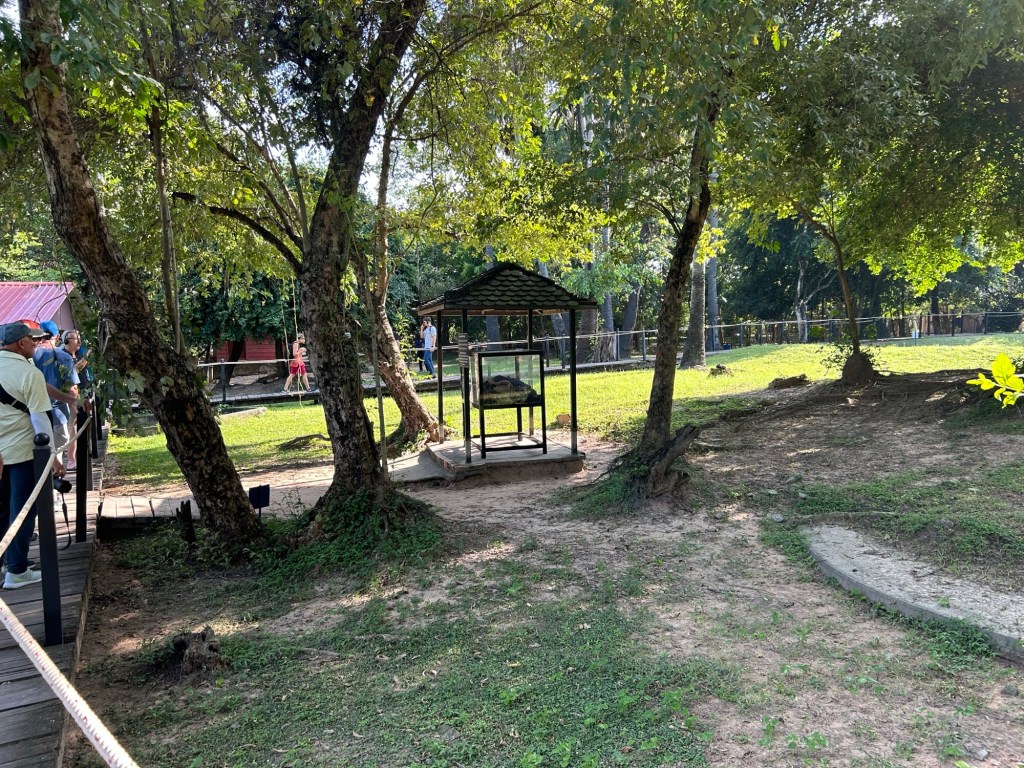
Pol Pot was angry that society allowed some people to have, while others had nothing. He wanted to restore to a base society of labourers. Anyone showing any sign of intelligence was most vulnerable.
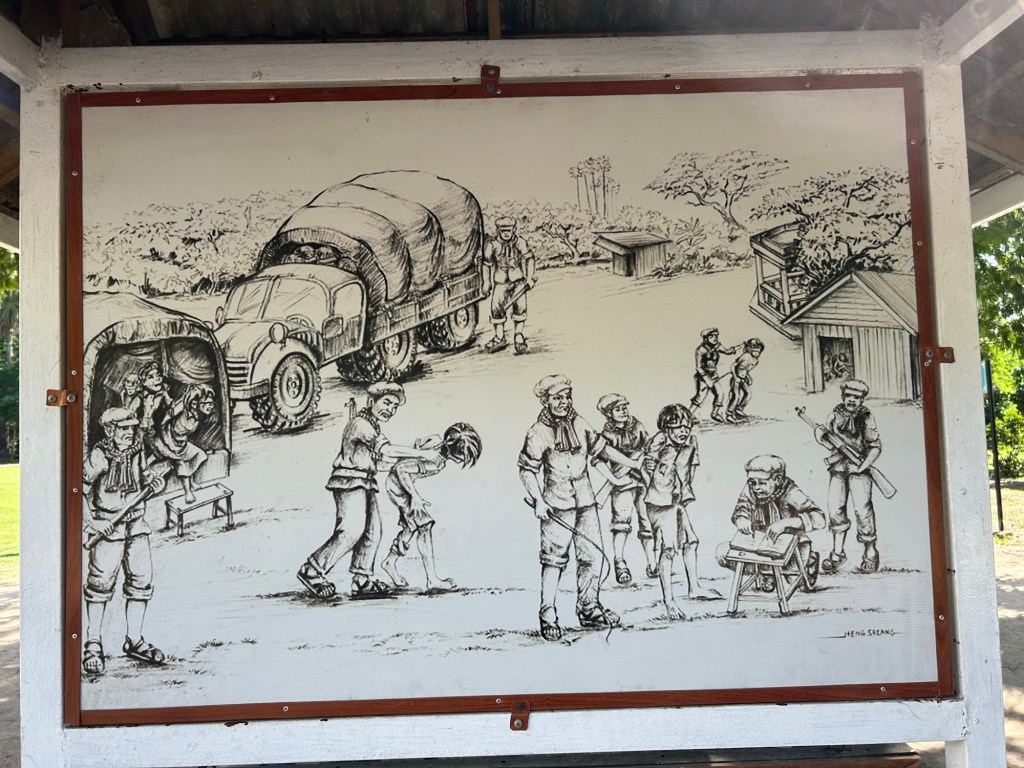
The killing fields were discovered by a Vietnamese journalist in 1979, who was investigating reports of mass graves in the area. He discovered hundreds of bodies scattered in varying degrees of decomposition.
In 1980, the Cambodian government officially recognised Choeung Ek as a killing field and built a memorial stupa in the centre to commemorate victims.
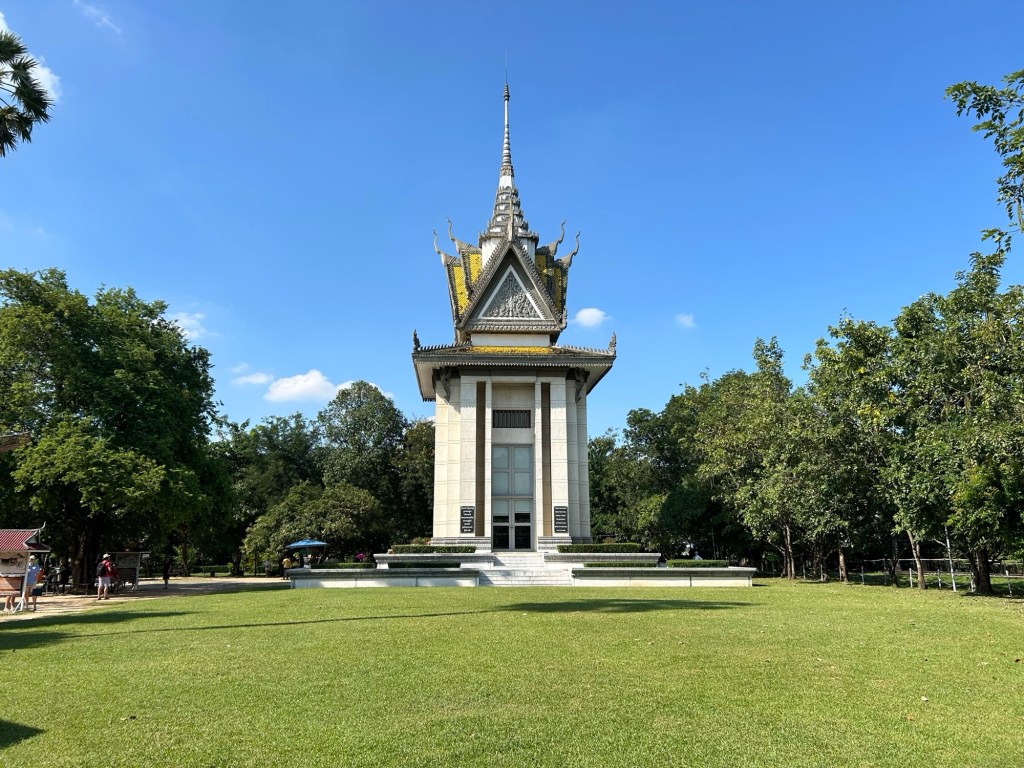
Inside the stupa, visitors are asked to take off shoes before entering. There are hundreds of skulls stacked on shelves as far up as the eye can see. All of these have been exhumed from the burial pits.
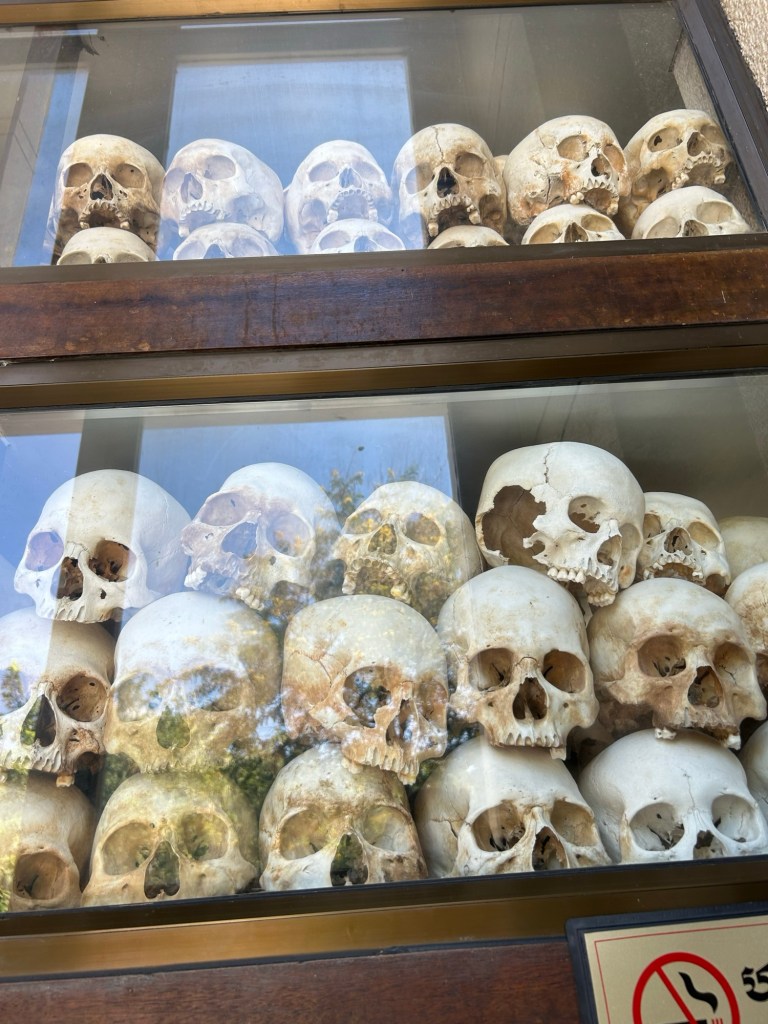
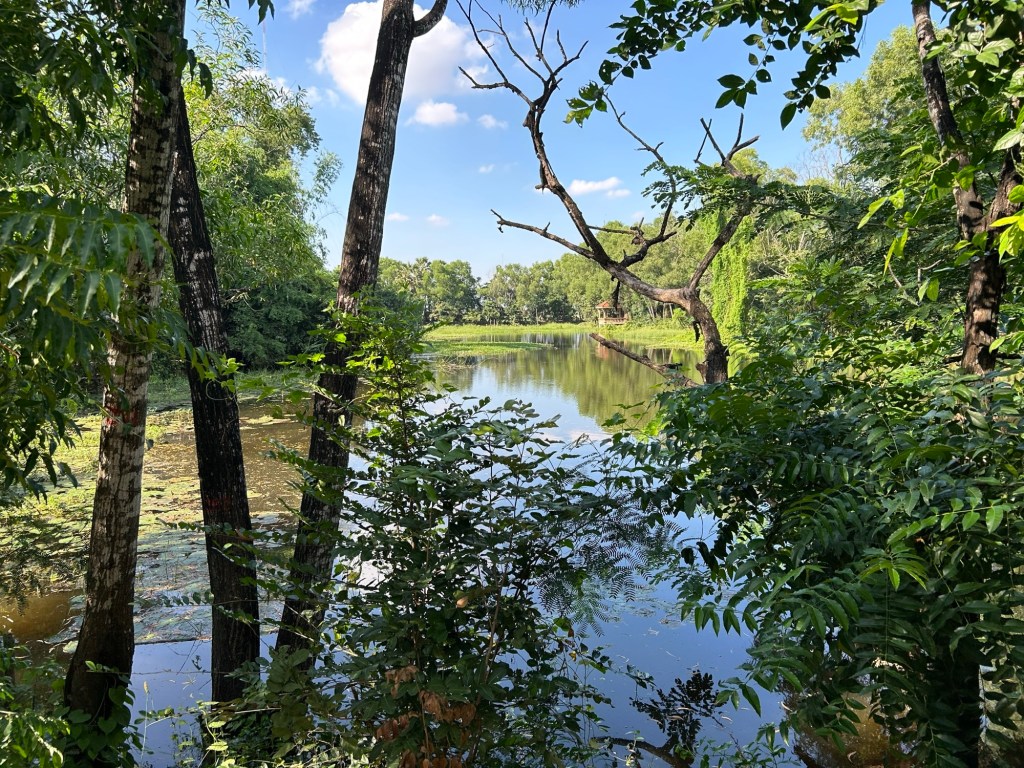
This is quite an overwhelming experience, informative audio guides help paint a visual picture of the atrocities committed, but I still struggle to associate what I am seeing with what we are told happened. Now it’s such a peaceful place. There is silence as you walk, and an abundance of life in the form of insects, flowers and trees.
The searing heat makes this experience even harder to cope with.

Choeung Ek was specifically chosen by the Khmer Rouge as it’s out of the way from the city centre, and beforehand had been an orchard and Chinese graveyard.
Any hint of religion was strictly forbidden, and music played at night to cover up the screams of executed victims. They would say that it’s “better to kill an innocent by mistake than miss an enemy by mistake”
The bodies thrown in the lake have been left there to lie in peace, however every couple of months, some bones or teeth wash up and are moved for posterity.
The benches provide a good spot in shade to just process thoughts and emotions. At one point, some instrumental music plays on the audio guide – ‘A memory from darkness by Kim Sophy. It’s beautifully poignant.
We hear stories of how prisoners were rounded up and thought they were being taken home by train. When the train continued past Phnom Penh, they realised there was a problem.
Among the graves lie 166 victims without heads. These were Khmer Rouge soldiers who paid the price for mismanagement.
The most tragic display is the Killing Tree, where soldiers smashed babies’ heads against the tree, killing them in front of their parents. The rest of the family would then be next.
For sure, this chapter in Cambodian history was absolutely disgraceful, but those days are now in its past. Cambodia is building a new future, while also committing to never forget the past.

This real life story of the atrocities committed at the hand of the Khmer Rouge, inspired the 1984 award winning drama film – ‘the Killing Fields’.
After the heaviness of the killing fields, we journeyed down to the river for some light relief (pun incoming). There, a flotilla of brightly illuminated boats was stationed ahead of next week’s Bon om Touk (boat paddling) festival.
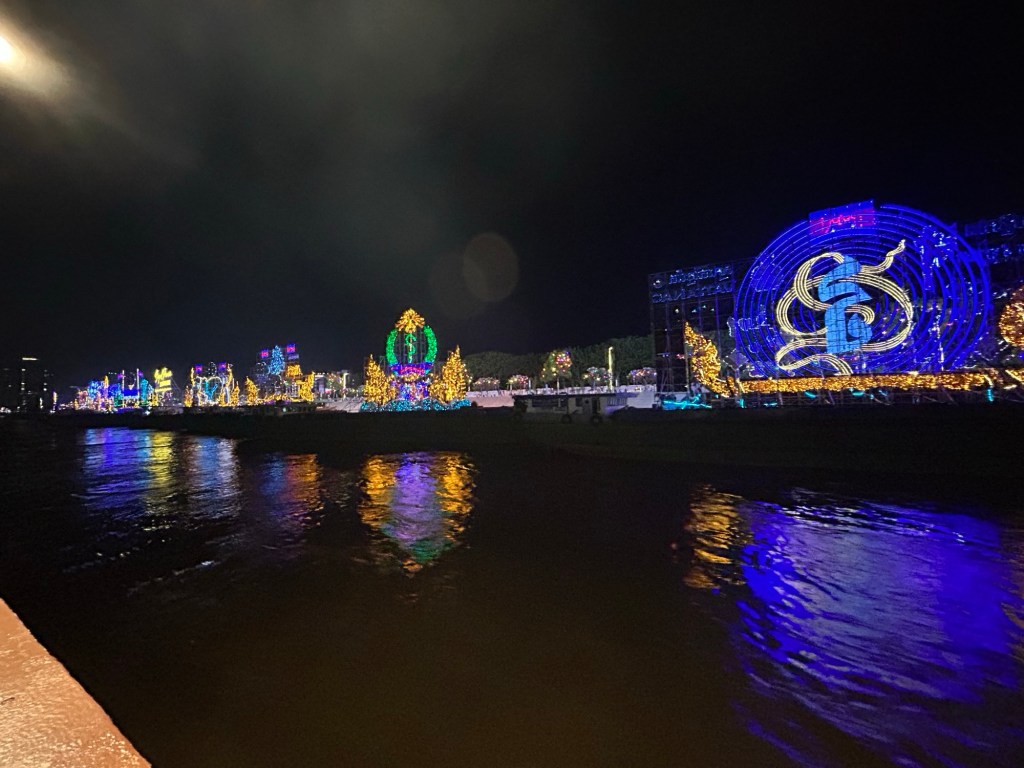
Boat tours go out onto the Mekong & Tonlé Sap rivers, and this is the best way to see Phnom Penh’s skyline at night, and this flotilla up close. The rich neon lights add a splash of colour to the city centre.
The water festival is held every year late October / early November, and marks the middle of the lunar cycle, and the official end to the monsoon season. At this point, the Tonlé Sap flow changes direction (it’s to do with flow rates in the Mekong coming from melting glaciers in the Himalayas).
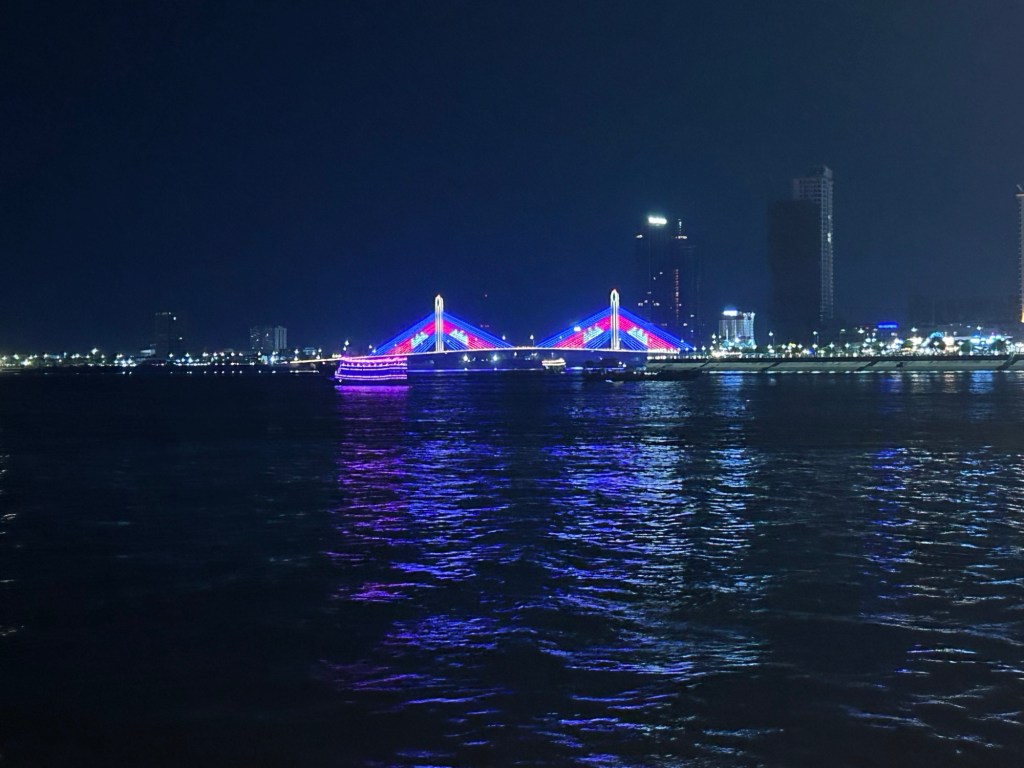
From the water, Koh Norea (Korean friendship) bridge sticks out in the distance. Here, the colours of the Cambodian flag project onto the side of the bridge, and it generally looks pretty cool.
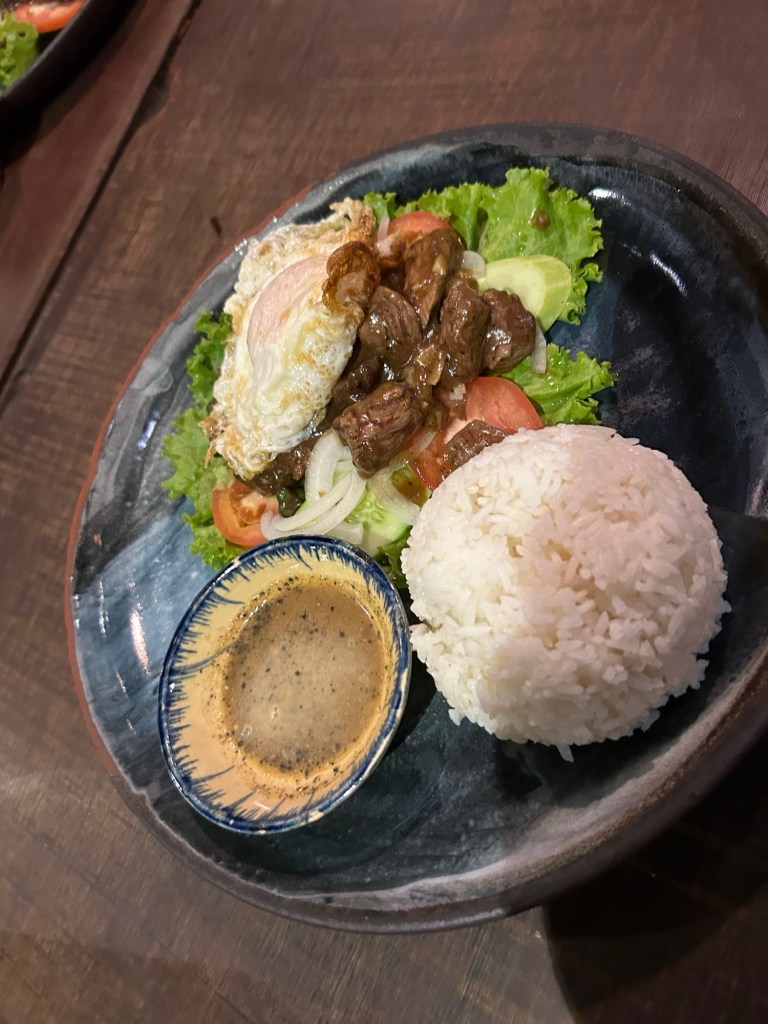
Sophie and Sok take us to the Kinin restaurant near our hotel. She recommends Lok Lak to us, as an authentic local dish. It’s beef chunks in a tangy peppered sauce with lettuce and a fried egg on top and is absolutely exquisite.
After dinner we exchange gifts and say our farewells to Sophie and Sok. For them, life in Phnom Penh goes on, but for us, we’ll be leaving tomorrow for Siem Reap further north in Cambodia.

It’s just after 9pm, and a few thousand steps shy of our 10,000 step daily target, Dad and I take a brief walk over to the Genocide Museum, located beside the hotel.
We didn’t get time to go in before it closed for the evening (and to be honest, it probably would have been too much, doing it on the same day as the killing fields), so only had a look from the outside.
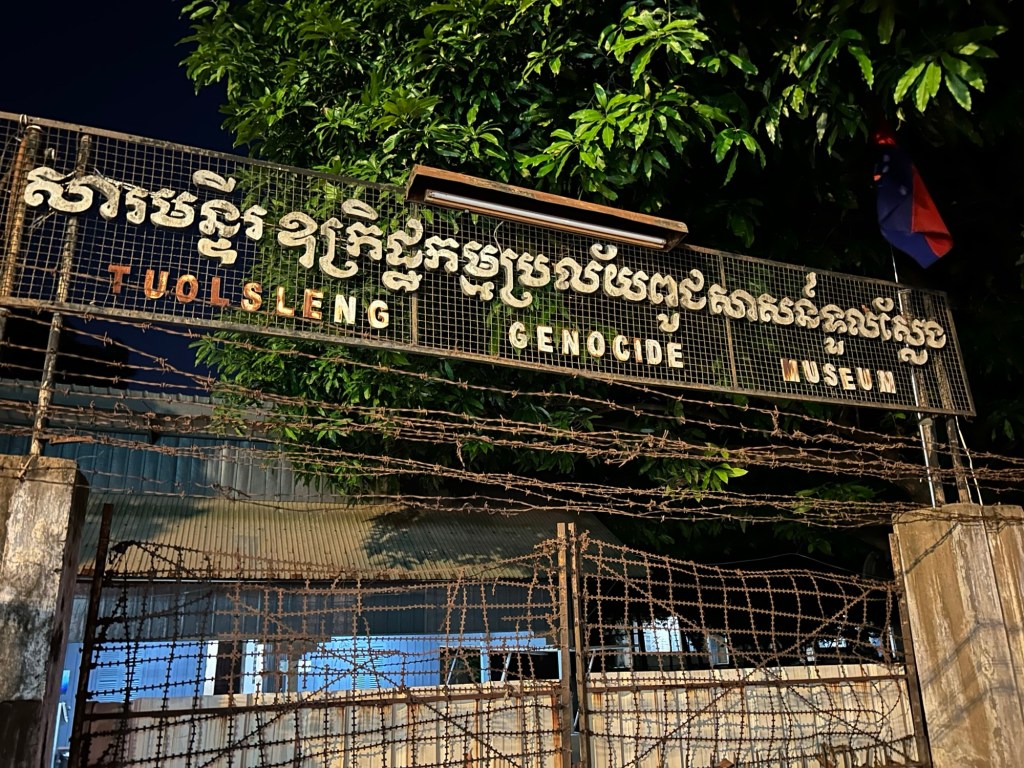
This was converted from a high school, to a high security prison by the Khmer Rouge, a few months after the came to power in 1975. Between then and 1979, it’s believed that at least 18,145 prisoners were detained here.
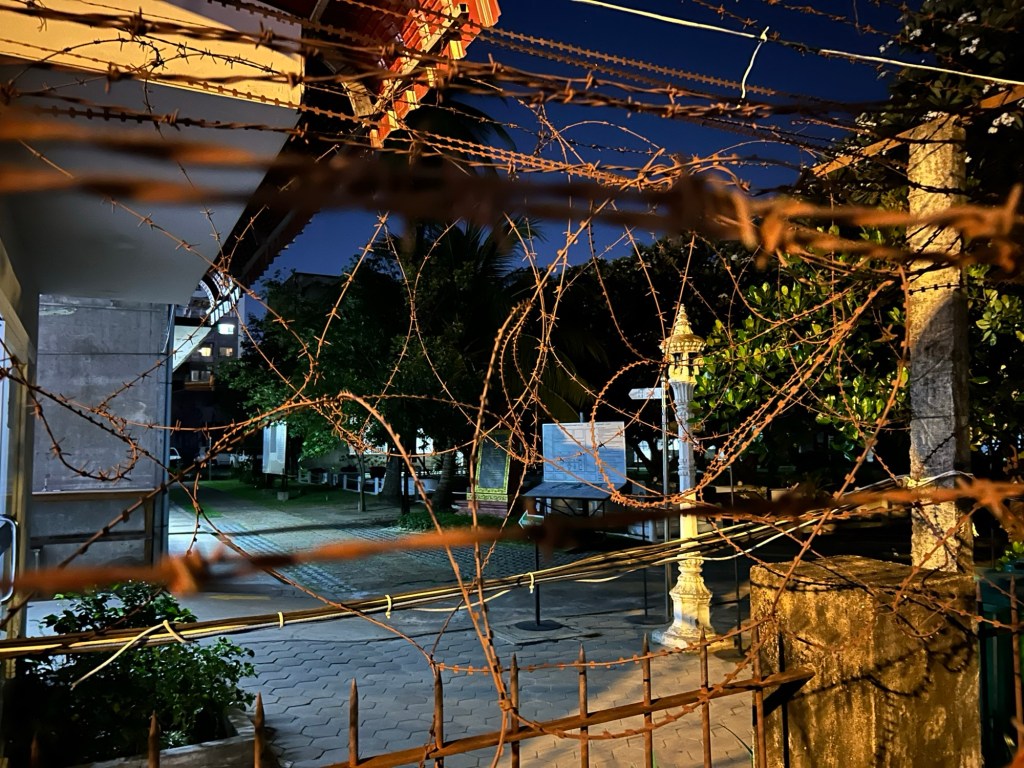
Prisoners were isolated from one another, beaten, and tortured by the guards, and brutally murdered. 18,133 prisoners were executed.
While reaching over the fence for a photo, a man wearing a Borussia Dortmund football top appears beside us and we start chatting about our time in Cambodia and the prison.
He is called David, and lives beside our hotel. He tells us that his brother was in the prison. He is quite difficult to make out, and looks too young to have been around in the 1970s, so he probably just means visiting in recent years.

Again, the people here are all so lovely and will all go out of their way to make conversation. Back home, he’d probably chase us down the street! 😂
After that we walk 3km to the market, but it’s a wild goose chase as the market was closed. 5 dollars for another tuktuk back to the hotel and ready for bed!

 See Travel Blog
Leave a comment