Hello and welcome back to Cambodia for more stories from the other side of the world. Today we will be checking out the ancient temples of Angkor Wat (unofficially voted the 8th wonder of the world) and the surrounding area. It’s pretty much the reason most people come to Cambodia, and I’ve heard a lot of amazing things, so keen to see for myself.
They always say that breakfast is the most important meal of the day (which I usually skip), but dad had the philosophy of setting your day up with a big meal (and with buffet breakfast included – we’d be fools not to take it up, so I go for coco pops).
I notice that we’re the only people down for breakfast. Are we the only people staying in this hotel? I’m not sure I’ve actually seen anyone else in the time we’ve been here!
After breakfast, a man is sitting in our hotel foyer dressed as a Boy Scout. It turns out to be our tour guide for the next few days – Kachhel.
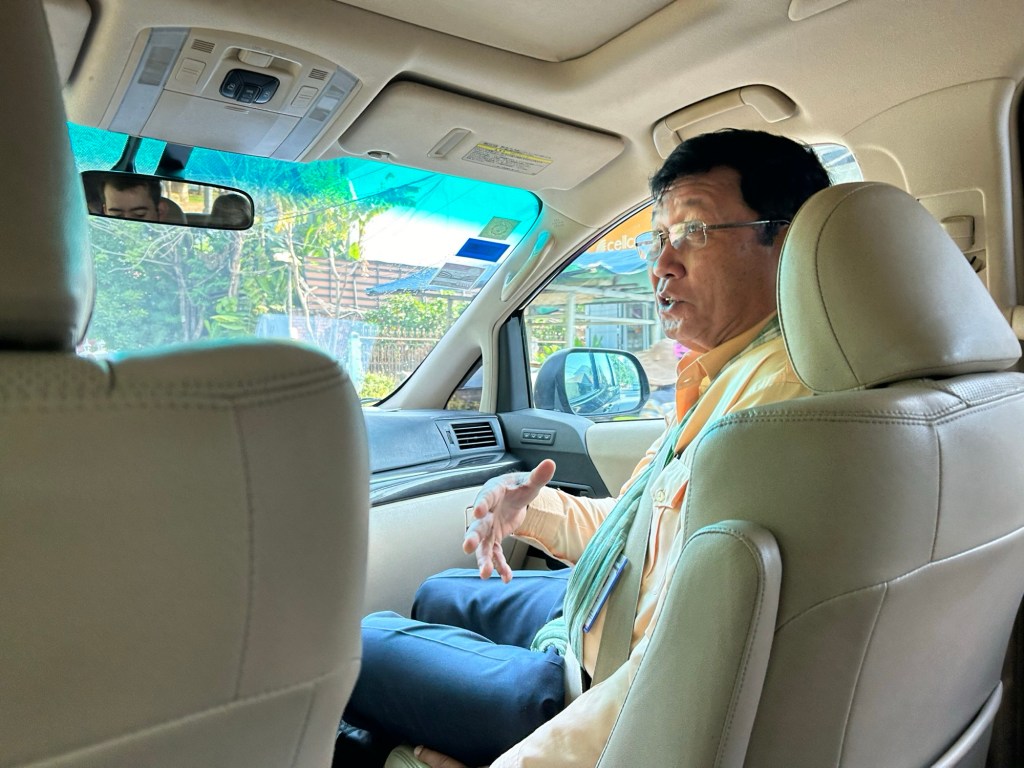
Kachhel takes us to the car we’ll be using for the day, and gives us a bit of background on Siem Reap. This city once measured just 1km wide and 7km long beside the river, but tourism exploded in the mid 1990s, and its growing fast. It was once the smallest town in Cambodia, but is now gateway to the Angkors and unrecognisable to those who knew it before.
Before the Cambodian genocide, there were only 3 hotels. Now there are around 100.
Before we are unleashed on Angkor Wat, we need to get a day pass to give us access. To get this, we must head to a tourist information centre just out of Siem Reap. The $37 cost has been built into the cost of our tour, so the guide purchased the tickets.
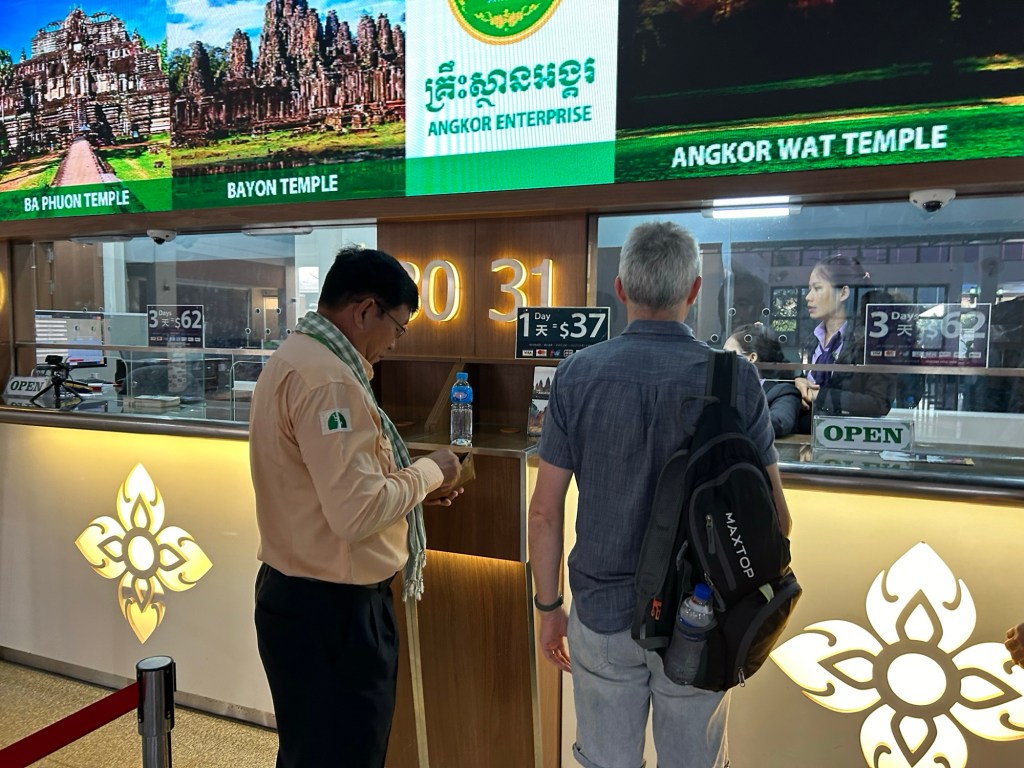
A webcam captures our photos for the ticket. I’ve got to say this is probably the coolest attraction ticket I’ve ever seen. I felt like saying that we had a few passport photos going to waste if that helps, but the moment escaped.

Kachhel gives us a taste of his experiences of the Khmer Rouge. Absolutely brutal. His father and grandfather were taken away from home with a notebook and pen ‘to study’ for three months, but he never saw them again. It is understandably an emotional topic, but he does very well to control it. After the war, his family moved to Phnom Penh to continue his education.
The wider temples area is known as just Angkor – meaning city. It was the ancient capital of the Khmer empire, which was around between 802-1431 AD. There are a lot of different things in that complex, the most famous of which being Angkor Wat – but we’ll get to that later. We’re purposely saving the best for last.
Like any good Boy Scout – Kachhel whips out his map of the area, and gives us the run down on our plan for the day.

The first stop is Angkor Thom – around 9 sq. km in area, and when I say square km, I really mean it. From above, this is a perfect square, and surrounded by a moat which was totally man made.
We cross the moat via a causeway, passing a row of gods pulling a snake on our left, and a row of demons pulling a snake on our right. These statues are in varying degrees of health, but the ones which have been restored, have been done so tastefully.

We enter through the South Gate (which I am calling, Gareth). Above ‘Gareth’ is a stone tower, with a large head on top. At one point, there would probably have been one of these large heads facing each of the 4 cardinal directions. If they’d got that wrong, it would have been a cardinal sin.
With the aid of an ancient lever system, our guide explains how they would have been able to lift and lower heavy large stone blocks. It’s quite clever and easy really.

In case you haven’t already figured it out, pretty much all of these buildings have been made almost exclusively from stone. That’s probably why they’ve endured for so long (it’s hard to imagine wooden buildings lasting over 1000 years!)
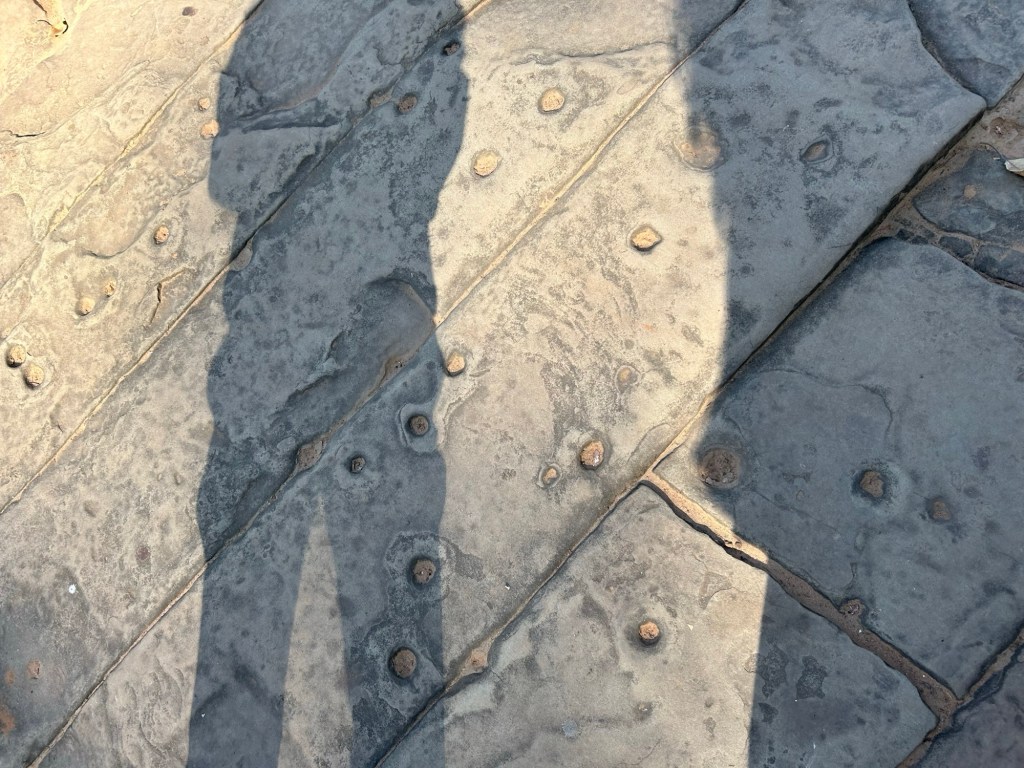
Most of the stones have very obvious holes in them, and these are where the lifting poles would have grabbed. I can’t quite comprehend how builders managed to do all of this without computers and power tools – particular when it comes to the intricate carvings in the stone, but they were clearly a clever and resourceful bunch!
At the other side of the South Gate, we jump back into the car to drive to the Bayon temple, in the centre of the complex. The car now smells like a Terry’s chocolate orange. That’s a very welcome smell!
In the very centre of Angkor Thom, is the Bayon Temple. Nobody’s quite sure what this was called at the time of construction – as Bayon was the name given by 19th century French explorers. The temple was built as a Buddhist monument by Jayavarman VII (the first Buddhist Khmer king).
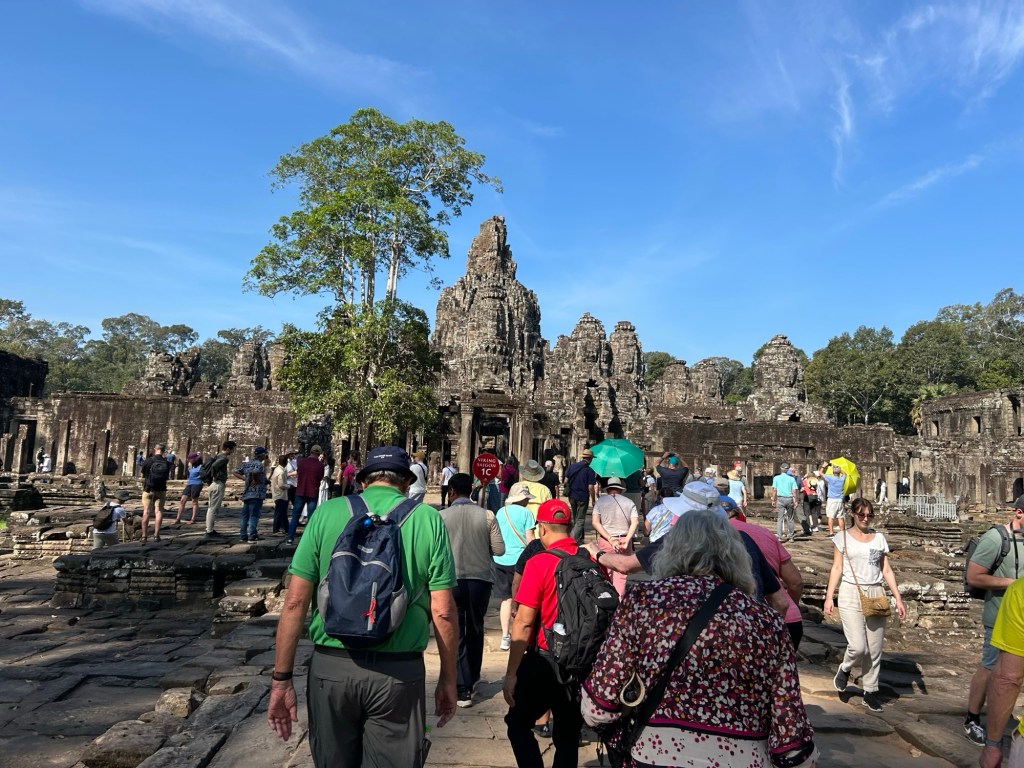
Kachhel explains how Buddhism and Hinduism were both allowed to coexist here, and both coexisted for hundreds of years. That proves to be a bit of a recurring theme in the temple architecture and designs.
While this area is very much in the jungle now, that wasn’t the case in its hay day: the trees have grown in the thousand years in the several hundred years following the downfall of the Khmer empire. Nobody lived inside these temples, instead, people (including the king) lived in wooden huts around the outside of the temples, which would have instead been used solely for worship.
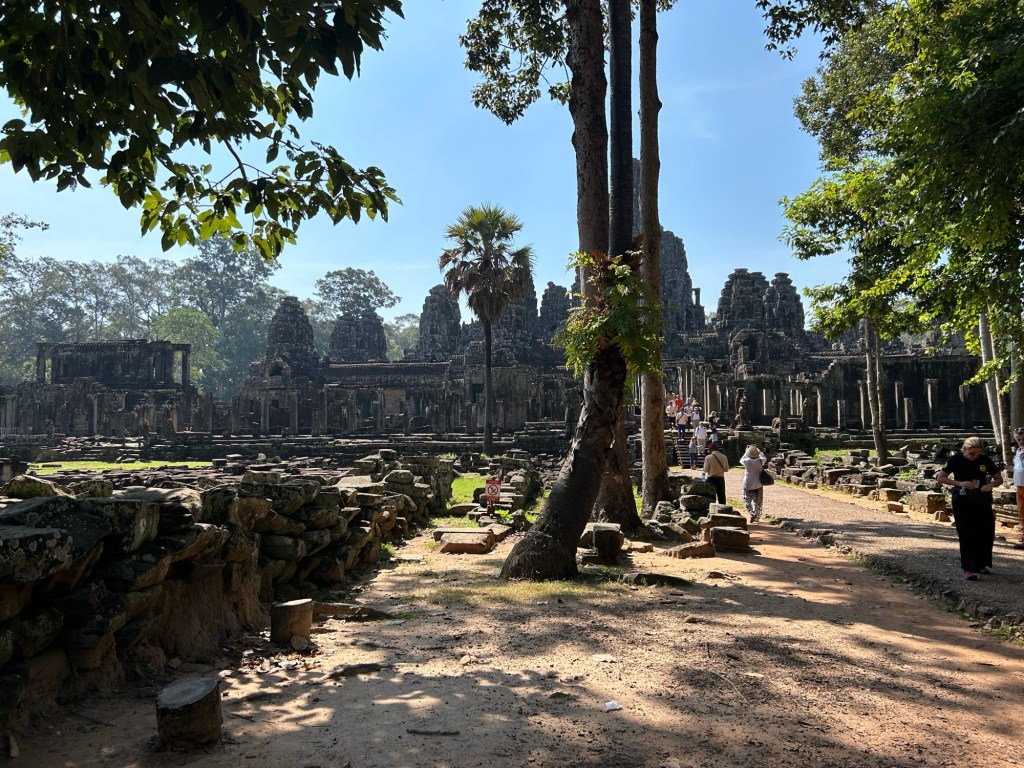
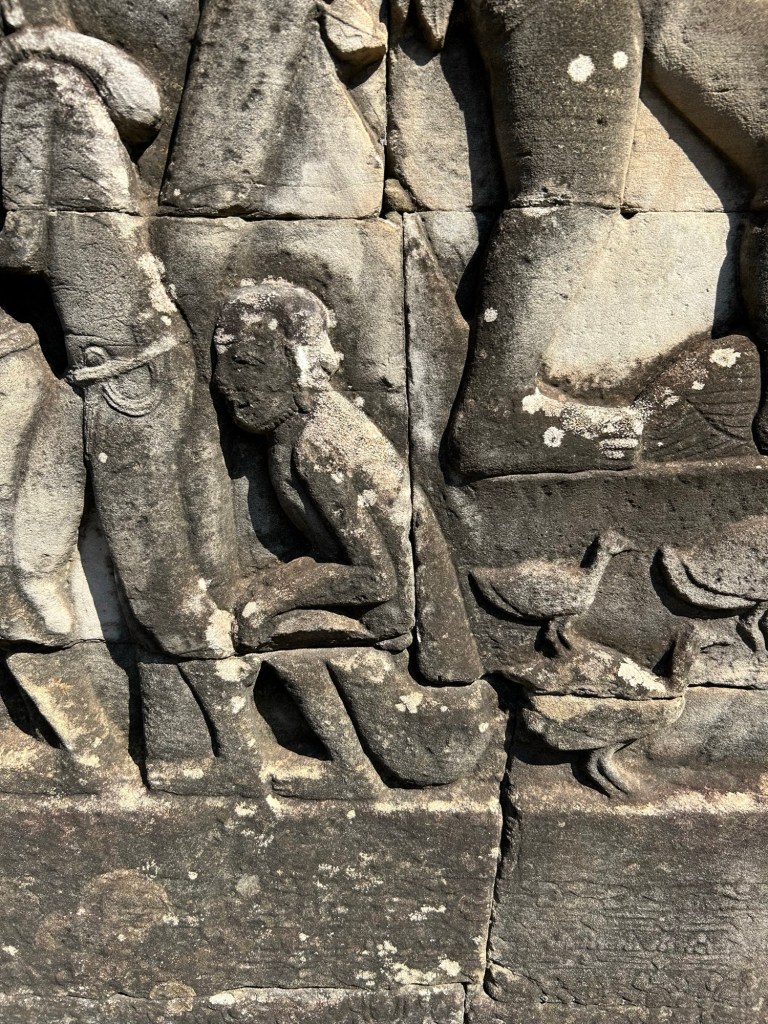
There are incredible inscriptions on nearly every stone, and each has an incredible level of precision and artistry unmatched by the western culture during that time.


Some stones have blank spaces, and we ask why. The answer is that it was intended for a sculpture of the king to be added after he died, but this never happened. The new king was clearly less interested.
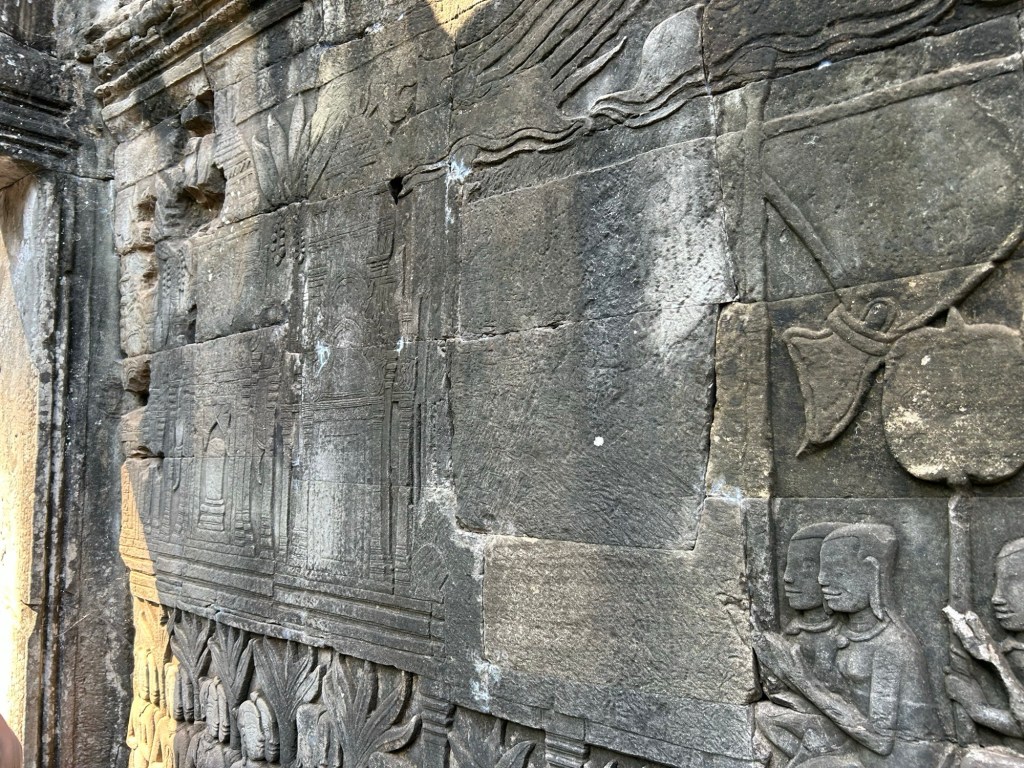
Angkor kings descended from the mother’s lineage, rather than the father’s side. Of course the latter is much more common these days (and even in Cambodia itself).
The Khmer people can be identified easily from the stone pictures via their long earlobes.
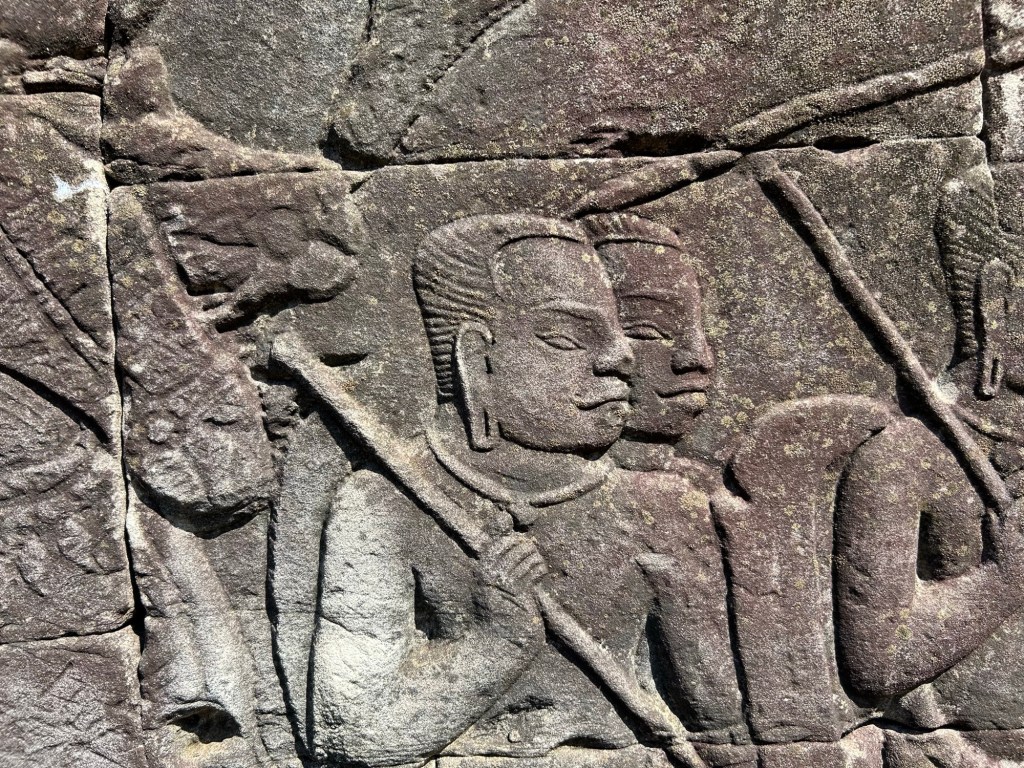
This image looks like two sumo wrestlers fighting. Surely that wasn’t a thing in those days?
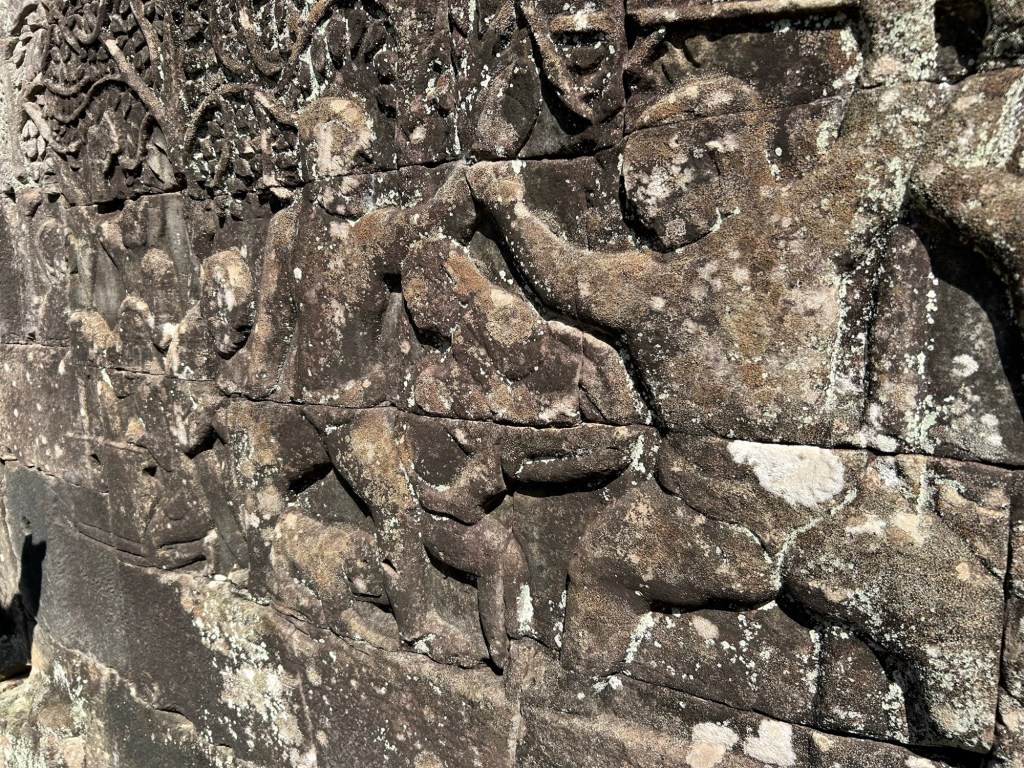
This one resembles someone squatting on a toilet. Maybe 10th / 11th century life wasn’t as different as we would think?
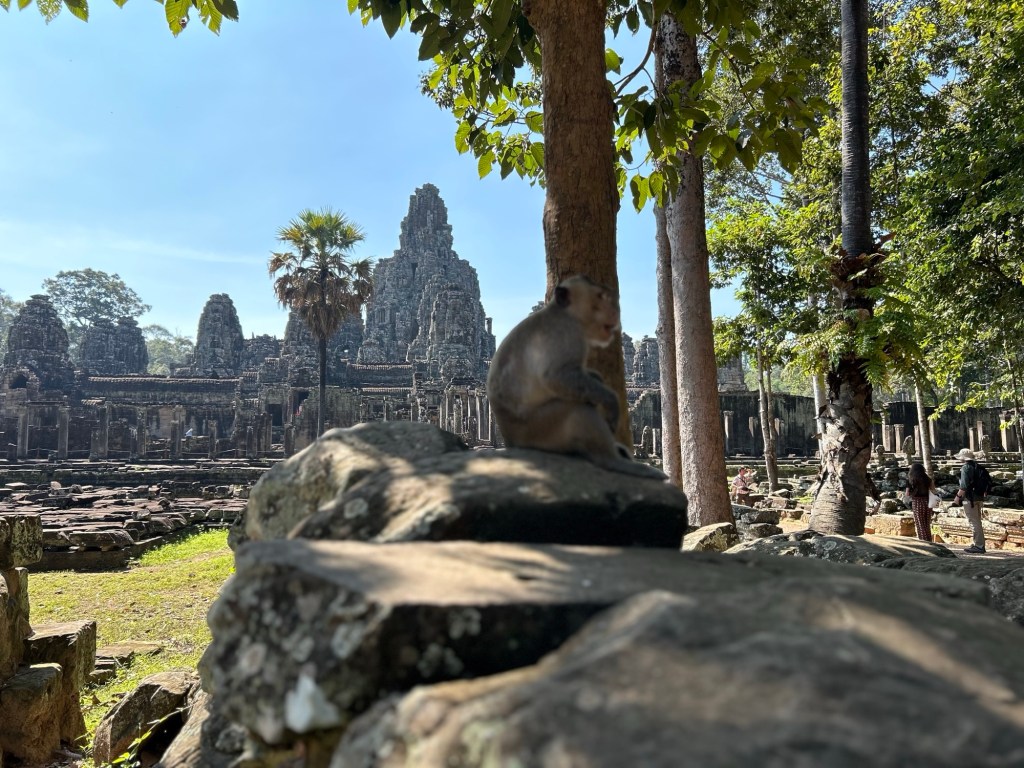
On the way out of Bayon Temple, we see a monkey sitting on a wall observing the world go by. Surrounding the money are a wall of tourists (myself included). The temple provides a dramatic backdrop.
Next up is the Baphuon Temple, described as an “11th century temple mountain”. My eye is immediately drawn to the chunky base on which the temple has been built.

Again this is made of many smaller blocks, and there are points where you can’t spot any seems between the blocks. There is no concrete / resin holding everything together, as this would have left a noticeable gap between blocks.
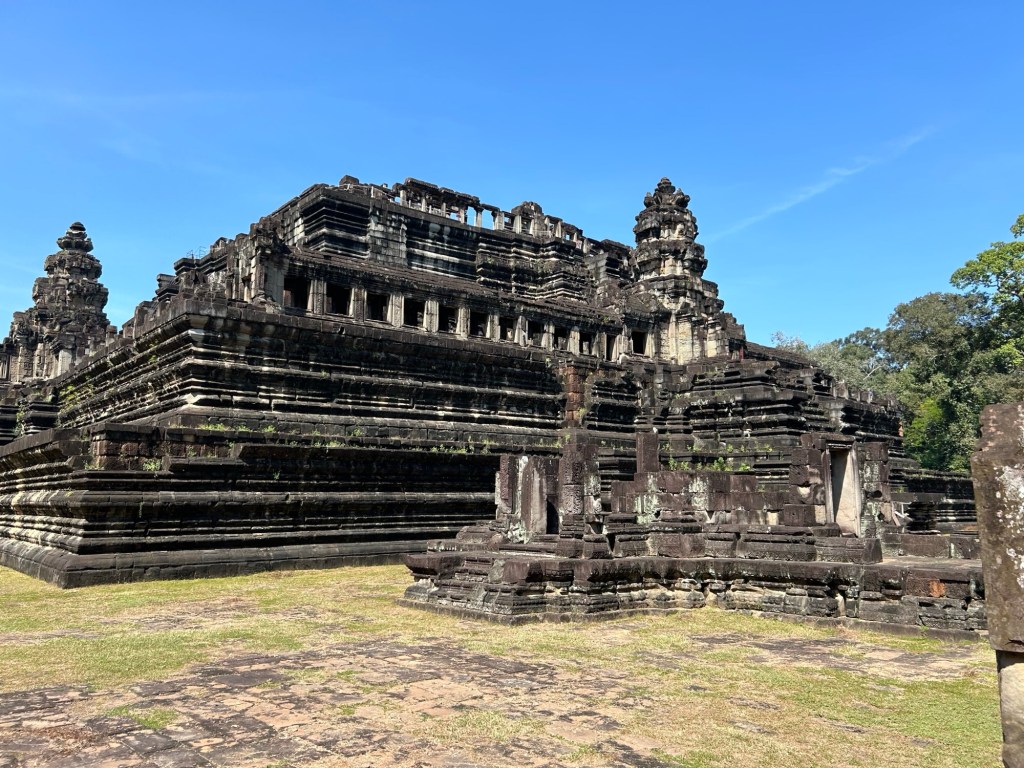
The Baphuon temple was one of the most opulent of the Angkor temples in its day, but time hasn’t been quite so kind. Like the Leaning Tower of Pisa, it was built on unsteady sandy ground. The temple’s foundations weren’t adequate to support its weight, and large portions are believed to have collapsed very early on.
Of what remained, this too wasn’t in great shape, so plans were drawn up for the temple to be dismantled block by block (around 300,000 stones in total) and rebuilt.
Sadly the project was abandoned during the civil war in the 1970s, when the plans were destroyed by the Khmer Rouge.
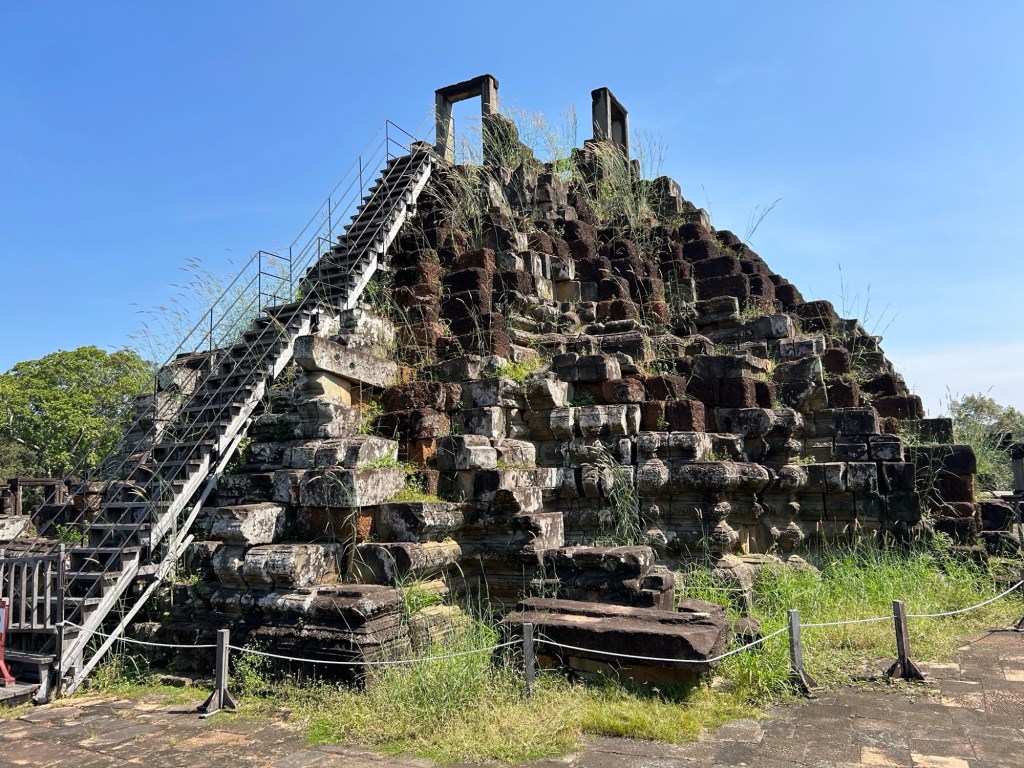
The second restoration project in 1996 years was more successful, with the aid of modern technology, but even this took 16 years to complete.
Just a short walk from that, is Phimesnakas (which sounds Greek) and was a Hindu temple with a name meaning celestial palace.
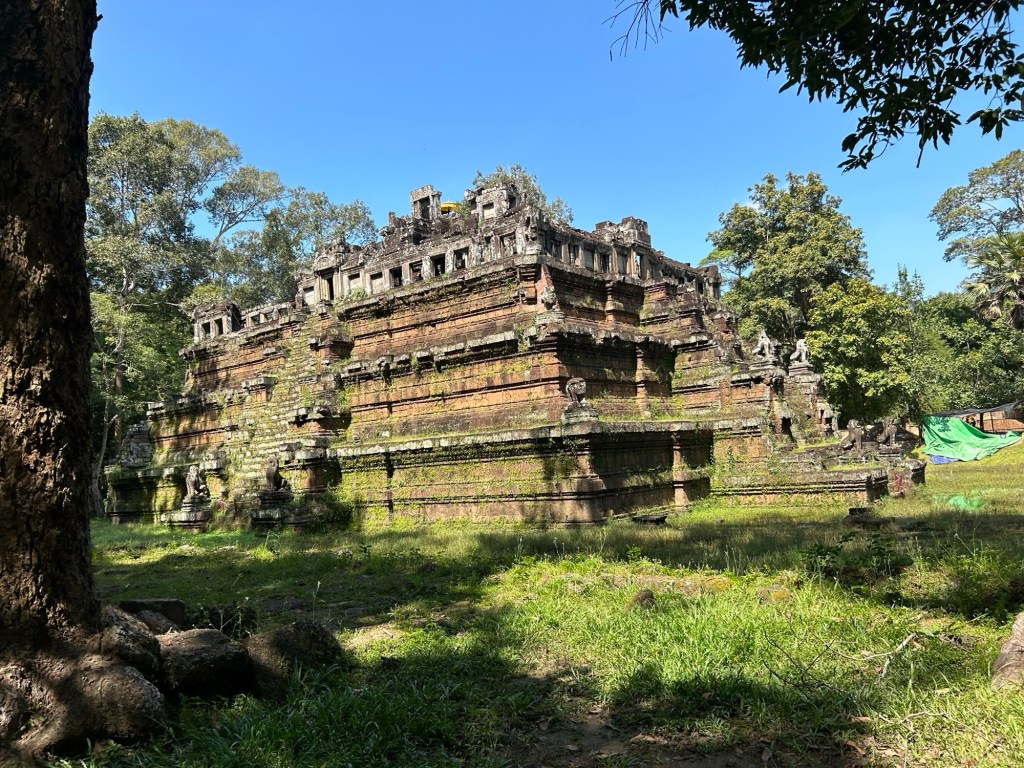
This is a hundred or so years older than the Baphuon temple, and was the focal point of King Suryavarman I’s capital. A couple of centuries later, the temple was swallowed up by the much larger Angkor Thom complex. It’s closed for restoration as we pass.
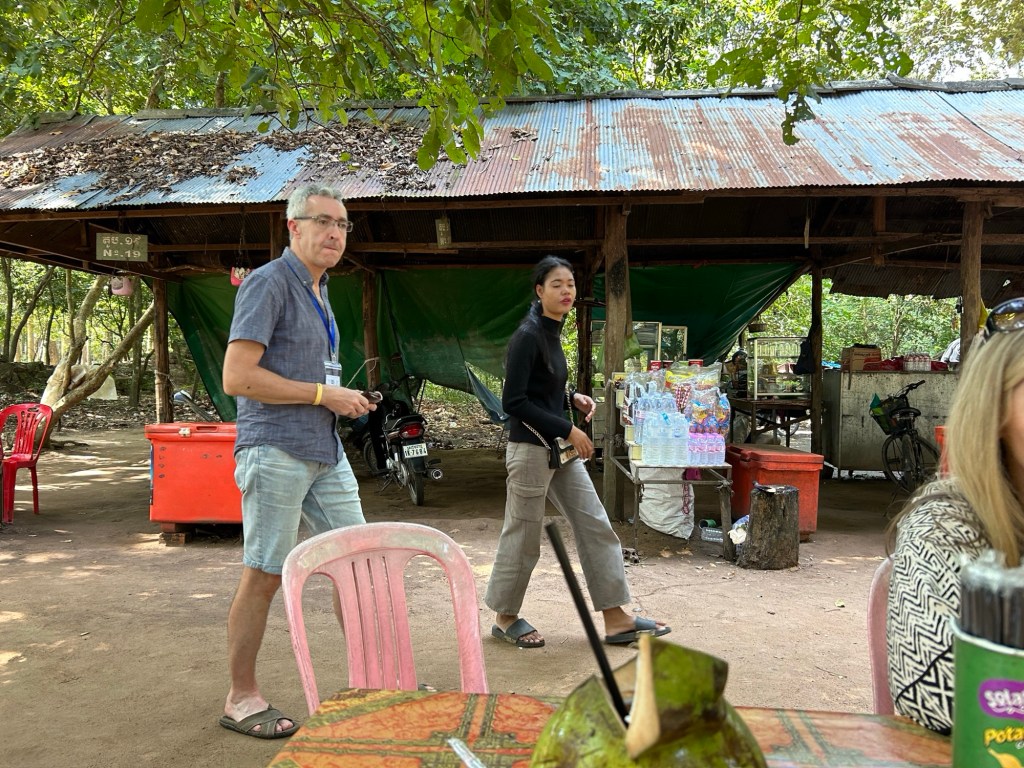
It is seriously hot today, and we’re downing water faster than a gas guzzling American muscle car. Looking for some respite, a coconut stall comes at just the right time. I opt instead for a Fanta straight out of the ice bucket (which by now his is more of a cold water bucket).
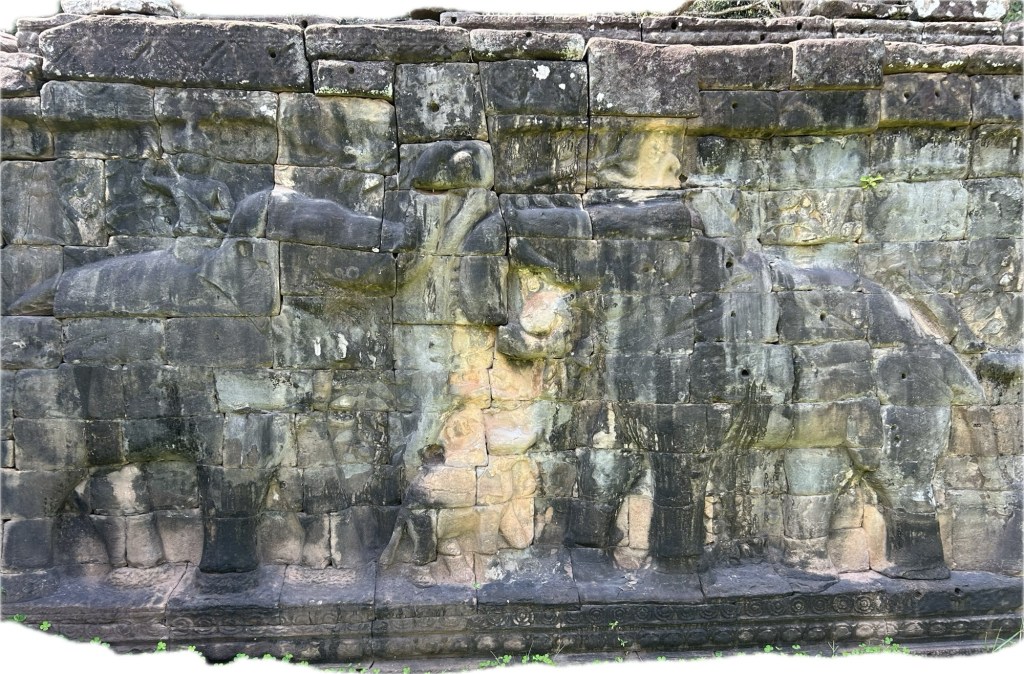
Every good landmark needs a good viewpoint, and the ancient Khmers had 2 – the Terrace of the Leper King and the Terrace of the Elephants.
The first of these two is named after the leper king statue on top, who is missing fingers on his right hand. That’s probably more to do with the weathering of time, than any disease the poor chap was carrying; in fact it’s not even known for sure who he is, let alone where the name comes from.

Our guide thinks this may be Yama, the god of death or judgement. There’s some evidence which suggests that this may have once been a royal crematorium.
The Terrace of the Elephants sits just beside Mr Leper, and runs for about 300 metres. There’s work going on around this, so we can’t see its full extent, but can make out full size elephant carvings and carved depictions on the terrace wall. A set of steps take us 2.5 metres up to the top.

Lunch wasn’t a success – little prickly shoots of lemongrass in my basil chilli chicken taste more like lemonglass, and I try to pick out the rice and chicken.
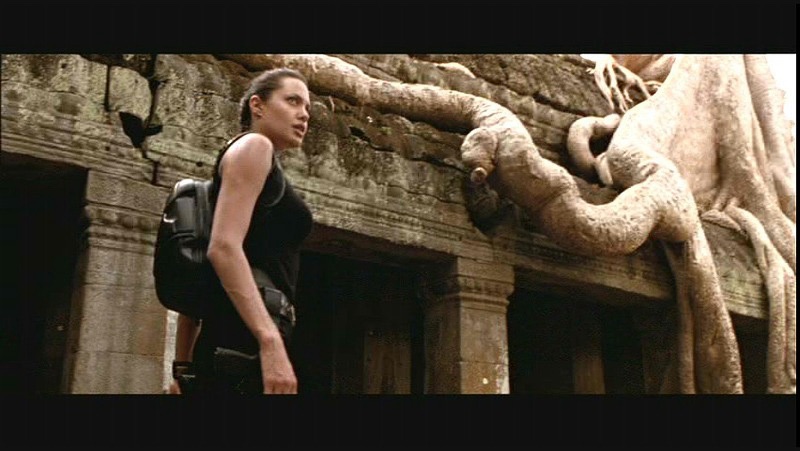
Up next is Ta Prohm temple, also known as Tomb Raider temple for a fleeting appearance in the 2001 film Lara Croft: Tomb Raider. Interestingly, Angelina Jolie liked Cambodia so much, she got one of her kids from here.
On the way to Ta Prohm, we walk past a band of men playing traditional instruments. Beside them, a sign explains that they are raising money for victims of land mines. Some of these men are missing limbs, and you can see have lost legs, so it’s clear that this is more than just a charity appeal.

During the various 20th century wars, aerial bombing raids were quite common (usually the Americans trying to take out Vietnamese fleeing over the border. Of course some of these bombs didn’t explode immediately, but instead many years later when farmers were ploughing their fields.
Whereas the other temples have been largely cleared of foliage around the stone, Ta Prohm still remains engulfed by trees.
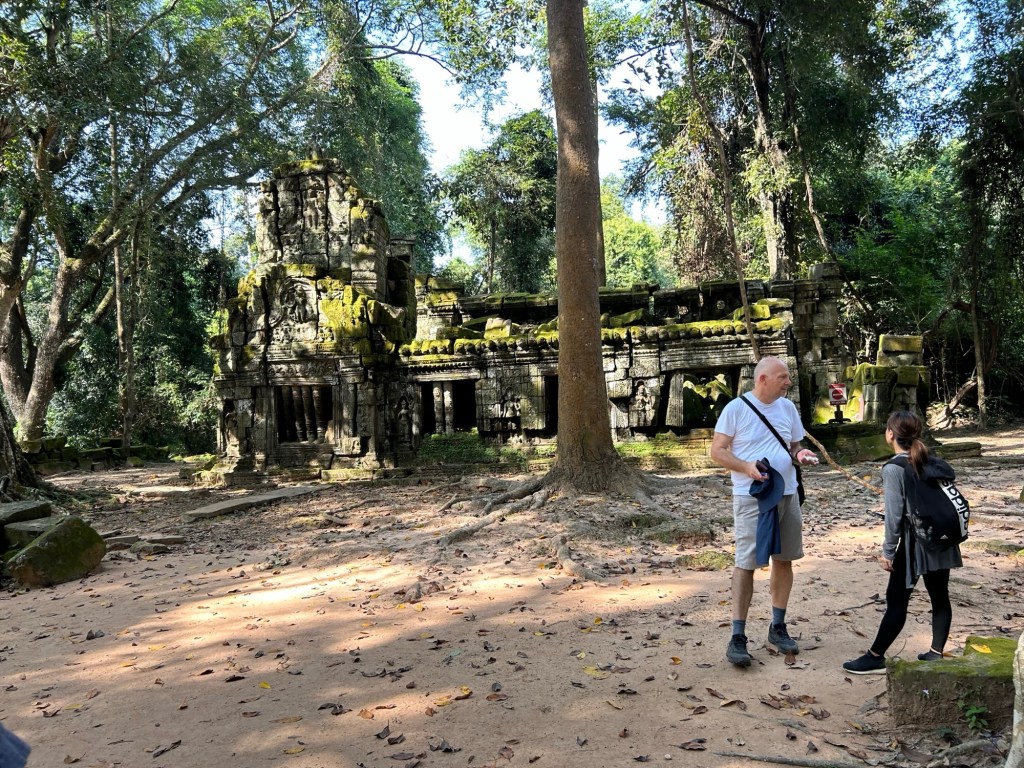
Ta Prohm was built by King Jayavarman VII as a Buddhist monastery in 1186. In the centre is the giant face of Prajnaparamita – wisdom personified.
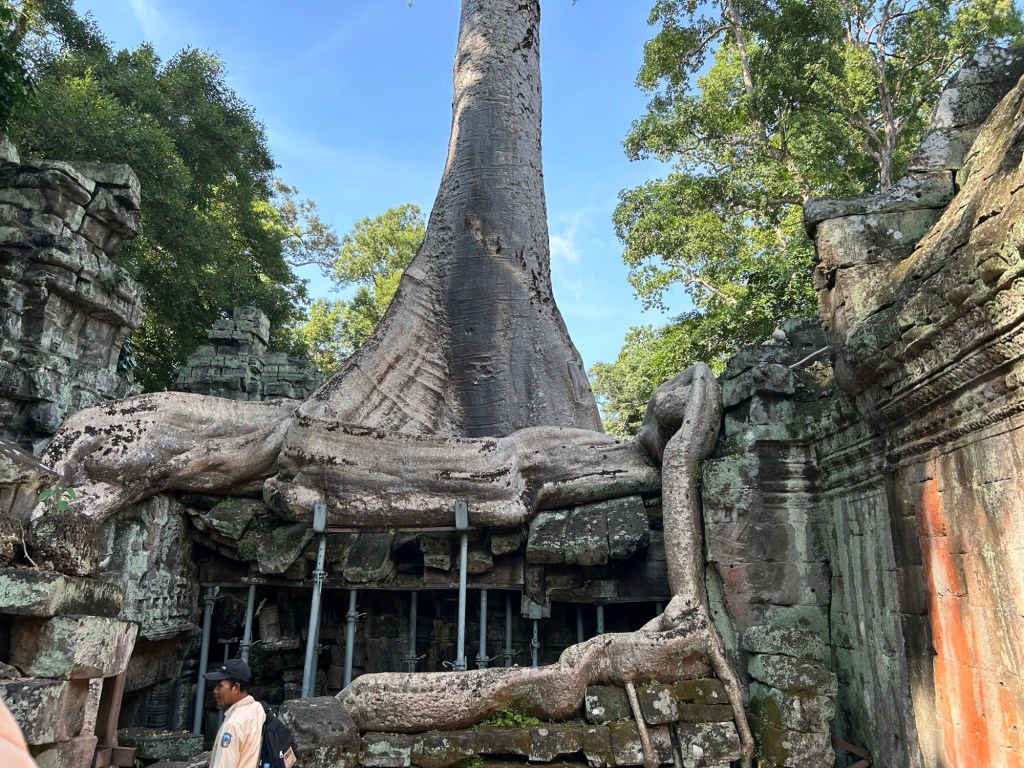
The reason this temple has been consumed by the jungle, is that strangling tree roots have grown through cracks in the stone, like winding serpents. Removing the roots would cause the whole stone structure to come tumbling down – which let’s face it wouldn’t be ideal.

It is a reminder that no matter how good man’s creation is – nature always wins.
As I mentioned earlier, Ta Prohm is better known as Tomb Raider temple, and this is the tree which featured briefly in the film.
There are a few other interesting spots here – not least the Dinosaur of Ta Prohm, hidden on a non prominent wall at the back of the the complex.

This was probably carved in the late 1100s, and appears to depict a Stegosaurus. There are some theories: maybe ancient Khmers discovered fossils and this is their imagining of the animal they came from, maybe this is actually a rhino in front of a bush, maybe dinosaurs lived much later than people previously thought, or maybe was only added much later to stoke a bit of PR. It would be nice to know for sure wouldn’t it!

On the way to Angkor Wat, our final destination of the day, and the Crown Jewels of the Angkor temples, we get some another chapter in the life story of tour guide Kachhel. He doesn’t finish work until around 10pm in the evening and goes to bed at 11. He usually wakes up 4.30 or 5am. in the brief time we’ve known him, it’s abundantly evident that he’s a very hard worker and has amazing energy for a 67 year old. (Some of the walking today has been very tough going).
Kachhel is a Christian. He goes to New Life Church here in Siem Reap. Only 3% of the population of Cambodia are Christian, so there aren’t very many around.
Everybody has told me that Angkor Wat is an incredible spectacle, and on first glance, it looks as good as the photos online if not better.

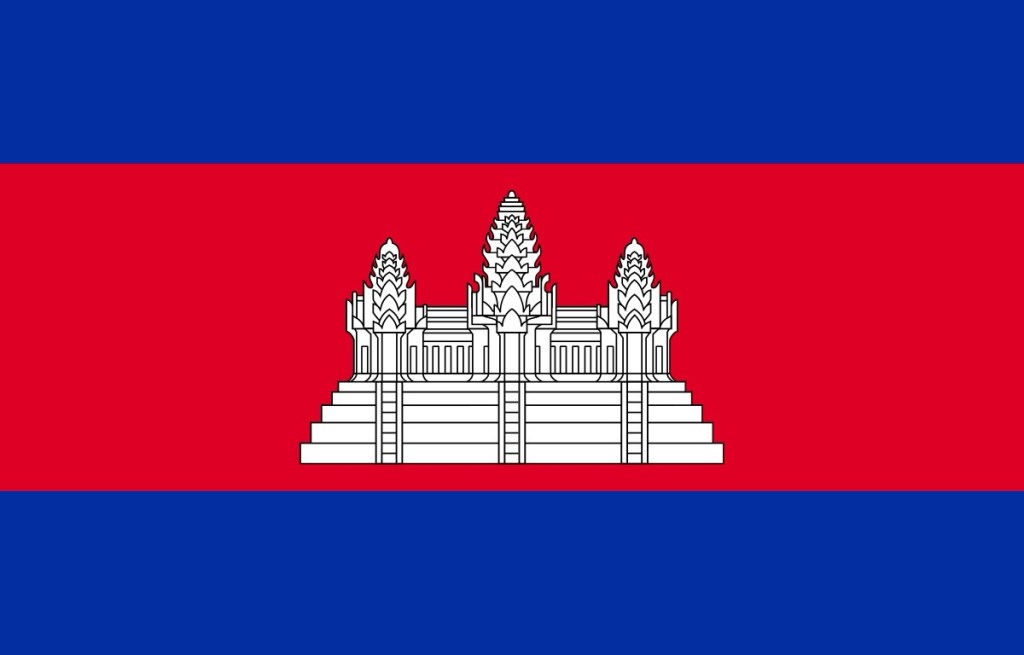
If you think it looks familiar, that’s because it appears in the middle of the Cambodian flag, and that’s the only national flag in the world featuring a building, believe it or not.
Surrounding the Angkor Wat complex, is a moat, and cutting through that is a stone causeway. We follow the path and enter through the front gate.
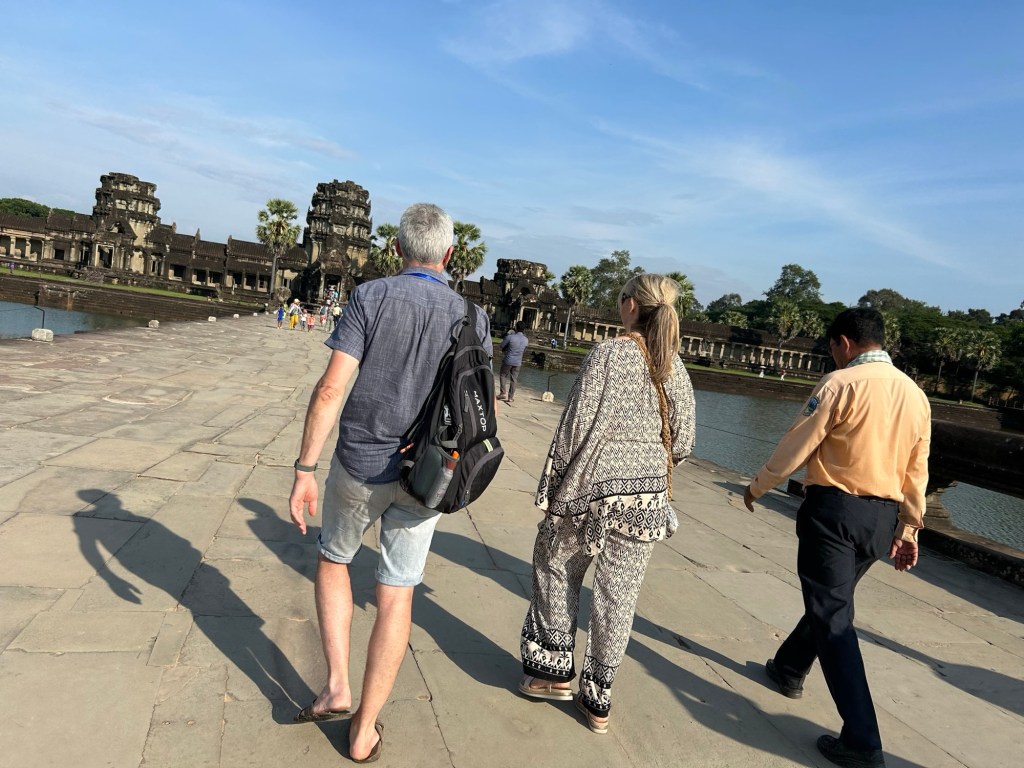
The architectural wonder’s name means City of Temples, and it was founded in 1150 AD by King Suryavarman II. This is currently the largest religious monument in the world, and there are approximately. 2.5 million visitors every year.
It’s thought this took 300,000 workers to build, was entirely stone, and never completed. King Suryavarman II died that same year (1150 AD).
In the door, some gunshots are pointed out to us, and this was from the time of the Cambodian genocide, when Khmer Rouge were hiding out inside the temple.

There are a plethora of incredible stone tapestries, depicting various Hindu and Buddhist tales, and one cannot question the quality of art and storytelling. In all, it’s said that there are roughly 1,200 square metres of carved reliefs, which is a relief to us all!

From a non-Buddhist perspective, these stories are just so implausible, and I can’t believe that other people believe them. For instance, we’re told a story of someone (the. moon goddess named Chang’e – one of the main goddesses of Chinese Buddhism) who swallowed a pill of immortality and flew into the sky. There’s a something to do with full moons and eclipses as well. Do people honestly believe in this goddess? If not, then why do they worship her.
I know the same accusations could probably be made about Christianity, but my argument to that would be that, the bible (particularly the New Testament), feels much more grounded in the real world, and everyday ordinary life. Sorry, that’s an aside.
Another story is about Sun Nukong (aka the Monkey King). I’m not fully listening, but from what I do gather, someone killed a buffalo, but he didn’t realise that the buffalo was inhabited by his brother. In front of an army of monkeys. Wtf?
Im finding it very funny watching mum trying to feign an interest in all of these stories.

As we make our way through the bowels of the temple, the sun inches closer to the horizon, and by the time we have climbed the long flight of steps leading up to the three central towers, there is a beautiful golden tint to the landscape.

Incidentally, I forgot to mention, there are 5 towers in total on top of the central structure, (1 on each side and another big one in the middle), and these represent the 5 peaks of Mount Meru – the sacred Hindu mountain, and mythical home of the gods. When first constructed, this was intended to be a Hindu temple, and a statue of Vishnu stood inside the top of the central tower. After the Cham people (from what is now Vietnam) raided the temple in 1177, Jayavarman VII decided the Hindu gods had failed him and redecorated the place accordingly. Vishnu was moved elsewhere, and a giant Buddha statue erected in its place.
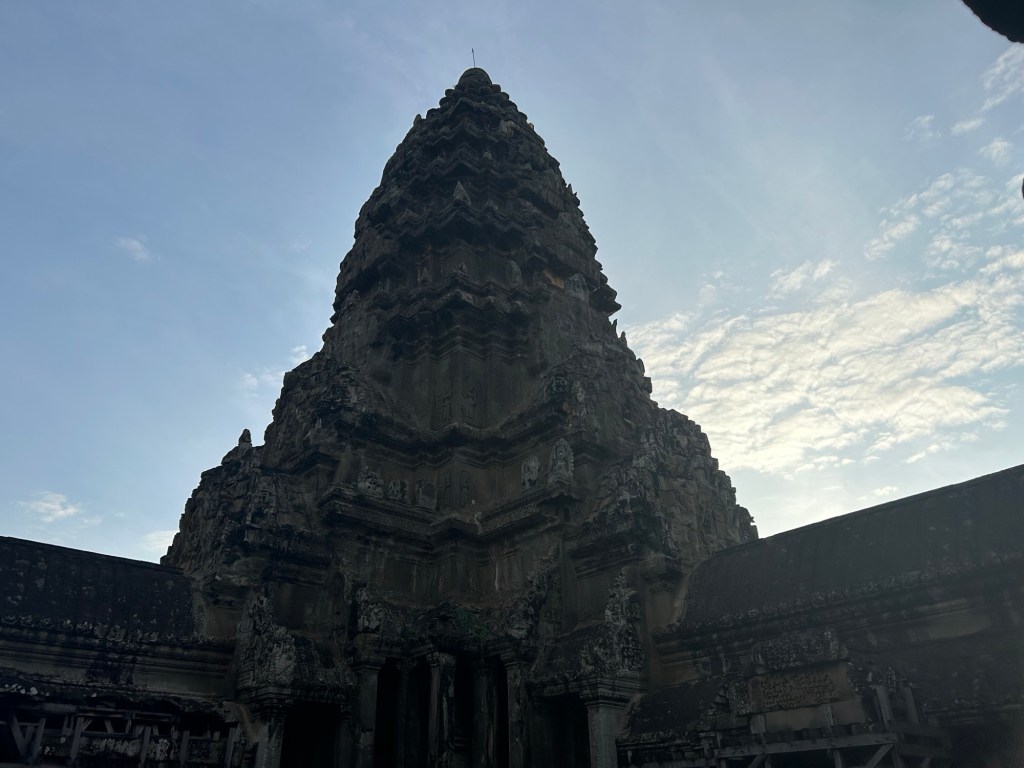
Our plan is to watch the sun set from the main tower, but a few minutes before it sinks into the trees, a security guard asks us (and everyone else there) to leave. The tower is closing. By the time we make it back down to the bottom, the sun has more or less disappeared, but the golden hue remains for a few more minutes.
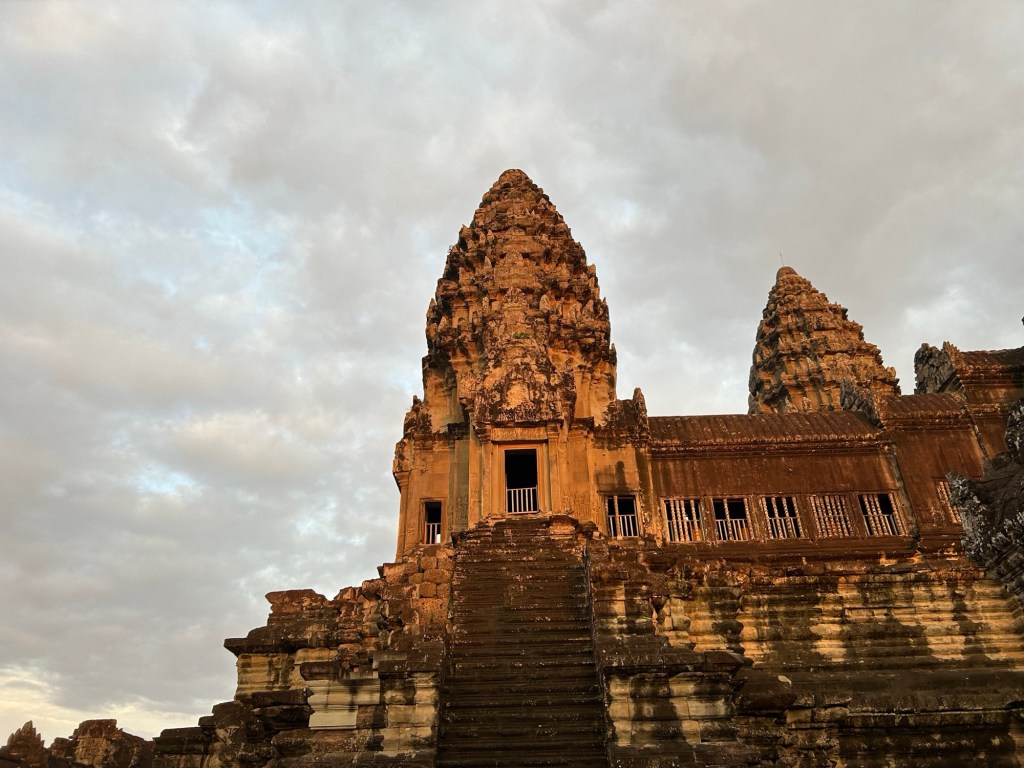
It’s a bit of a mystical dream, walking back out through the grounds and towards the car – the place looks simply stunning.
This concluded our tour, and after heading briefly back to the hotel, we ventured out into Siem Reap, where a 10 minute walk from the hotel brought us to Elia Greek Kitchen restaurant, which I had spotted the night before when walking back. Don’t get me wrong, Vietnamese and Cambodian food is great, and up there with the best of them, but to me they don’t come anywhere near Greek food. This was the best meal of the holiday so far. Hands down!

Thats us suitably fuelled and ready to rest ahead of the next tour tomorrow morning.

 See Travel Blog
Leave a comment