Well last night wasn’t a great introduction to Bangkok if I’m honest. I think after the flight we were all a bit tired and cranky, and the craziness of Chinatown was too much craziness to cope with.
After a good nights sleep (or as good a night as 5 hours of sleep will allow), we’re up at 6am for breakfast before we head on today’s tour.
I must say, I’m loving the hotel – the Royal Hotel Bangkok, is probably the best of the many we’ve stayed in on this trip. Our room is on the 14th floor – one below the rooftop bar and swimming pool (which dad is particularly going to have fun with).
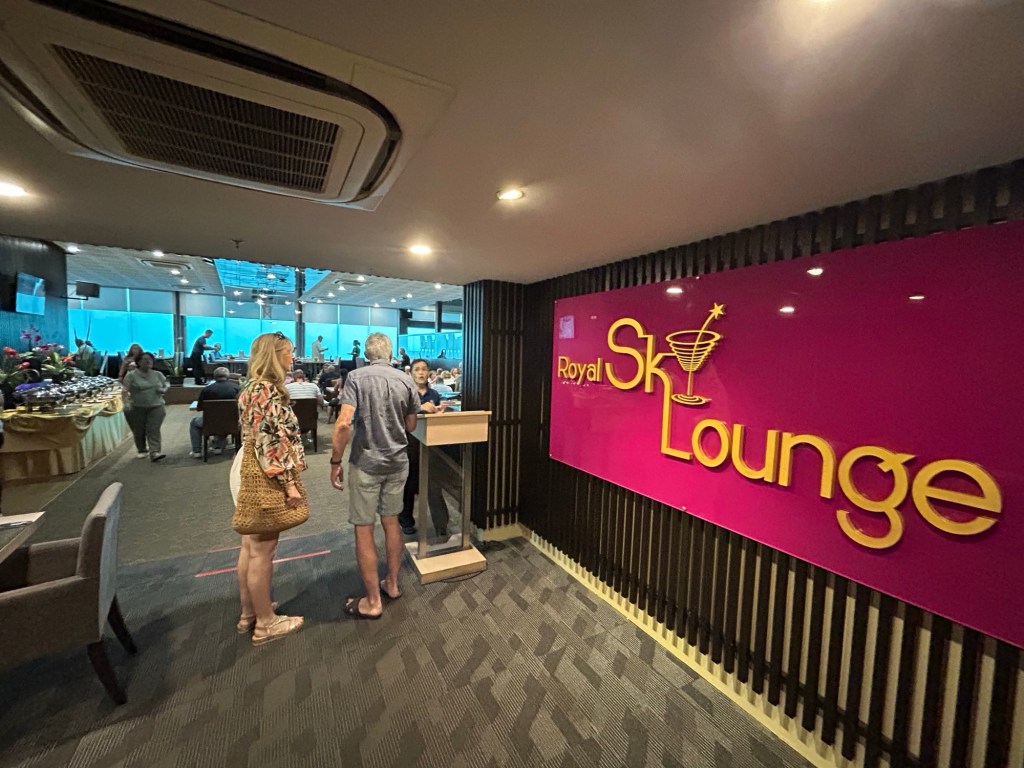
We’re met at reception by a new guide – Aekh (or Flipping Aekh as I have now unofficially renamed him).
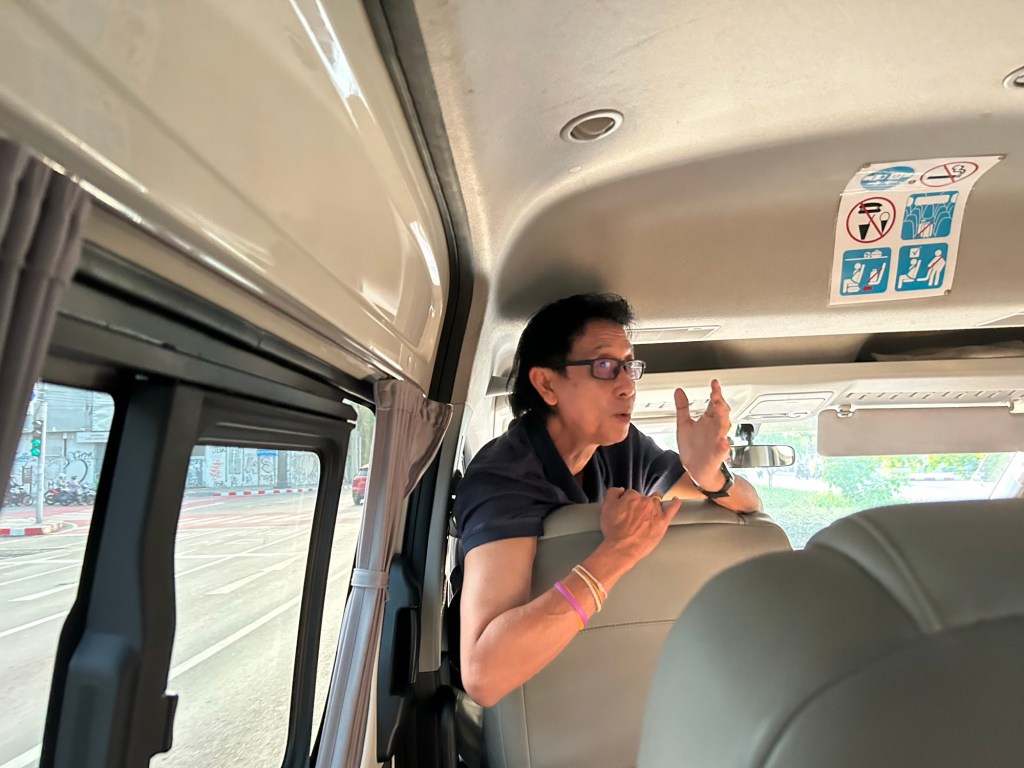
Funny enough, Chinatown is an absolute ghost town this morning. It’s a far cry from the herd we were fighting through last night. I guess it’s just better (and more popular at night).

“Welcome to Thailand, the land of smiles”, Aekh proclaims to kick off the tour. The Thai’s love to shop, so today we’re heading to two markets: a train market and a floating market.
Today we’re joined on our tour for the first time on this holiday by other people: a (somewhere between middle aged and elderly) husband and wife from America.
There’s further exposition, as Aekh fills the time spent travelling on the road. Thailand means land of the free and was renamed from Siam in the 1930 by the then king.
Pulling out his map, he explains that Thailand is shaped like an elephant. At first, I don’t really see it. That seems like a lucky coincidence, for a country so closely tied to the things.
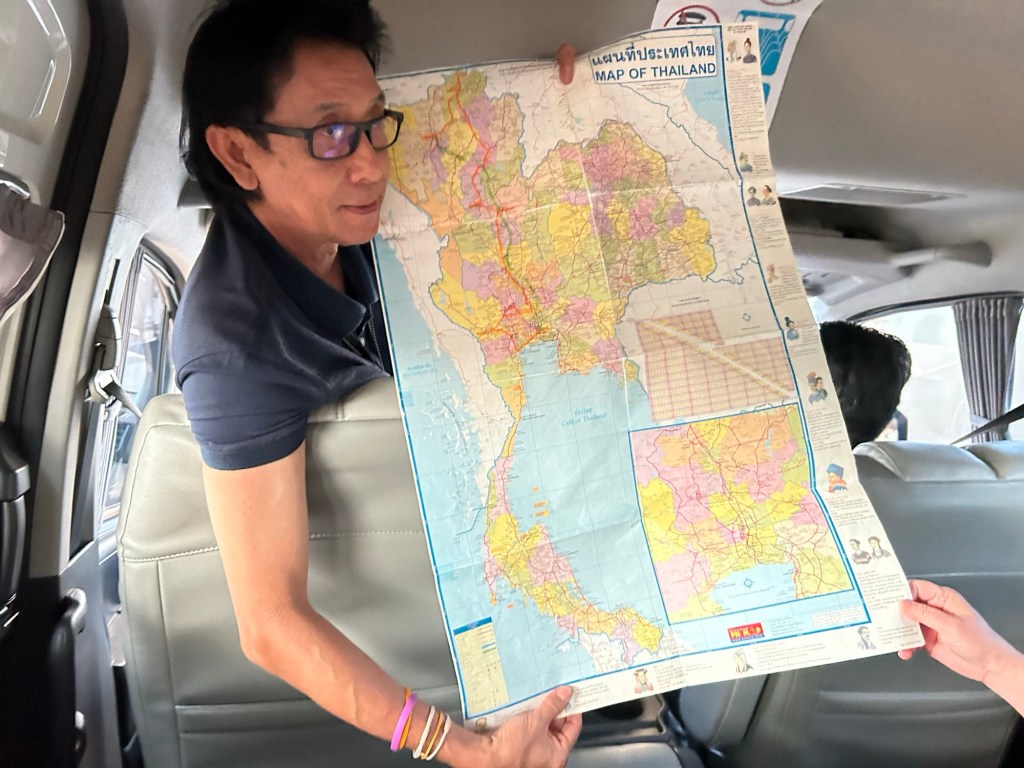
(The long bit at the bottom is meant to be the trunk, and the big bulky bit at the top is meant to be the face and ears).
After an hour on the road, we rock up at the side of a street and walk the final short stretch to our first destination: the Maeklong Railway Market.

Here, a railway line passes through the centre of a busy market street. It’s reminding me a lot of Train Street in Hanoi, but on a much more compressed scale. The market is practically on the line.
As with the aforementioned train street, this is an active railway line, and we’re told the next train will be coming at 8:30am. That’s about 20 minutes to get drinks and a few quick photos before the train arrives.
Walking through the market, there’s a very strong fruity smell (likely a combination of different fruits, including the infamous durian). Subconsciously, this smell takes me straight back to a holiday in Australia when I was three. I don’t really remember anything of this holiday, but instantly place the smell. That’s a little bit freaky to be honest.

5 minutes before the train comes, market sellers begin to wind back the roller awnings, and clear the decks. A bell rings to alert punters to clear off, and everyone finds their way to a safe viewing spot, behind a line marked at the side. There’s a couple of people shouting instructions to make sure there’s no problems.
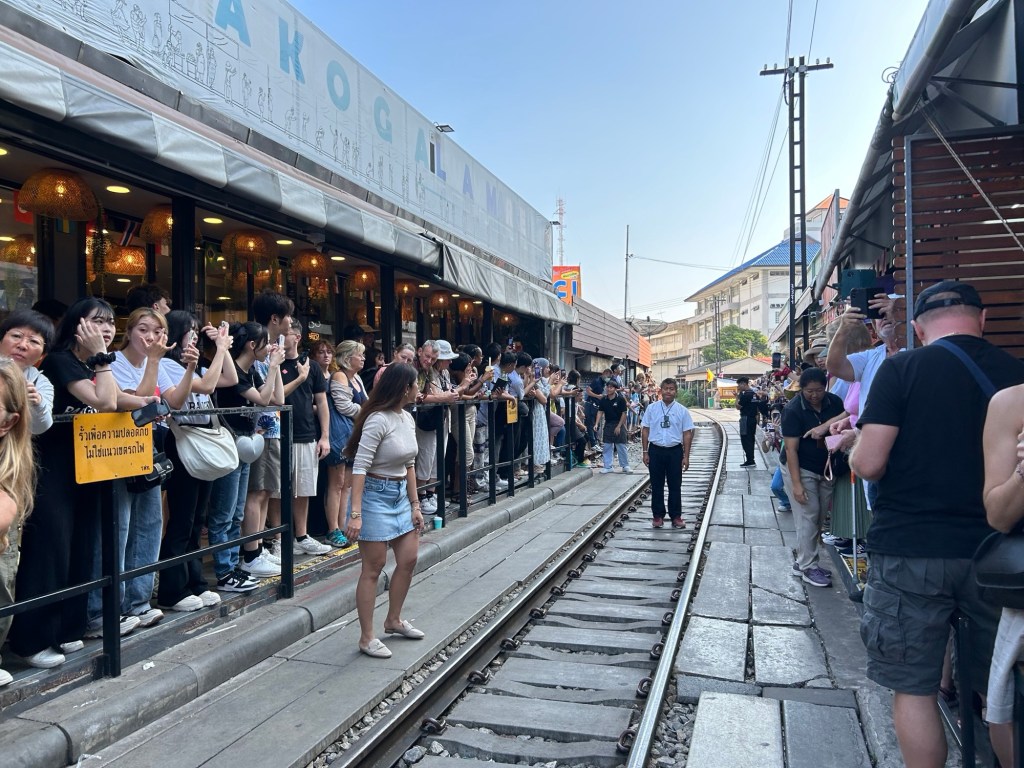
The much anticipated train arrives at 8:32am, and at an even slower speed than walking pace, crawls through.
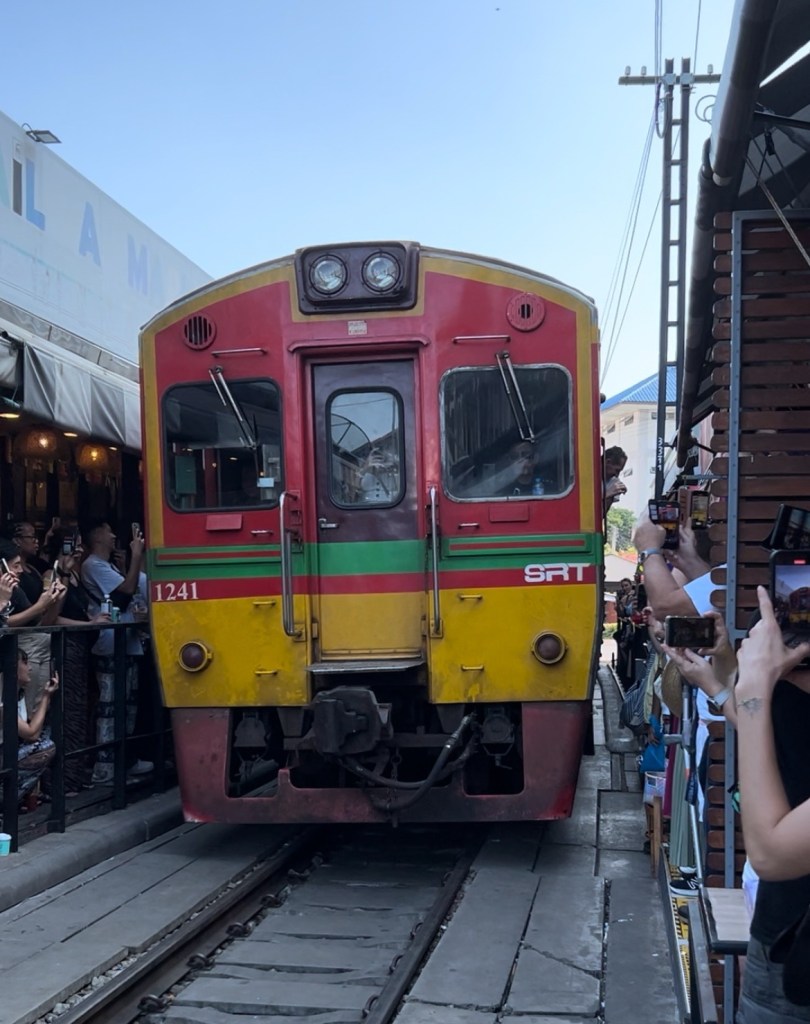
Because of the speed, it’s safe to stick a hand out. At the side of the road, you don’t even need to reach to touch the train. It’s literally at the end of your nose! Some people are high fiving passengers leaning out the windows.
After the train goes past, tourists flood back onto the line and follow it. It’s almost like a funeral procession!

Within a minute, all of the awnings are back up and it’s back to business for the market traders.
This train market is the most famous of its type in Thailand. It’s been going for over 100 years, and people are encouraged to do it while they can. There’s no guarantee that this kind of spectacle will go on forever in this increasingly health and safety conscious world.
Beside the train line is a more conventional market building, and it was through this market’s expansion, that it spilled out onto the adjacent railway line.

We walk through this market in order to get back to the bus. It’s mostly fish and meat, so it smells like death in here.
Once back on the bus, we recognised a familiar whiff, as the other couple on the tour opened their backpack. They’d bought some durian fruit at the market, and (although unintended), made sure everyone else knew about it! Aekh said to them that durians are usually banned in buses and hotels due to the sickly smell. I knew he was subtly telling them it was very inconsiderate and to put it away, but I’m not sure our American friends twigged!
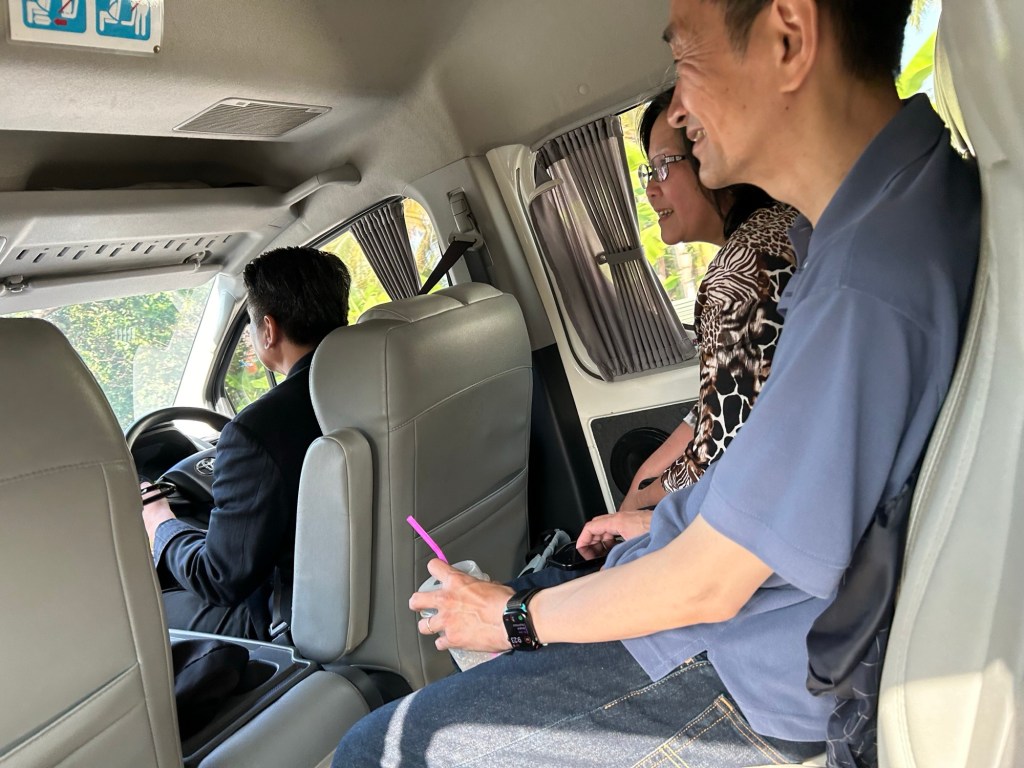
The bus brought us to a boat terminal, where we would be whisked along the river to see the floating markets, before experiencing in the flesh.
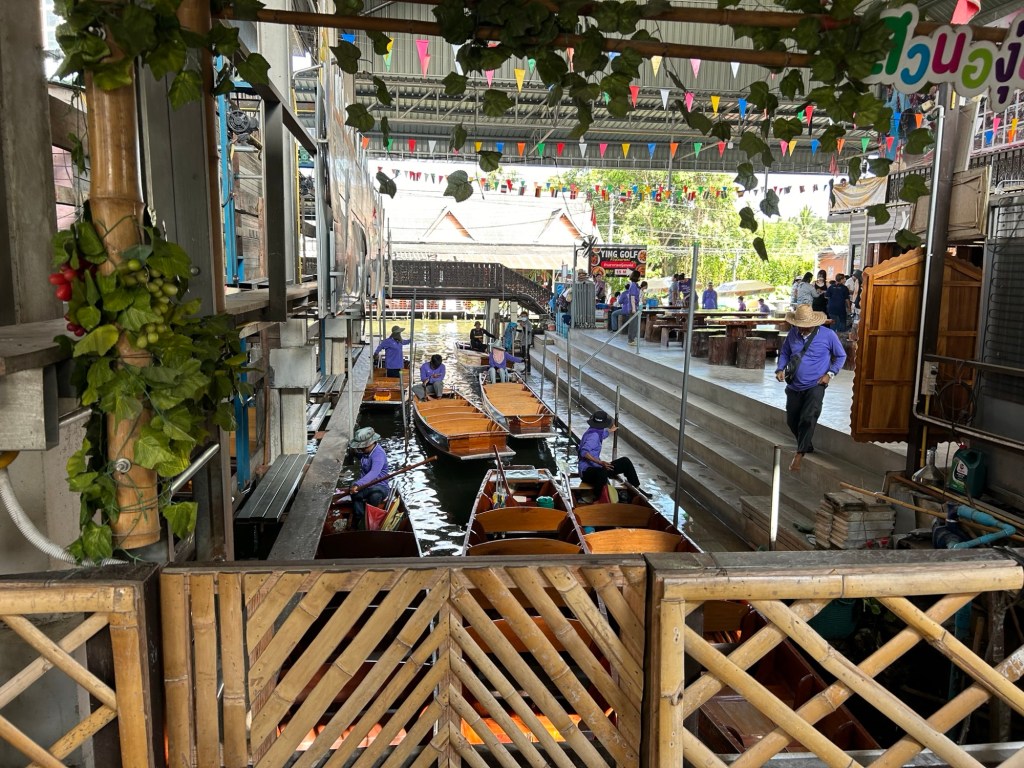
The Damnoen Saduak Floating Market was formally opened in 1971, along a canal which King Rama IV had commissioned in the late 1860s. It actually consists of three smaller markets: Ton Khem, Hia Kui and Khun Phitak.
The floating market is now a hit with tourists, and haggling is necessary to get the overinflated prices down to something a little more decent.
True connoisseurs will say this market lacks authenticity, and is only a success because tourists are too blind to see bad deals and cheap poor quality products, but it does have a lovely charm.
While navigating the maze of canals, we were treated to durian stench once more as our friends tucked into their picnic lunch. Maybe I’m just too exposed to it by now, because this time it wasn’t actually too bad!
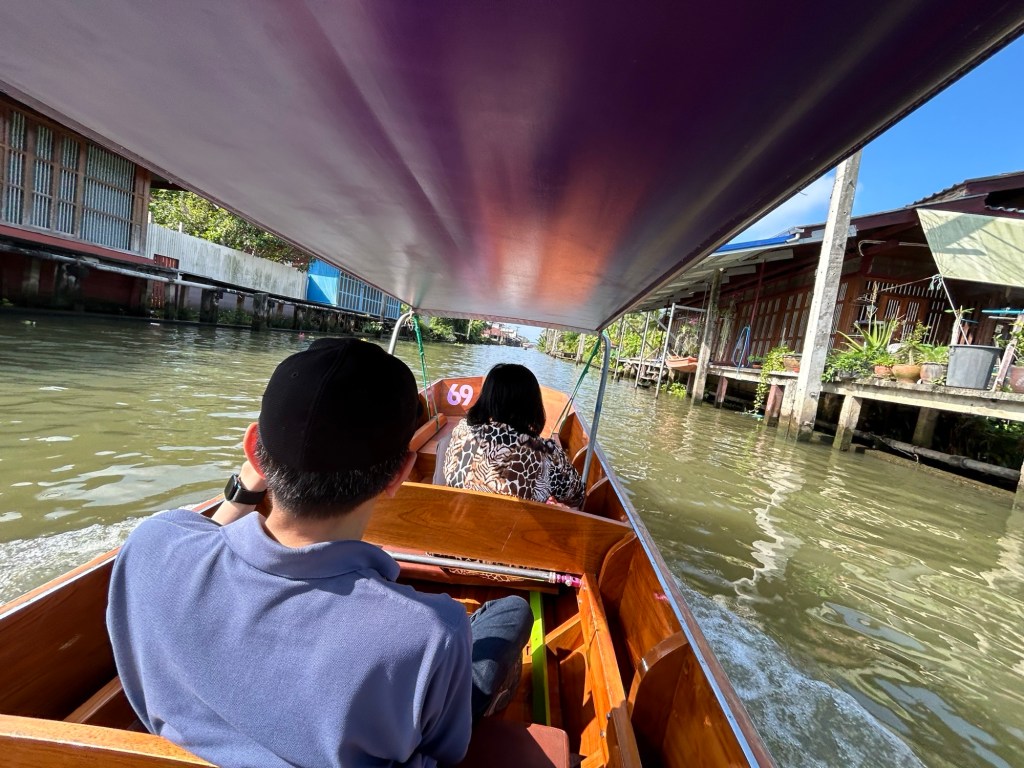
The boat tour was ok, but didn’t really show us much of the markets. The tour guide said because this area is much busier, the traffic is far heavier. By taking us on the scenic route, we’d cover more ground and will have a better chance to explore the market by foot later on.
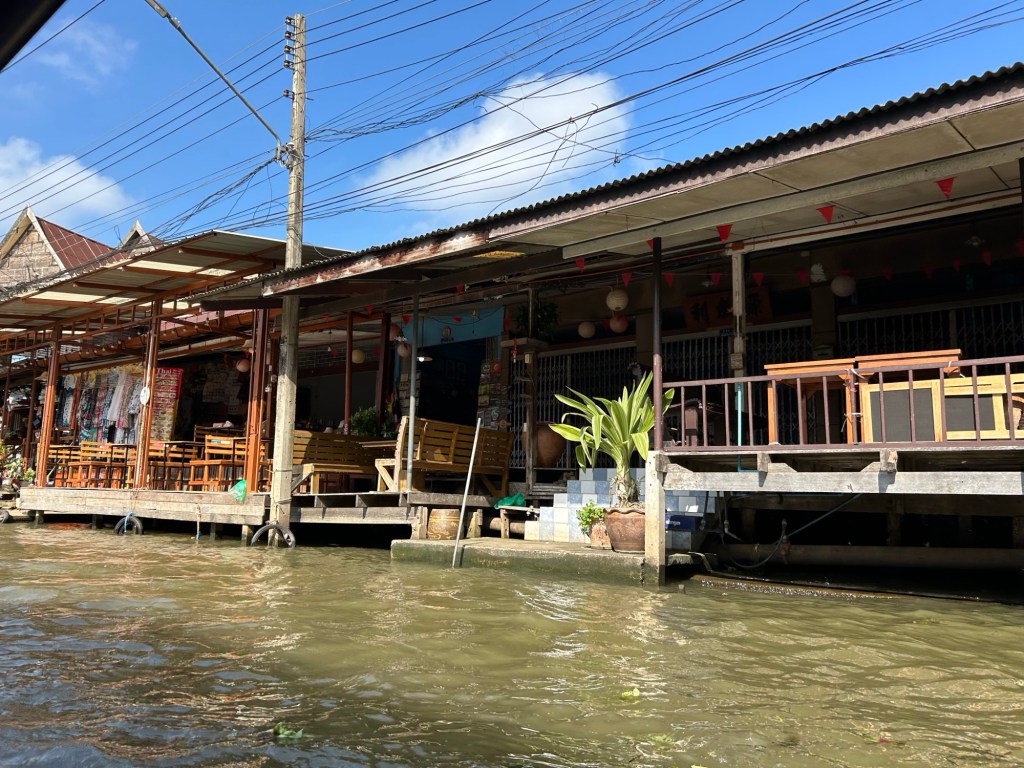
Every good market needs good animal photo ops, and among the few animals yet uncooked, are an albino snake and flying squirrel.


Honestly I’m not sure I know what a flying squirrel actually is, so I consulted the web. I looks like a sloth but isn’t – just imagine a regular squirrel wearing one of those wing suits.

The flappy skin between the arms and legs helps these things glide – and they’ll just jump off a tree. They’re basically daredevil adrenaline junkies of the rodent world.
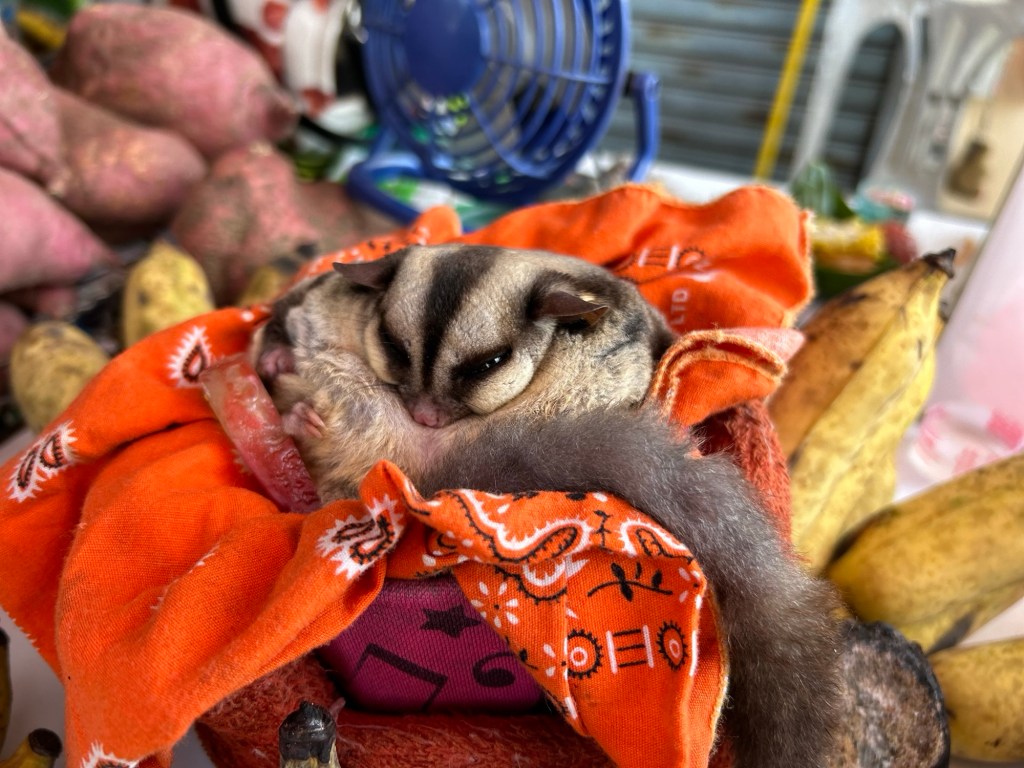
While these creatures are cute and harmless, they do pose a problem. They reproduce twice every year, so if they find a way into your house, you’ll know about it pretty fast. Leave it too long and they’ll all take control and kick you out!
At one corner, perched in front of a closed garage door, one lady is cooking up a storm – or coconut pancakes to give them their proper title.
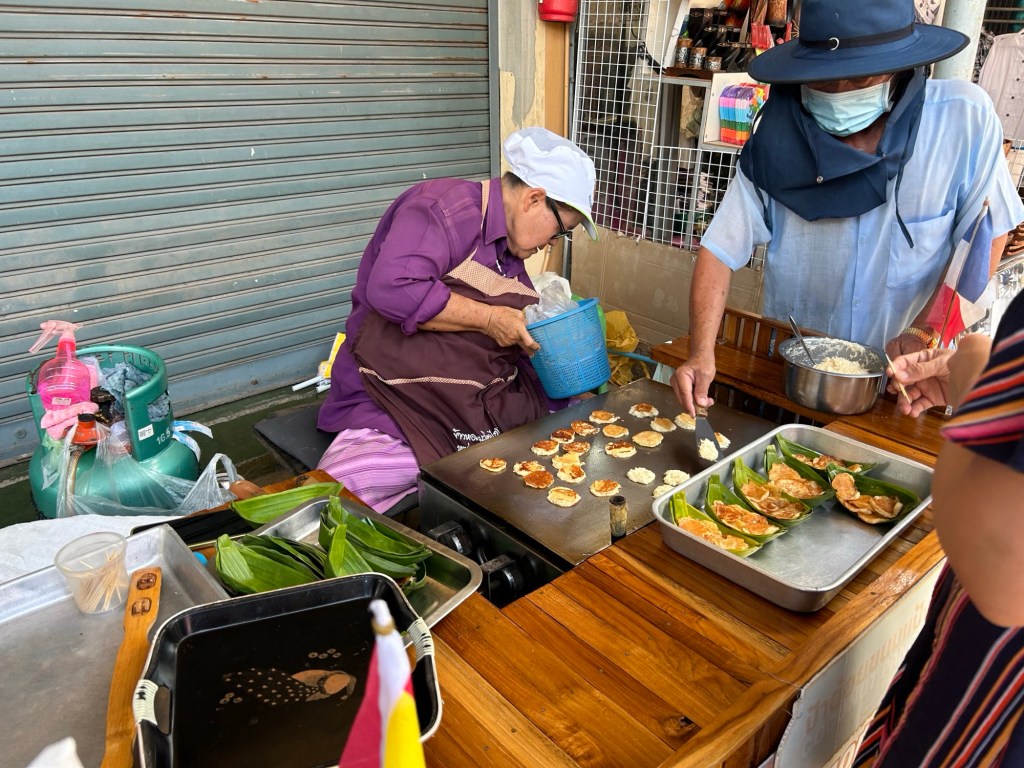
Let me tell you, these things are the bees knees. This is easily the tastiest street foot we’ve had on this trip through south east Asia! (Bonus points for the leaf boat they’ve been presented in!)

One particular market has been recommended, as the one with the cheapest prices. No haggling required we’re told by Aekh! I’m pretty sure he’s just friendly with the owner and earning commission for referrals!
In fairness, this lady is very friendly, and while her English is non existent – we’re somehow able to communicate through hand gestures and smiles.
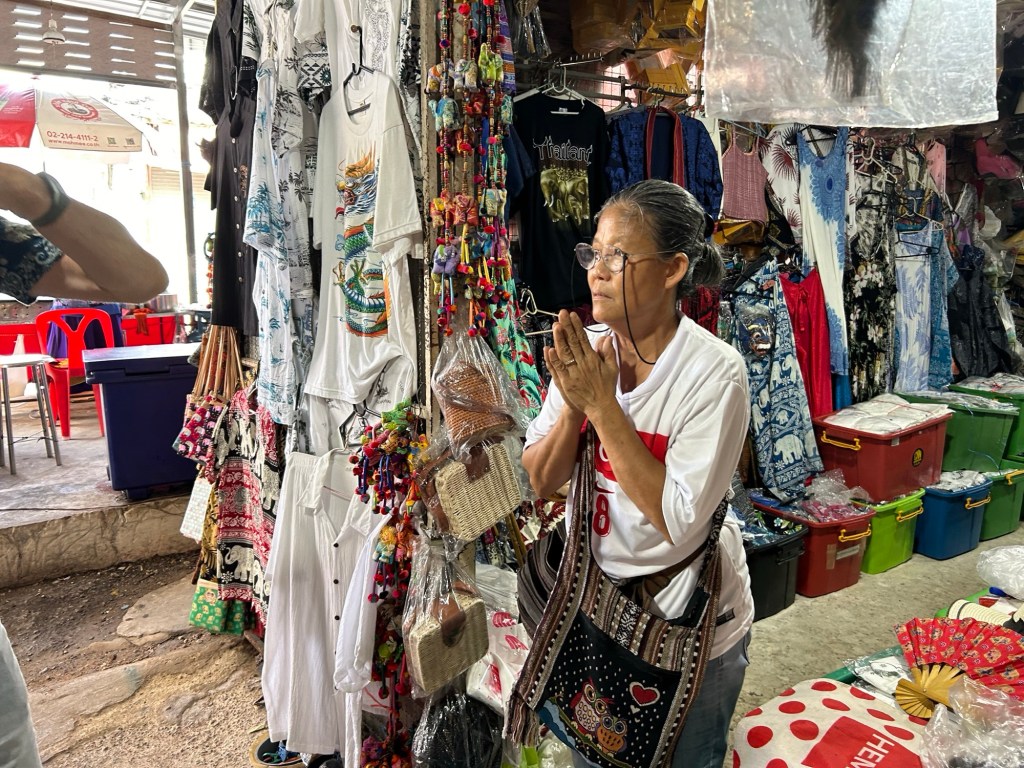
Here I buy a miniature pool table for the office, some postcards and a wooden elephant. The lady whips out some white tusks – which she refers to as ‘ivory’ and shows me where to put them. I’m no expert on Elephant anatomy, but I think that’s pretty self explanatory.
After this, we walk towards the central covered area of the floating market. I take a few photos of some nice pictures on the wall, then take a scolding from a member of staff who tells me they’re actually for sale!

Still managed to get the photos, though, so joke’s on her! 😝
At this point, I’m ready for a drink – and looking for one particular local brand. Can’t find it at the first three bars we pass.
Eventually we find one place that does actually have Red Bull – I thought it’s meant to be popular in Thailand? Anyway, this is what it looks like…
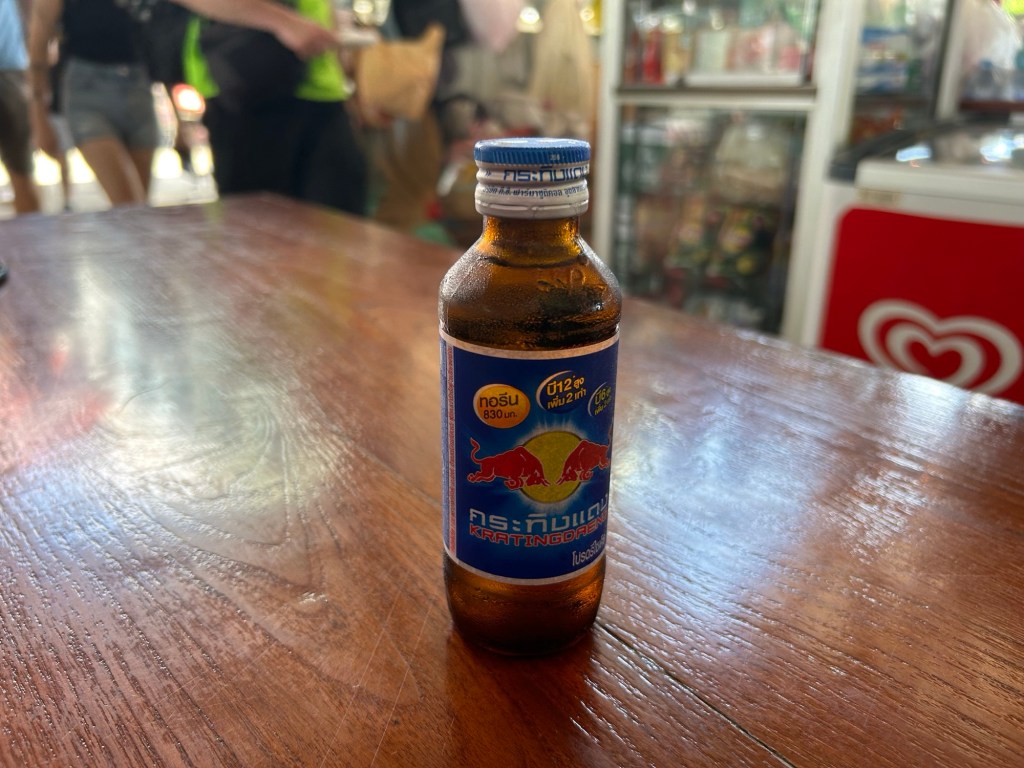
For those unfamiliar with the history of Red Bull – here known as กระทิงแดง (Krathing Daeng). It was invented in 1975 as a refreshing relief for Thai labourers. In 1982, the Austrian businessman Dietrich Mateschitz visited Thailand and discovered it helped cure his jet lag. He cut a deal to develop the flavour for the Western market, market it, and distribute it. Red Bull and Krathing Daeng are now sister companies but sell two distinctly different products.
Upon tasting the Thai version – it’s definitely the same flavour as what we’re familiar with, but without fizz. That leaves it tasting more like a medicine than a drink. It might be a touch sweeter, but it’s still good!
I’m not sure it works though – I ended up sleeping most of the bus journey back! Good to see that energy boost working well!
The bus brought us back into Bangkok at around 1pm – nice and early to give us a good bit of time to see around the city at our own pace. This would be our only opportunity!
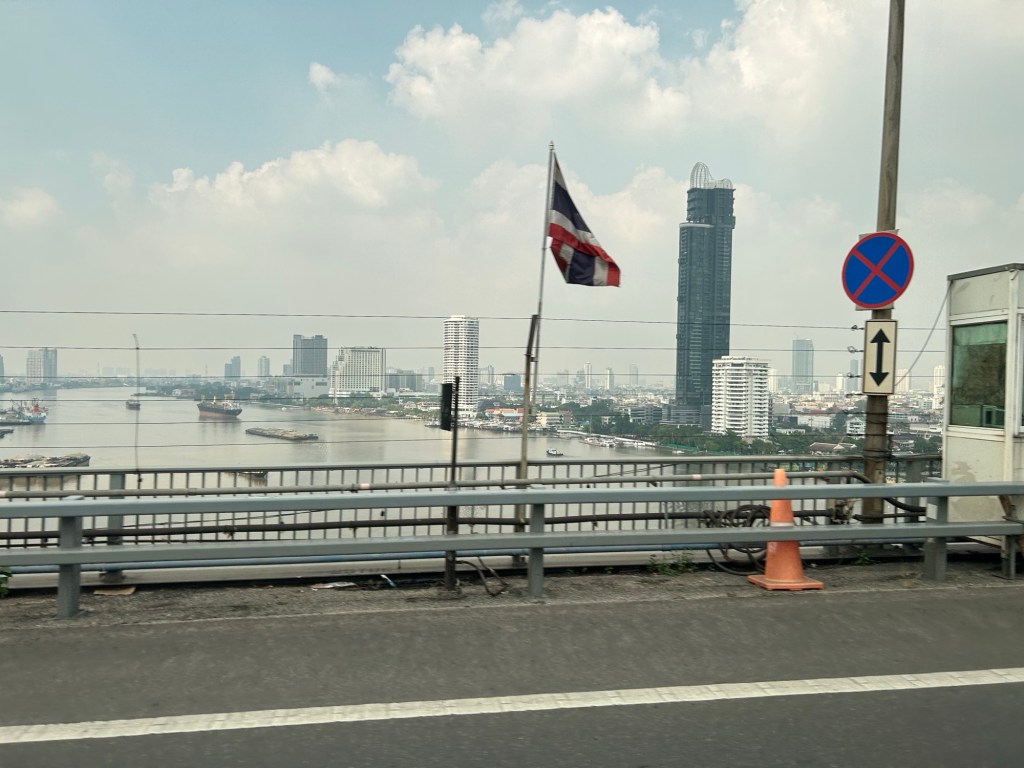
The bus leaves us at our hotel, and we head up to the skybar for lunch. It’s a ham and cheese toastie for me!
After lunch we venture out into the city centre (via taxi) and arrive beside the Grand Palace complex. Disappointingly, there’s a large white stone wall blocking our view of the palace itself, but we persevere on.
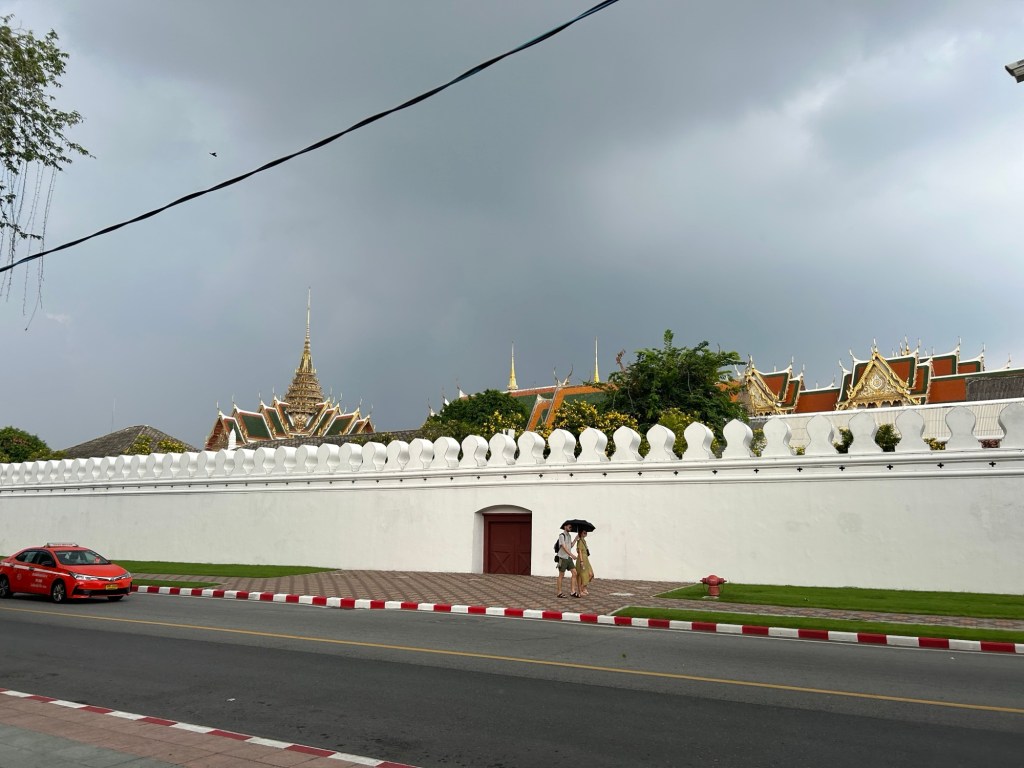
Roughly half way past the complex on the river side, a tour guide operator tries to sell us a guided tuktuk city tour. It is spitting with rain and black clouds are looming, but I’m more keen to see the city on foot. With hindsight, I’m glad we did! The rain stopped a few minutes later.
The tour guide did tell us that the King was about to visit the palace, so I try to find the main entrance to loiter with intent. Soon an underground pass takes us towards the North gate.
There’s quite a heavy military presence outside the palace, which is closed to visitors. Understandable given the King is due to rock up any minute.
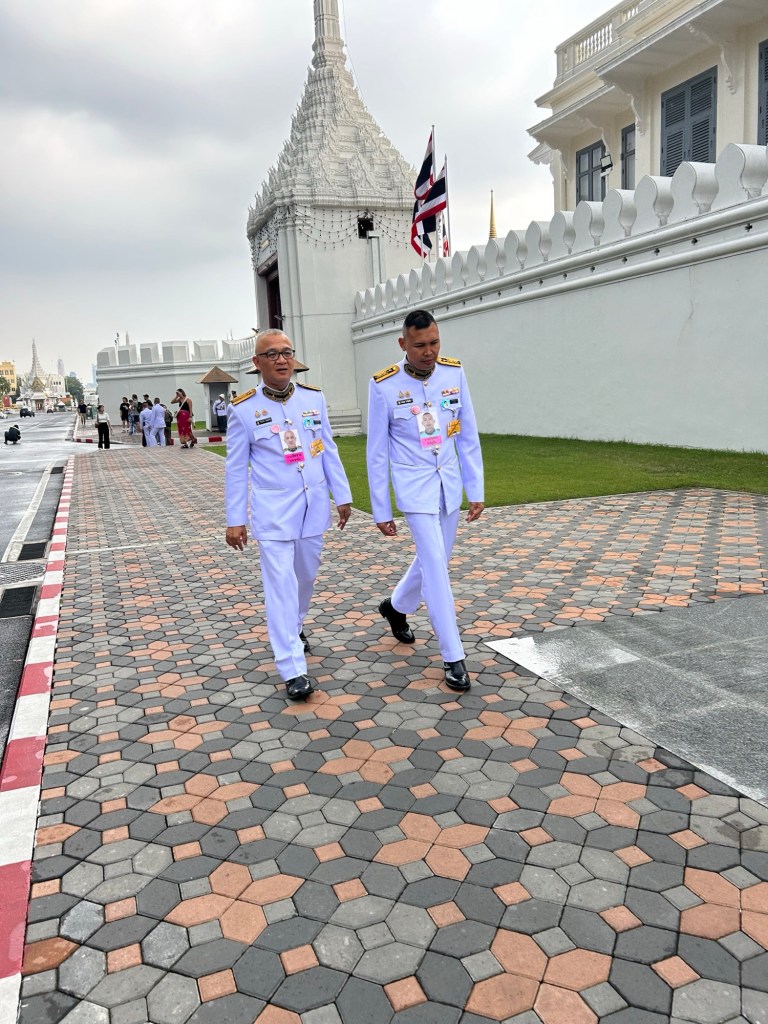
There’s also a group of volunteers out scraping stuff off the ground. Considering they’re wearing luminous tabards – I’d say there there by compulsion, not by choice. As for what it is that they’re scraping – there are hundreds upon hundreds of tiny black squares stuck to the ground. I think there must have been some military parade or inspection, and these were to tell the soldiers where to stand.
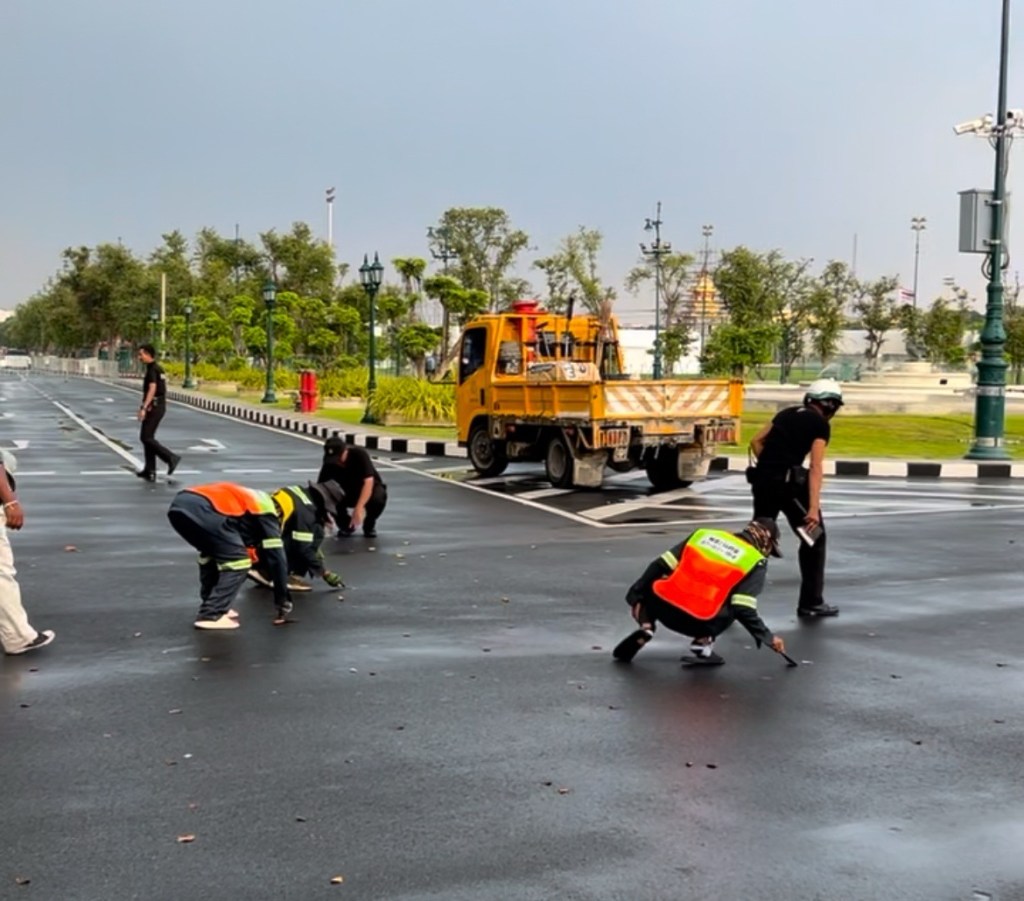
We hang around for about 15 minutes, but there’s no sign of the king, and we have other things to see, so walk on. Finally a good view of the palace presents itself.
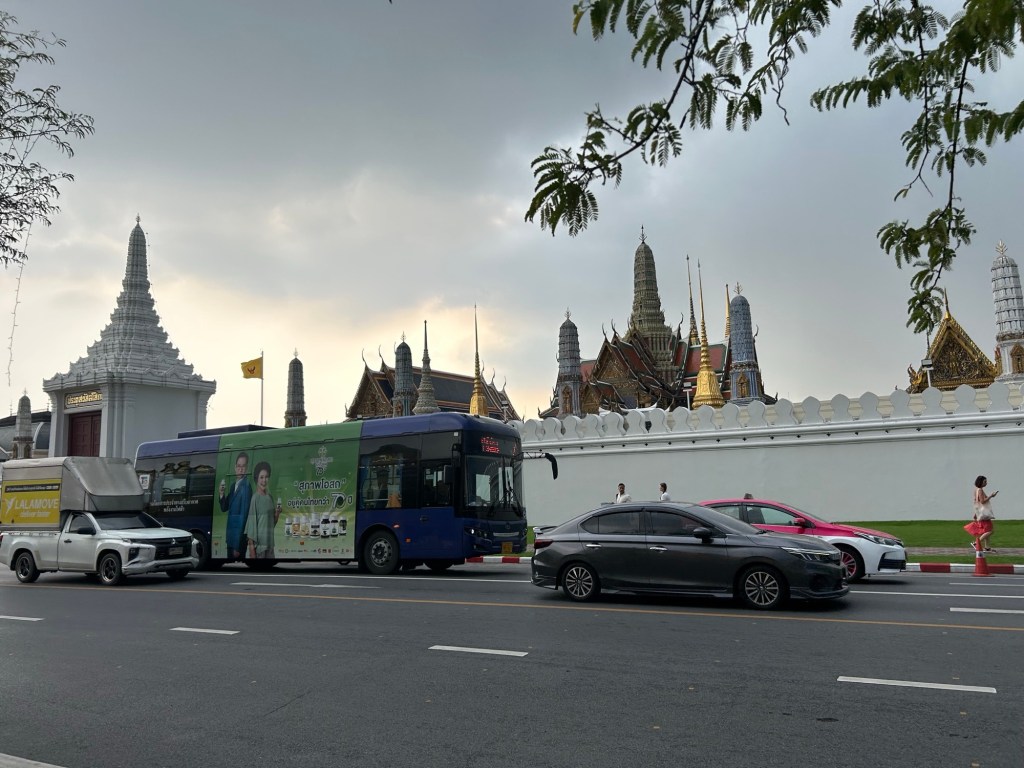
The Grand Palace was built in 1782, but only completed in 1925. It wasn’t always this grand though! Building materials weren’t quite so readily available back in 18th century Bangkok, so it was mostly wooden. Obviously at some point in the subsequent years, Thai people discovered gold, and every building since then has been absolutely caked with the stuff!
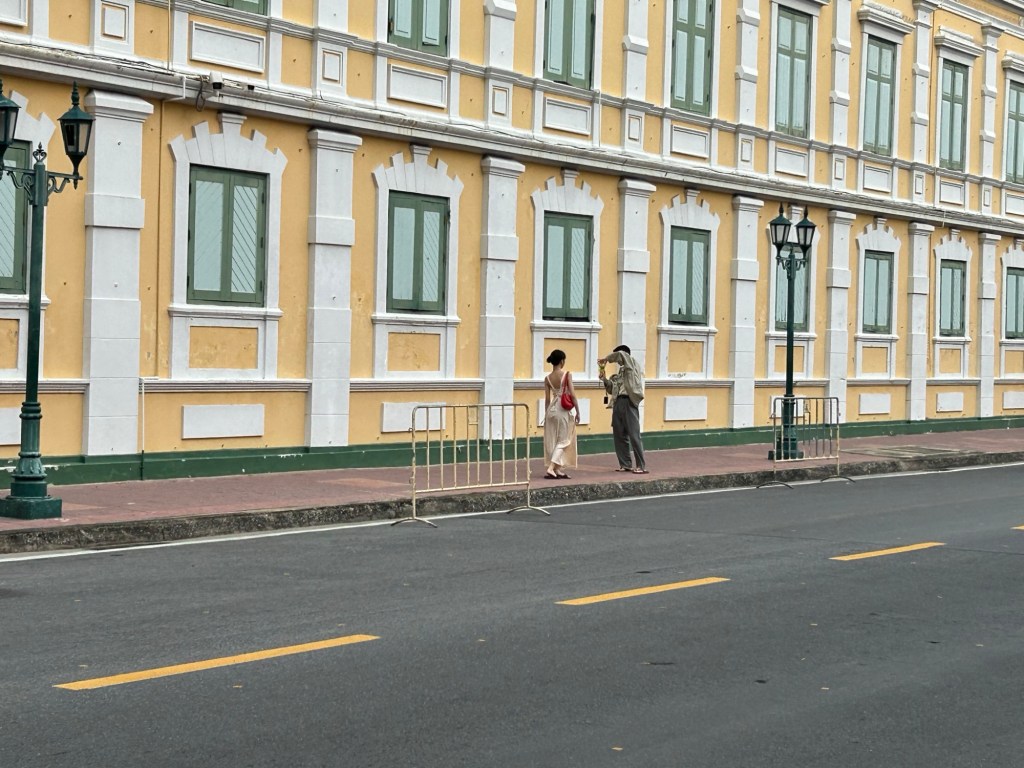
We walk on past a university, where it looks like it’s graduation day. There are a lot of people out and about, and they’re dressed to the nines! A lot are taking photos.
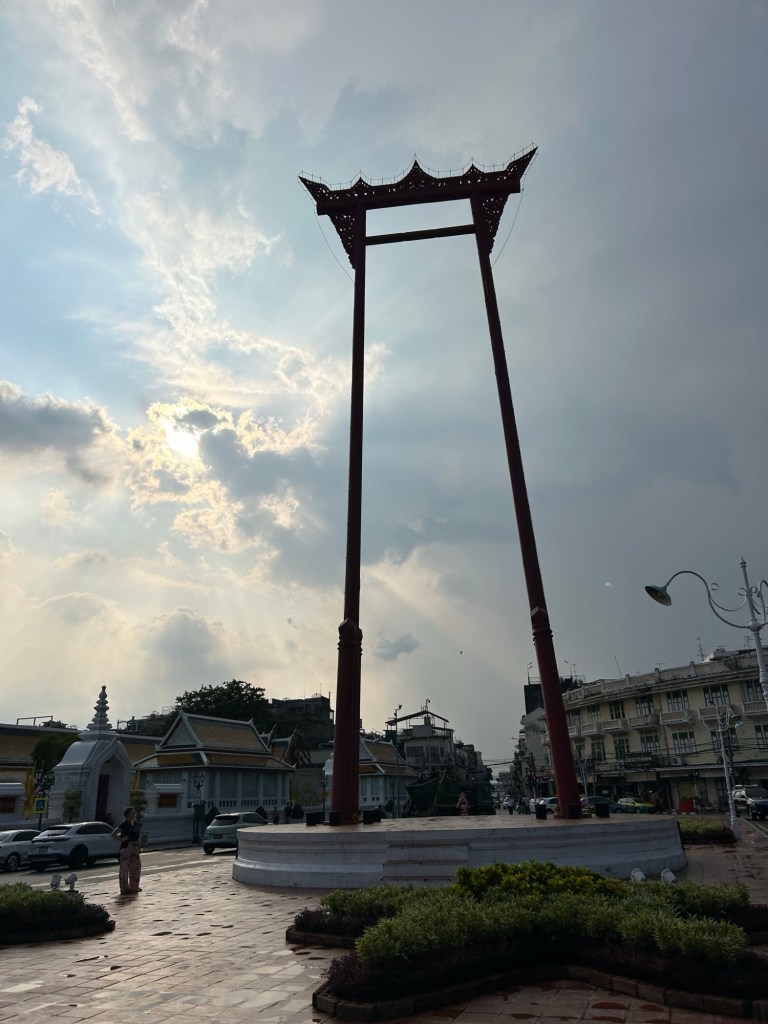
The next landmark on my list is the Giant Swing, and if you ever there’s a place worth swinging by, then surely this must be it!
On first look, yes this is exactly what the name would suggest – a giant swing, but rather disappointingly, it’s missing the actual swinging bit.

This was actually used from 1784-1935, when it was decided that the practice was not health and safety friendly. I’d say the multiple fatalities didn’t help in that respect!
The swinging ceremony – here known as Triyampavai-Tripavai was a Hindu ritual to worship the god Siwa. They believed that Siwa visited Thailand at the end of every year, so wanted to put on a good show while they were here.
Not far away from the Giant swing is another monument – this one celebrating Thailand’s political freedom: The Democracy Monument.
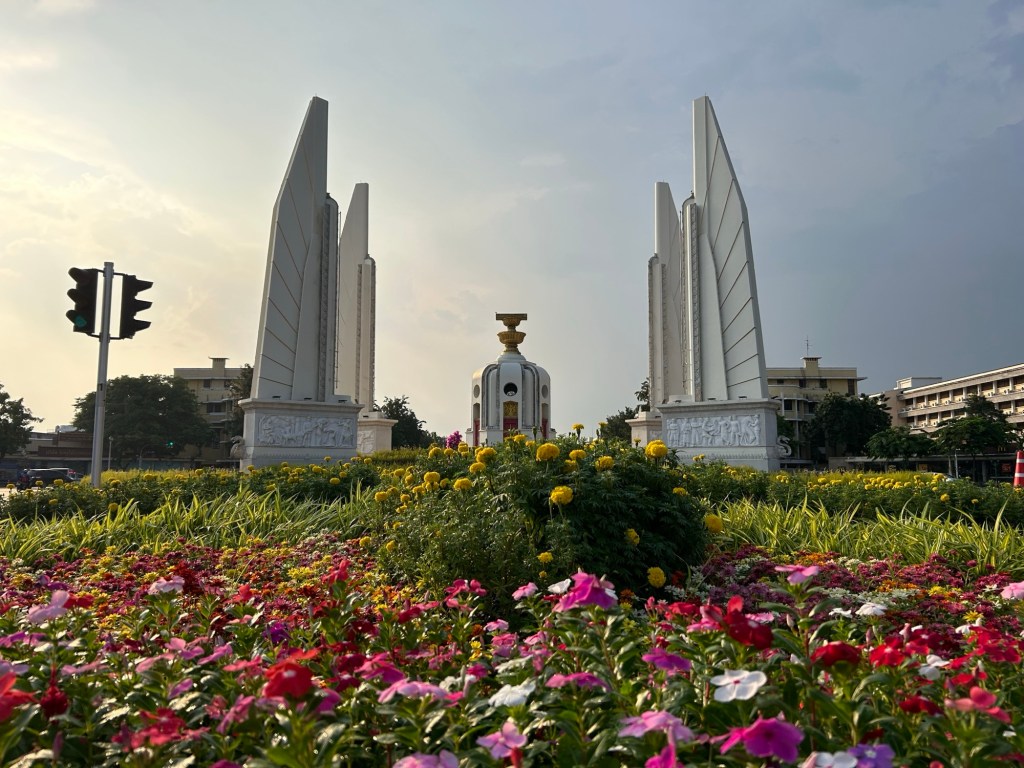
But when you read between the lines that the government want you to read, you’ll discover that this monument actually marks the 1932 Siamese Revolution, where the then King (Prajadhipok) was deposed while on holiday in a military coup. In his place, a military government was installed. Now forgive me if I’ve missed something, but what exactly is democratic about a military coup and forced government. It’s not like the people had any say in the matter!
For that reason, this has often been the site of political protests. Everything seems to be a bit happier nowadays though.
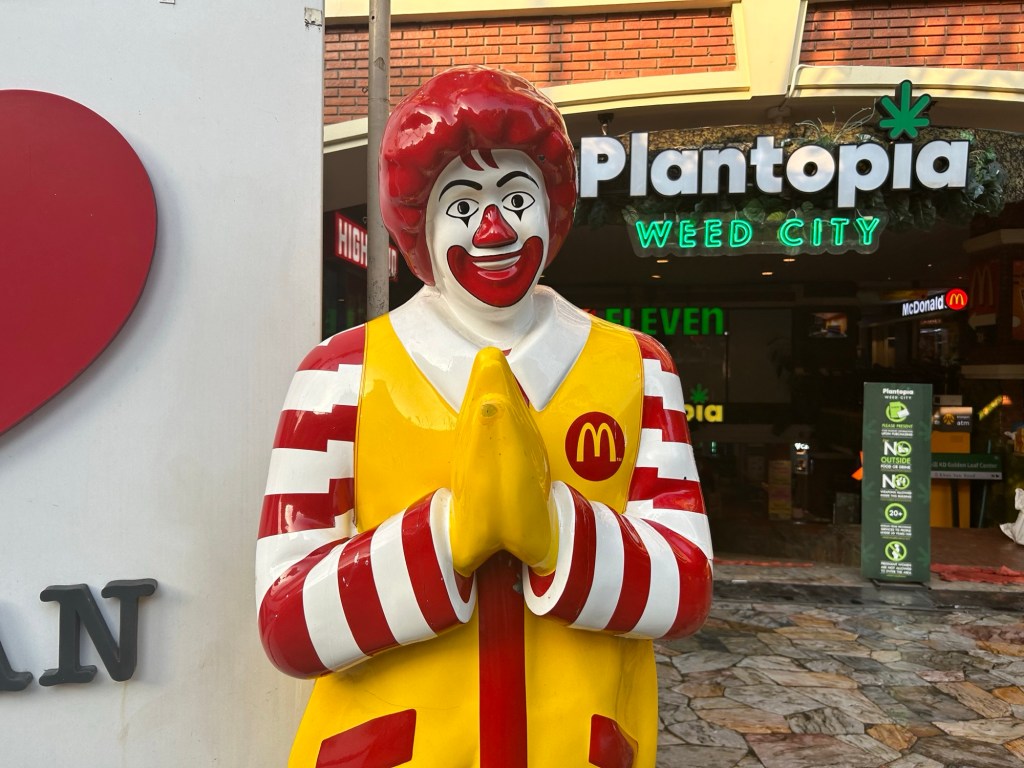
Khao San Road is described as a backpacker paradise. But in reality this is just street that stinks of weed, and is aimed at tourists. So this is where you’ll find the tackiest souvenir stalls, and McDonalds (so far the only one I’ve seen since we’ve arrived in Thailand).
Some of the more unusual offerings here include a crocodile grill, where you can pay 10 Baht to take a photo of a display of crocodile heads out the front. Was I going to pay 10 Baht to take the photo? Was I heck.
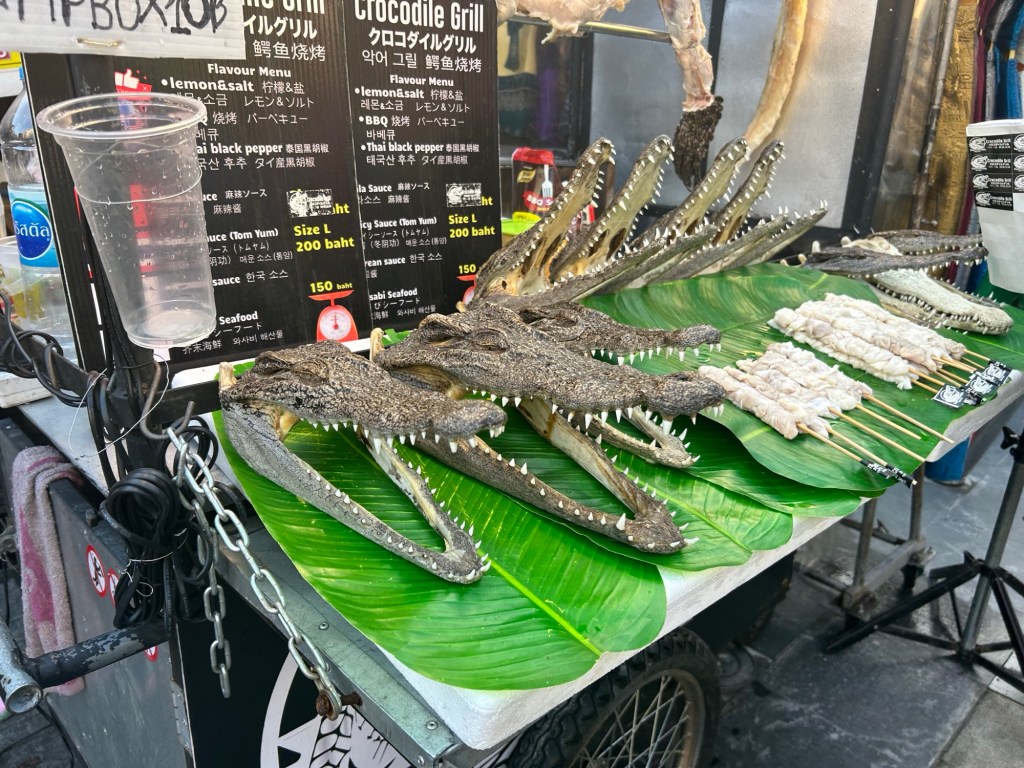
Well if anyone’s going to appreciate a quick snap, it’s a crocodile!
Another display went one step further, showing a naked crocodile’s insides. No thanks.

Anyway, starting to feel a bit light headed from that weed smell, we walked on, back towards the grand palace to see if there was any sign of the king.
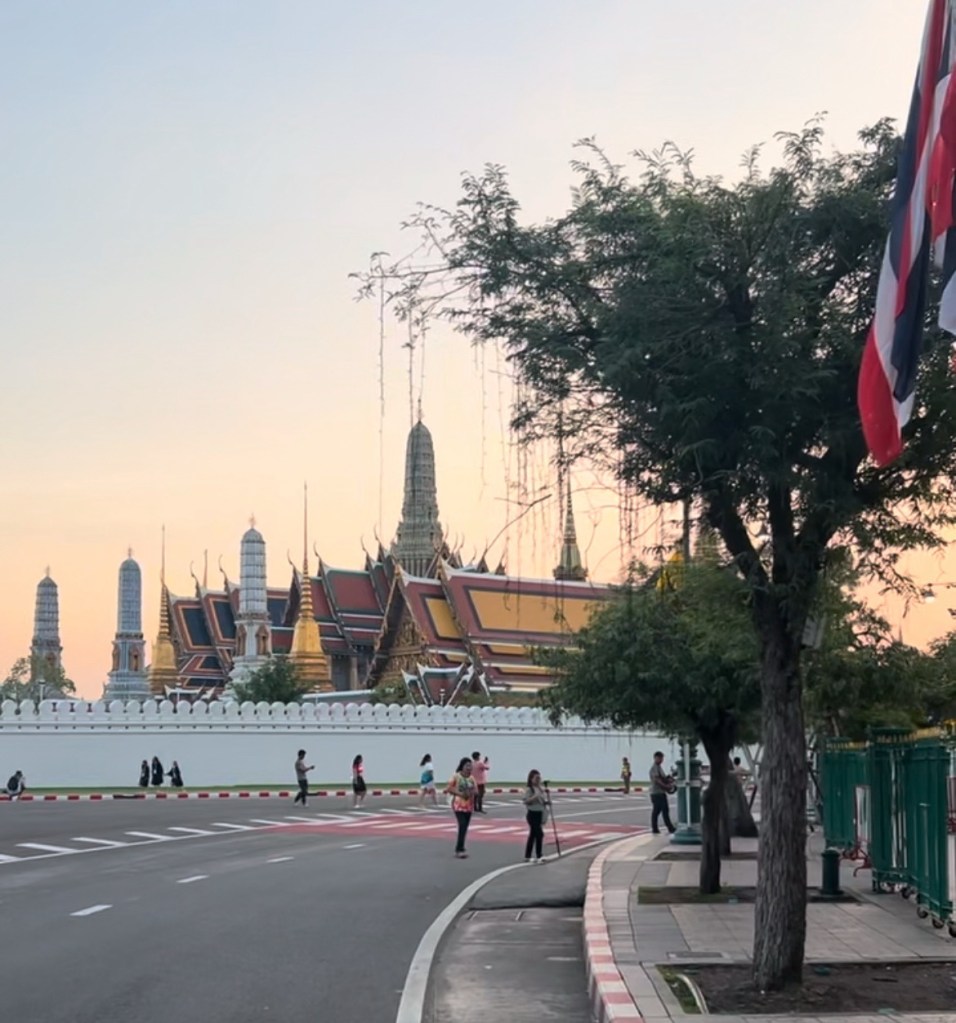
The sun was now setting, leaving a beautiful golden glow over the shiny roofs of the palace.
Here, we discover that police have now re-closed off a couple of roads around the palace and we are informed that the king is about to leave.
Not only have the roads closed for traffic, but for pedestrians as well, and we are told by police to head into Sanan Luang – which is a royal field / park beside the palace.
We potter around for 5/10 minutes looking for the best vantage point and waiting for the king to appear. While I am admiring the squirrels and hoping they’ll jump off the tree like their flying compatriots, Dad is somewhere else conversing with the locals. Mum and I are directed away from gate directly opposite the palace. I should say that the park has been completely closed off by a retractable fence. It’s clear that this gets a lot of use!
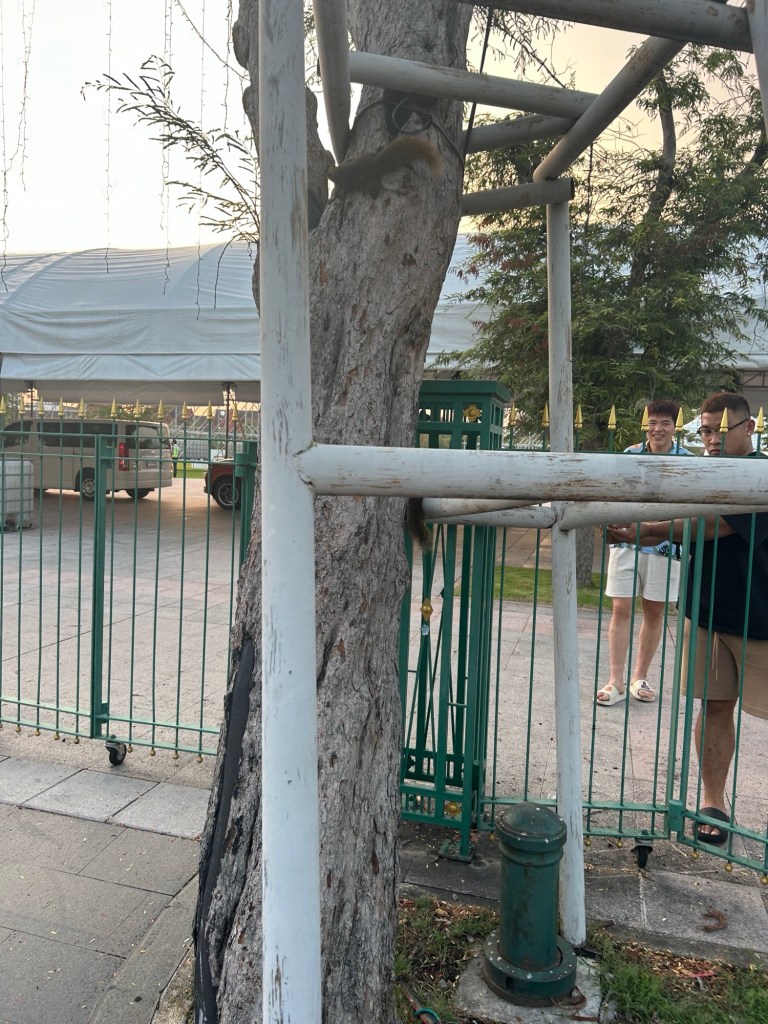
Dad returns and informs us that he has been invited to join a group ‘to see the king’. We’re not quite sure if this means we’re meeting the king, but at the very least, I was hoping he would walk close enough to get a photograph.
Underneath a marquee, a large group of people wearing yellow T-shirts are sat anticipating the king’s arrival.
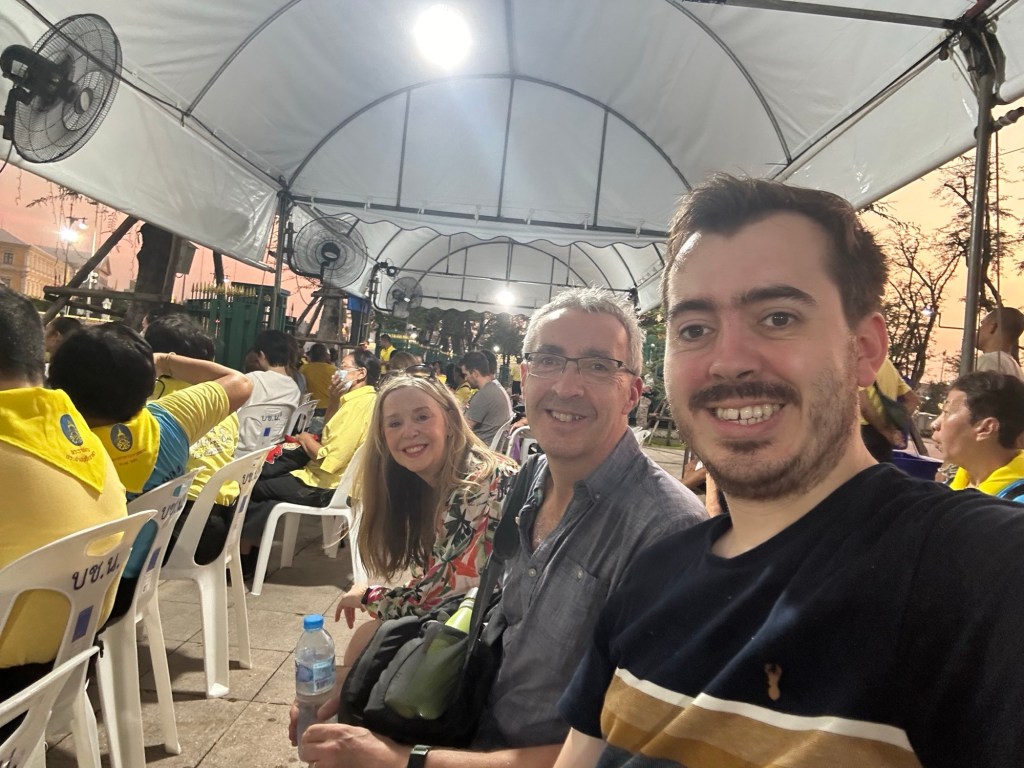
We are given chairs to sit in, and one lady kindly hands us a bottle of water each. It’s nice to be included in their happy moment!
So who are these people – it looks like some group, but I’m not entirely sure what they do. We’ve seen many others around the city today dressed similarly. The ones in blue seem to be the leaders.
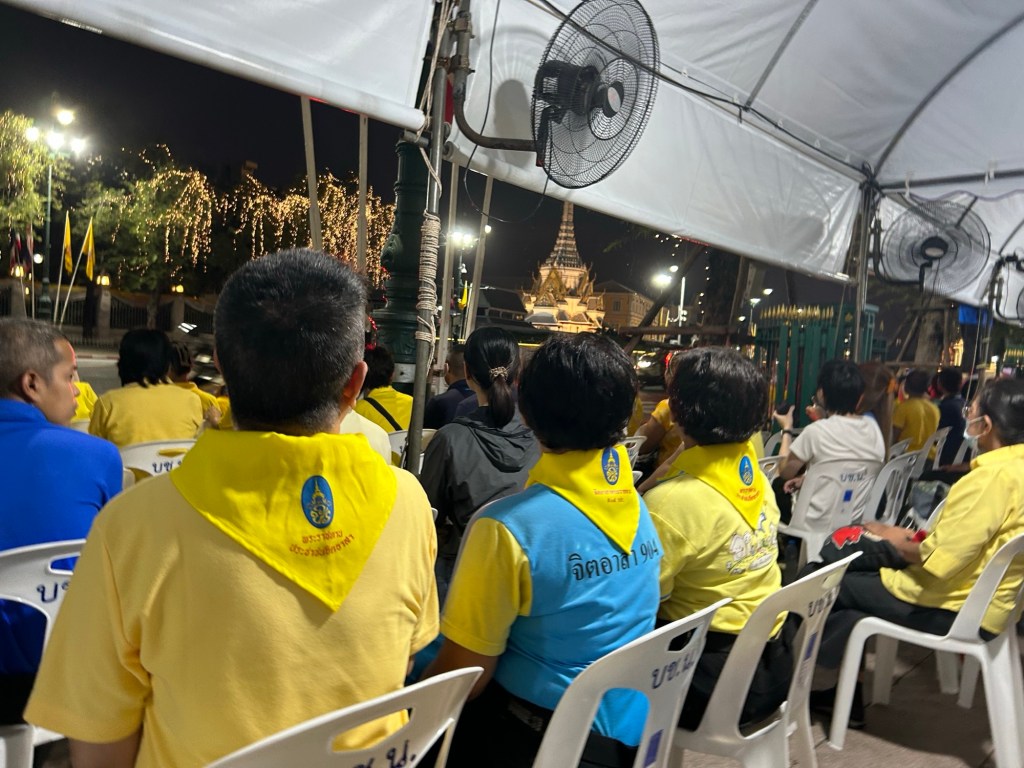
One person tells us that we are not to stand when he comes. Again likely for security reasons, but the Thai are very touchy about their monarchy. It is a criminal offence to disrespect the royal family, and it’s also illegal to stand on a coin or lick a stamp in public, as both contain the image of the king.
But with all these rules, it does sound like maybe he’ll be walking by. Maybe meeting some lucky punters at the side of the road?
Wouldn’t that be cool?
Not a chance of it!
The king, behind tinted windows in the back of an old fashioned car was just driving past. Within three seconds he was out of sight!
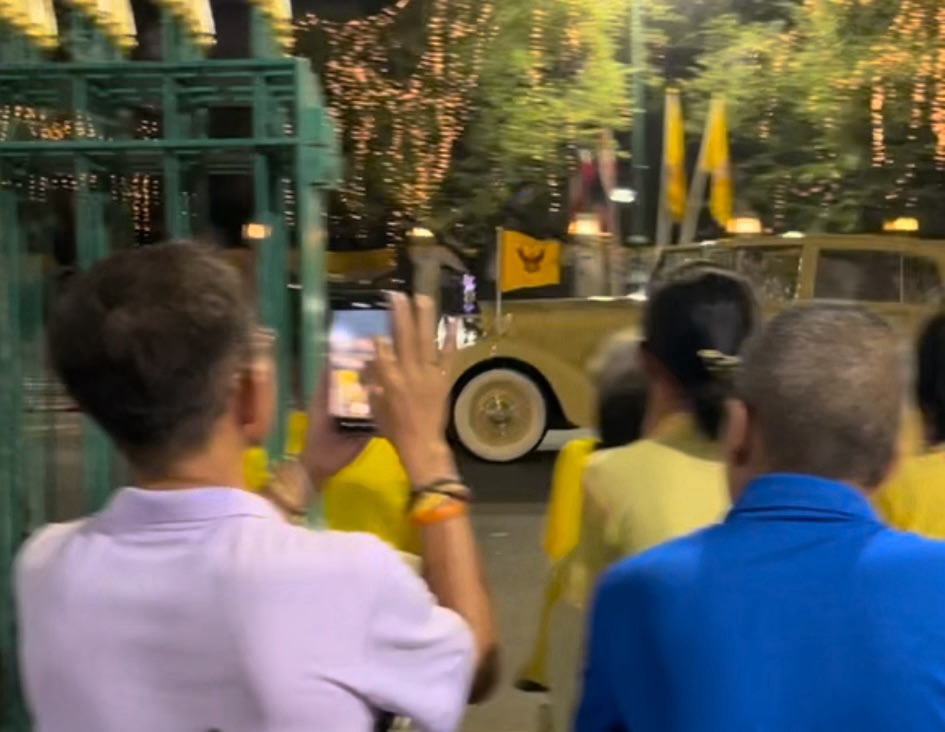
As he passed, some of the yellow t-shirt group were praying and some were chanting. There was no emotion at all.
We’re later informed that they’re chanting God save the king.
Was that worth the hype and long wait? Not even remotely!
With the roads back open again, we walked back past the palace, where more marquees are up, and piles of cones deposited ahead of tomorrow morning’s Bangkok marathon.

Following a brief stop at the hotel, we head back out for dinner via taxi. The traffic is quite busy (it’s a Saturday night), and the driver has sneakily covered up the metre.
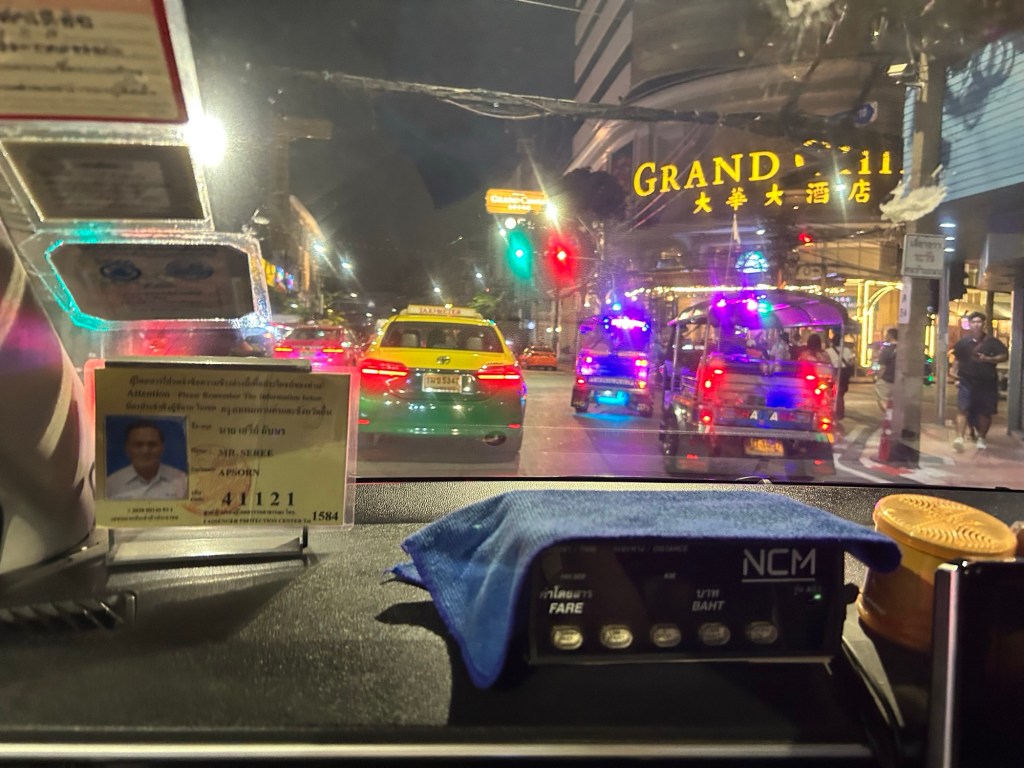
But we do engage in a little bit of chat. Of all the taxi drivers we’ve had on this holiday, this is the first one I can actually recall speaking English.
Where are you from – Ireland. Ah football! Roy Keane! He’s a man united fan. So was I. That was just about the height of it!
We’re heading to Asiatique: The Riverfront, where some old factories on the riverside have been converted into quite fancy shops and restaurants.
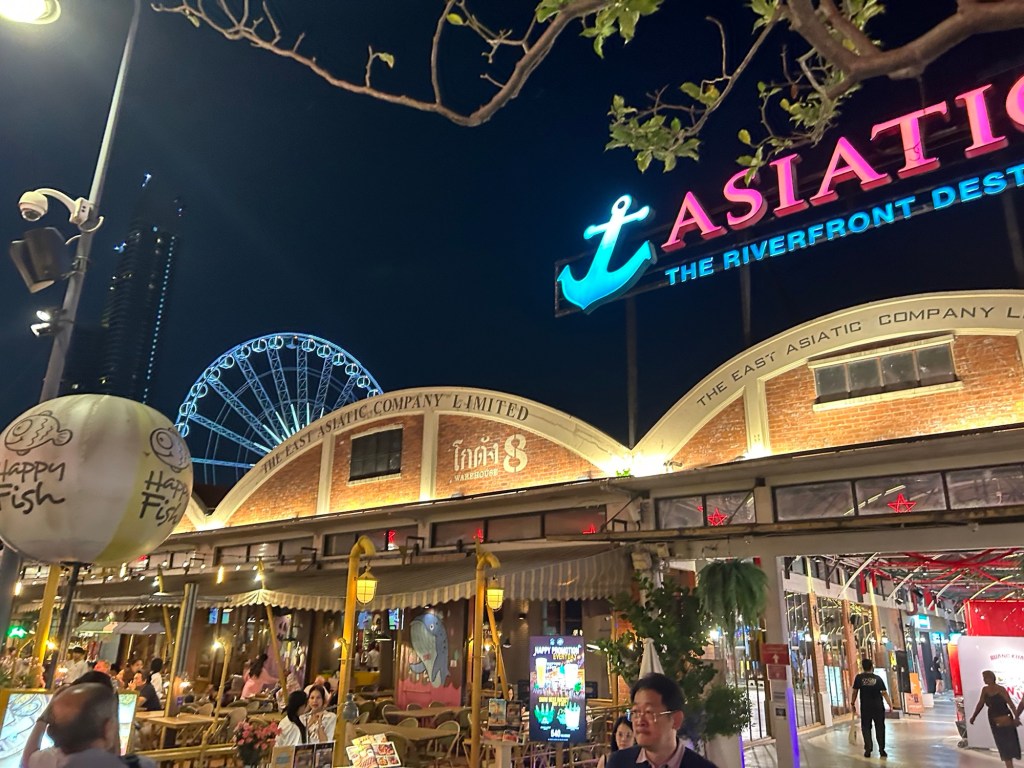
The factories used to store Teak – which is wood from a type of tree. It was then shipped off all round the world. Nowadays the only teak you’ll find is in the word steak on the printed restaurant menus.
The food here is mostly fish based – which I’m not a lover of, so go for the best looking alternative, which is spaghetti with Italian sausage. It wasn’t half bad. On the screen beside us, Ireland are playing Fiji in the rugby.
After dinner we head over to Asiatique sky – the largest ferris wheel in Thailand at a height of 60 metres.
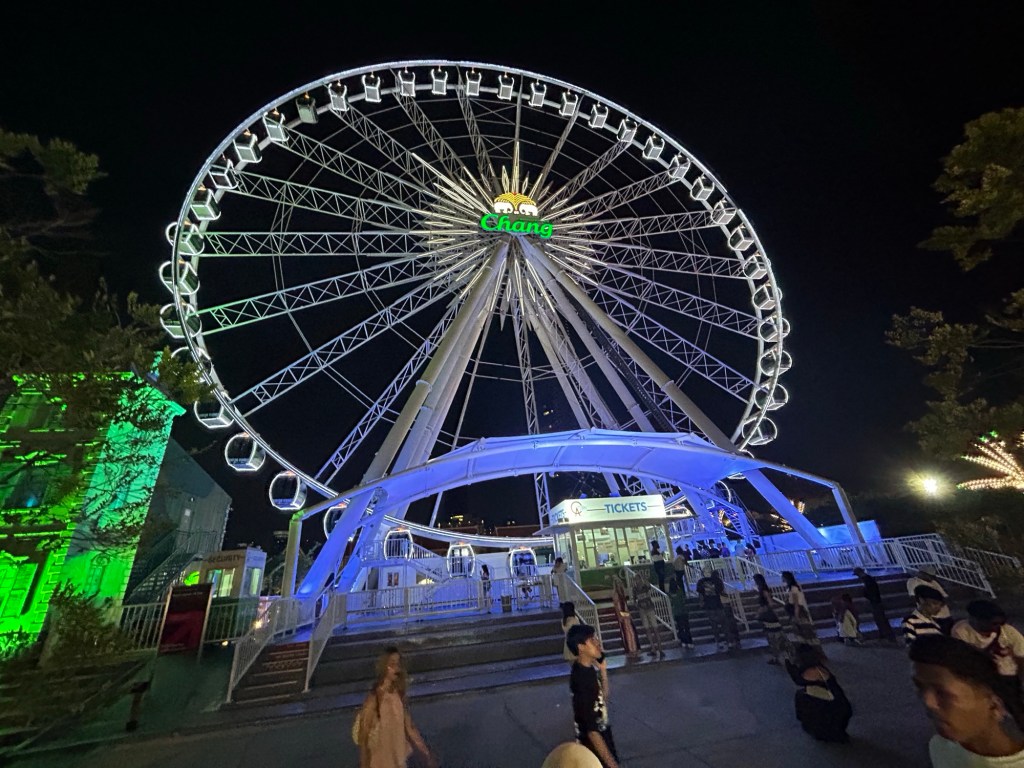
The views from the top are pretty good, and we watch boats go up and down the river. In the distance (in central Bangkok) there are signs of light shows and fireworks. I think tonight is the main night of the Loy Krathong festival.
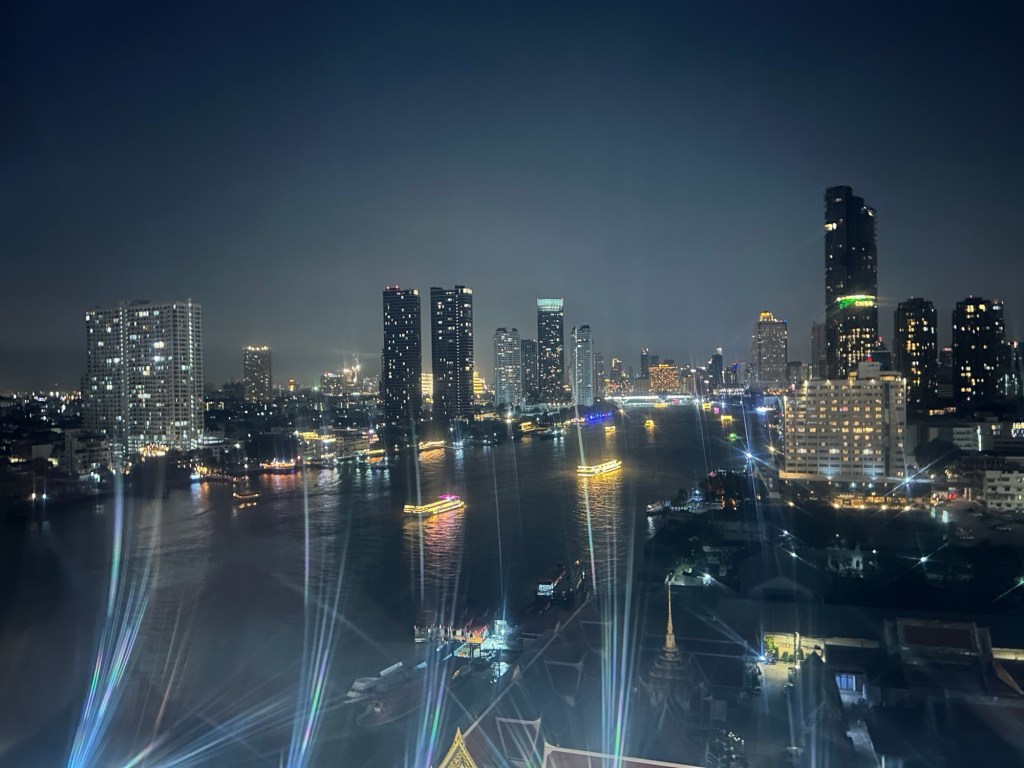
Following a few laps around the wheel, we decide to call it a day and make our way back to the hotel in Chinatown. It’s only half 9, but we’re wiped from a busy day and have to get up at about 5am tomorrow for our last organised tour.
Going back from Asiatique, I assess that Thái drivers are awful. Whereas Vietnamese and Cambodian drivers were skilled in weaving through the chaos (largely down to overpopulation), the Thai drivers have much more space to breath in the roads, but they are always speeding, drive through red lights, never keeping inside the lines and flash lights at anyone who gets in their way. So impatient. Crazy.

Anyway we just about make it back alive and turn in for the night.

 See Travel Blog
Leave a comment