Good morning from Albania. It’s day three of our expedition to the western Balkans. Today we’re heading down into Dürres to pick up a tour which will take us to southern Albania to visit the historic city of Gjirokastër and the mysterious ‘Blue Eye’.
Google Maps tells us it’s a 45 minute walk from our flat to the meeting point (Dürres Bus Station), and we weren’t able to pre book a taxi, so opt to drive down and wing it with parking.
Fortunately parking options are much better than anticipated closer to the port, so we don’t have any issues and walk the remaining distance – some 5 minutes or so.
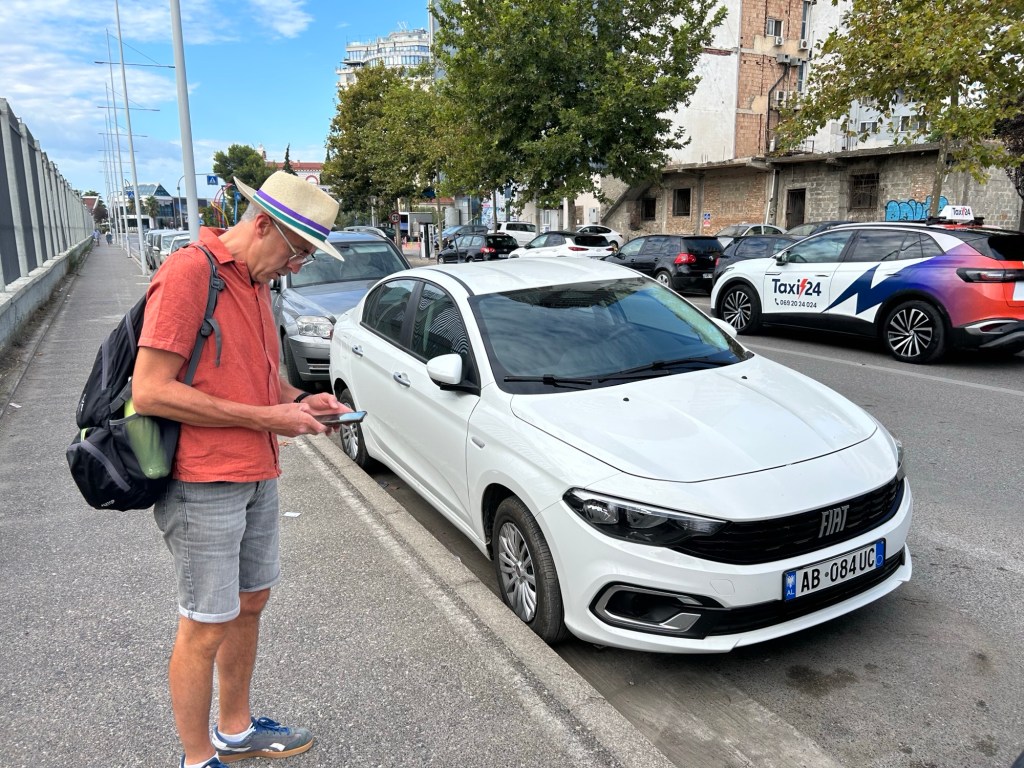
The difficulty comes when we arrive though, we’re about 5 mins early and there’s no sign of our tour bus (or anyone obviously waiting for one). A man wearing a red t shirt with the iconic Albanian double headed eagle walks over to us, but neither of us had the ability to converse in the other’s language, so he tries to point us down the road to the market – we stand our ground, knowing we’re already at the right rendezvous spot.

Soon enough, the bus does arrive. It’s already made its way from Tirana and pretty much everyone else is already on board. We’re welcomed by the tour guide named Bledi before heading on our merry way.

These tours are often a great way for learning about local history and culture, and I’m glad we chose to do this one pretty early in the holiday – Bledi gave a great introduction to Albania for us. I’ll be honest, it’s a country I didn’t know an awful lot about before coming here.
But first – the golden rule of Albania: “It’s mandatory to start your day in Albania with an espresso”. He goes on to add that “there is 1 coffee bar for every 183 people that live here.” That puts it 2nd or 3rd in the most cafes per capita list in Europe. Bledi then tells us that Albanians sit almost 4 hours per day in coffee bars, but I’ve no idea if he’s telling the truth or exaggerating. The people here don’t seem to have a particularly great work ethic, so I wouldn’t be surprised if it were true, but the maths ain’t mathing!
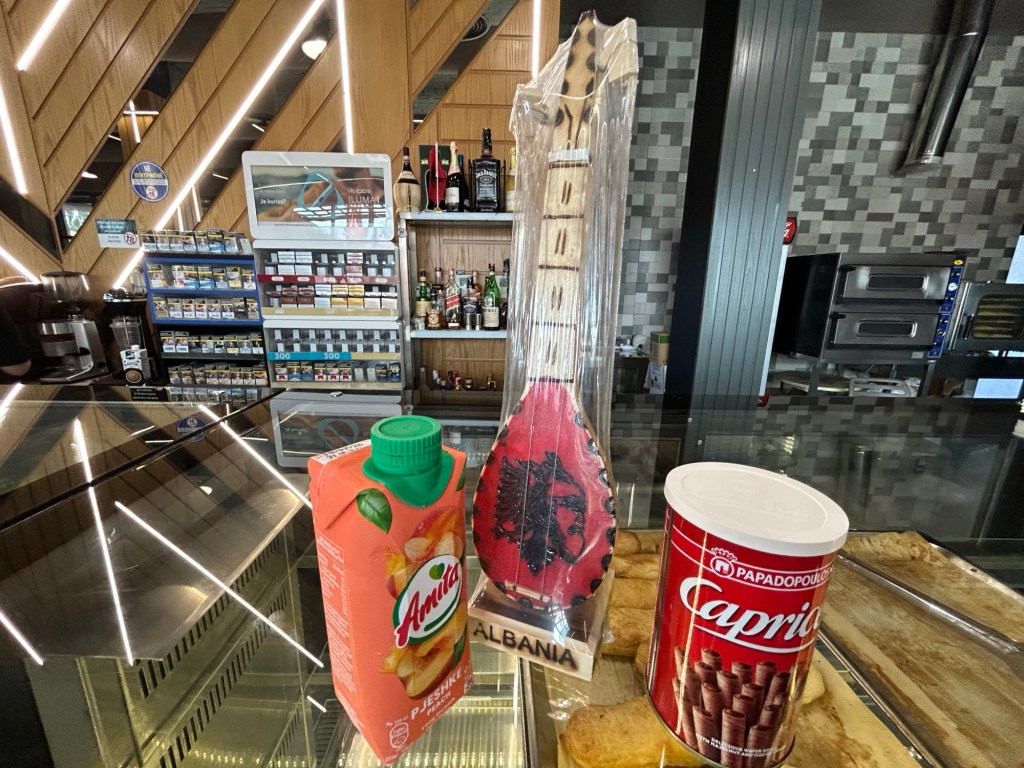
Speaking of coffee, the first stop was a comfort break almost an hour in, and while many took the opportunity to grab a coffee, I took the opportunity to buy more tat from the gift shop – a miniature traditional guitar with the flag emblazoned on its body. I also spotted some of the chocolate filled wafer rolls I remember from Greece. They’re so good!
Back on the road now, and before getting onto more facts, Bledi stops to give us a PSA. There’s now a serious tone in his voice. He tells us that Liam Neeson is the most hated person in Albania – if you’ve seen the movie Taken, the protagonists are the Albanian mafia, and now all Albanians are perceived to be criminals and in gangs. So much so, the country have had to launch a campaign to prove otherwise…
In fairness, I don’t think Liam Neeson was the one who decided to make the villains Albanian, and he’s still a national treasure in Northern Ireland.
As Bledi’s spiel continues, it’s clear there’s a friendly rivalry with the Greeks. He insists that Albania has the better Olives, Raki is better than Ouzo and the food on the whole is better. He’s not right about the food though – nowhere, and I cannot empathise enough, has better food than the Greek.
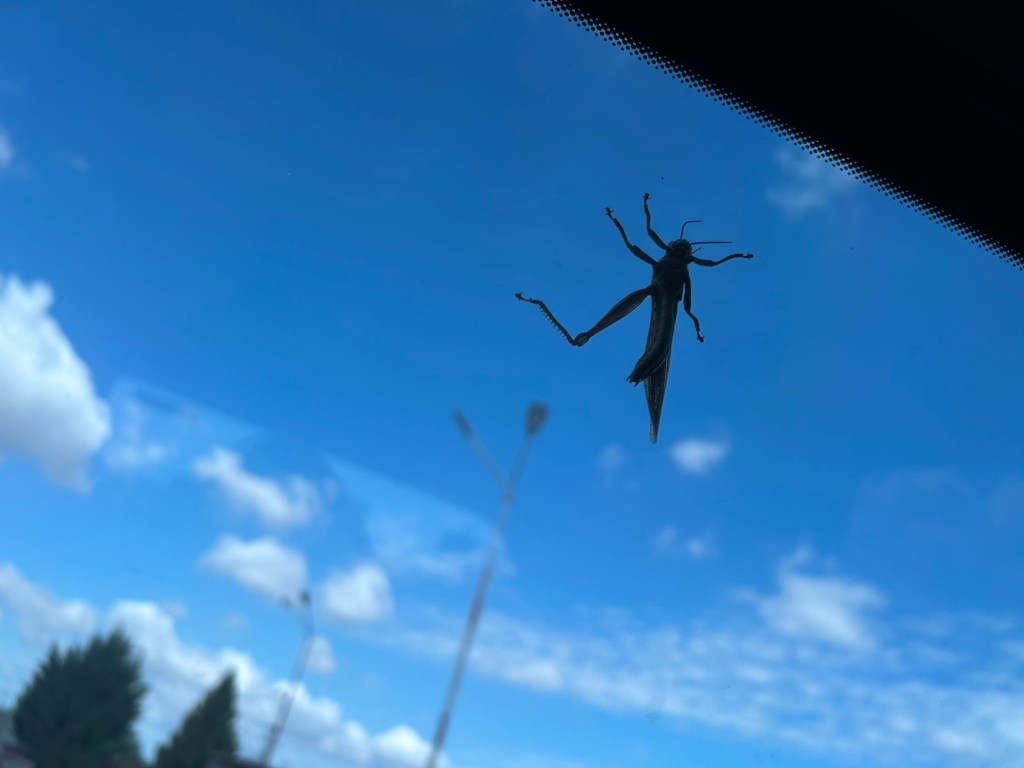
I nearly jump off my seat when I catch a ginormous bug on the window in the corner of my eye. It’s on the outside but clinging on valiantly for dear life.
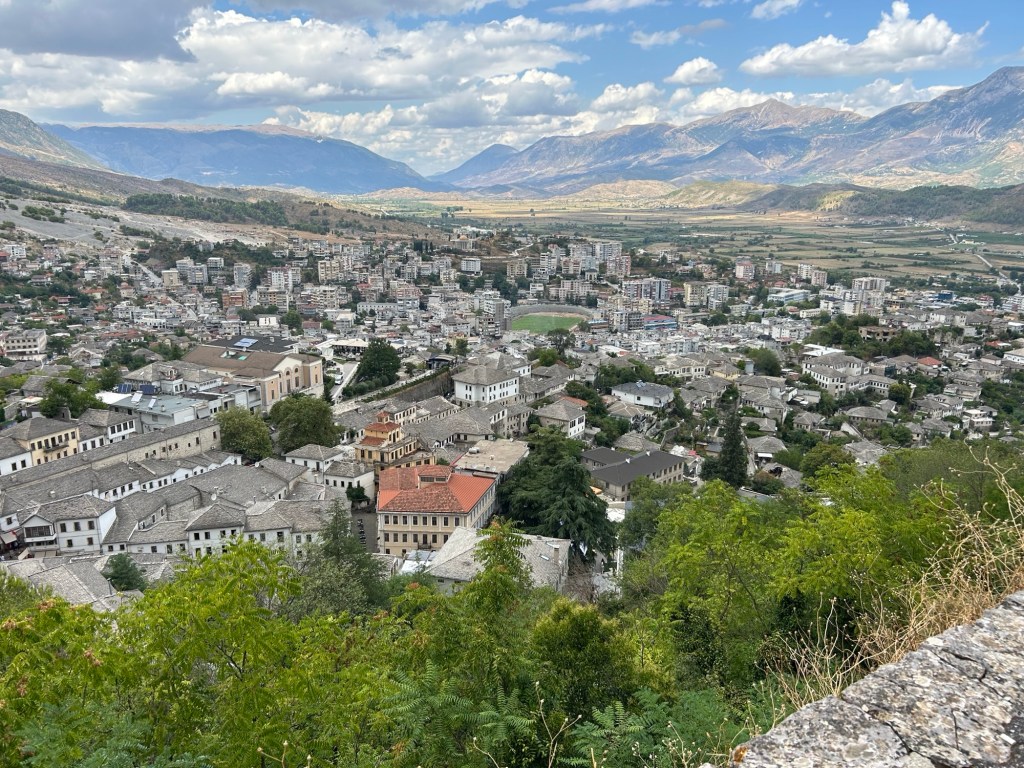
After some 4 hours on the road, the bus pulls up beside a large square and we disembark in the town of Gjirokastër / Gjirokastra (nobody is quite sure which is the right one to use). I’ll go with Gjirokastër.

Gjirokastër is one of 3 UNESCO World Heritage cities in Albania (along with Butrint and Berat), and has been for about 20 years.
From the square, some narrow streets lead up hill, and we’re heading up to the castle. It’s a tough climb in parts, and the marble cobbled flooring proves slippery for those members in the group with inadequate footwear. These include an elderly American lady named Jane, who my dad seems to be escorting up the hill.
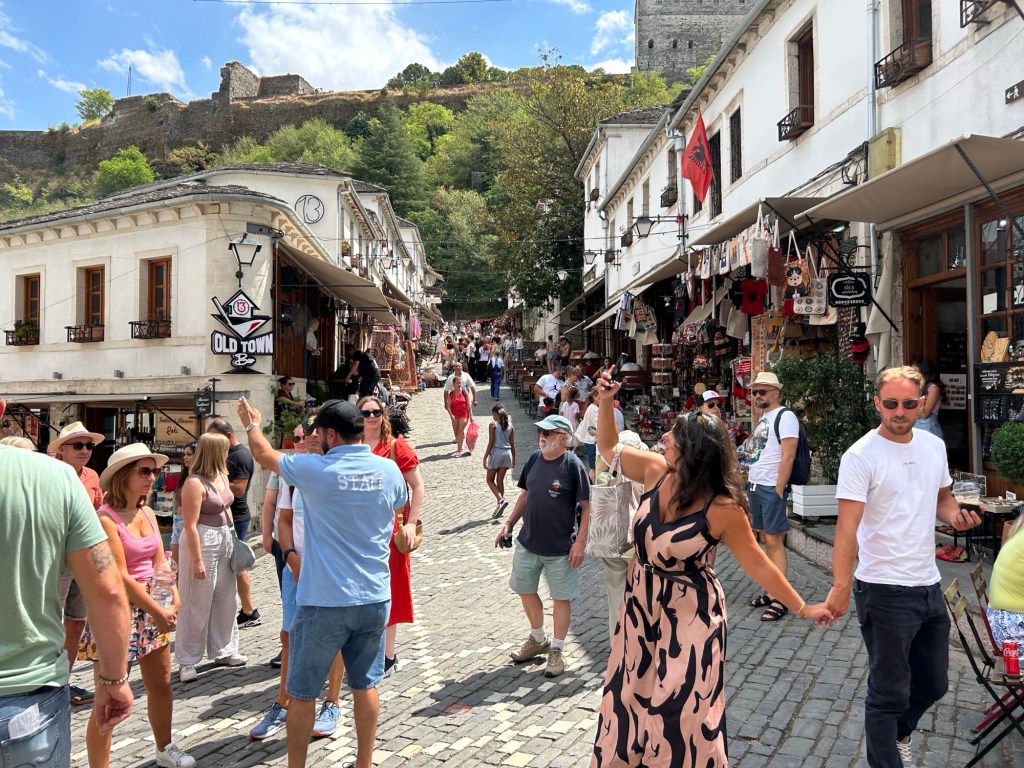
The backstreets leading up to the castle are busy but not overcrowded, and have a nice atmosphere. The steps are lined with vendors selling bracelets, nuts and patterned fabrics.
Bledi takes us inside the castle and gives us the full run down. The castle sits 336 metres over a valley. There’s a legend here of a Princess Argjiro living here in the 15th century. When the Ottomans came to invade, she jumped from the castle walls to her death to avoid being captured. It’s said the child survived.
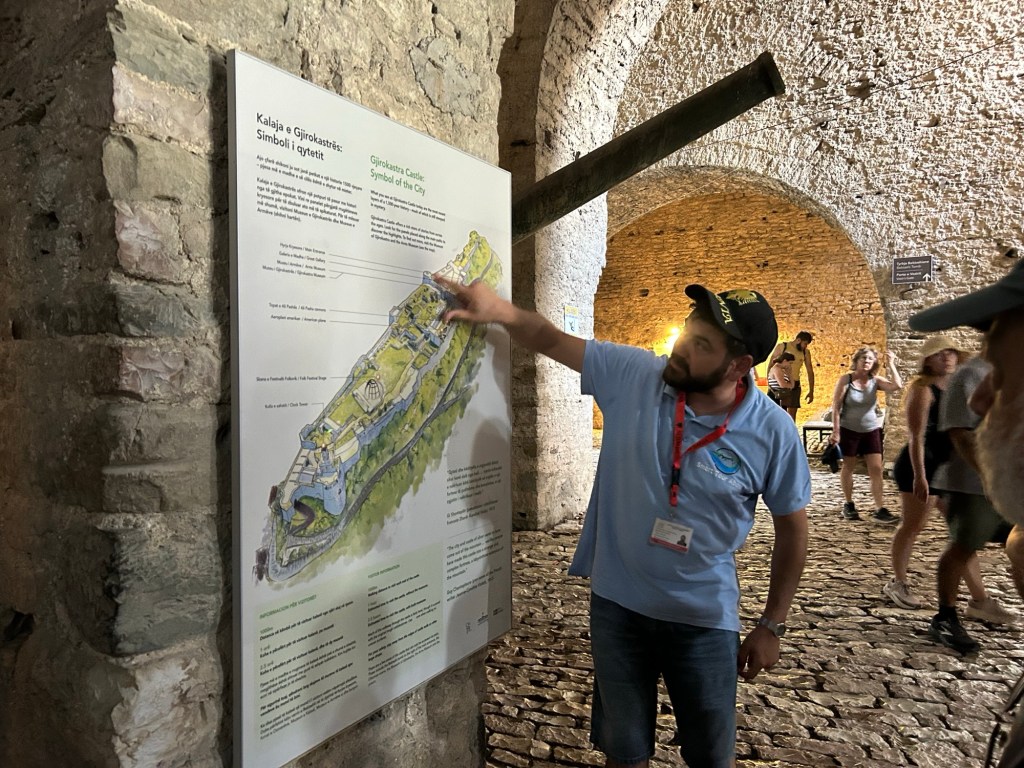
The castle was used by King Zog and house political prisoners during Communist times.
Inside the castle, a row of cannons line either side of an arched thoroughfare. One end leads up onto the roof, while the other leads down to the clock tower and a couple of museums.

We have a couple of hours for free exploration, and Jane has now latched onto us for the duration.
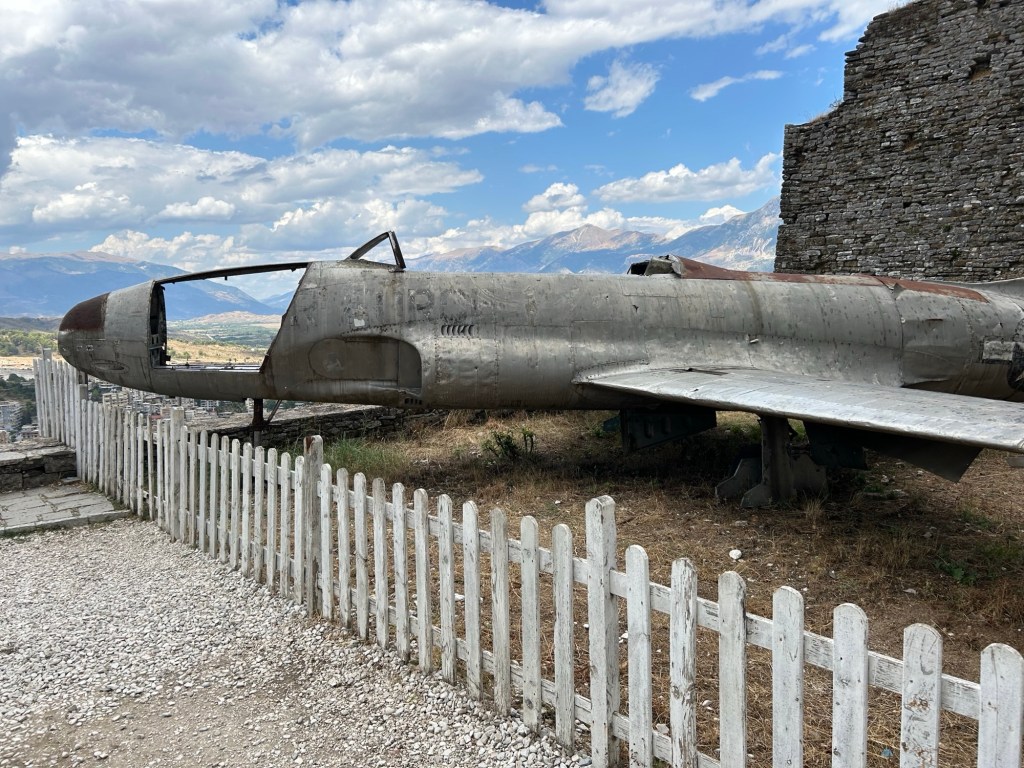
On the way to the clock tower, we spot the remains of an American T-33 military plane from the late 1950s. This was during the period of paranoia by the communist government. The damaged plane was forced to land in Tirana airport after suffering mechanical issues. The American story is that they were flying from France to a military base in Naples, Italy and got lost in thick fog then ran out of full and had to make an emergency landing in Tirana. The Albanians say it was a spy plane and intercepted it, forcing it to land in Tirana. The pilot was imprisoned, and the remnants of the plane displayed as a trophy up on top of Gjirokastër castle. If they really did get lost, they were a heck of a distance away from Naples!
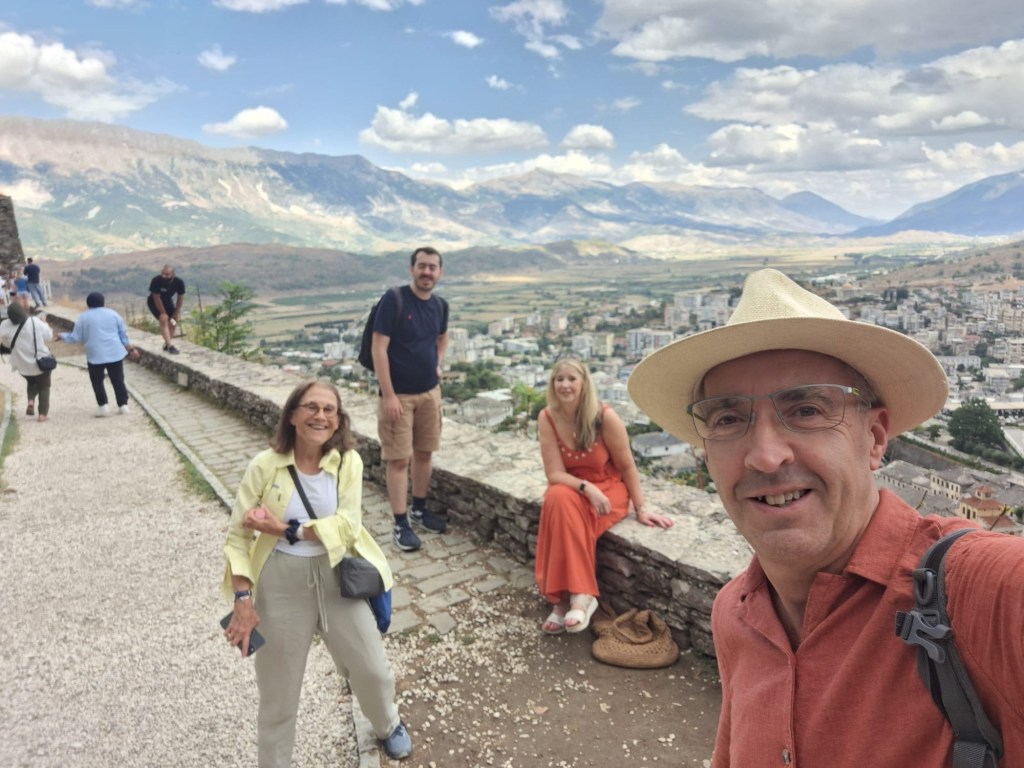
The views from the top are simply stunning, and while we’re taking pictures, a few spots of rain start to drop. Concerned about the impact precipitation would have on the already slippery slope back down the hill, we depart the castle complex in search of some food for the stomach.
Having made it back down the hill safely (with Jane still clinging onto Dad’s arm like a vice gripping a piece of wood), we stop in one of the many souvenir shops to see what they have on offer. Jane is particularly enamoured with the selection of stylish rugs hanging from the ceiling. Jane is a lovely lady, but before I go any further, let me remind you that she is American and all of the tropes of American tourists are about to play out in real time. These rugs are hung up from the ceiling, so require assistance in order to inspect up close. Jane can’t decide from one to another – “this one looks good”, “no wait, this one is better”, “actually the first one was good”. The young female shopkeeper shouts down to tell us more about the rugs, that they’re traditional and hand crafted, but Jane is too wrapped up in her flip-flopping to notice. The girl tries again but again is ignored. Next thing I know, and she has her head pressed firmly on the counter.
Then Jane decided she wanted a pair of traditional Armenian slippers, but after trying on every pair in the shop, there weren’t any that were the right size (let’s call it Goldilocks syndrome).
Anyway, a few examples of brutality that is foreign tourism and the psychological scars it leaves on its victims.
The shopkeeper girl obviously wasn’t having a great day, so I bought a few fridge magnets, postcards and rug for the house with as little fuss as possible then popped a €5 tip in the jar and went on my merry way.
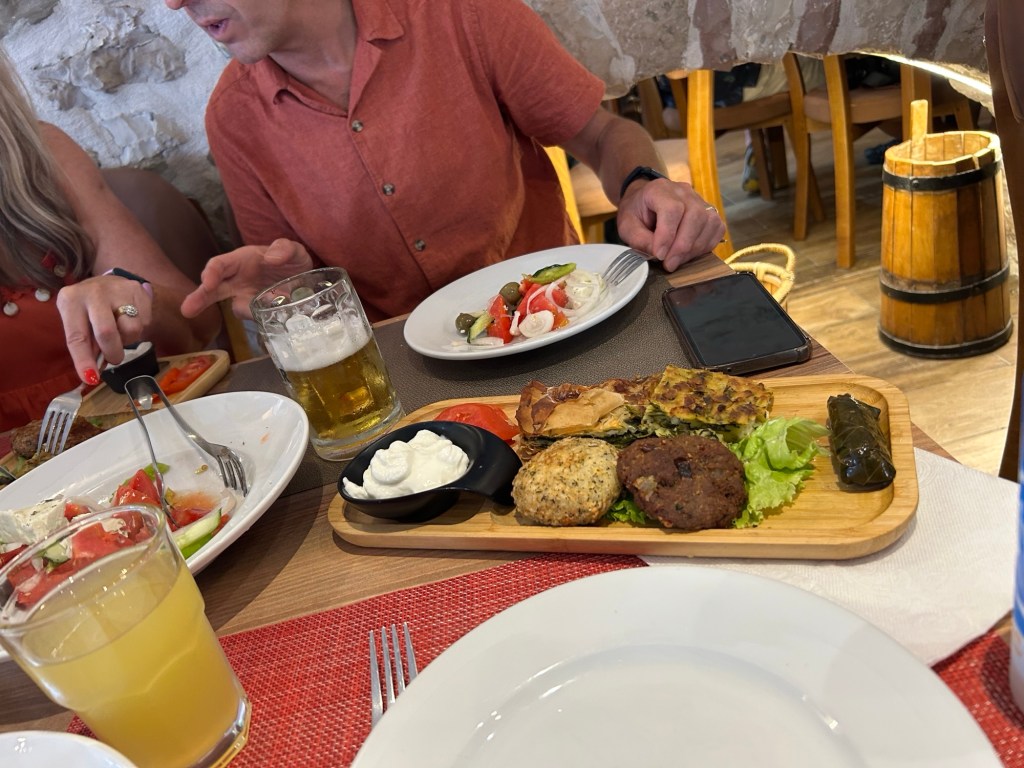
Jane’s now tied at the hip with us, so a lunch on our own was never really on the cards, but we went back to the restaurant that the tour guide had recommended, to find most of the rest of our group already inside. I hope Bledi’s getting a commission from that place!
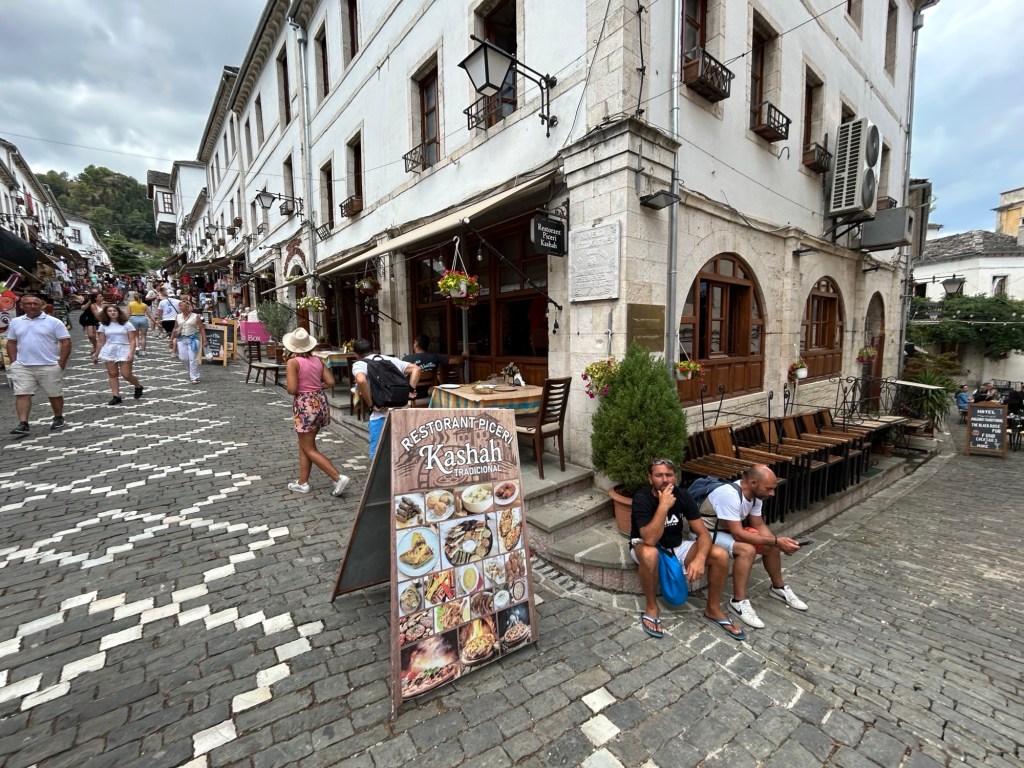
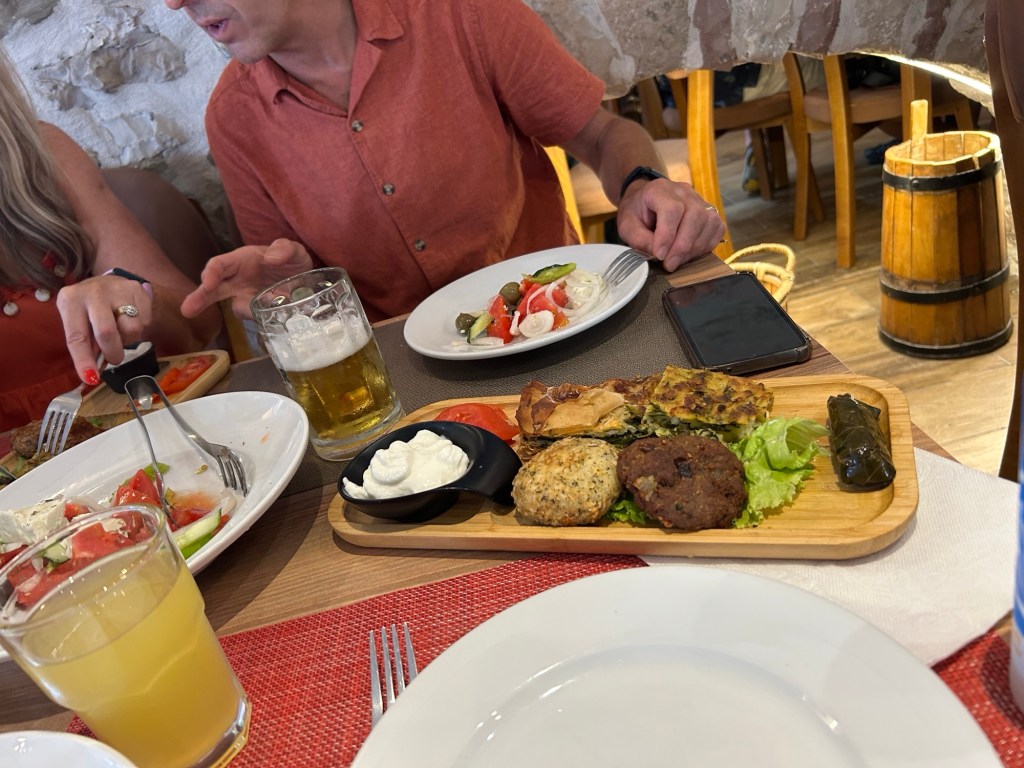
We went for a Greek-style salad, complete with large slab of Feta cheese on top (yes! 🙌) and a little sharing platter. It was all very nice.
By the time we’d squared up the bill, we had about 10 minutes to get back to the square where we were told to reassemble. That gave just enough time to grab a coffee / tea and sweet treat from the Kalimera coffee shop. This was my biggest faux pas of the holiday so far – teas here are absolutely disgusting. Now normally I take my teas more resembling a milkshake, but because the milk here is condensed, it just lacks the hearty dairy taste that we get back home. And the tea itself resembled one of those spice bags you get down the local market. No amount of sugar was gonna save that monstrosity!

Anyway back on the bus with only a few diplomatic incidents. I have to say, Gjirokäster has great vibes, beautiful place.
Our other stop on this tour would be the Blue Eye, I’ll tell you more on that in a moment… but on the way there, we’re given an explanation on religion in Albania.
In the height of communism, Albania became the first nation in the world to declare itself an Atheist state and religion was totally outlawed & priests and imams killed or prisoners. When the Democratic Party took control in the 1990s, religious freedom returned and all the main religions managed to peacefully coexist (Islam, Christian Catholic and Christian Orthodox). As I said yesterday, I don’t think it’s fully caught on, and the ones who are religious don’t tend to be particularly devout.
But one thing I did find interesting – about 10% of Muslims in Albania follow the Bektashi Order. This originated in the 13th century during the period of Ottoman rule. The Albanian government are looking to protect this, and are looking to create a tiny Bektashi independent state (much like the Vatican City) where they can set their own laws. Apparently they met with Pope Francis before his death to discuss this, and he gave them his blessing.
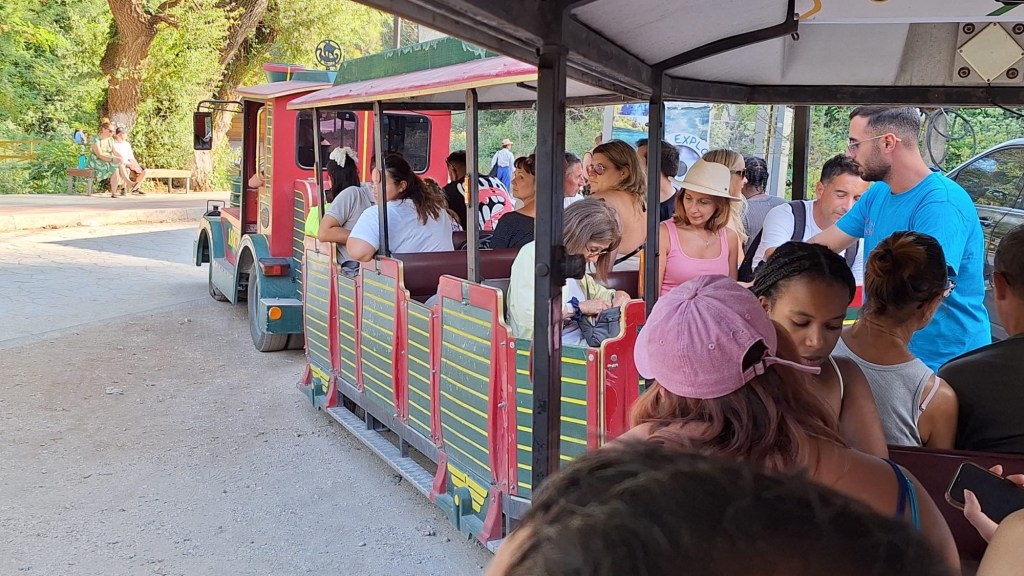
We finally arrive at the entrance to the Blue Eye, surrounded by thick forest, and board a tourist train (what we would call a ‘Dolly Trolley’) to save us the 2km walk. It’s only 600 Lek (€6) per person return, but saves a strenuous uphill walk in the heat.
The Blue Eye itself is a natural spring of water, named after the rich blue colour, and the shape when viewed from above. In fact, that colour is so vivid, that it looks more like it’s filled with Listerine mouthwash than water. I’ve had an eye on this one for quite a while! The eye shape is a bit more of a stretch, personally I didn’t see it, but maybe we just didn’t have a good angle.

The water bubbles up from a deep underground cave (some 50m down) and the waters are icy all year round. You can’t swim in the main pool, but can get into the river further upstream. Indeed, the icy waters proved just a bit too icy for the old man. Needless to say, I faked some camera difficulties when photographing him in the water for full effect.
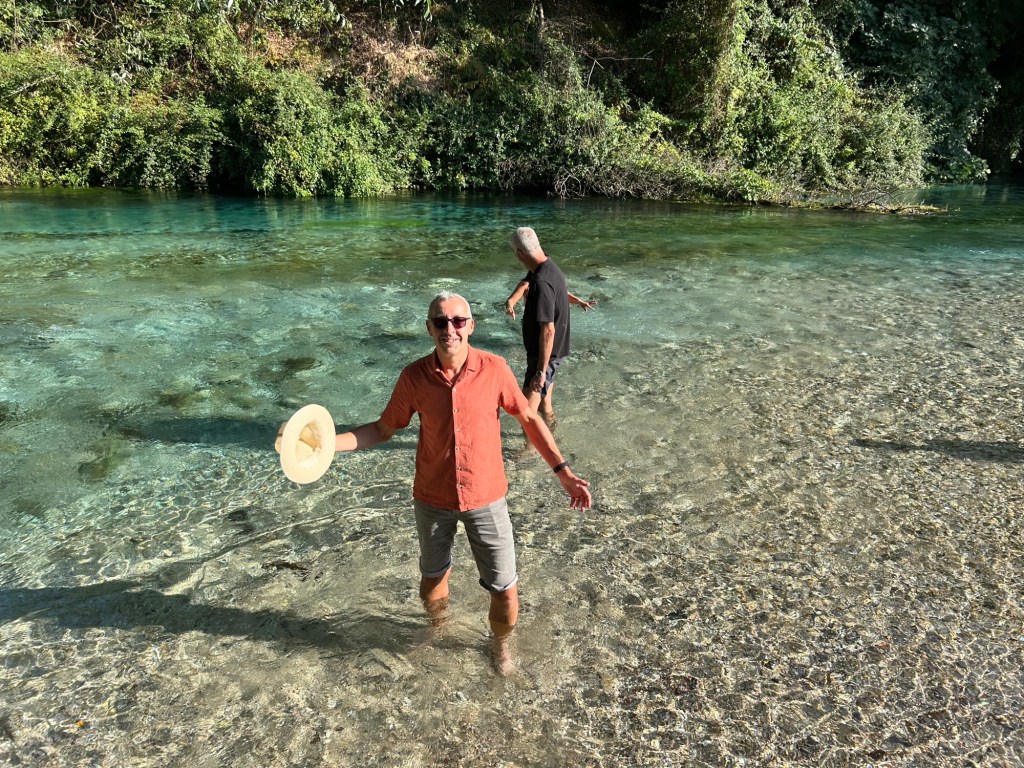
Looking over the Blue Eye is a little balcony 5/6 metres up, and this gives a good wider angle of the pool area. Still not making out that eye shape though!

Now, the water is crystal clear, and the guide tells me it is drinkable. But getting it into the bottle is a different story, it’s a steep bank most of the way around, and I have no intention of getting my feet damp. So you can imagine the sight of me squatted on my honkers, stretching into the water, while gravity and my weight try to pull me towards the water. I did manage it, but the water around the edge was so muddy that it wasn’t worth drinking anyway.
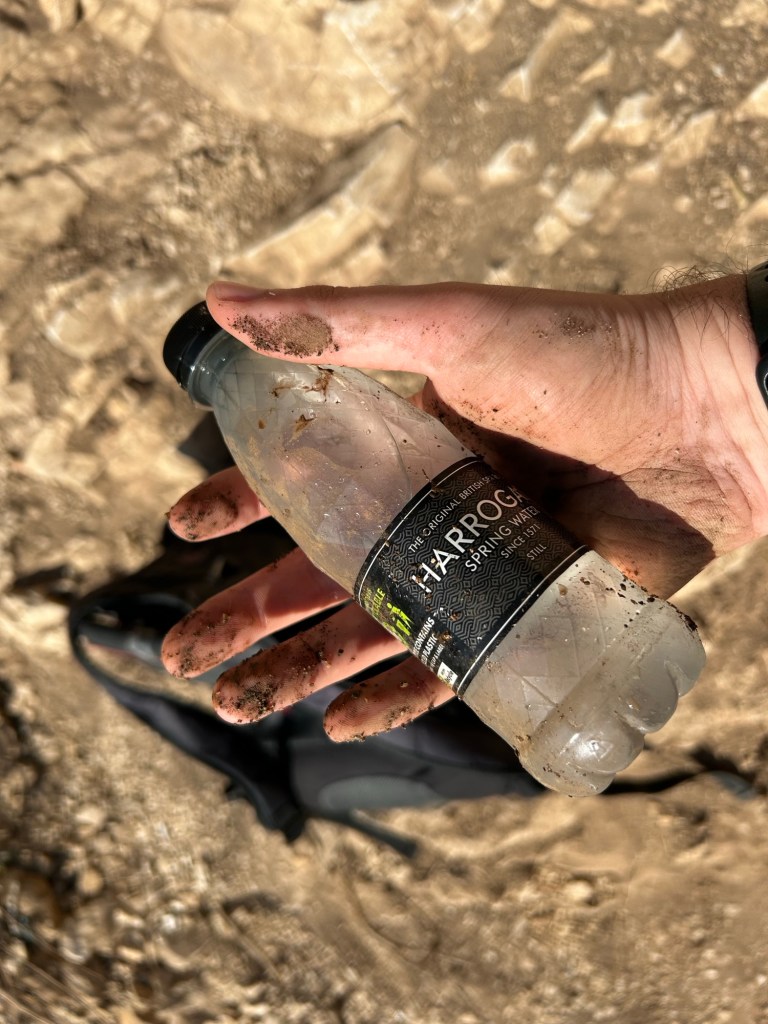
Also, the last time I tried drinking natural water in Slovenia (which has gone down in Hull Family infamy as ‘the Vintgar Gorge Incident’ left me feeling sick for days. I guess I’ve learnt the hard way. But just look at the colour of that – another example of something being good in theory, but final execution lacking!
We didn’t have much time here free, but if you wanted, there was the option to hire a scooter, kayak or swim in the river.
The bus ride back was very long and bumpy. The roads here are something else, and about 3 hours and a beautiful sunset later we made it safely back to Dürres.
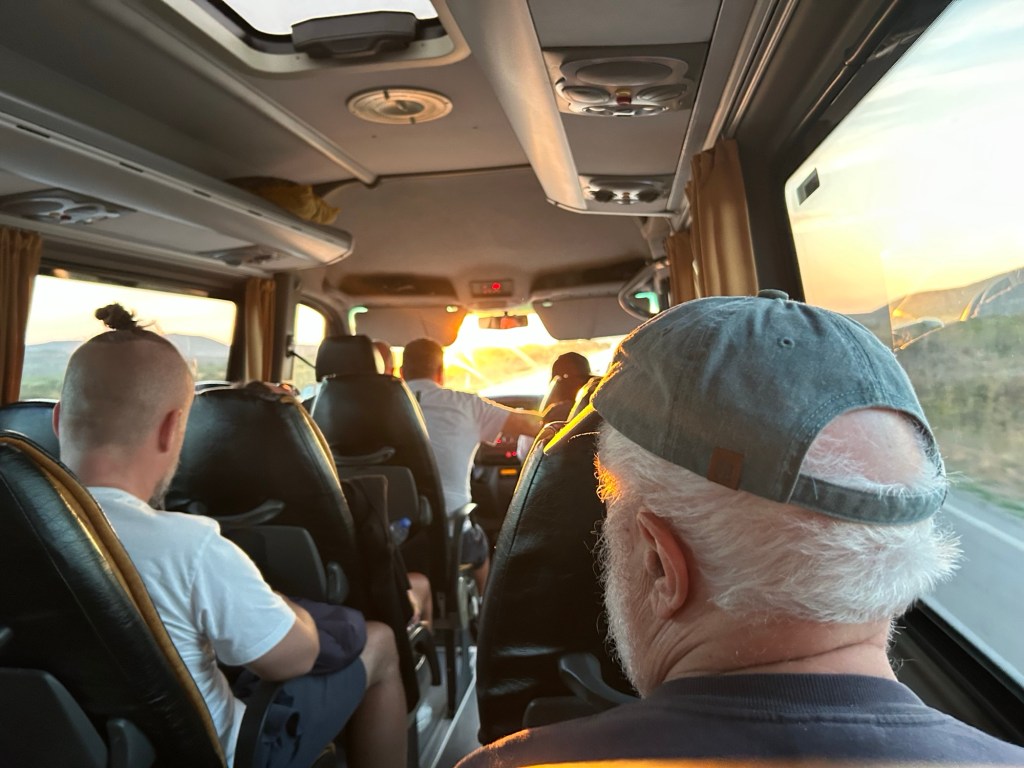
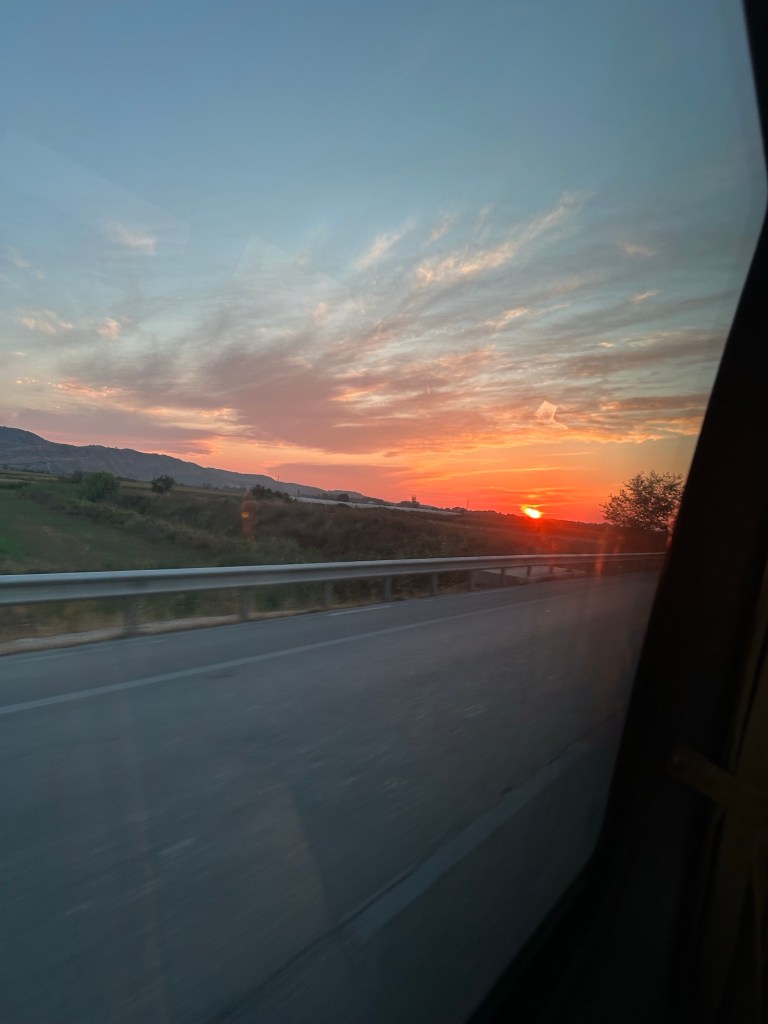
It was a very long day, but thoroughly enjoyable, and great to see a side of Albania that we wouldn’t have been able to drive to. I do thoroughly recommend the guided tours, as you don’t feel like you’re missing anything. We used GetYourGuide, and the tour operator was Smart Tour Albania.

 See Travel Blog
Leave a comment