Well, I’m pleased to say our first night in Skopje was a pleasant one, and aside from no hot water this morning, our accommodation is pretty much perfect.
We have another tour booked for today, and it’s one that I’d been particularly pushing for (let’s just say mum and dad took a bit of persuading).
I love to tick off countries, and when I heard that we’re only 45 minutes to the Kosovan border, it was a no brainer.
Kosovo isn’t really a country that any of us know much about. I do know it was formerly part of Yugoslavia, and broke away from Serbia in 2008. It’s described by some as the youngest country in the Europe, but that depends who you ask, as there are still a number of countries who don’t recognise their sovereignty. I’m sure we’ll get into that later.
Anyway, looking ahead to the logistics of today, we’re due to pick up our tour group from Macedonia street in Skopje city centre. It’s a 15 minute drive or so.
We find a multi storey car park, no more than a 5 minute walk away from the meeting point, and arrive with a minute or two to spare.
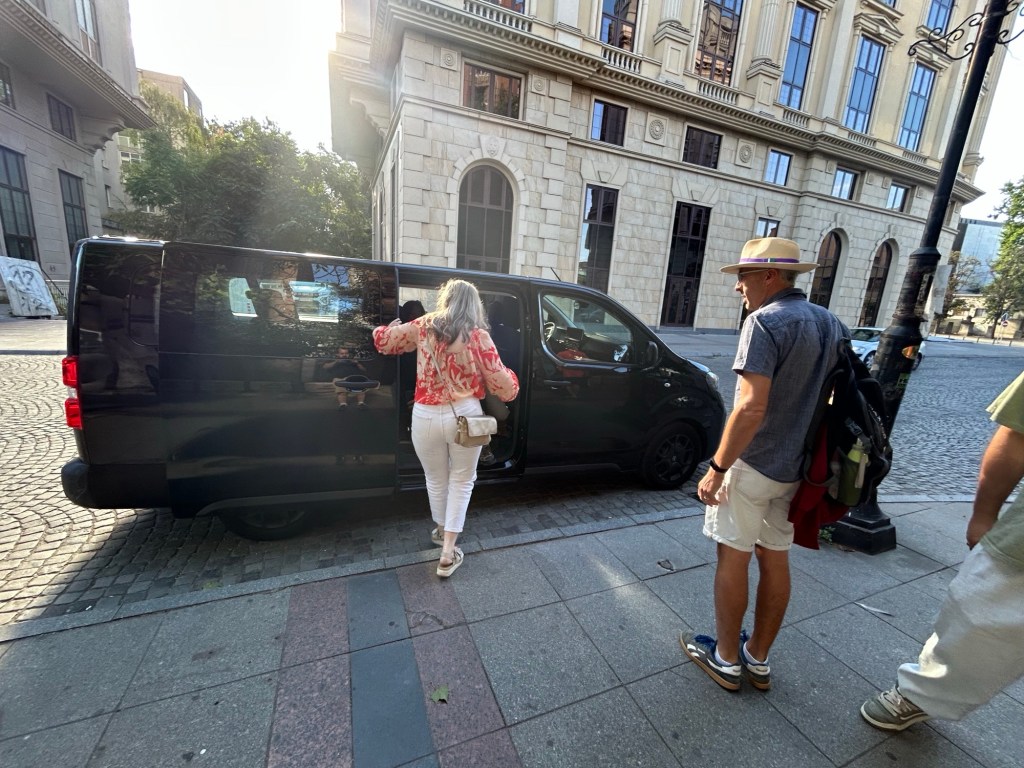
Unlike all of the other tours we’ve done, this one is in a mini van, with 4 other people (a mother and daughter from Panama, a man from California, USA, and his partner from the Philippines) plus the guide. The other tours we’ve done have all been pretty full buses and much bigger groups.
We’ve been told to bring our passports, that’s pretty standard procedure for moving between countries these days, but disappointingly they aren’t stamped upon entry. That’s three countries we’ve been to on this trip, and still not one single stamp in the passport.
Our first stop is a comfort break on a mountain side in a place called Prevalla. There is a restaurant and hotel, with market stalls outside. Sadly the markets only take cash, and as we’re now in a different country with a different currency (Euro), we haven’t had a chance to get to an ATM. That was a tough moment having to walk past the cheese stall and say no. 😢
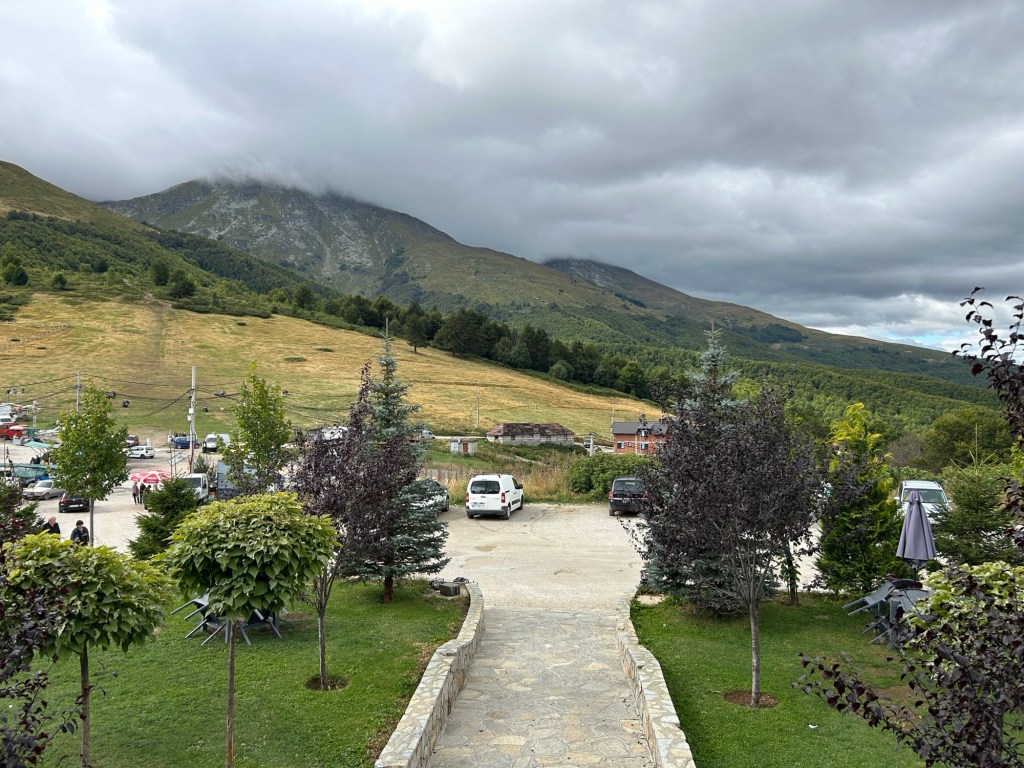
The temperature up here is freezing. It must be 10/11 degrees Celsius, with a cutting wind coming off the mountain side.
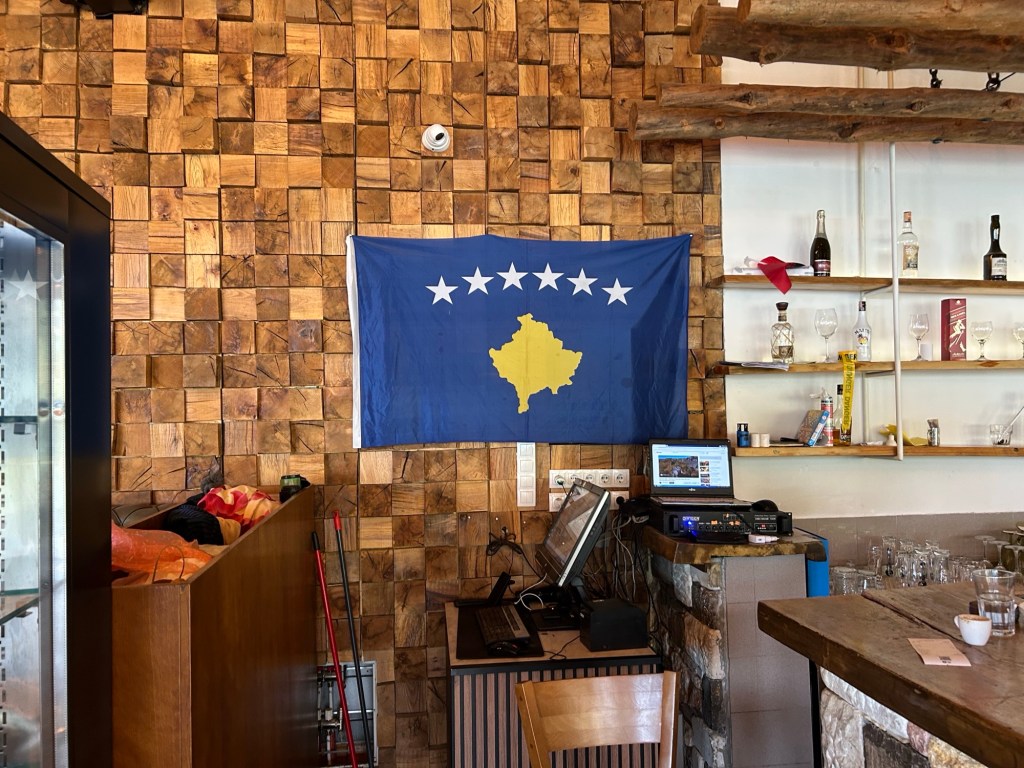
After using the facilities, we get back on the bus, and soon pass a cow randomly walking down the middle of the road. They’re always difficult to moo-ve out of the way, aren’t they!

Our tour guide is called Zlatko, he’s got curly dark hair, a beard and is repping a green flat brimmed bucket hat from the Steve Irwin collection. He’s very chilled!

Zlatko tells us some interesting stuff on the road to Prizren, not least how there are very few Roman ruins found in the central Balkans. At one stage Kosovo would have been part of the Roman Empire, but there’s hardly any physical evidence of that today. Why is that? Zlatko has a theory. Maybe a natural disaster, like heavy flooding or an earthquake has caused any Roman remains to be buried at a much deeper level than places like Croatia on the coast.
Kosovo, like Slovenia, Croatia, Bosnia and Herzegovina, Serbia, Montenegro, and North Macedonia formerly belonged to the unified nation of Yugoslavia prior to its dissolution in the mid-1990s. Yugoslavia means land of the southern Slavs. The Yugoslav capital was Belgrade (now modern day Serbia). While some of these states broke away peacefully (Slovenia and North Macedonia), others were subjected to bloody wars where many innocent lives were lost (not least Croatia and Bosnia & Herzegovina). The reason for this is that these countries did not return weaponry to Serbia, which was a term which needed to be met before Serbia withdrew their army. Kosovo followed a slightly different story. It remained a part of Serbia for another decade, then declared their own independence (a move which had been backed by the USA).
Why was this controversial, well apparently, the region was and still is almost entirely ethnically Albanian. There are many Albanian flags flying from the lamppost and hardly any Kosovan ones. You’d genuinely think we were in Albania.
For some time, the Albanian peoples had been neglected and oppressed by the government in Belgrade. According to the UN, this meant that minorities facing oppression have a right to secede. Peace talks failed, and boundaries for an independent Kosovo were drawn up in London of all places (the Ahtisaari plan). Serbia never agreed to this and never recognised Kosovo as an independent state (along with Spain, China and Russia among others – these countries are concerned that if they recognise Kosovo as independent, then they’ll lose credence over their own claims on other territories for the same reasons, like Spain on the Basque Country and Catalonia, Russia on Ukraine and China on Taiwan and Hong Kong).
I must say, from what I’ve heard so far, I’m torn on the idea of Kosovan independence. Historically, there was not any defined place called Kosovo, so it looks like the US and a few others have basically drawn this country up out of nowhere to solve one problem, but create an even bigger one. We’ve seen time and time again, the problems called when the USA weigh in on international disputes (see also Iraq, Afghanistan, Vietnam).

I ask Zlatko, if Kosovo is all Albanians, then would it not make more sense for it to combine with Albania? He says yes, that’s already been proposed in a concept known as Greater Albania. It’s a complex and controversial subject, but it seems public opinion is swaying in this direction. Zlatko is against the idea – anything which will provoke further conflict is not worth doing. In my head, I’m drawing a lot of parallels between the situation here and back home in Ireland. IMHO dding this region to Albania probably does make more sense in the long run.
Also they celebrate Christmas here on the Orthodox date – 7th January. Just an FYI, really.
The bus pulls in to a small outdoor car park in Prizren. I’m intrigued to know where we’re gonna end up parking as there aren’t any spaces. Zlatko just abandons the minibus in the middle, then tells us that he will leave the keys and an attendant will park up for us. Fair enough, that’s one solution, but very trusting.
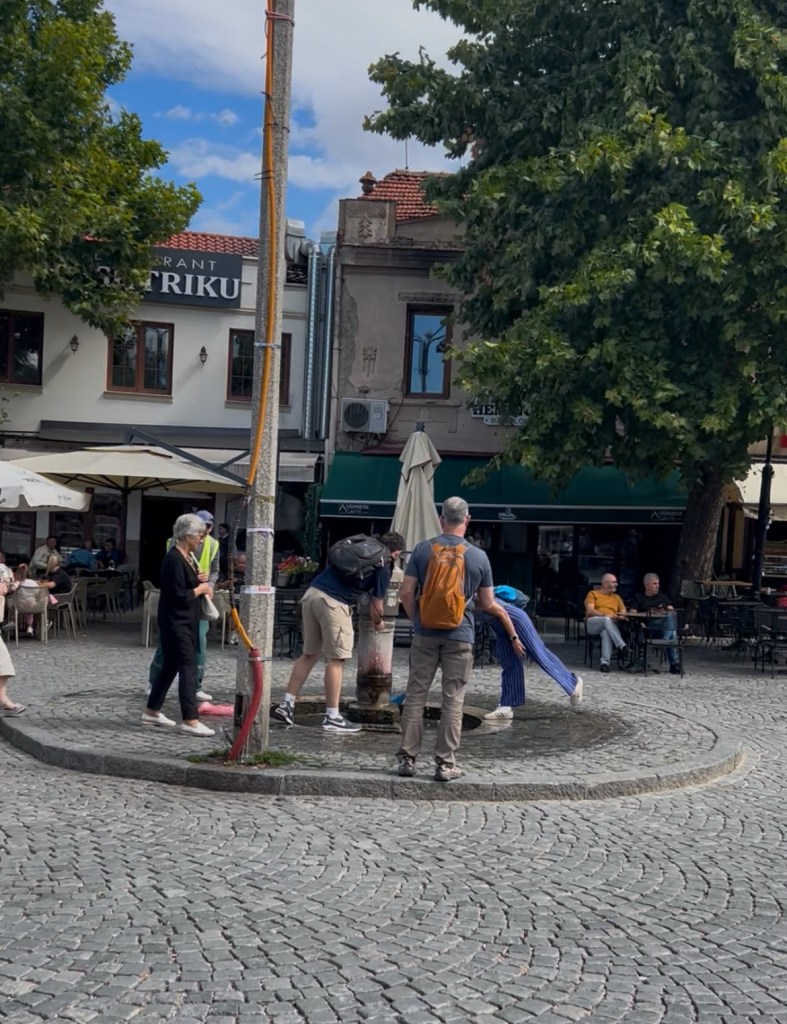
We walk into the centre of Prizren to an open space known as the Shadërvan – this is the main square of Prizren. In the middle of the square is a fountain, which is said to bring good fortune to those who drink its water. The guide explains that if you’re single and drink the water, you’ll have a long and successful marriage – “it really works”. I’m not superstitious, but I need all the help I can get, so rush straight in for a swig.
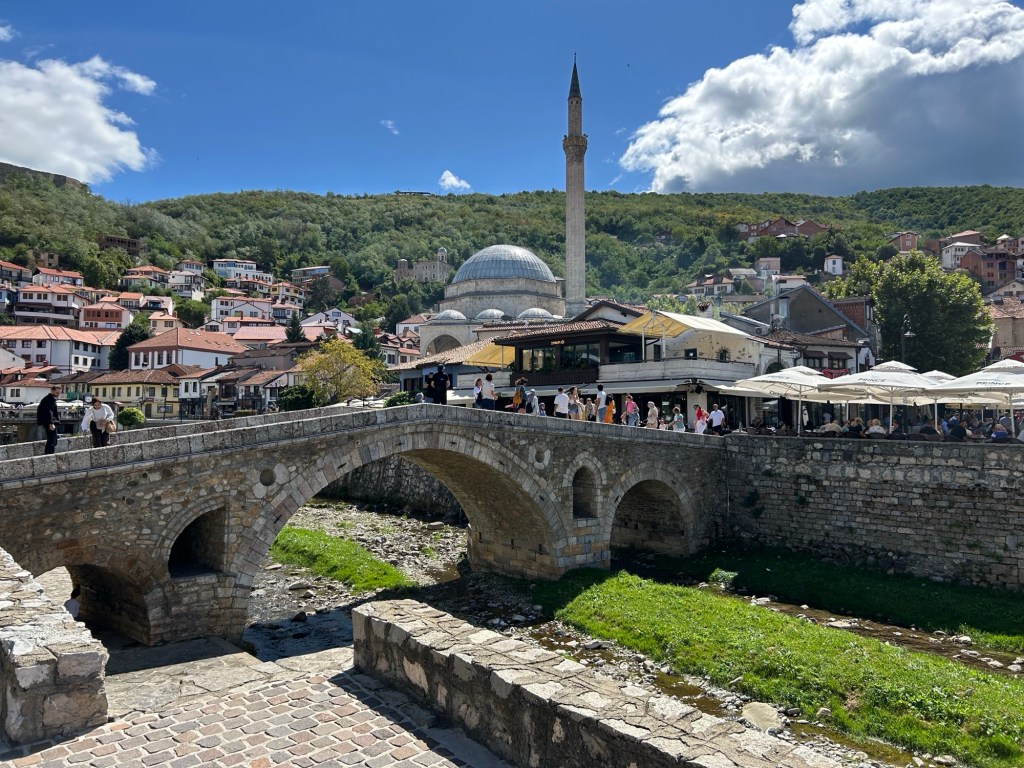
The Bistrica River flows splits the city top to bottom, and there are some rather pretty bridges carrying people from one site to the other. There’s a nice atmosphere about the place. One of these is the ‘Old Stone Bridge’ – boy do I love a literal name! Further down the river is the ‘Blue Lovers’ Bridge’. Both provide a great spot for a nice photo.
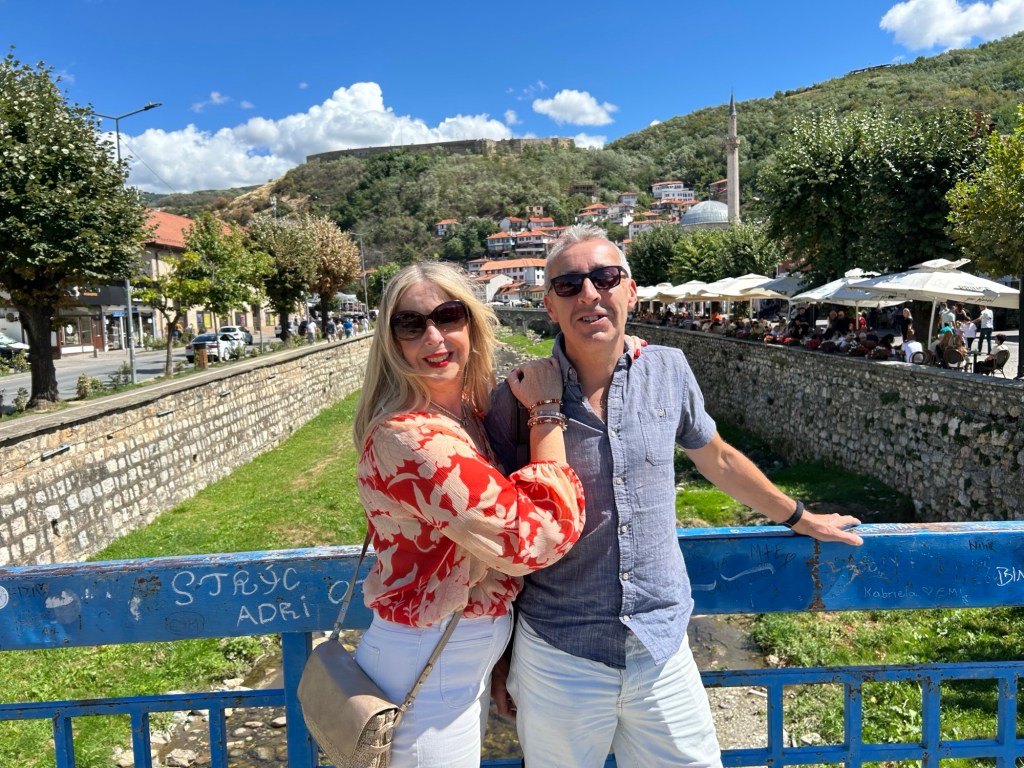
As the walking tour wraps up, we head back to Shadërvan Square for lunch, and a restaurant called Pashtriku beside the fountain.
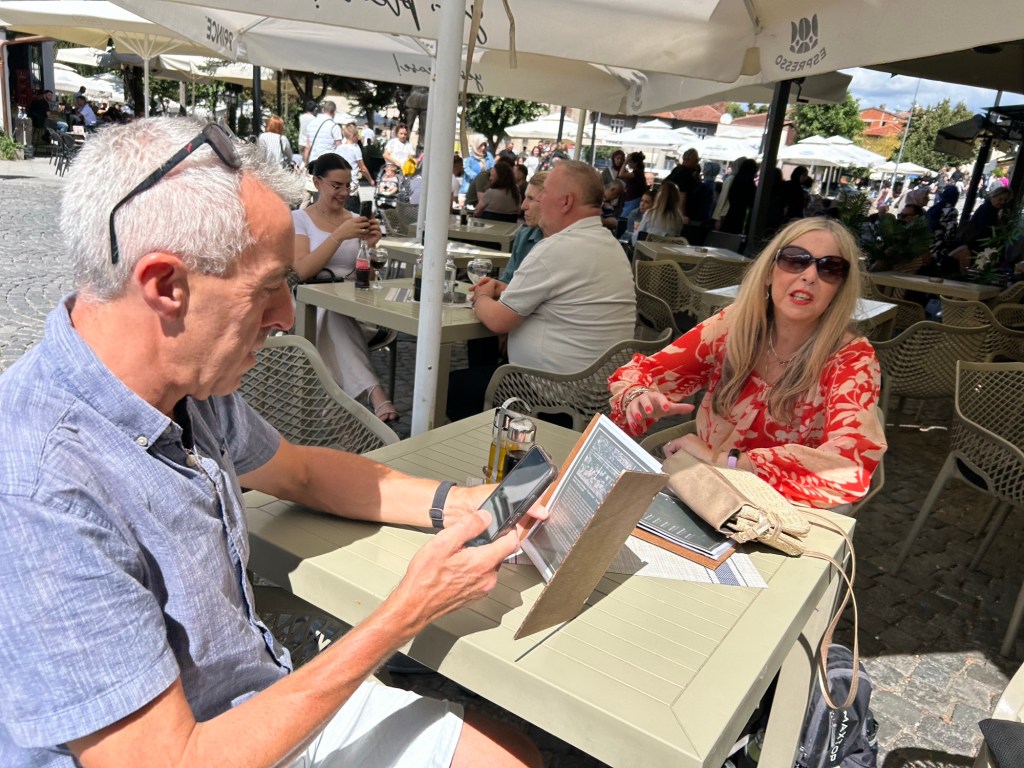
After lunch, we have half an hour remaining for free exploration. I can see there are a lot of mosques here. I suppose that’s to be expected given the Albanian ties. A funny moment ensues as 1pm hits and the call for prayer begins – it’s like all the mosques are trying to outdo each other and it’s just a cacophony of noise.

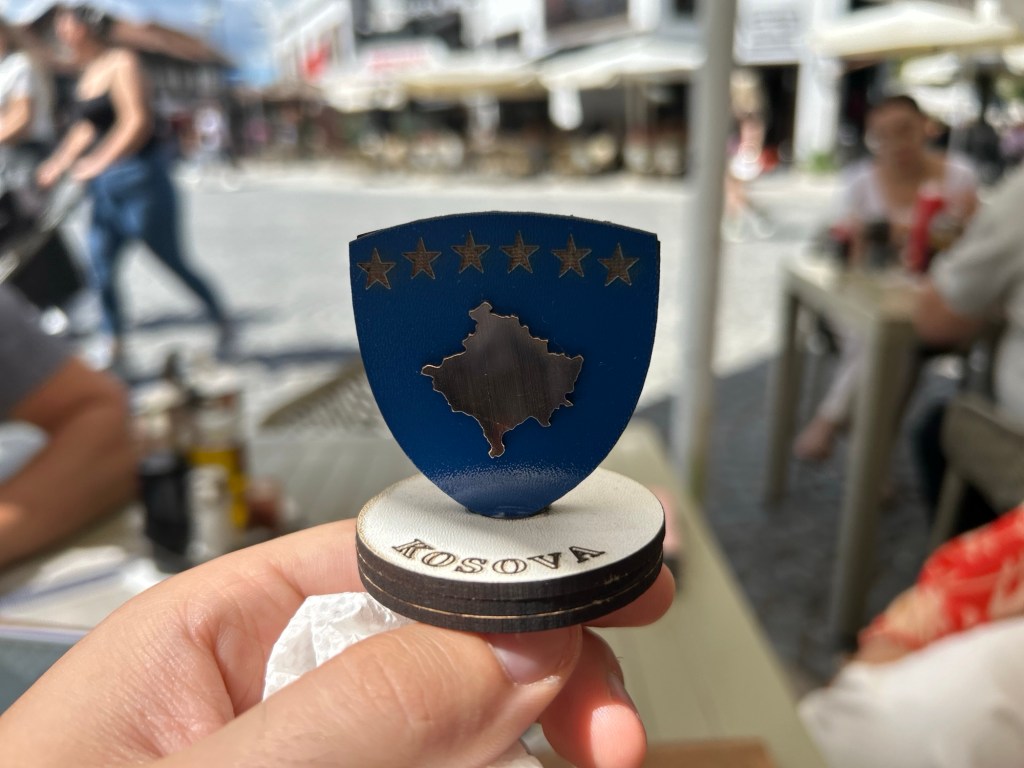
There are a great selection of souvenir shops around the city centre, and I find a little wooden plinth with the Kosovo flag for my souvenir shelf.
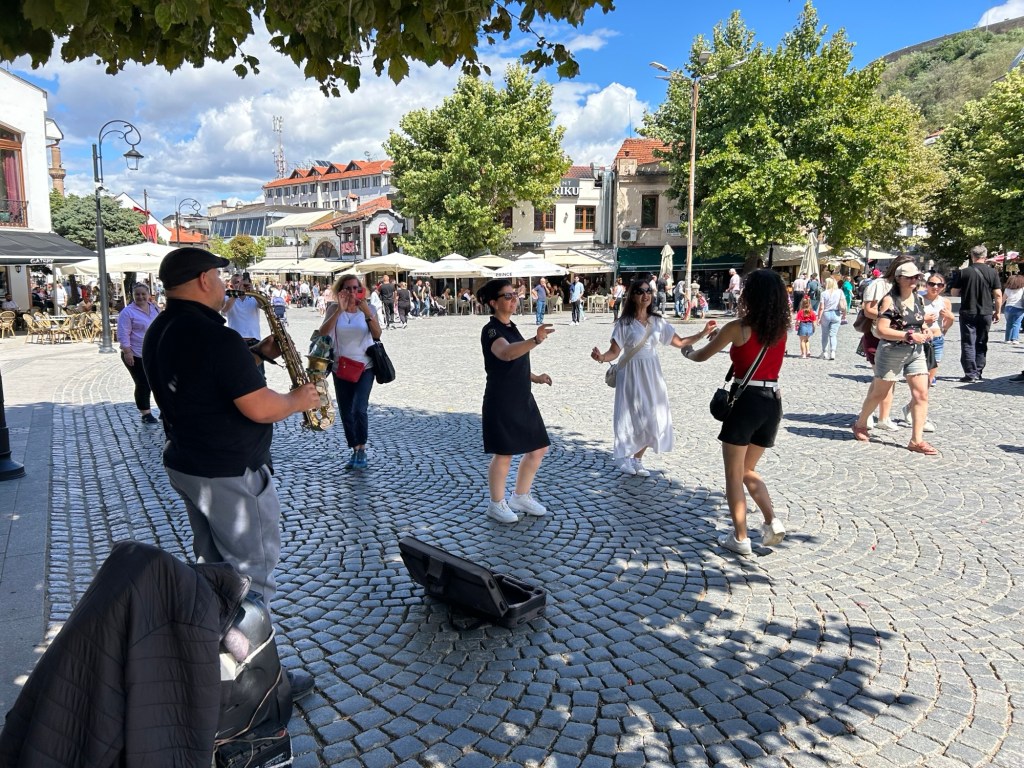
At 1:10pm, we meet the rest of our group under a tree. There, a saxophone player is entertaining passers by, and three ladies are dancing to the music. It’s not exactly Strictly Come Dancing, but they are enjoying themselves, and it looks like the passing pedestrians are also enjoying it. Speaking of which, how do we start a campaign to have the next series of Strictly done on cobblestones? That would certainly liven things up!
The walking tour recommences following the lunch break, and Zlatko brings us Prizren’s Roman Catholic Cathedral – aka Catholic Cathedral of Our Lady of Perpetual Succour. Those Catholics sure love a snappy title! On another note, what does Succour mean? Anybody?
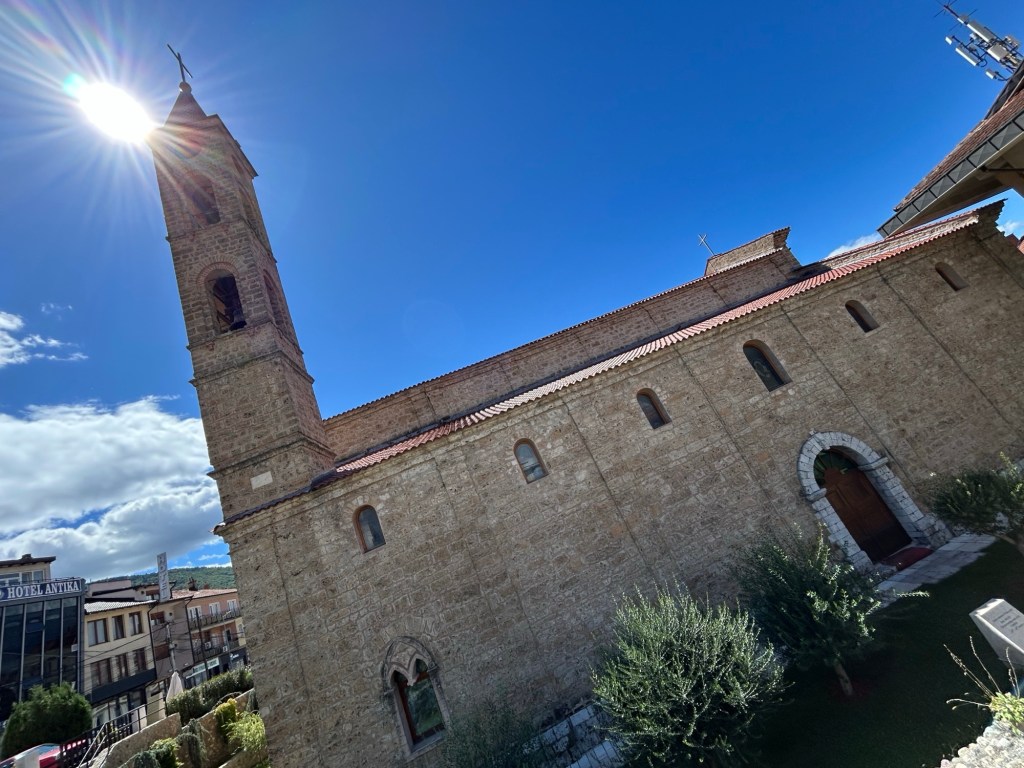
I find it interesting that when we come on these tours, the few buildings they take you inside are always churches. I think that’s testament to how open and welcoming churches are to all visitors – they’re not all like this, but this is how it should do. Contrast that with a mosque where you have to take off your shoes, wash yourself, and women must cover up and stay segregated from the men. The Bible says “come just as you are.”

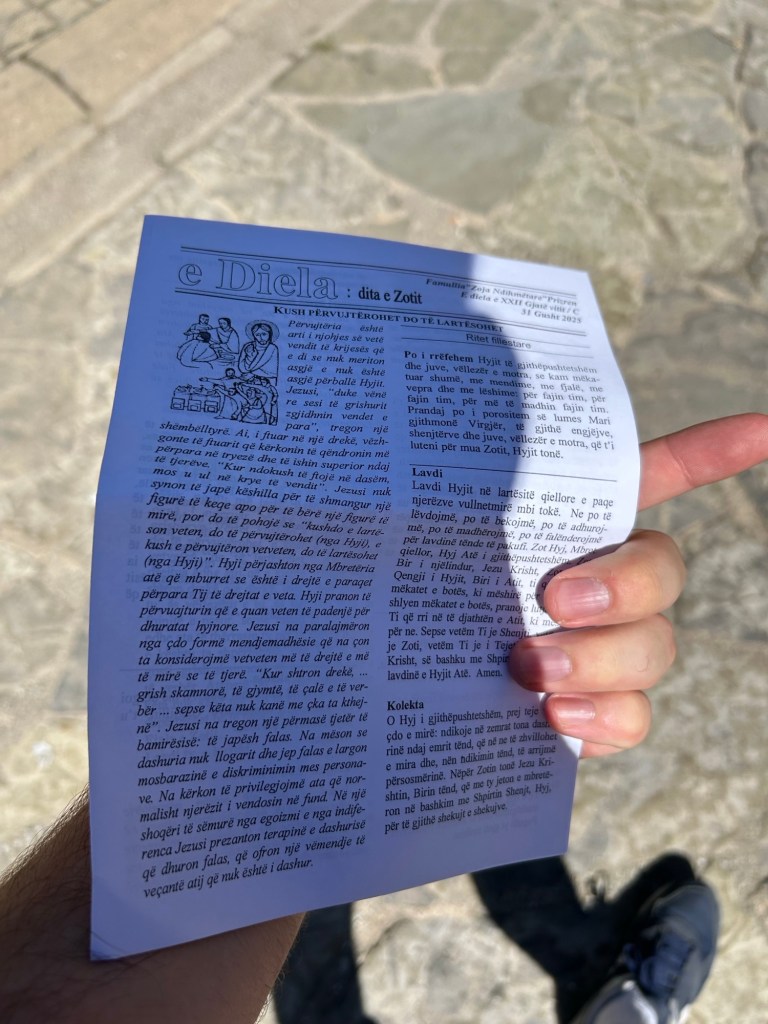
It is a Sunday, although clearly mass has long finished, but I pick up a discarded church newsletter in one of the pews for my scrapbook.
After a few minutes of quiet contemplation, Zlatko leads the group back to the bus past a pile of bricks. Dad is enthralled!

From Prizren, we head to Kosovo’s capital, Pristina. The car park here is a multi-story, and unlike the last one, is somewhere that I would actually park in myself.

A short walk from the car park takes us past the Newborn monument. It seems as though the good people of Kosovo want to remind the world that this is a newly born country. Every year, this monument is repainted with a new design, and tourists love to photograph it extensively. The phrase monument is a bit of a stretch – at the end of the day though, it’s just a bunch of colourful 3D letters. Overrated if you ask me! At least if it said Kosovo, people would actually know where you are – we could be outside the maternity ward of a hospital in Belfast for all I care.

Across the road from the Newborn Monument is another one, the Heroinat monument representing the contribution of Albanian women during the Kosovo war during the final 2 years of the 20th century.
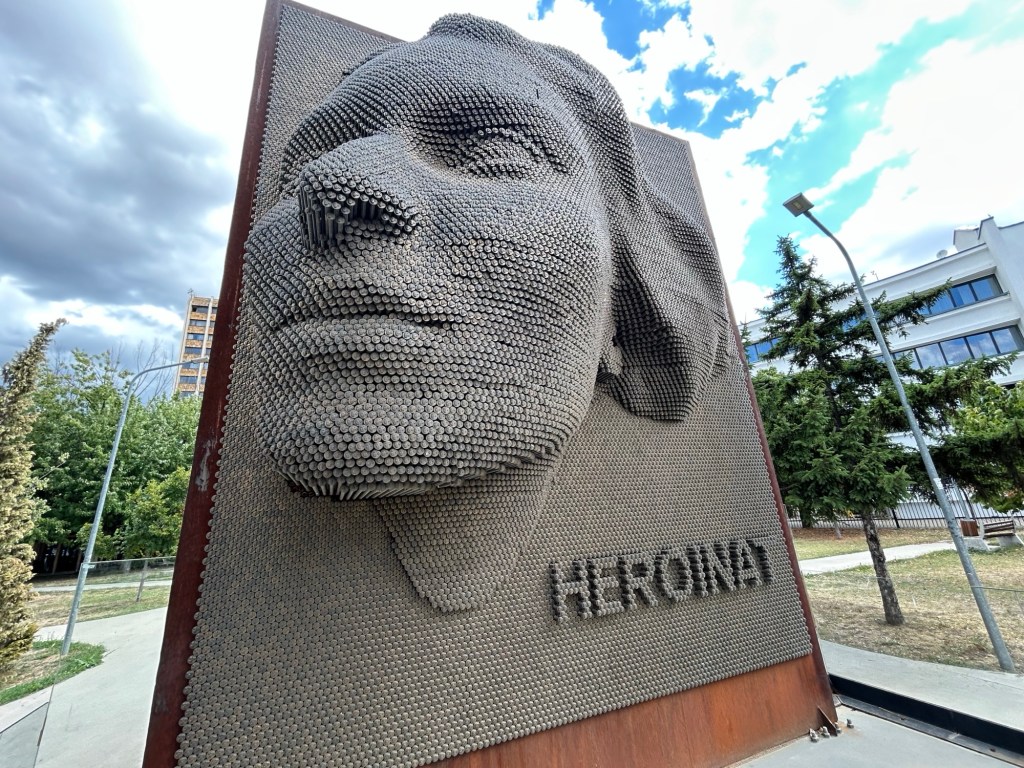
This one reminds me of those metal pin contraptions that you used to make a face imprint in when you were younger.
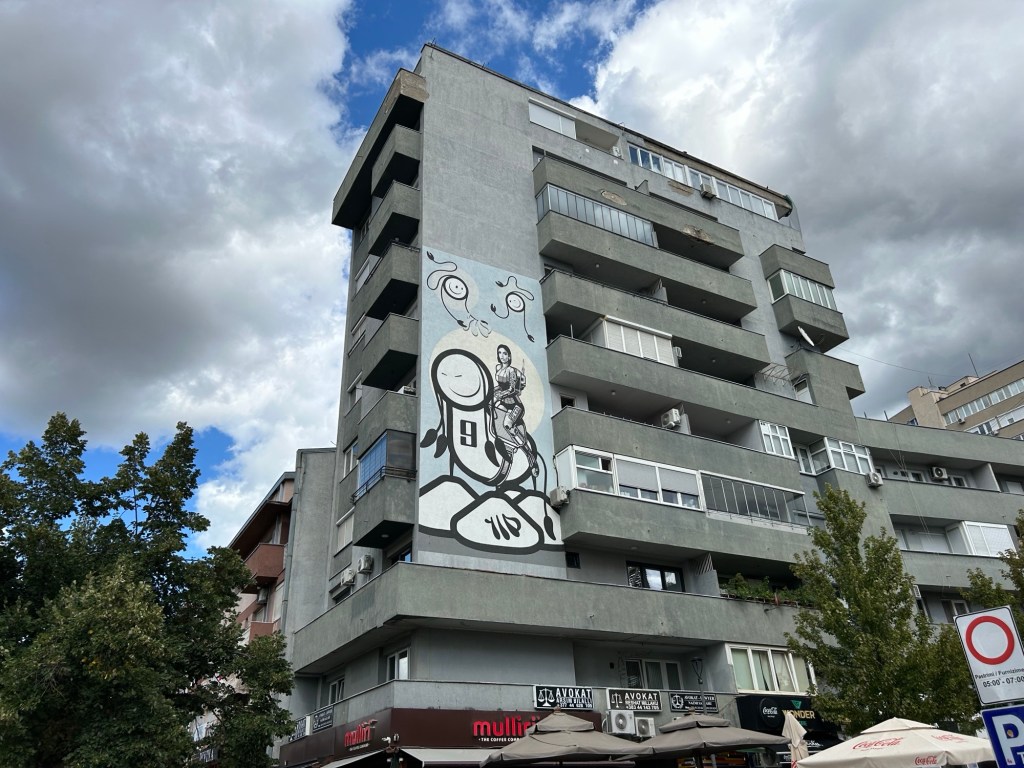
We walk on past a mural of Dua Lipa – we’ve been in Pristina for at least half an hour now and I still haven’t seen anything that gives me hope that this place has any class or redeeming features. Dua Lipa was born in London to ethic Kosovan-Albanian parents. She’s no more Kosovan than Donald Trump is Scottish, but I suppose that doesn’t stop them claiming her as theirs nonetheless. For some reason she’s riding a blob wearing clogs.
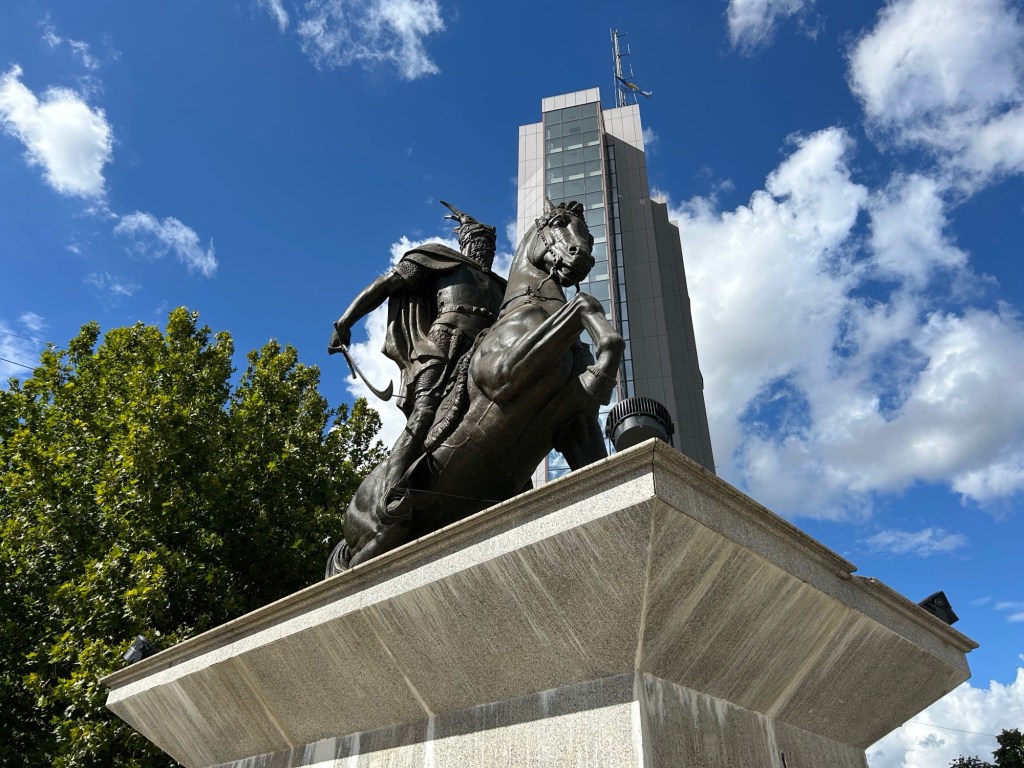
The main square (like Tirana) is named after Skanderbeg, and also features a statue of the man himself on horseback. There is rubbish and broken glass scattered all over the ground. We’re told it doesn’t always look like that – there was a festival in the square last night and the tidy up operation is underway.
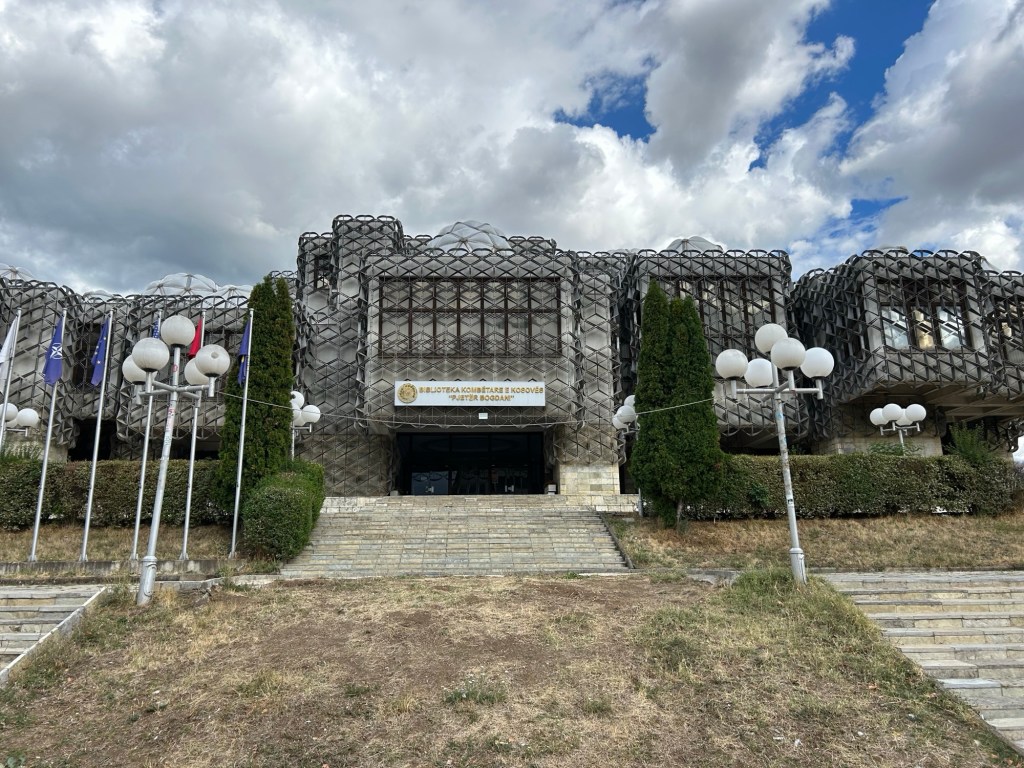
We’re then brought to the National Library of Kosovo, also named after Pjetër Bogdani – an Albanian writer during the Renaissance period. There are 73 bubble shaped domes on the roof, but as nice as those may be, they’re totally overshadowed by the oppressive iron railings wrapped around the building like an infestation of poisoned ivy. This is brutalist in name and nature.

Our last stop in Pristina is another church – the Katedralja Nënë Tereza / Cathedral of Mother Teresa. Mother Teresa the latest in a long line of celebrities that Kosovo tries to pass off as their own!

Zlatko (whose name means gold in Macedonian) has been teasing the impressive views from the bell tower. We’ll see how true to his word he is! I’m shocked to find there are two – one each side of the huge and dramatic arched door. In the photos online there’s only one bell tower, but this church has been under renovation for a few years.
Inside is pretty plain actually. There’s a statue of Jesus behind the main altar. A statue of the virgin Mary is in the right hand transept, and Mother Teresa herself (whose name means was promoted to sainthood in 2016 by Pope Francis – 19 years after her death) in the left hand transept beneath a large and simple wooden cross.

We’re led through a door stage left to the entrance of the bell tower. Disappointingly, it’s a lift straight to the top. I know it’s pretty sad, but I’m of the opinion that good views must be earned. As the lift doors open, a white plastered wall is directly in front of us covered top to bottom in graffiti. In fact, the graffiti continues the whole way around the outer wall.

The view is decent, to be fair. The library’s pretty close, and that’s the only building that I’m able to recognise.
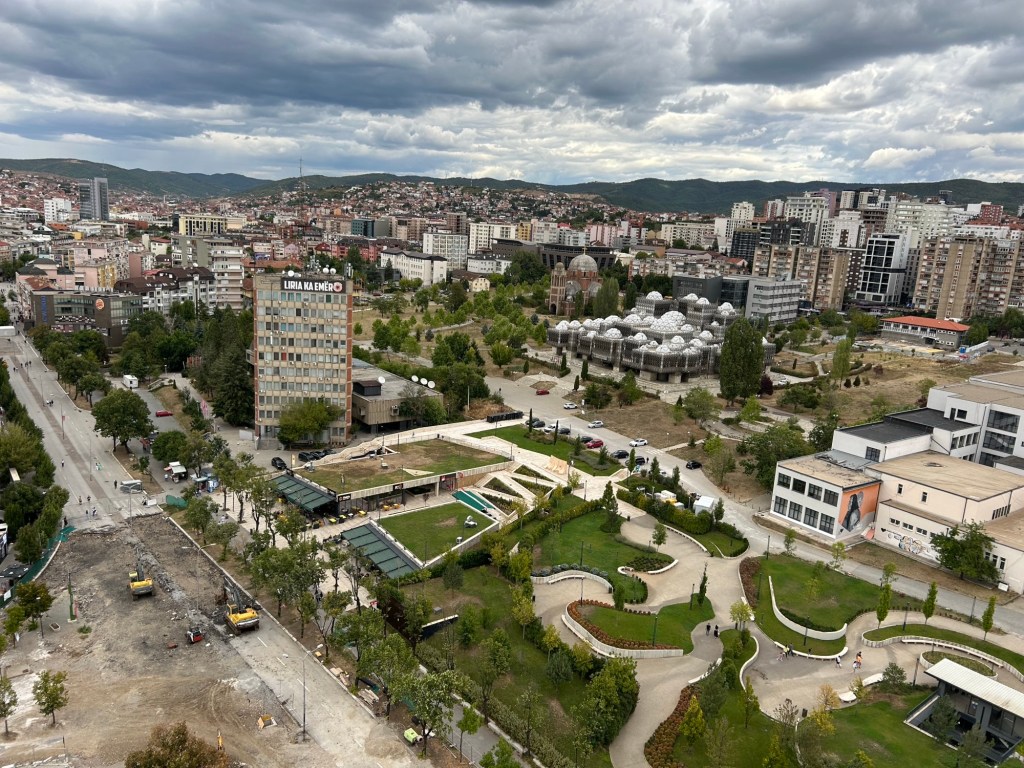
With only a few minutes before the turn of the hour, I gamble on the bells ringing. Alas 4pm comes and goes with no bells to be heard. Dejectedly we enter the lift to descent back to planet earth. Inside the lift we hear the bells ring. Flip sake, what bells ring 2 minutes past the hour?
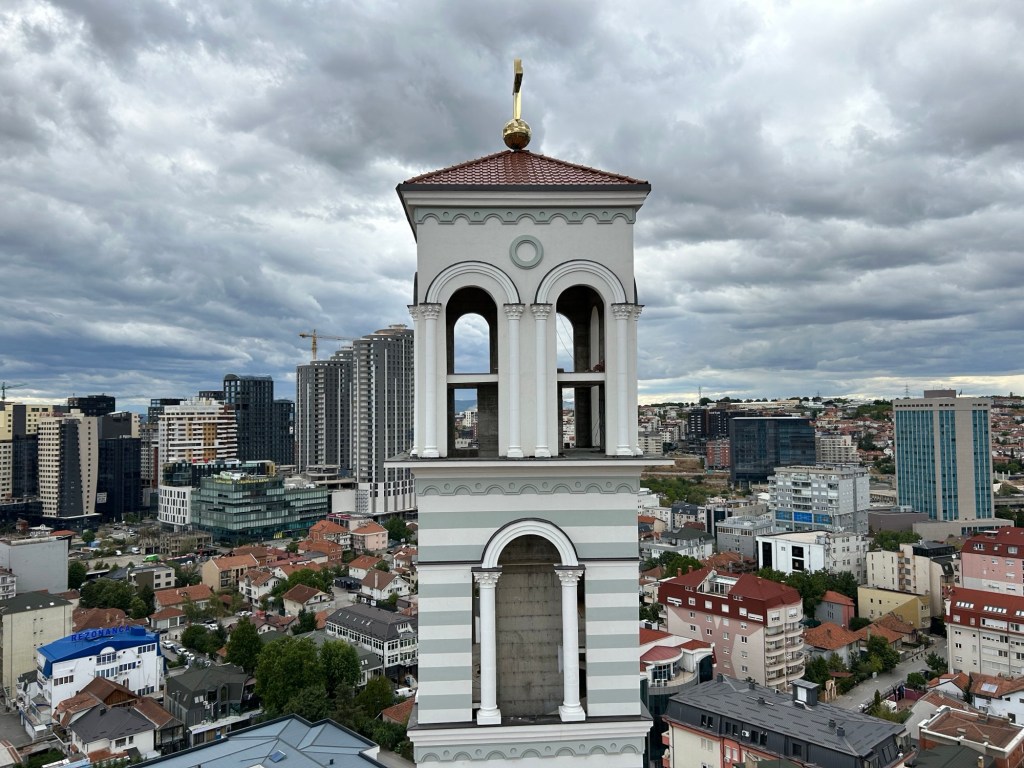
And with that, our time in Kosovo draws to a close. So what did I make of the place? Well, it’s not great to put it mildly. It’s a young country, and the place isn’t on the tourism map yet, nor should it be. There’s a lot of construction projects going on, and maybe in a few years it’ll be a different story.

Again, we booked this tour through GetYourGuide. It cost over £100 pp, and was it worth the money? The guide was fantastic as ever, but on a value for money stake – absolutely not. There just weren’t enough interesting things to fill the day. Am I glad we came? Yes, it’s always good to see new countries, and see places for myself. The joy in travelling is finding unexpectedly brilliant places, and every now and again you’ll come across one or two places that aren’t to your tastes. It’s all worth it in the end!

 See Travel Blog
Leave a comment