Salam from Morocco!
We’ve spent the last day and a half in the centre of Marrakesh, and today we’ll be heading further afield, away from the city and up into the Atlas Mountains.
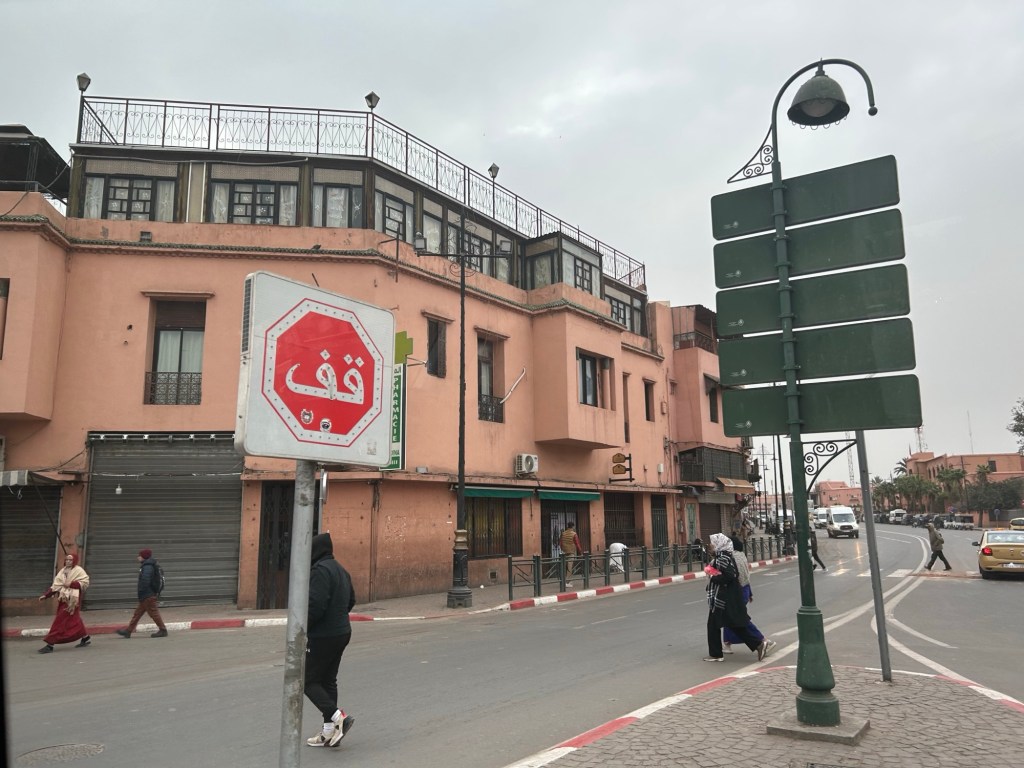
We’ve arranged a tour through Get Your Guide, to take us there. I’d strongly recommend this app for finding fun things to do anytime you’re away anywhere!
We’ve been asked to be at the front door of the hotel for 7:30am – that’s an early start, but I’m sure it’ll be well worth it later! There a bus will pick us up (I’m hoping it will be accompanied by a driver or we won’t be getting very far!) 😂
Thankfully there is a driver, he’s quite young, and his name is Jamal. He’s got a bit of a curly dreadlocks thing going on, and with the reggae music on the radio, it’s almost like we’re in the Caribbean!
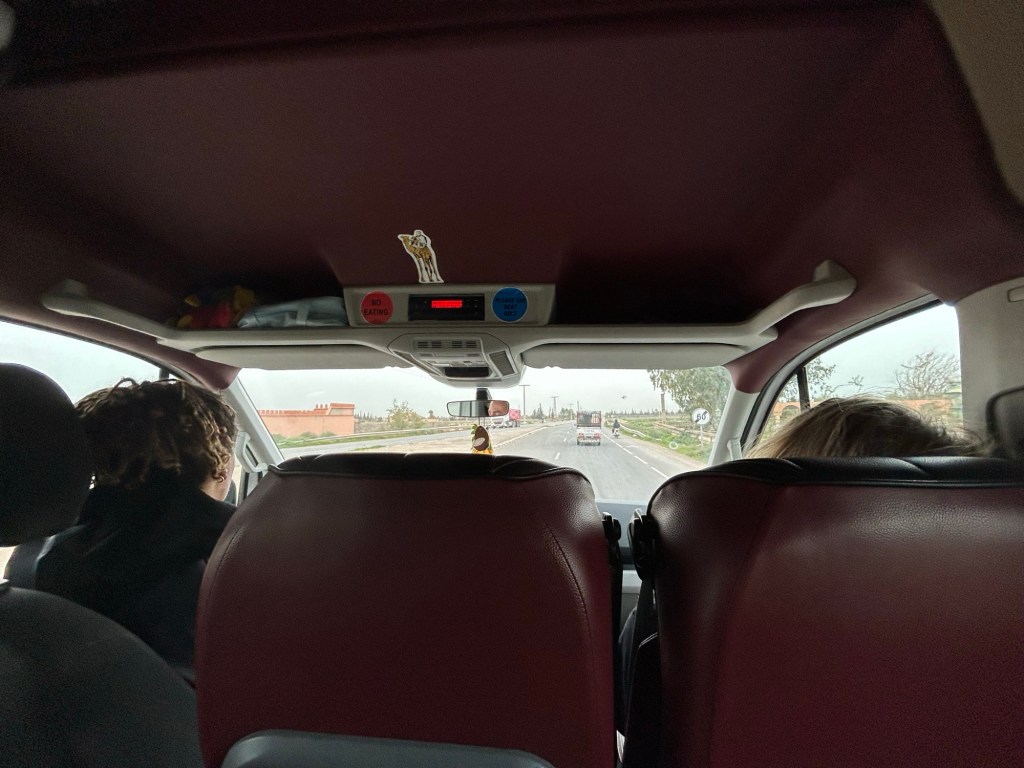
After collecting about ten other passengers, we head onto the open road, destined for the hills. The weather today is very hazy – you can just make out the faint outline of the hills in the distance, and it looks like the taller ones are topped with a sprinkling of snow – but it’s really hard to tell. The story goes that they’re called the Atlas Mountains because in this weather an atlas is the only way to find them!
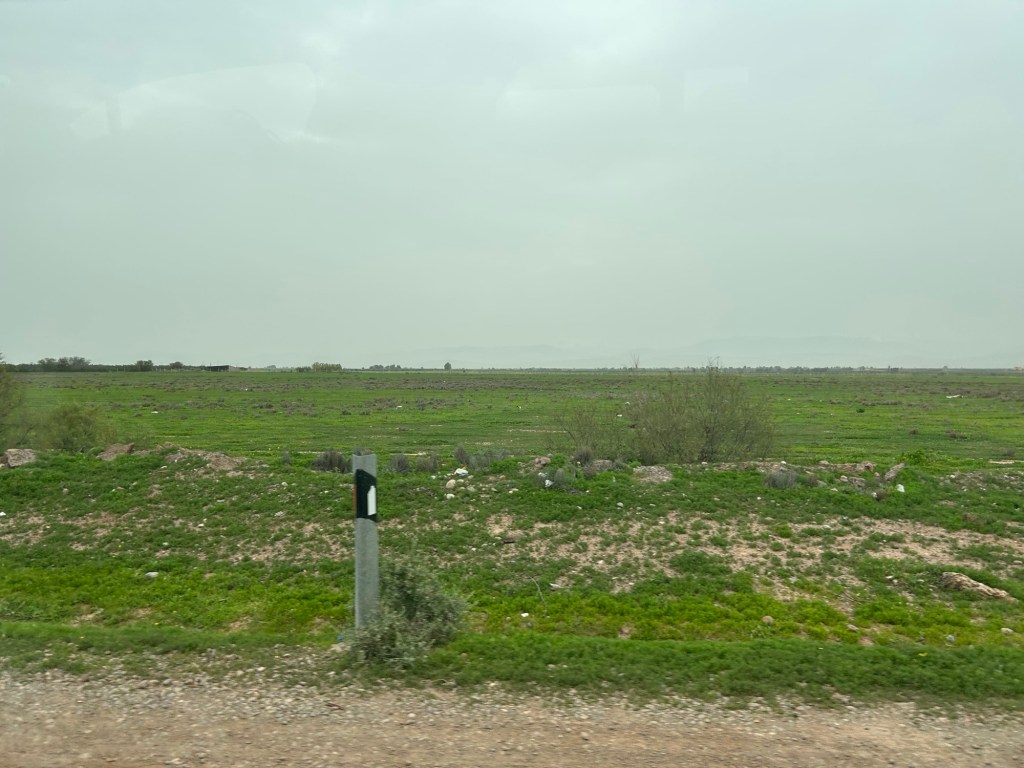
Also peeping through the haze, is the sight of twenty or thirty hot air balloons. The sunrise balloon ride is one of the pricier experience options in the wider Marrakesh area, and the two girls from Bangor we talked to last night were booked to do it this morning. I feel for them, because I don’t think you’d make out much through the mist.
It’s a three hour drive to Ouzoud, and on the way, I see young students making their way to school along the side of the road. The roads are strangely quiet, for what you’d expect to be a busy time of the day. It looks like rush hour traffic isn’t really a thing (in this part of Morocco at least.
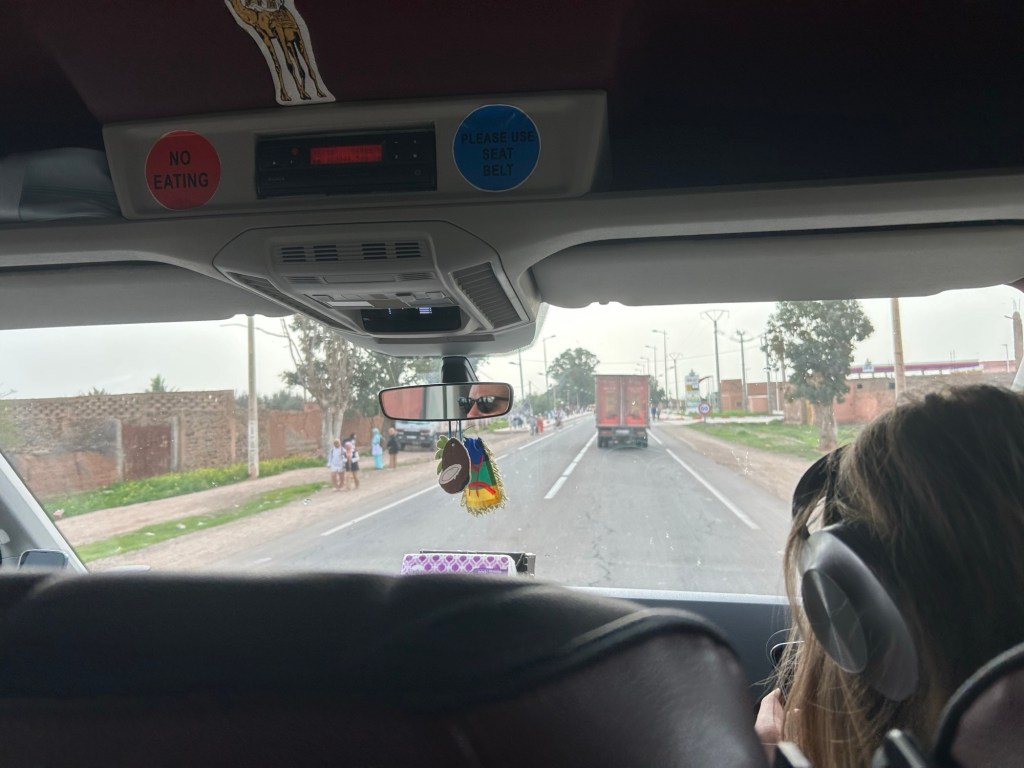
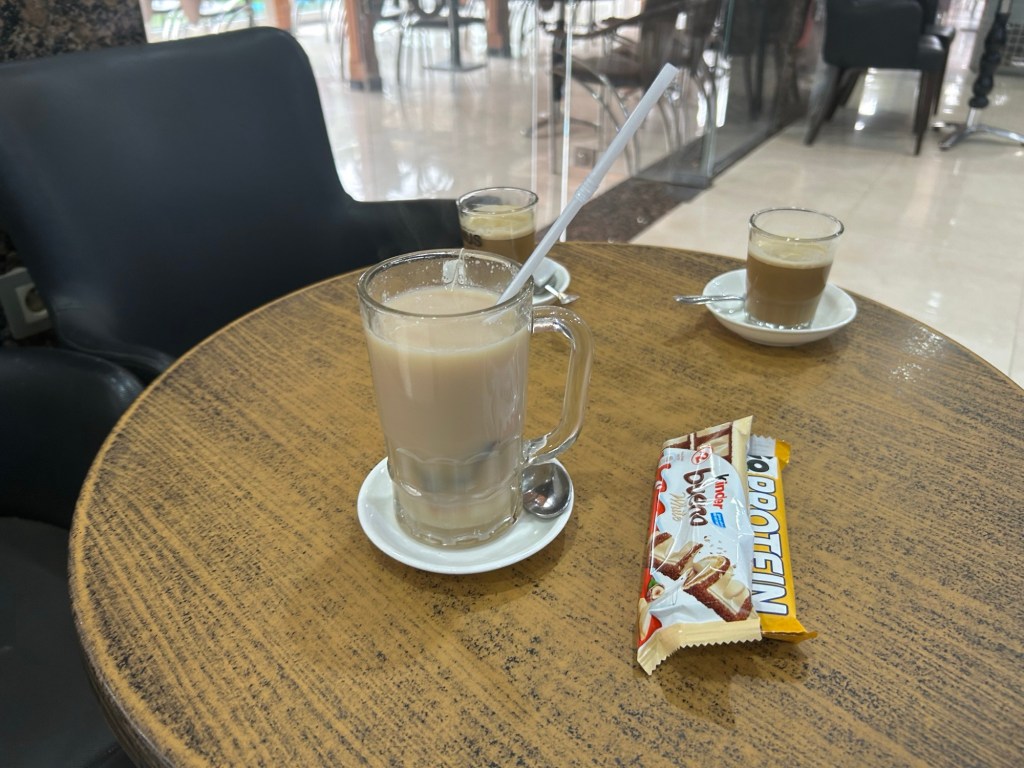
The outward journey is broken up with a stop at a roadside service station. We order hot drinks to get the endorphins going. I am not a morning person at all!
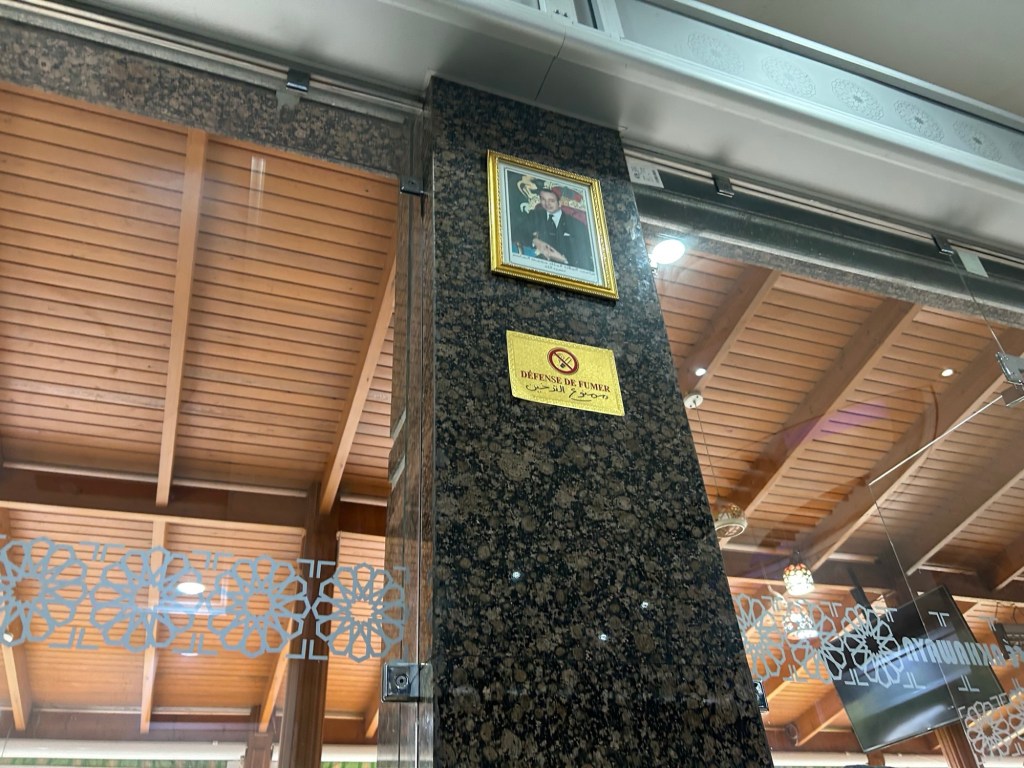
On the walls inside the cafe, I spot a gold frame with a portrait who I can only assume must be the King of Morocco – Mohammed VI. Checking online to confirm my suspicions, it must be a very old picture.
Sadly my tea was only just approaching drinkable temperature when the call came from the driver that we would be heading on. Faced with a difficult dilemma of either burning my mouth or wasting a good cup of tea, I did what any decent human would have done, and asked for the tea to be decanted into a paper cup to bring it with me!
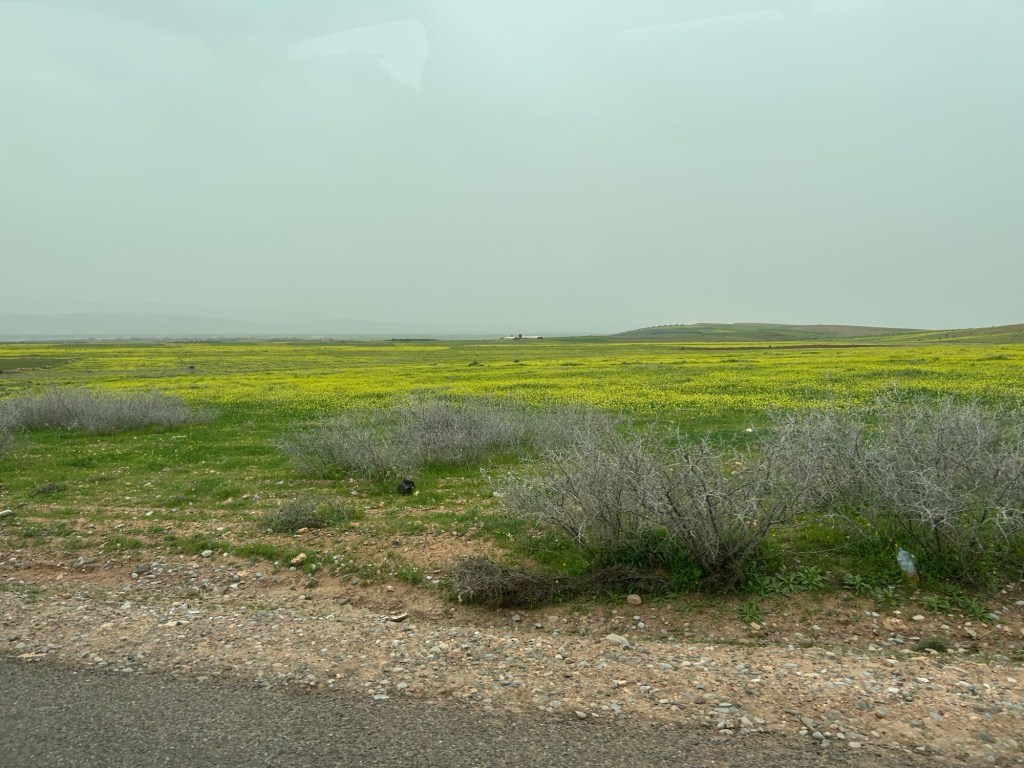
The bus journey continued through the Moroccan countryside, and I’m amazed at how luscious and green the landscape is. Clearly rain coming in off the Atlantic, and cooler temperatures keeps the grass fresh and well watered, but this isn’t how I pictured the terrain to look at all.
After another hour and a bit on the road, the bus arrives in Ouzoud village. We’re met at the side of the road by a moustachioed man with a safari hat draped stylishly round the back of his neck. This is one cool guy, with a bit of an Indiana Jones vibe about him – that hat is primed and ready to be thrown at an attacking camel at the drop of a… (you know the drill!)
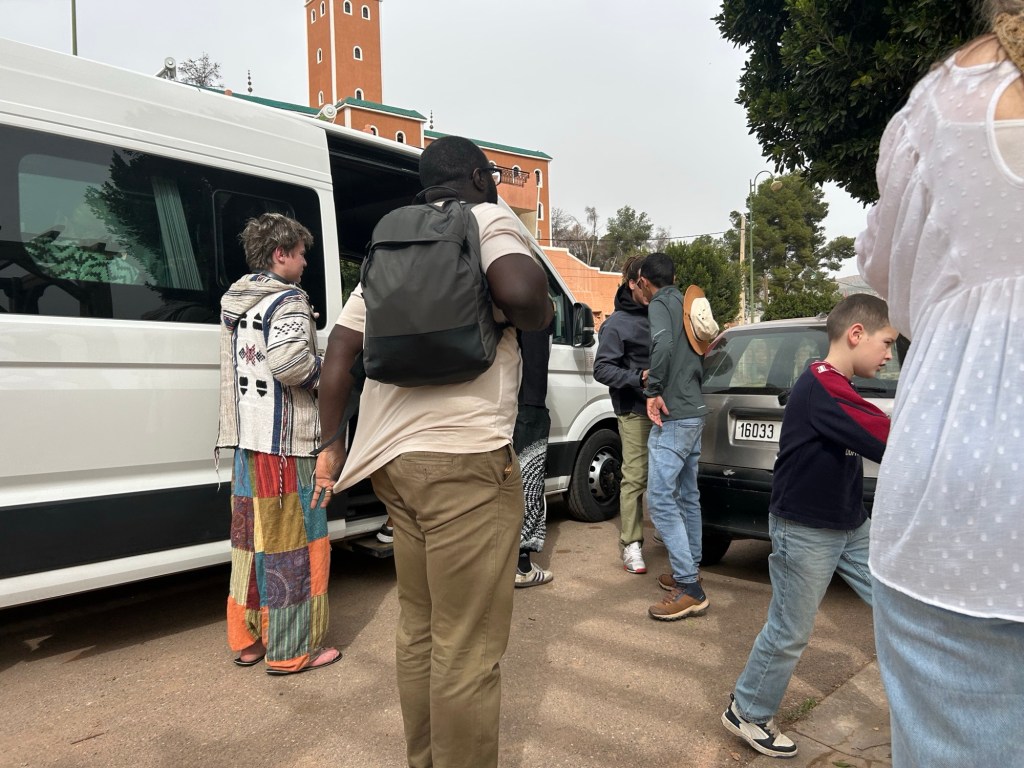
He introduces himself as Imad. As in ‘I’ve absolutely no idea where Imad’.
On first glance, there’s not much to the place. There are only 8000 residents, mostly in makeshift tin huts by the looks of it.
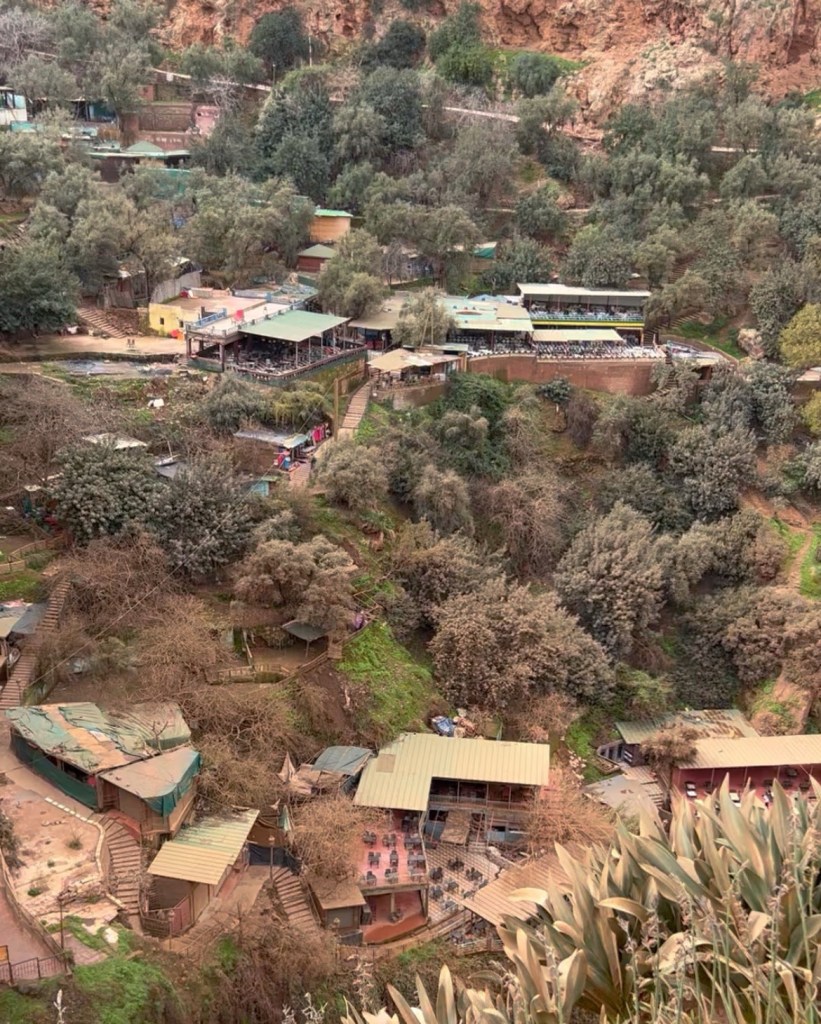
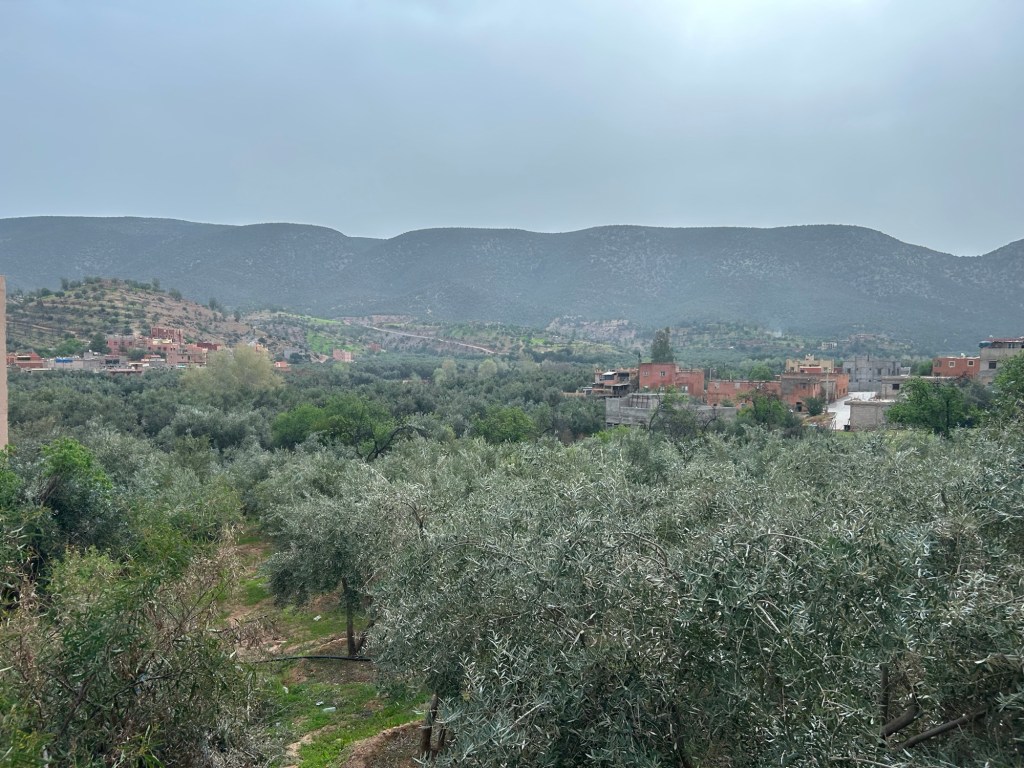
Ouzoud means ‘olive trees’ and they are absolutely everywhere. Rumour has it that not just some of the trees are olive trees, but ‘olive’ them. They’re oil over!
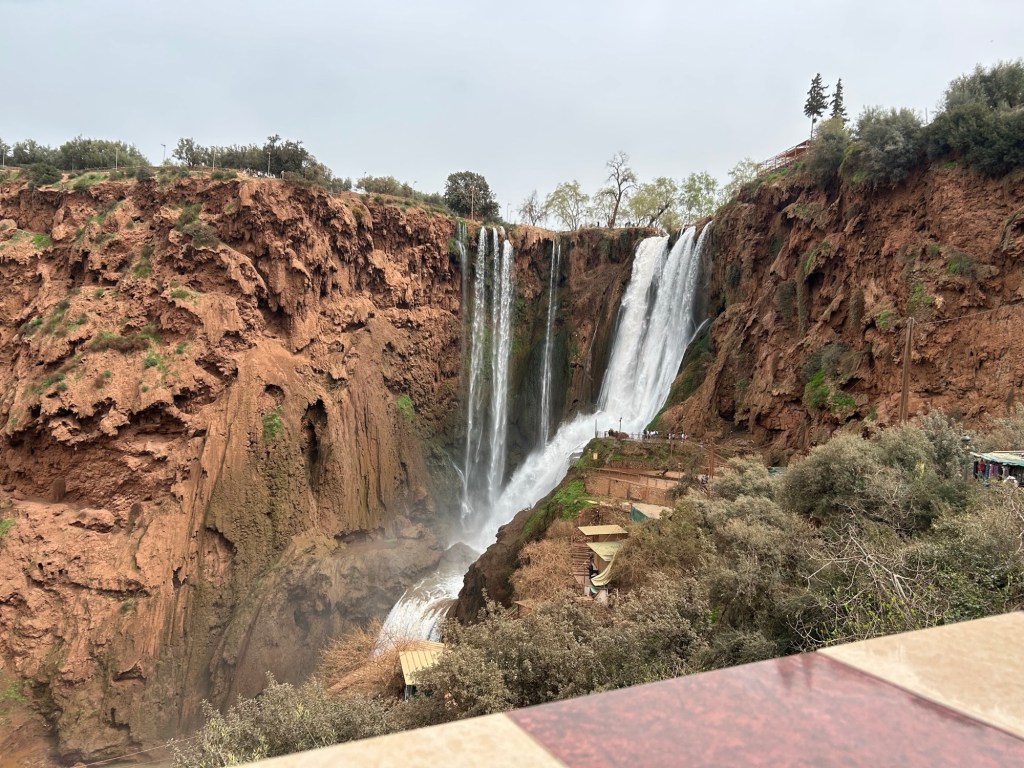
After a brief trek across the road and down some steps, we are rewarded with our first view of the famous Ouzoud Waterfall. That said, I don’t think anyone was really paying attention on the waterfall at all – all eyes were on the monkeys.
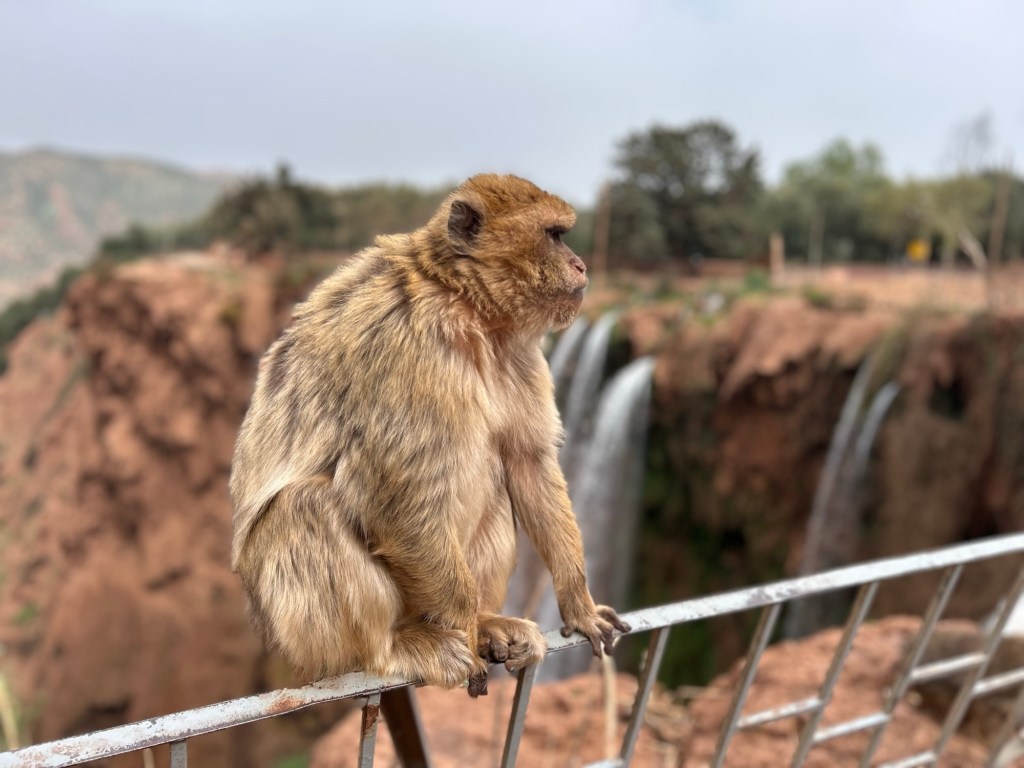
The monkeys (genus Macaca sylvanus aka Barbary Apes) are the same species found in Gibraltar. These are native to the Atlas Mountains, and were believed to have been introduced to Gibraltar by the Moors when they occupied Spain from 711-1492. Ah yes… Sir Roger, Demi, Sir Bobby et al have a lot to answer for!
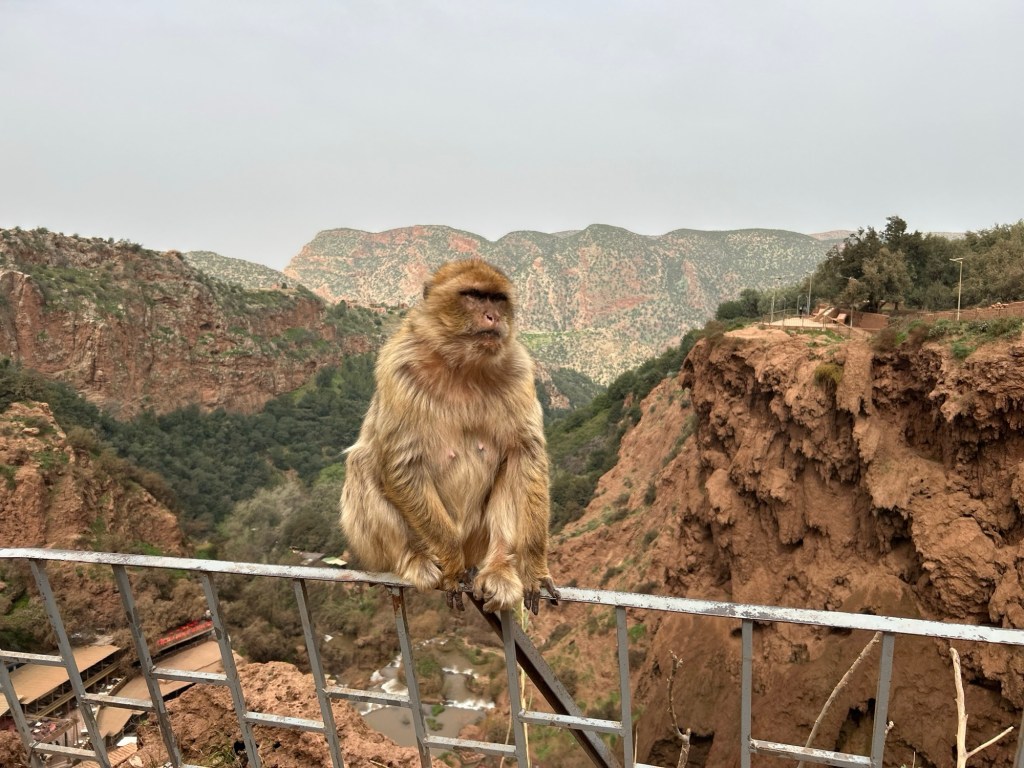
The apes here are far better behaved than their cheeky relatives across the Strait of Gibraltar. We’re told not to get too close, and be careful around them, but generally speaking if you don’t bother them, they won’t bother you.
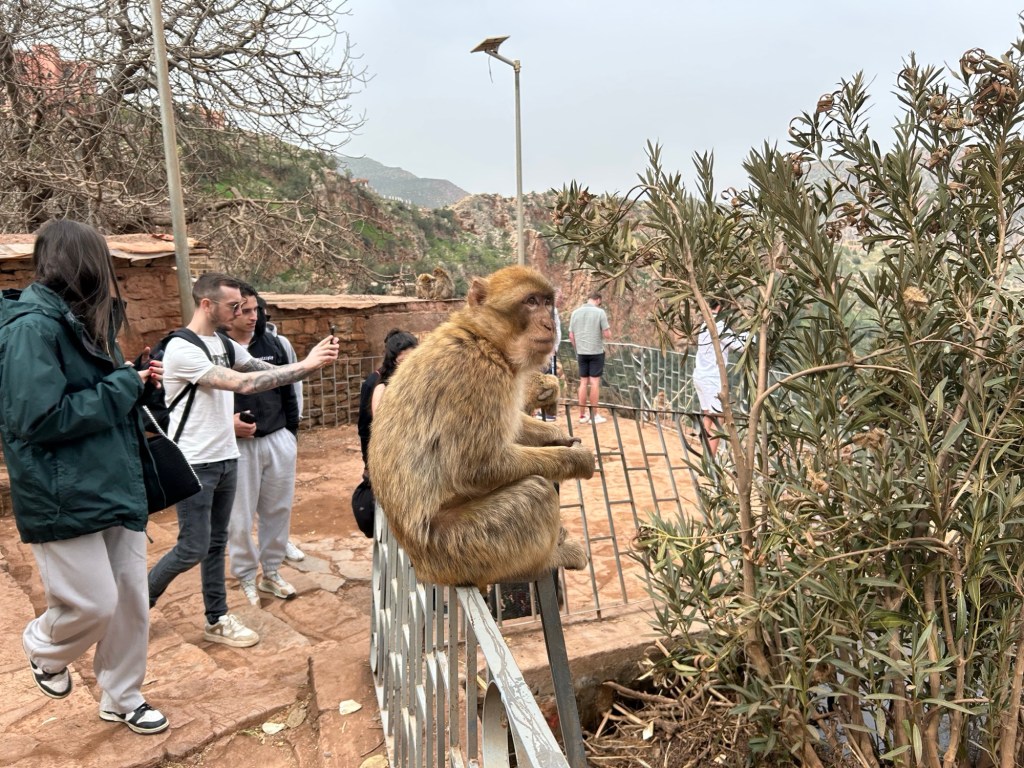
There are a few locals trying to get us to buy some seeds to feed to the monkeys, but we’ve been warned this isn’t good for them. It is fascinating just standing and watching them (the monkeys, not the people). I’m not saying that we’re all evolved from monkeys, but it is amazing how similar their actions are to ours: particularly watching one comb through the furry coat of its friend.
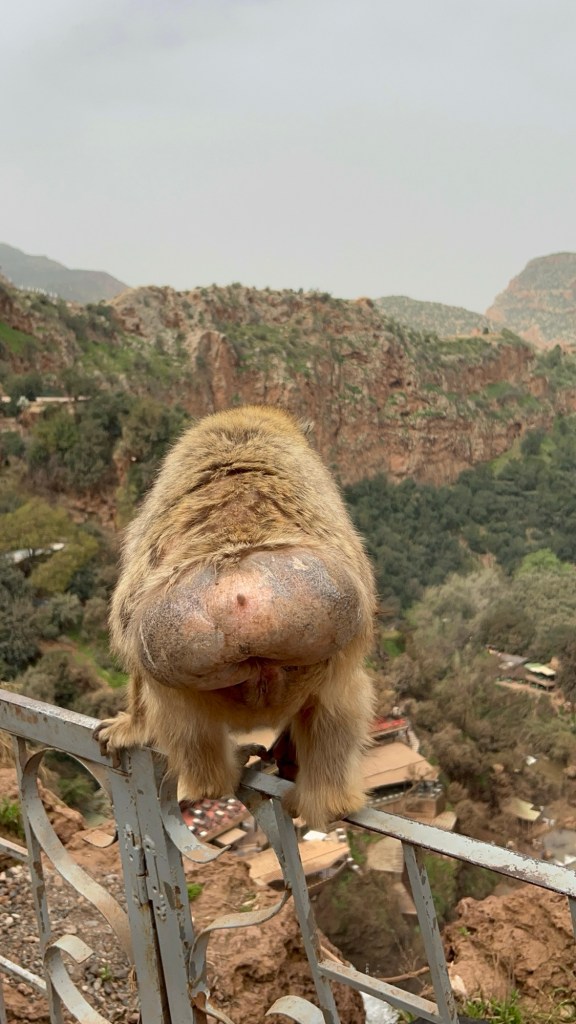
One of the apes bounces across the fence, and I notice a giant bulbous growth on its bottom. I don’t know if this is normal, but none of the others bums seem to protrude quite so much. Google says that the females experience swelling during mating season, so maybe this one’s just struck it lucky!
We’re told it’s time to move on, and walk past the top of the waterfall. It’s hard to get much of a view from this angle – the best views are from the bottom looking up.
We stop at the side of an olive grove and Imad tells us more. Each tree is marked with at least one coloured symbol – each representing the family that owns it. Some trees have more than one marking, and these are shared evenly. Olive harvest season runs from December to February, so there aren’t many left on the trees, only faint traces of crushed olives on the ground.
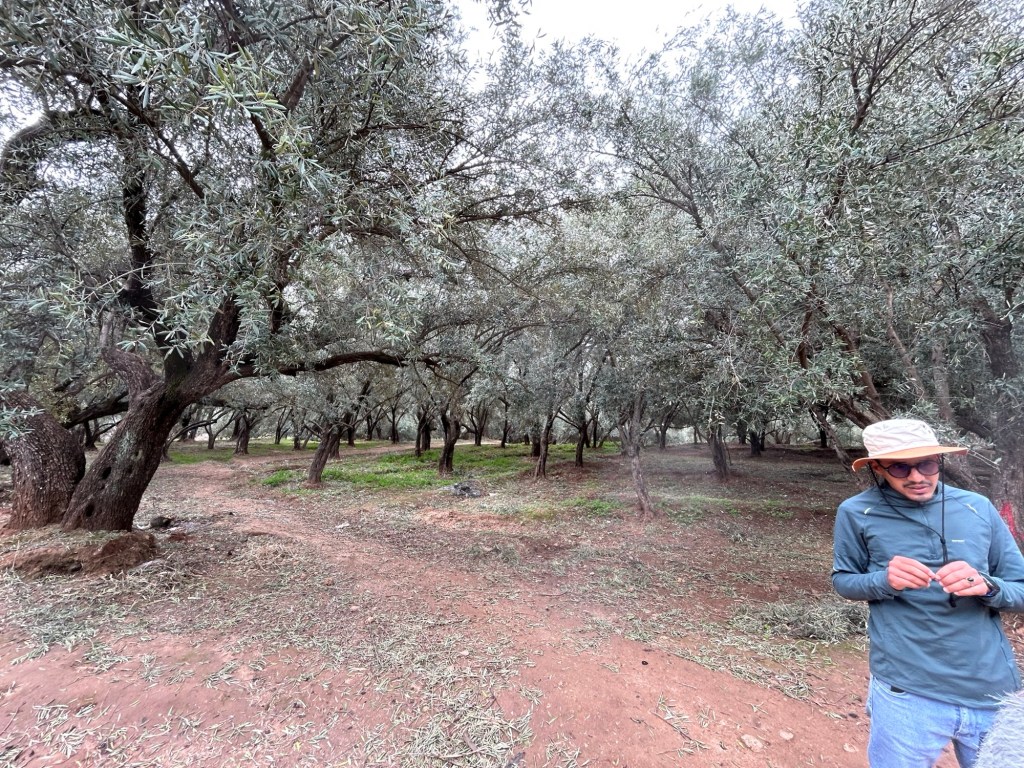
We’re told how olive oil from machines just doesn’t taste the same. Personally I prefer it out of a bottle!
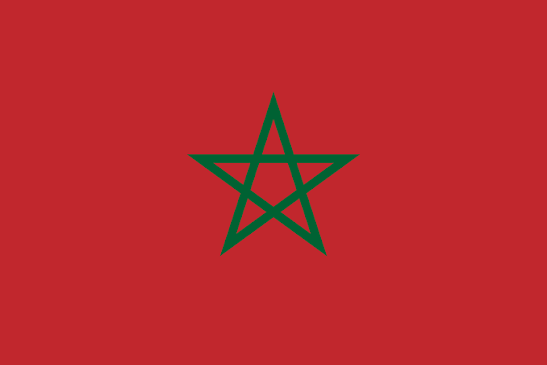
Imad explains the story of the Moroccan flag. The red represents the blood of unity between brothers, and the green star representing the 5 pillars of Islam.
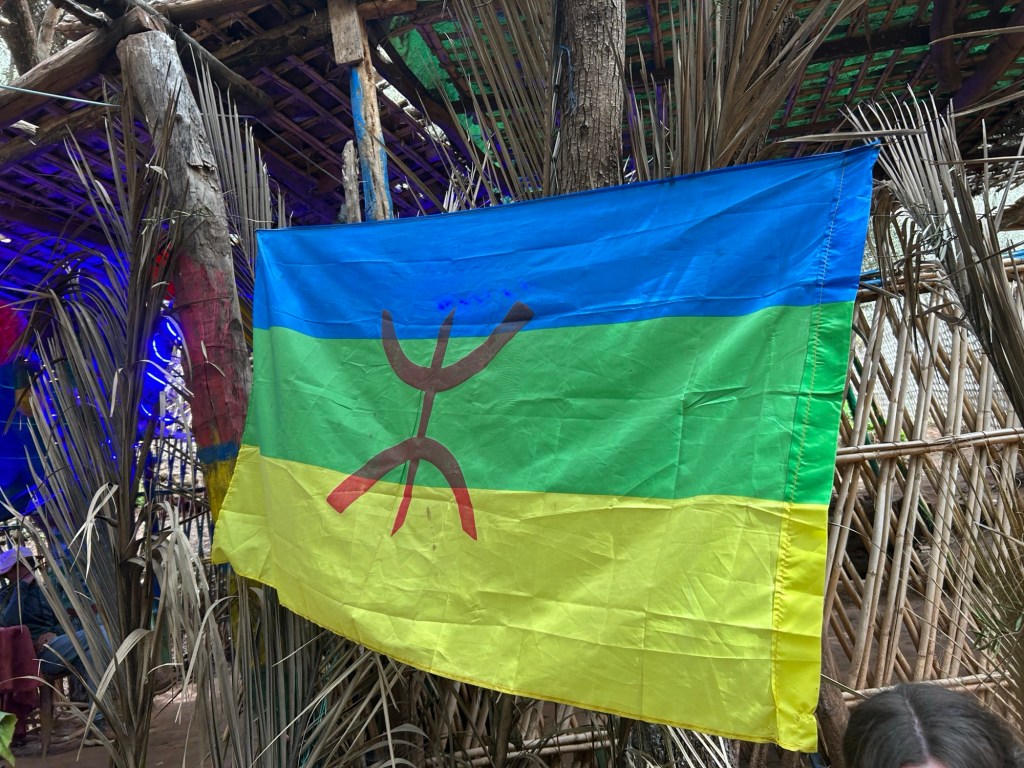
There’s also another flag hung up on the wall – belonging to the Amazigh people (an indigenous tribe spanning much of Northern Africa. This one has a blue stripe representing the sea, a green stripe representing the land and a yellow stripe representing the desert. On top of the stripes is a red ⵣ symbol representing freedom of the people. Mum tells Imad this is her new favourite flag – yeh right!
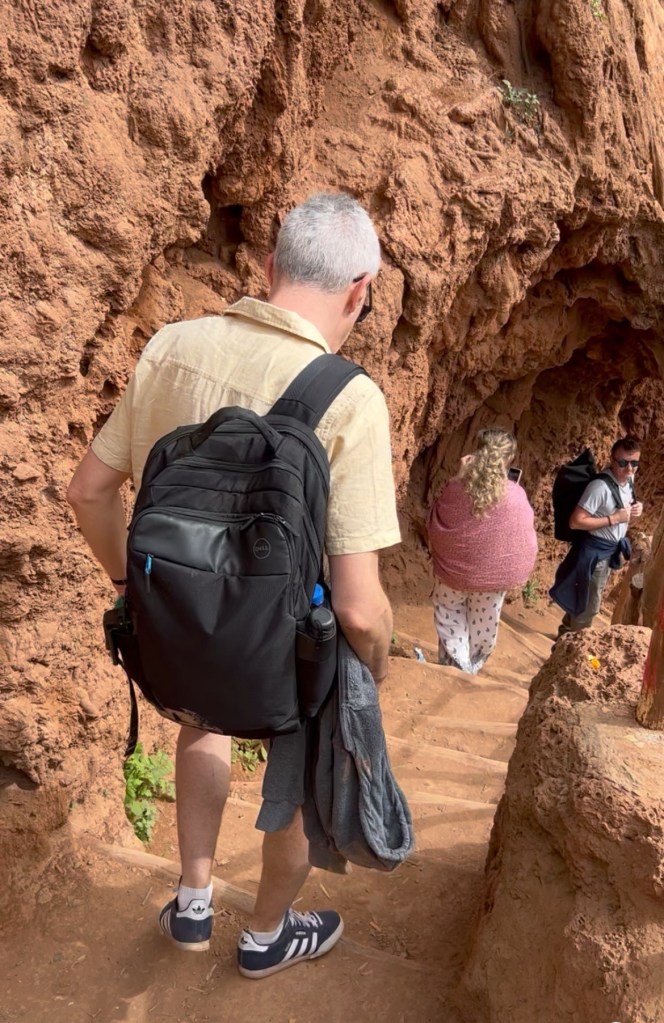
It’s quite a few steep steps down the mountain. The steps are very earthy, and I’m thinking these would be treacherous after heavy rain.
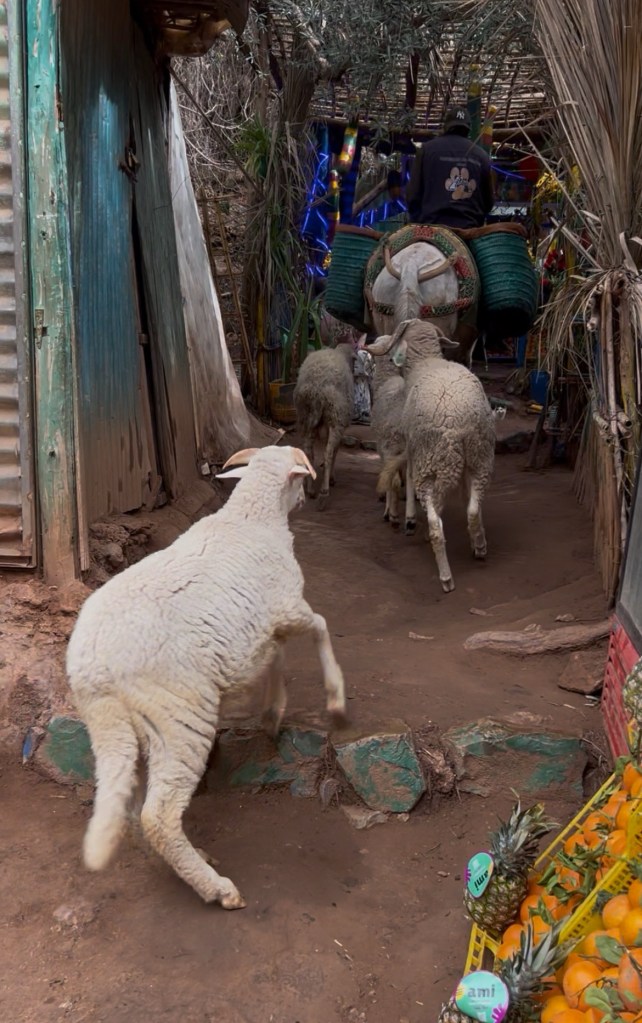
Halfway down is a juice bar – very timely indeed! I queue up for a freshly squeezed orange juice, and as I wait, hear the hooves of a donkey approaching. It looks like donkey is the only way of bringing goods up and down the steep hill – so this is a delivery of supplies for the bar. Toeing behind are a herd of sheep, charging gleefully into the bar area.
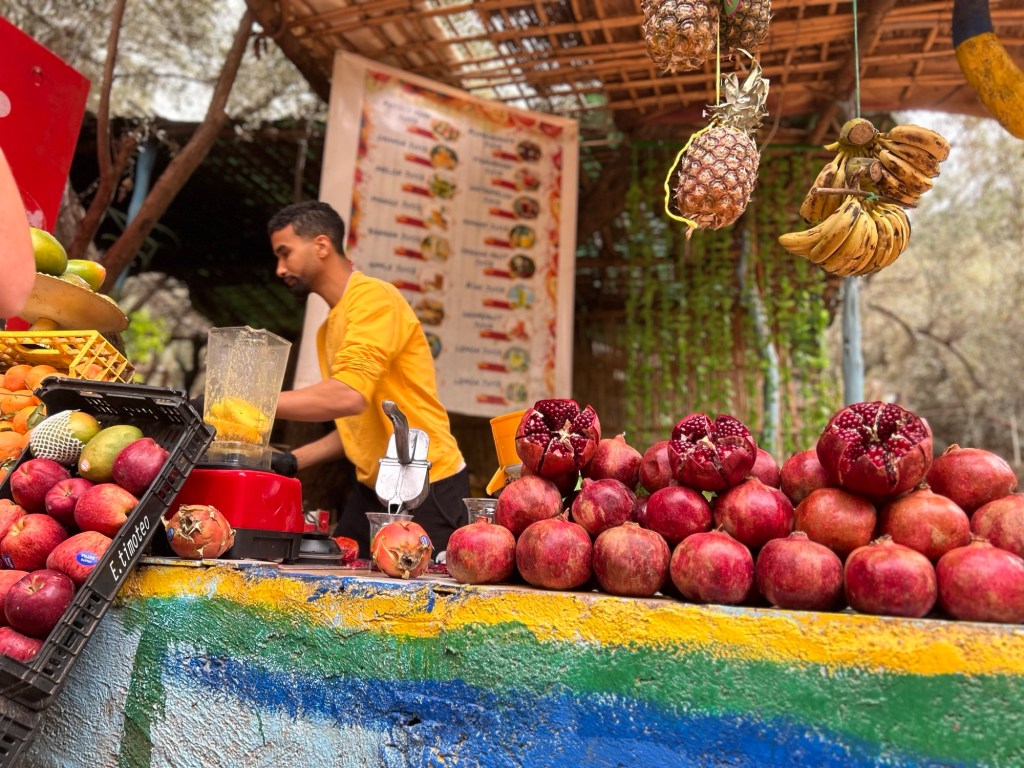
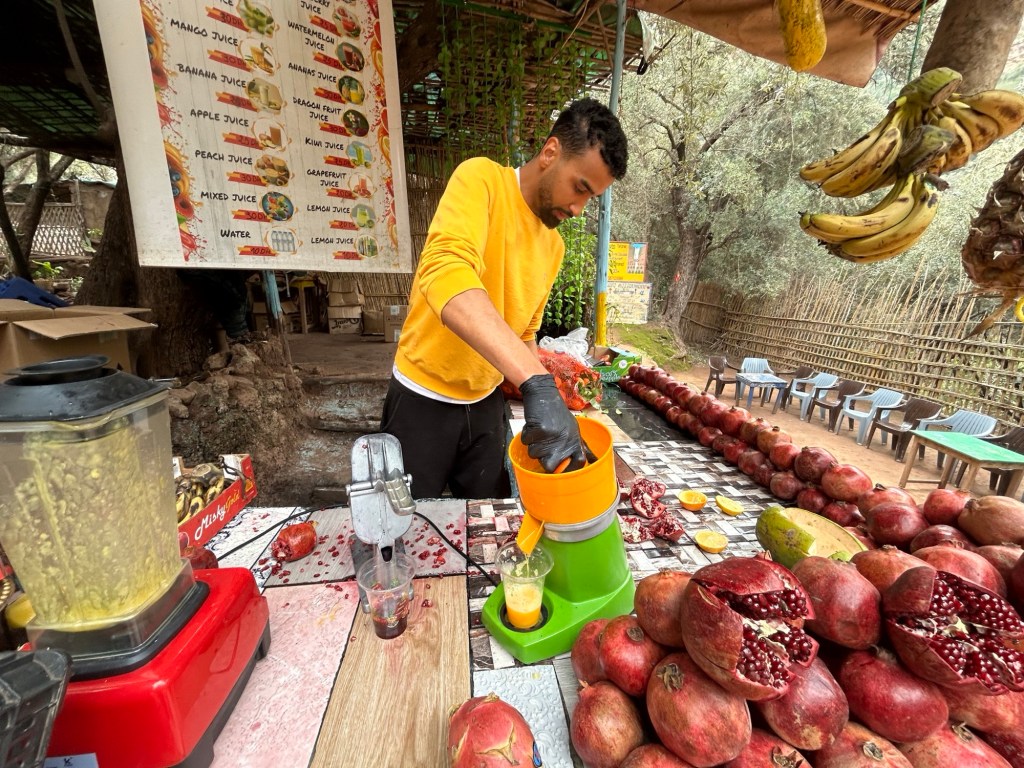
If there’s one thing that Morocco excels at, it’s fruit juice. It’s all freshly made, sweet and so flavoursome.
Continuing down the steps, the noise of the waterfall grows ever louder. The Ouzoud waterfall itself is 110 metres high, making it the highest in Morocco and seventh highest in Africa. The Ouzoud falls is two metres taller than the world famous Victoria Falls (which is much, much wider, and therefore way ahead in the water displacement stakes).
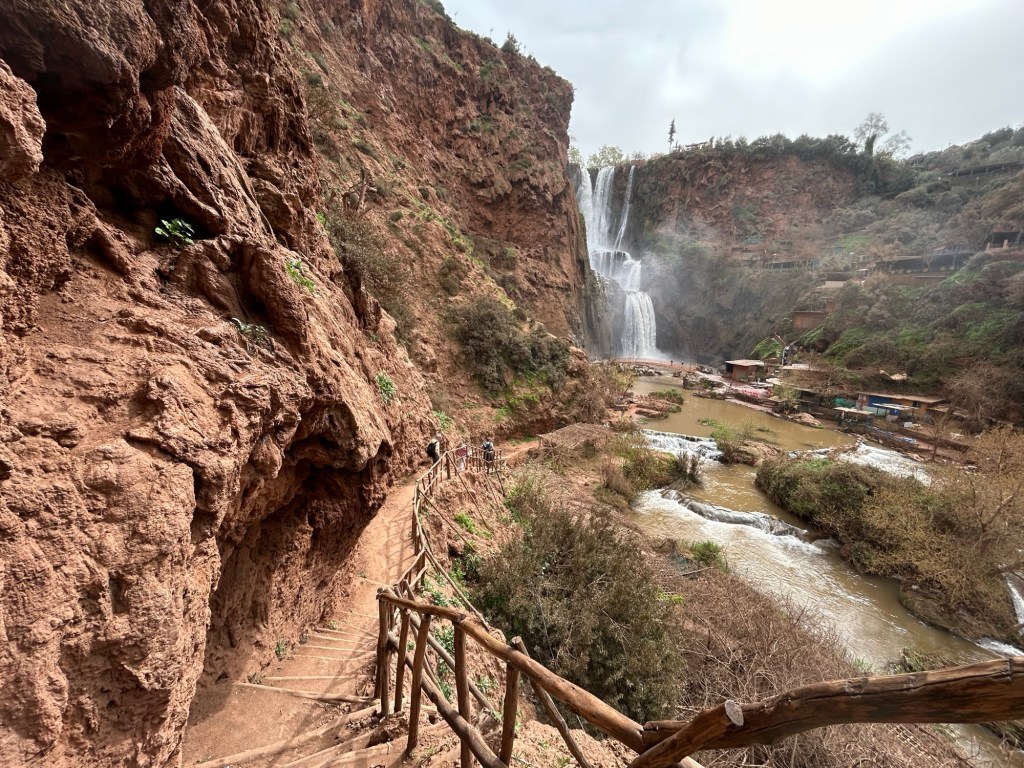
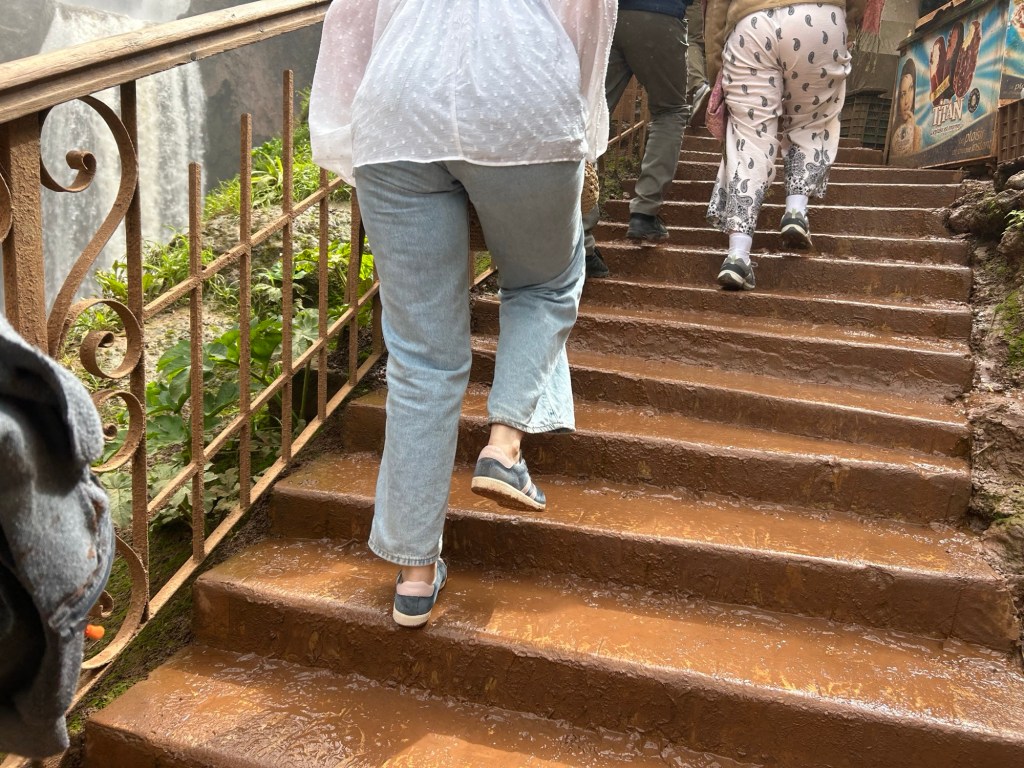
As we get closer to the bottom, the reddish earthen steps become increasingly muddy – wetted by the damp air. There are some great viewpoints on the way down, and several tour groups converge into one, competing over the prime photo positions.
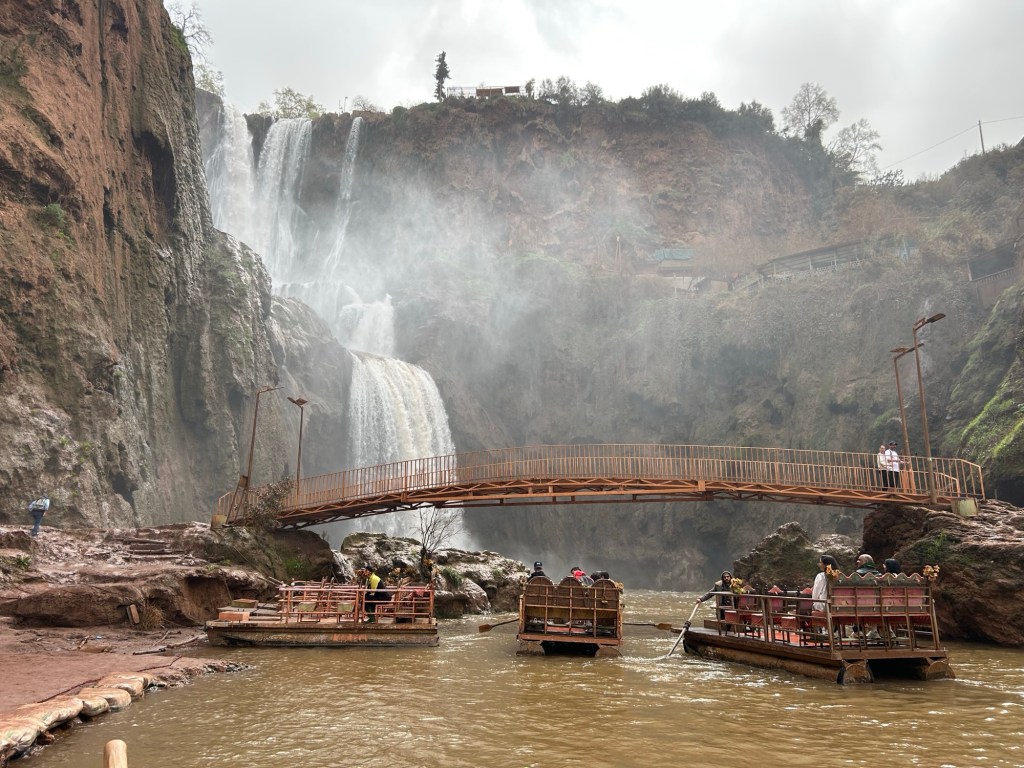
Beneath the waterfall is a pool of water, no more than 100 metres squared, before the river cascades further down the valley. In this little pool, boats are queued up and ready to take tourists towards the falls. Maid of the Mist this most certainly is not, but I like it for that. These little rowing boats, each powered by hand, are far more raw and not overly commercialised like you would see in Niagara.
My dad, who for some reason thought it would be a good idea to bring an umbrella to Africa, finally had an opportunity to use it. The power of the water falling 110 metres and bouncing off the pool leaves misty water hanging in the air. We’re told to expect to get a bit wet . It’s not an intense saturation, more like if you have the kitchen tap on at full blast for too long and everything else in the kitchen ends up soaked with the splashback.
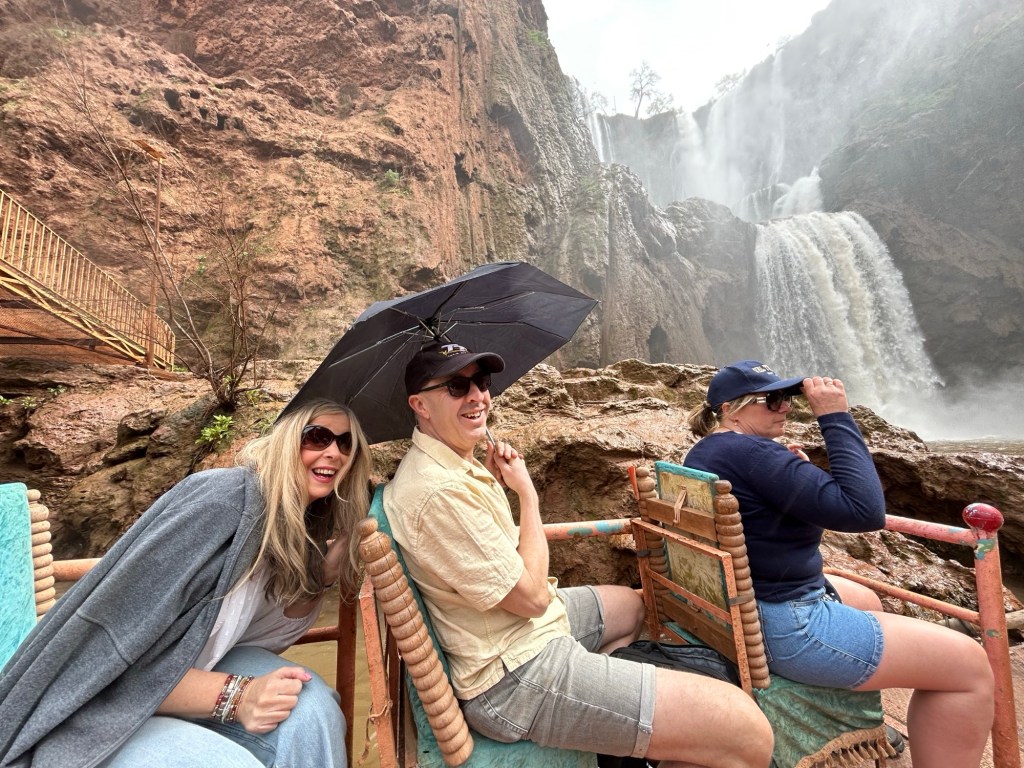
The boat ride lasts about 15 minutes, and after that, it’s time to make our way back up the mountain via more muddy steps.
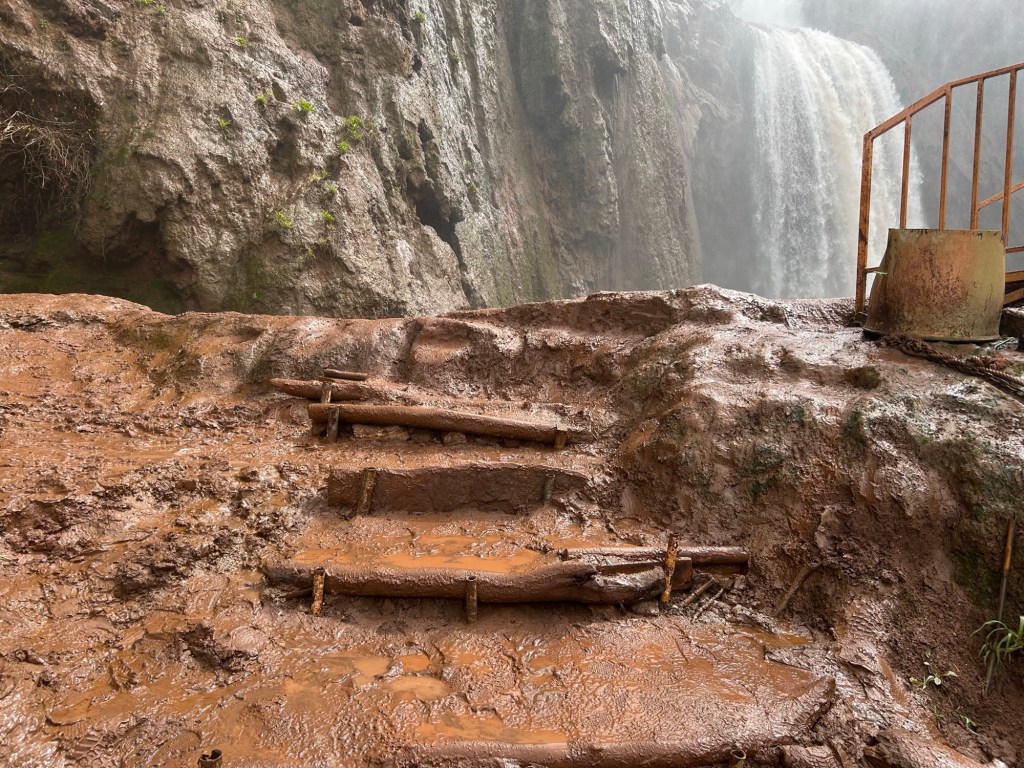
A bit of a top tip from mum – don’t wear light jeans when visiting. Those earthy steps are now a complete mudbath, and quite treacherous. I’d say this whole place is unreachable when it does rain.
We’re told there are three options for lunch. A restaurant at the bottom, middle, and top. We don’t get much of a say in the matter though, the best views are from the middle and that’s absolutely fine with me!
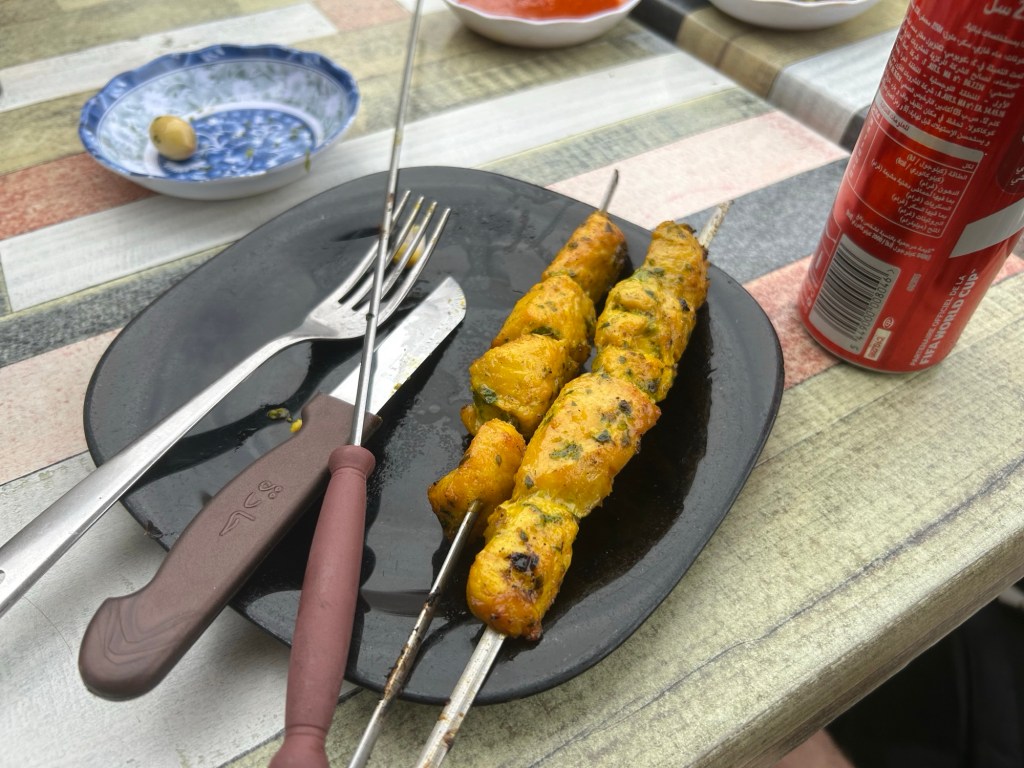
I’m quite in the mood for kebabs for lunch, and that works out well. There are just four options – three versions of tagine (which we’ve now had for every meal so far on this trip) and chicken kebabs. They’re giving summer barbecue back home, but fuel me up well.
After lunch, we reconcile with the bus again and set off on the three hour trip back to Marrakesh. Incidentally the students we saw making their way to school earlier were now also heading home by the side of the road.
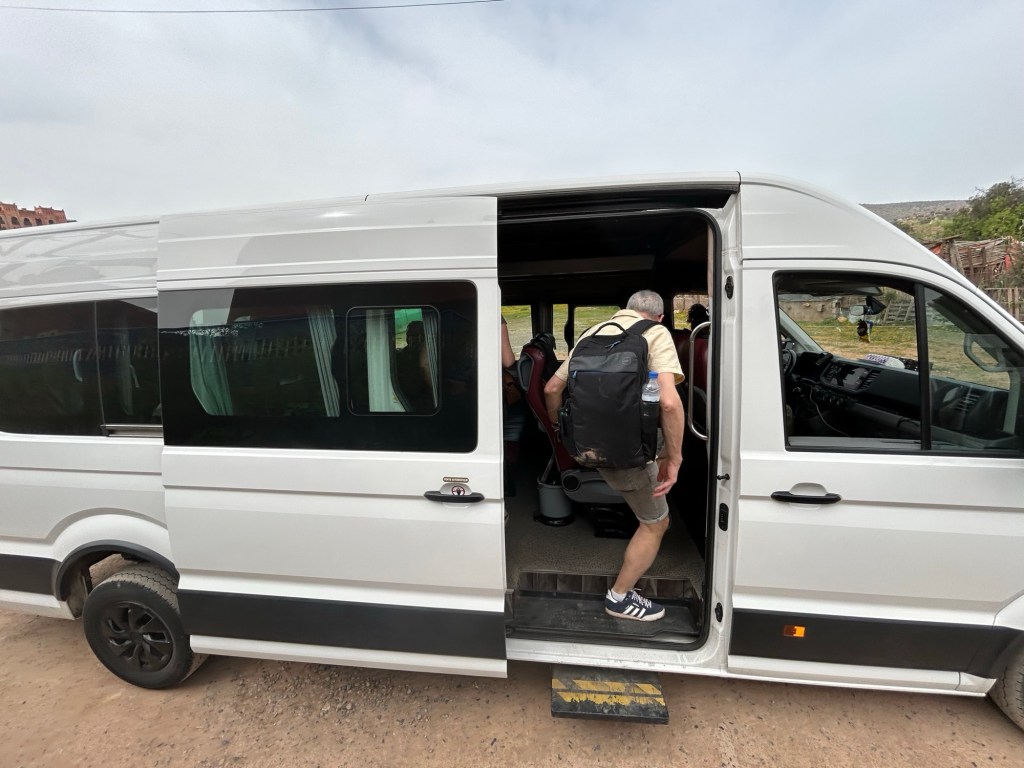
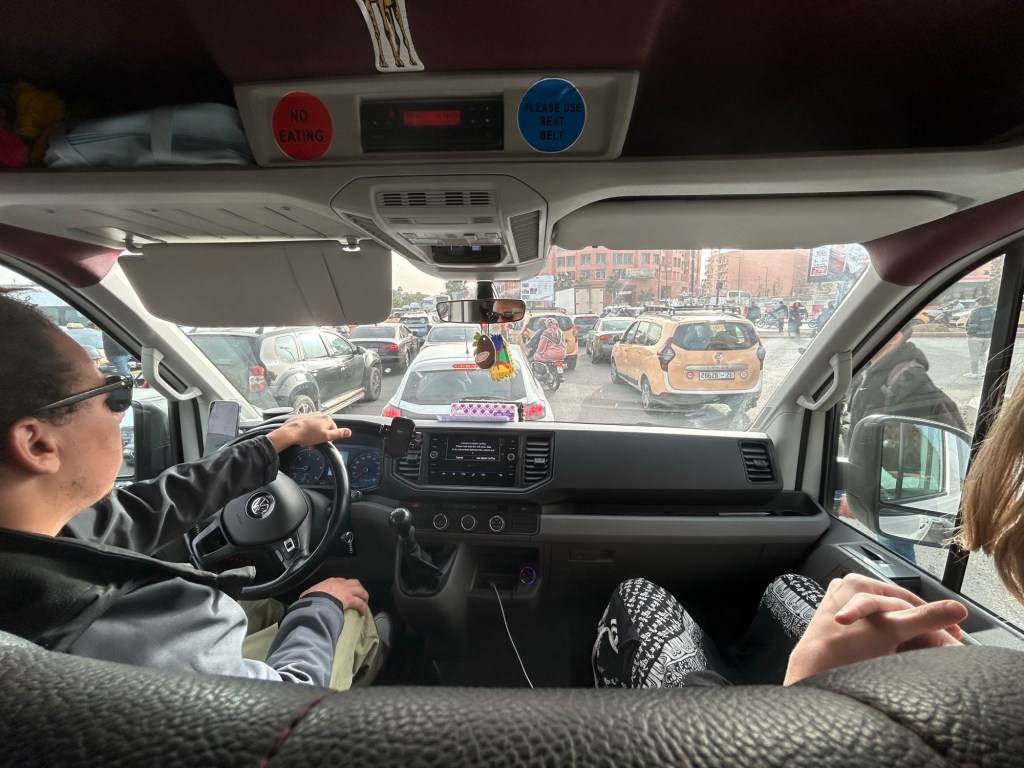
Coming back into the city, and the rush hour traffic which eluded us earlier was in full force – bumper to bumper for a couple of kilometres. For some reason roundabouts seem to work differently here it looks like those coming onto the roundabout have right of way over those already on it.
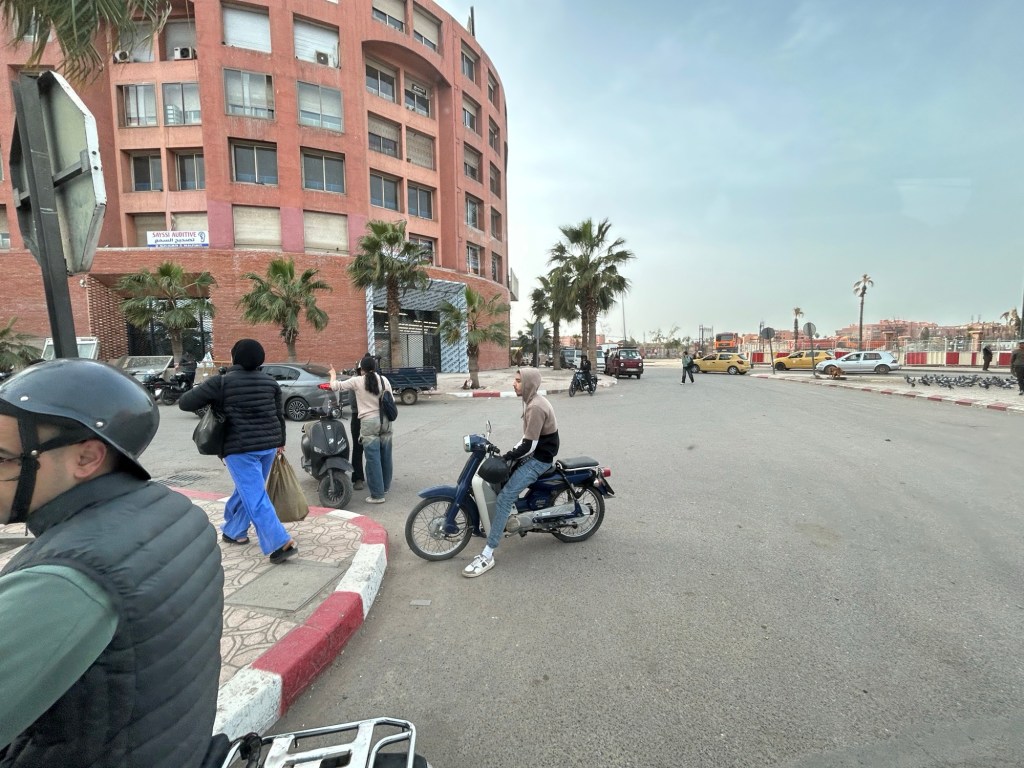
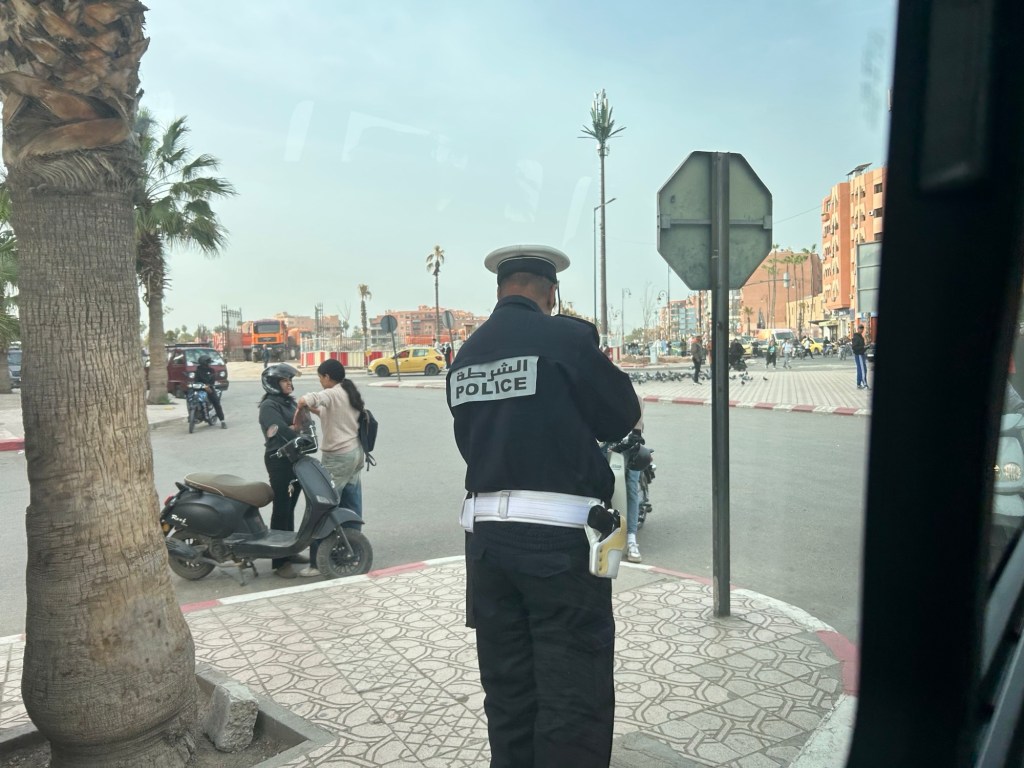
I spotted an interesting altercation between a police officer and a scooter rider at the side of the road. It looks like the young rider had been caught doing something he shouldn’t, and had a cheeky grin on his face as he was being told off. It was giving mischievous schoolboy energy.
After a quick stop back at the hotel, we headed back out for dinner. We’re all tagined out, so fancy something a little more international tonight.
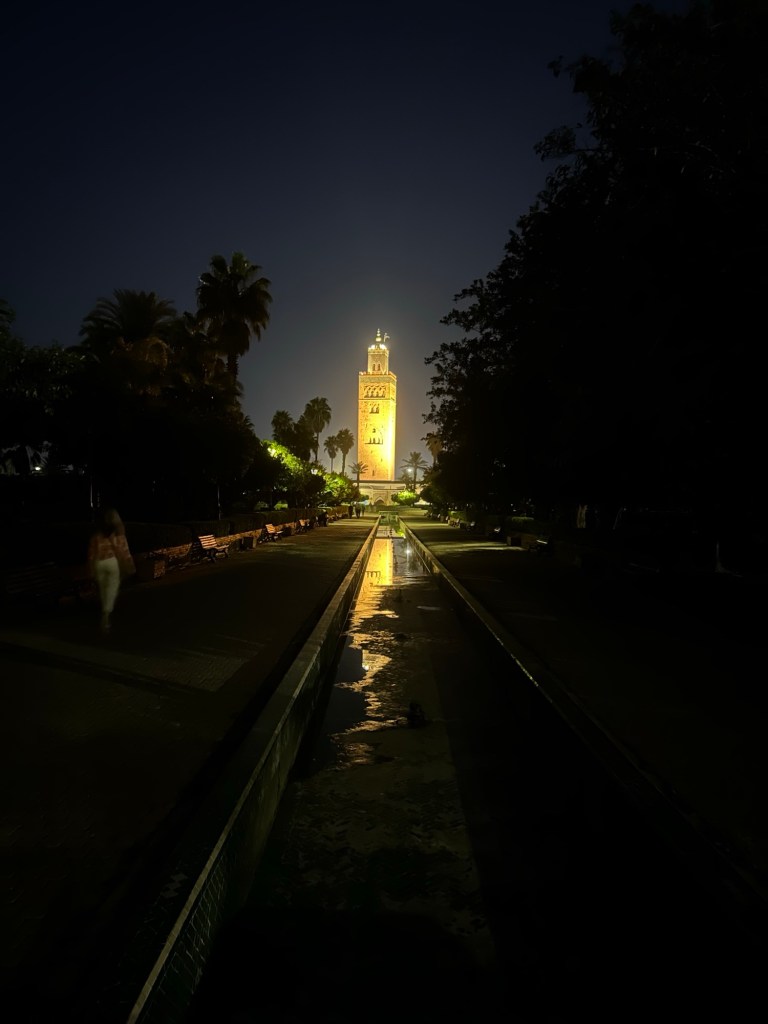
We arrive at the Jemaa el-Fnaa square and find a restaurant with a rooftop terrace – the Aqua restaurant, cafe and pizzeria (they had me at pizza). From here it’s so nice just watching the world go by. There’s order to the chaos.
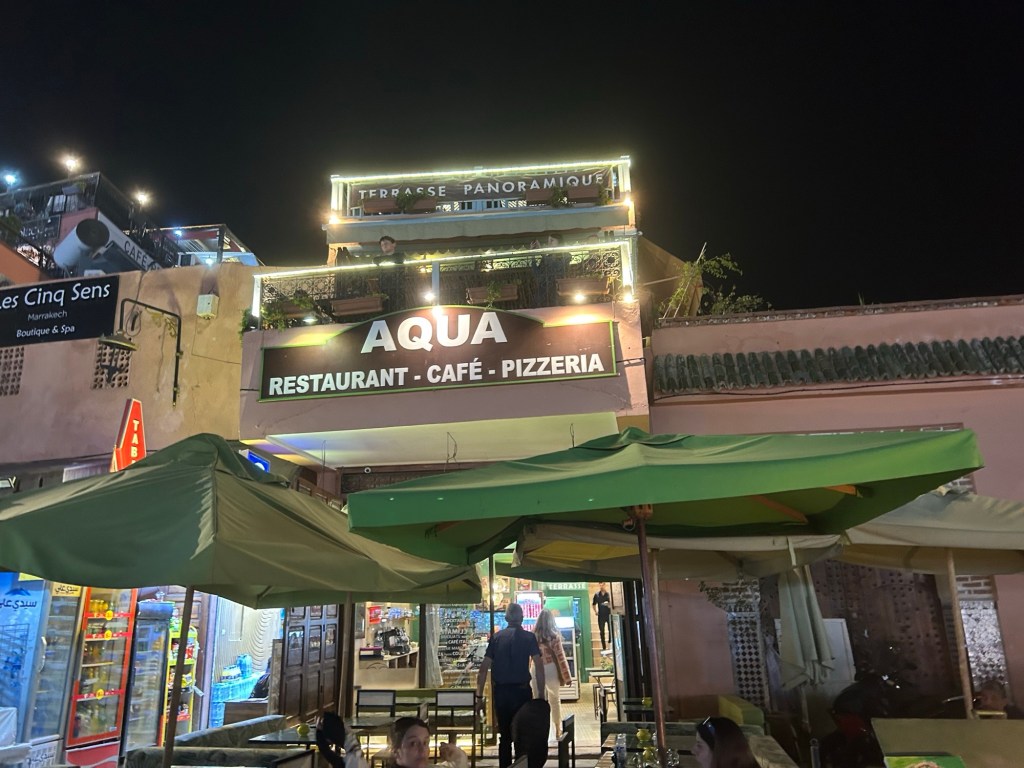
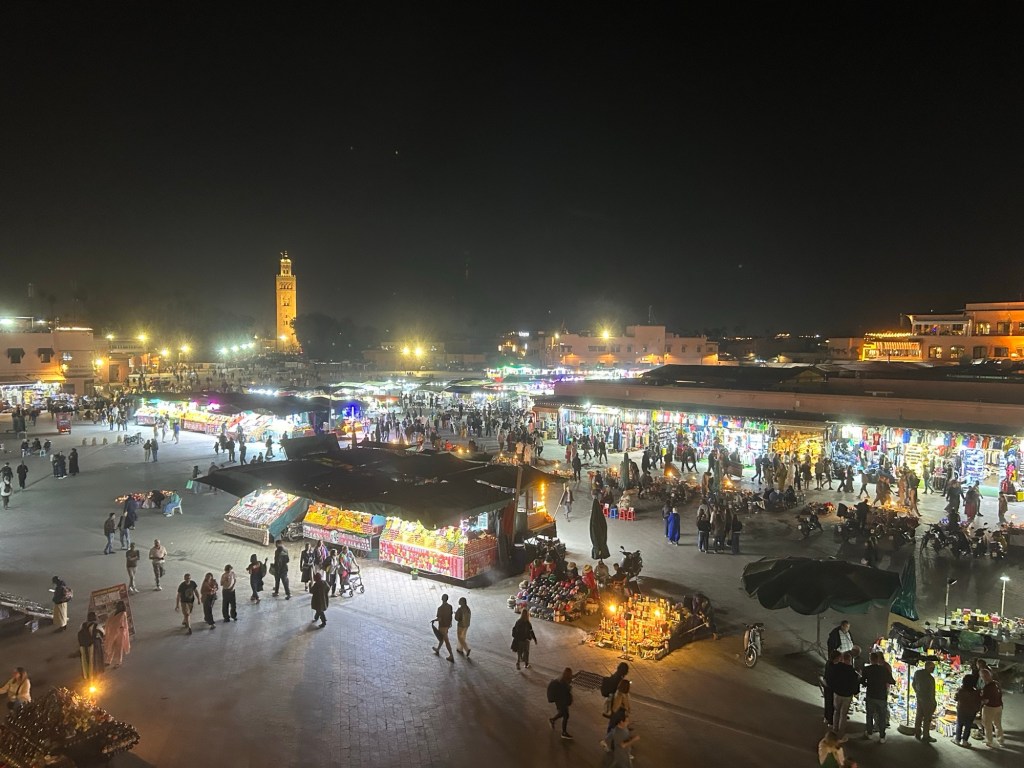
This restaurant, like so many in Marrakesh is cash only – it’s always wise to have some Dirhams on hand just in case! (I say always, probably not if you’re in any other country, but I’m sure you know what I mean).
While we have one more full day, this is our last night in the centre of Marrakesh, so I really want to soak up the night-time atmosphere in the souks and square. It’s while walking through the backstreets, that one random thought crosses my mind. I’ve watched loads of travel programmes over the years (and even some in preparation for coming here), but while these are great at getting a feel for places, one thing they just don’t capture is the smell (which I would say is an integral component of foreign travel). I wonder if anyone will ever be able to invent a TV which can replicate these smells.
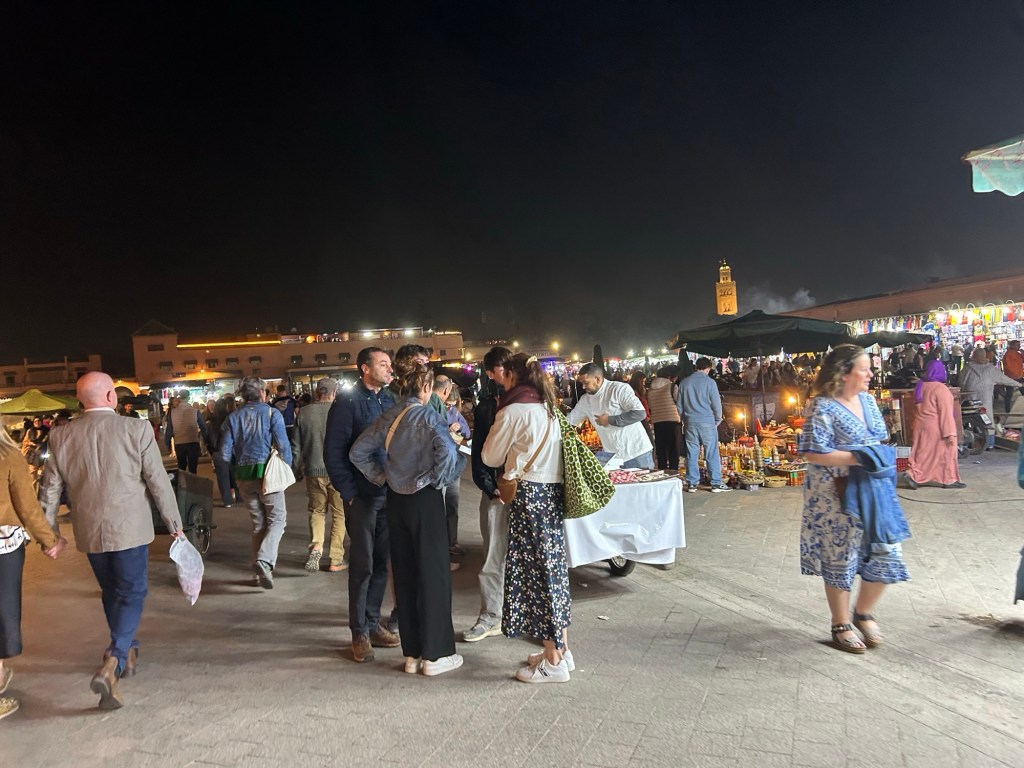
It’s the smell of smoke, grilled food, spices – even horse poo; smells which on their own can be overwhelming, but collectively combine to give a city its signature scent.
Anyway, if anyone is able to invent a smell-o-vision, I’ll absolutely be queuing up to buy one.
Meandering through the maze of streets surrounding the main square, we come across a Photo Booth. I’m purposefully trying to be more spontaneous, and this is right up my street. I have some trouble persuading my parents to buy in, but eventually they concede. (I think it was the prop fezzes which was the clincher)!
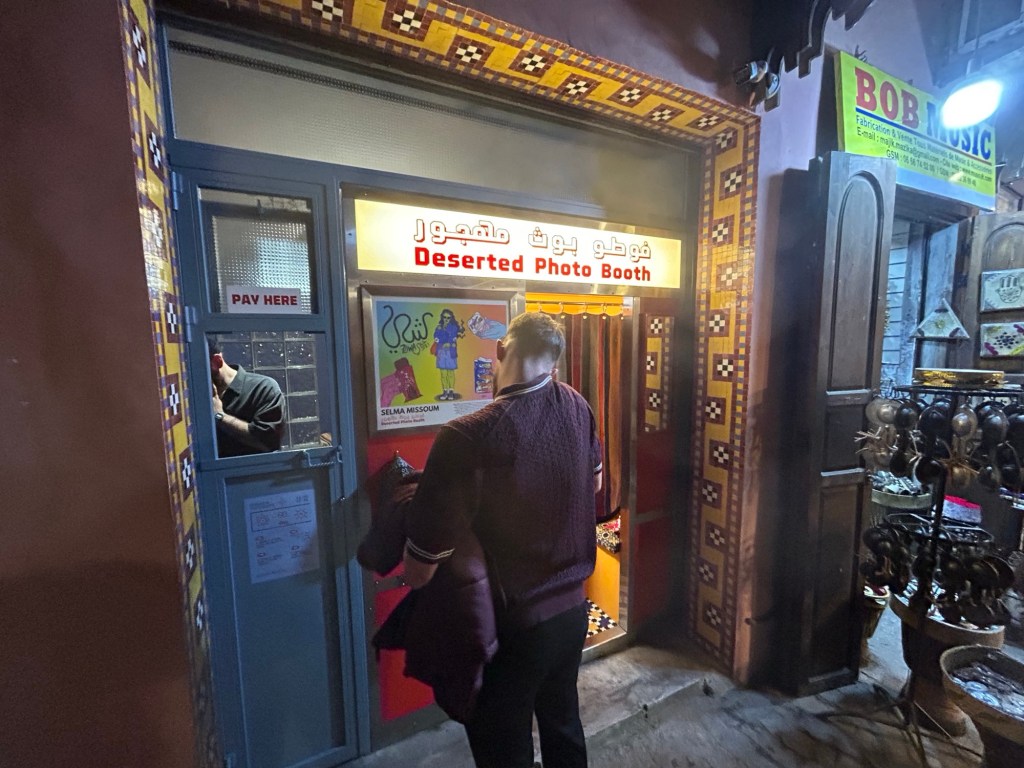
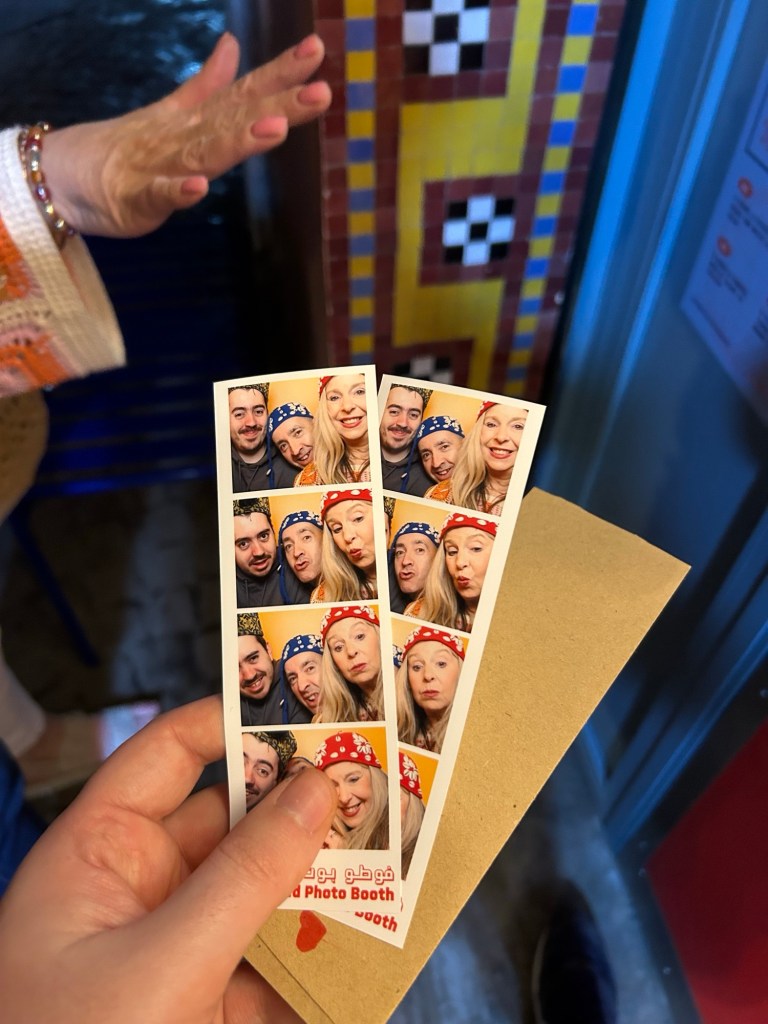
It took me a little time, but I’m finally feeling Marrakesh now. Loving our time here so far, and more fun things ahead tomorrow!

 See Travel Blog
Leave a comment