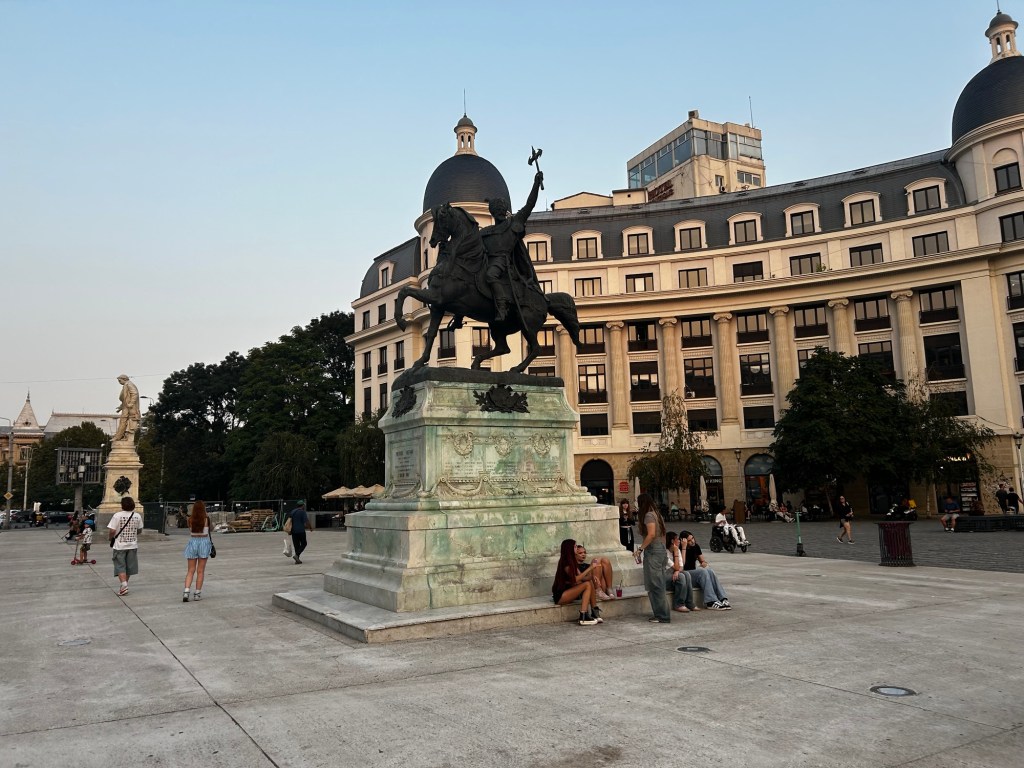
Good morning bright and early from Căciulați in the outskirts of Bucharest in Romania.
This morning we’ve signed up for a free walking tour around the Romanian capital. We’ve been told to meet at 10:30am in Roma Square. We timed it last night and it should take us about 40 minutes, so set off with about 70 minutes just to be safe.
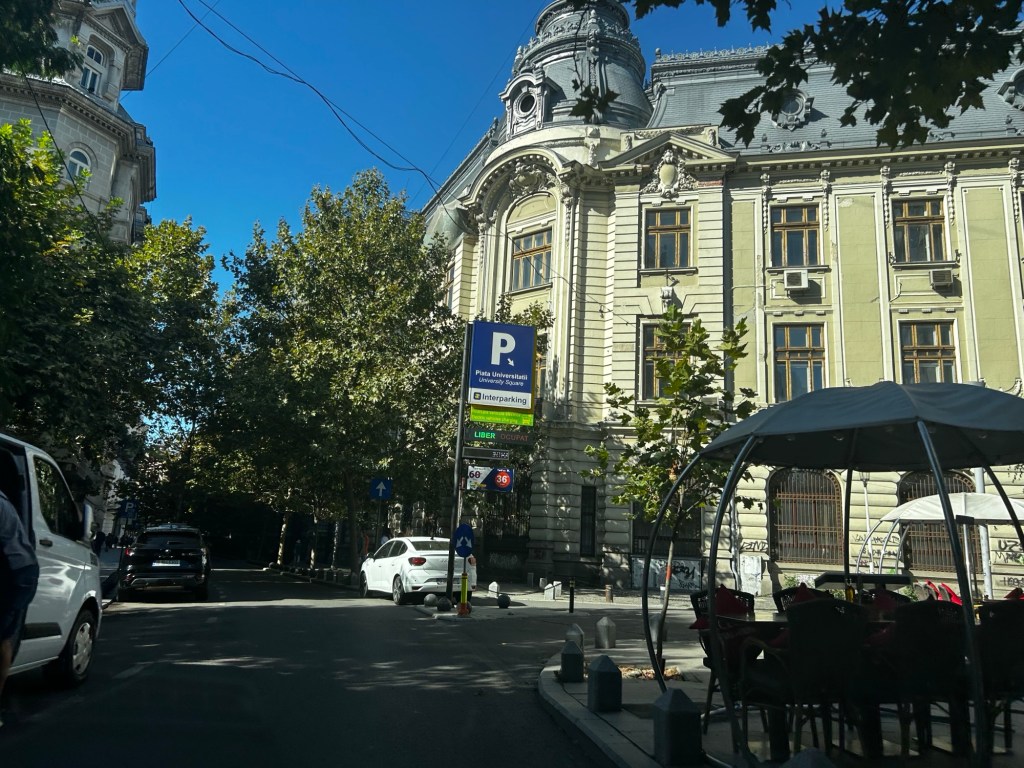
It’s as well we did, because last night we didn’t factor in morning rush-hour traffic around Bucharest. The roads are very heavy and we arrive at a city centre car park with 10 minutes to sprint down the road to the meeting point.
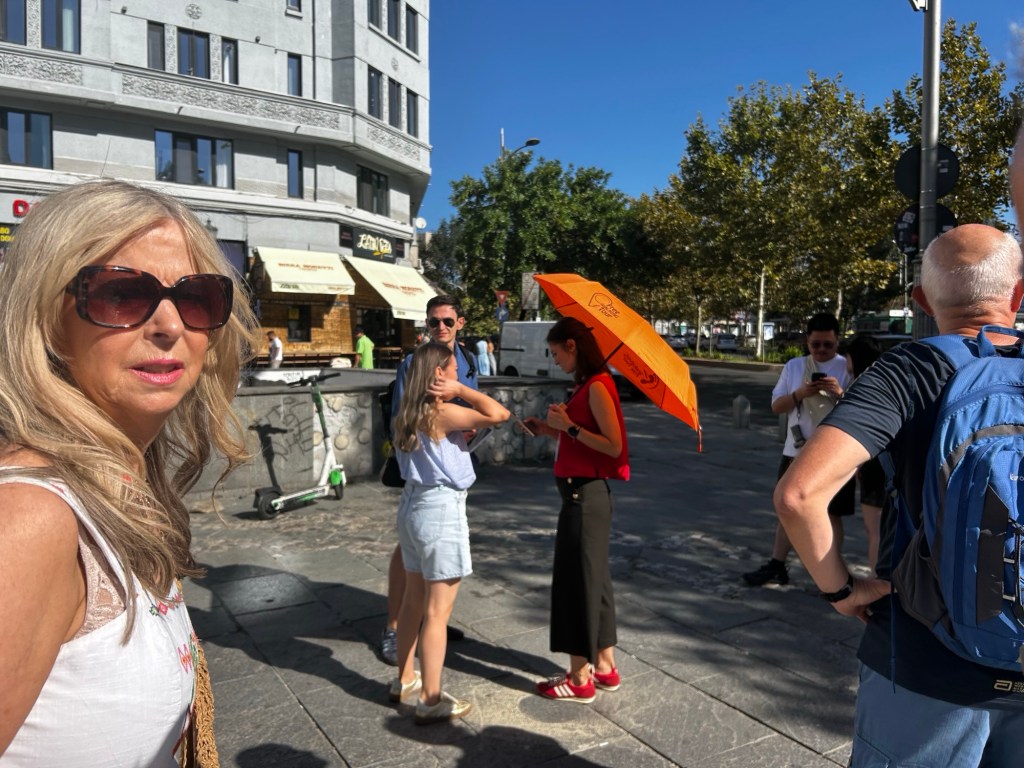
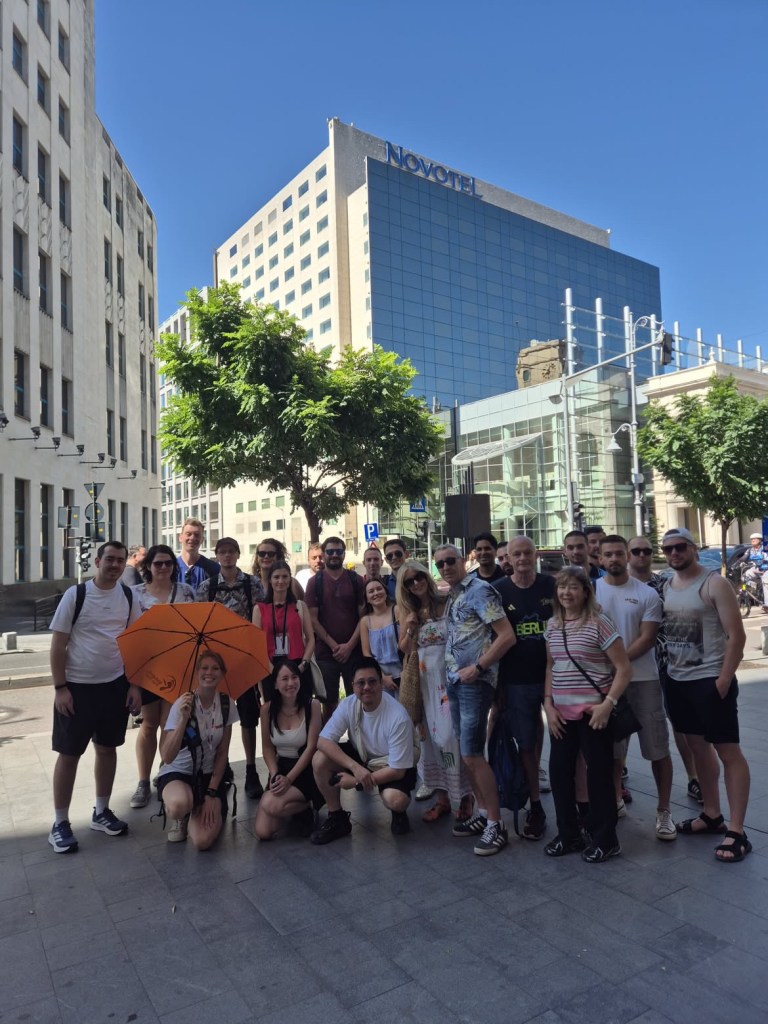
When we arrive at Roma square, there’s a woman clutching an instantly recognisable orange umbrella. I have to ask, the increasing popularity of walking tours through the last 20 years, must have worked wonders in the umbrella industry!
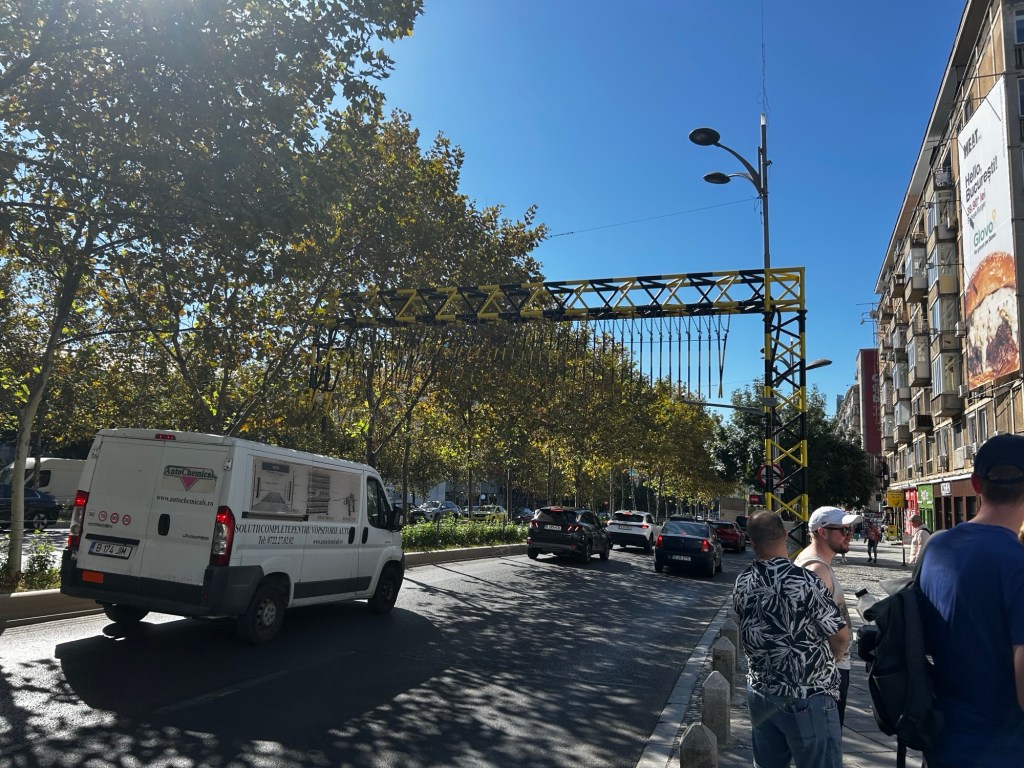
Catching my breath again, I hear an almighty clatter from the busy road beside. There’s a height restriction barrier over the road, and a lorry has absolutely clattered the dangling bars hanging from it. A few seconds later, there’s the sound of car horns tooting furiously as the same lorry swerves in front of them to avoid a low bridge.
Just after 10:30, the tour begins. Our guide is called Ana. She’s quite young for a tour guide – I’d say maybe early thirties but I’ve a bad track record at guessing ages.
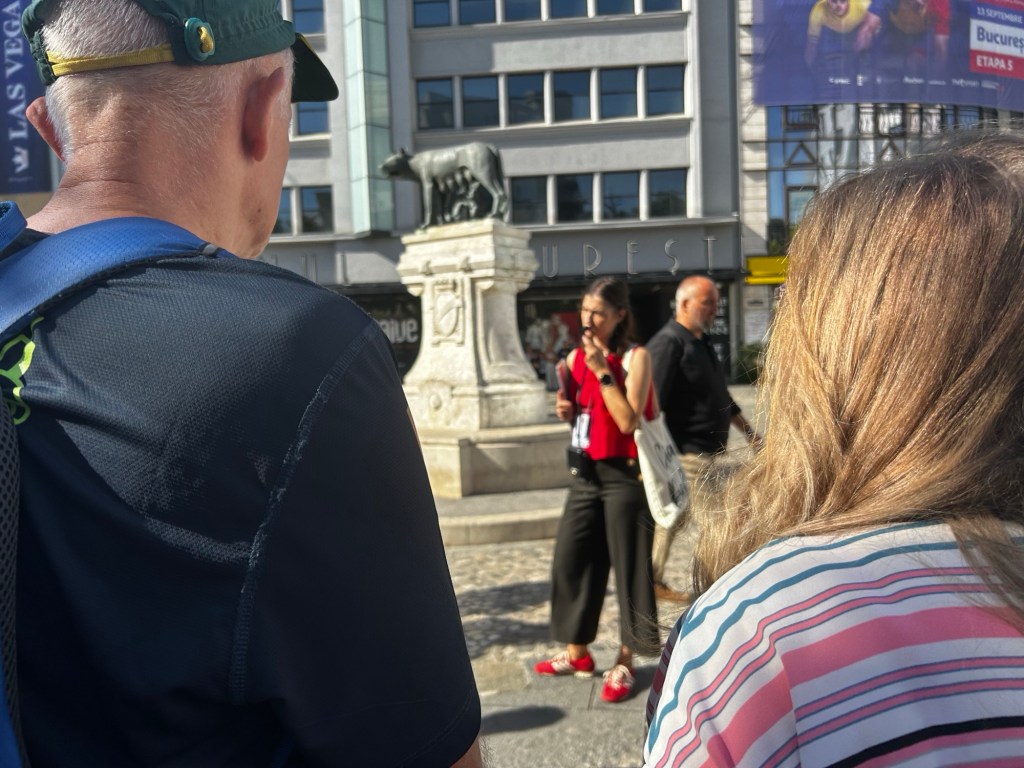
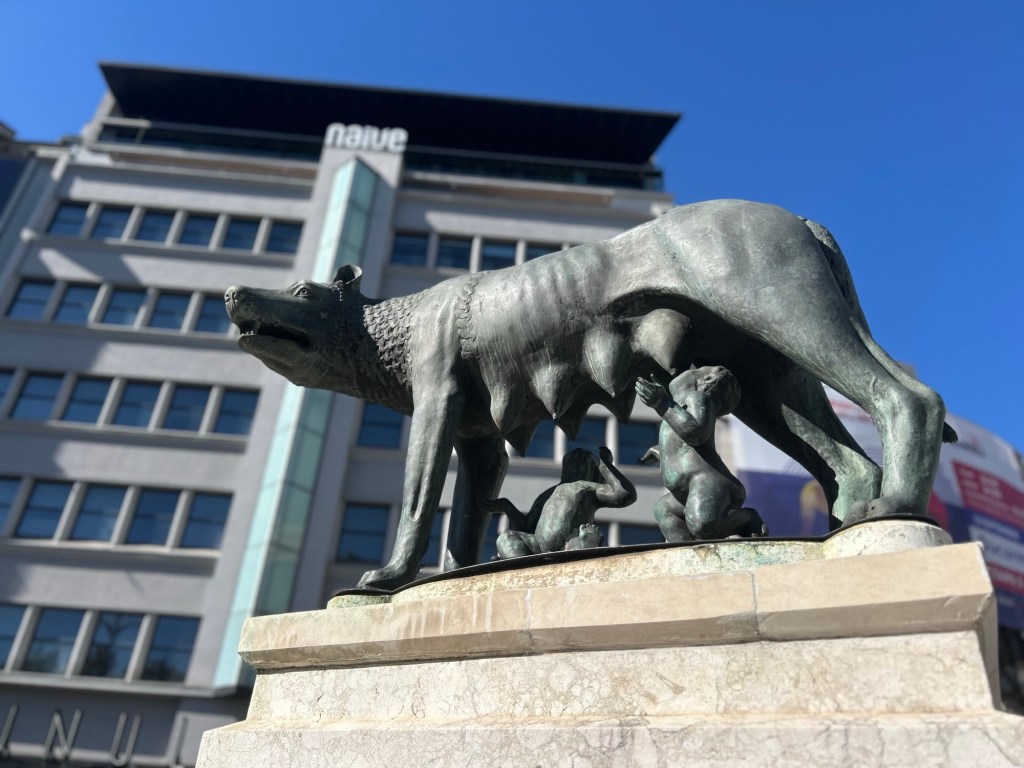
The statue in the middle of Roma Square is a statue of two babies sucking the teats of a wolf. The babies are Romulus and Remus, the mythological twin-founders of Rome. This statue is a replica of the Capitoline Wolf statue in Rome (which I now realise I forgot to seek out when I was there in June!)
Both Romania and Rome have ties going back a couple of thousand years. Emperor Trajan conquered the land of Dacia (modern day Romania) in 106AD. As an aside, that’s where the Romanian car brand takes its name from.
Even now, Romanian language and culture is heavily influenced by that period (the Romanian language is the only Romance language spoken in Eastern Europe) and the name literally means “land of the Romans”.
The replica statue was gifted by the City of Rome in 1906 to commemorate the 40th year of King Carol I’s reign, and both places’ shared history.
Bucharest has mythical origins of its own. Legend has it that a Romanian Shepherd called Bucur grazed his sheep by the Dâmbovițan and built a small church. That became the first settlement in the area, and the name București stuck, meaning “the people of Bucur”.
Bucharest’s name also means “the city of joy” from the word bucurie meaning joy or gladness.
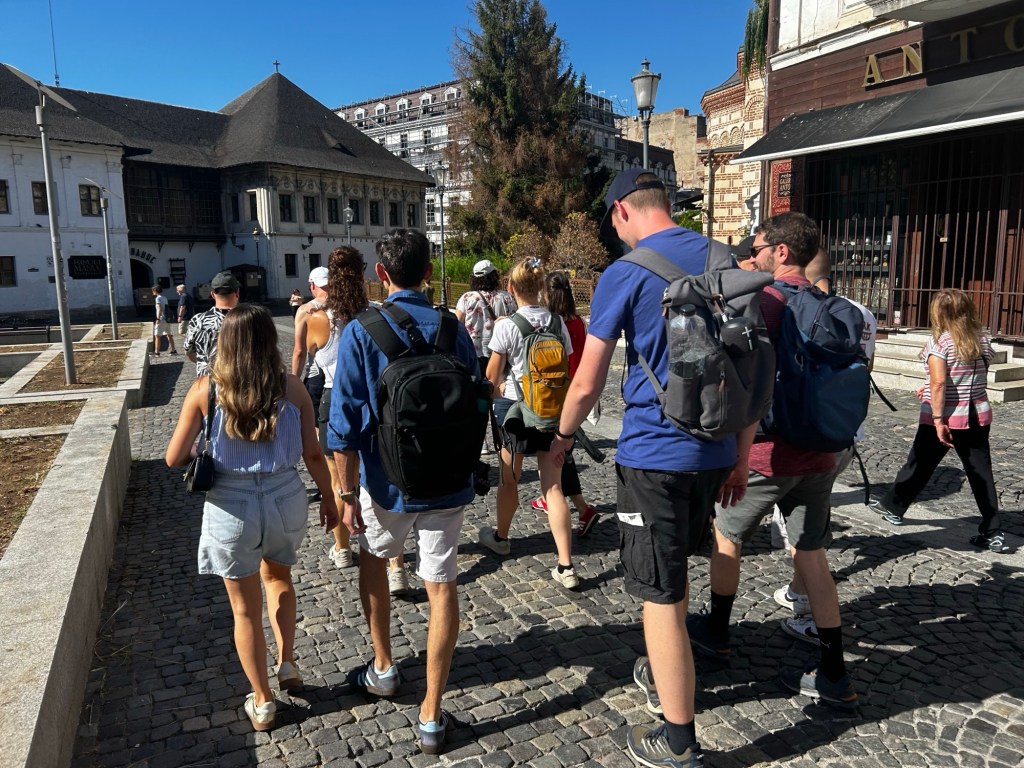
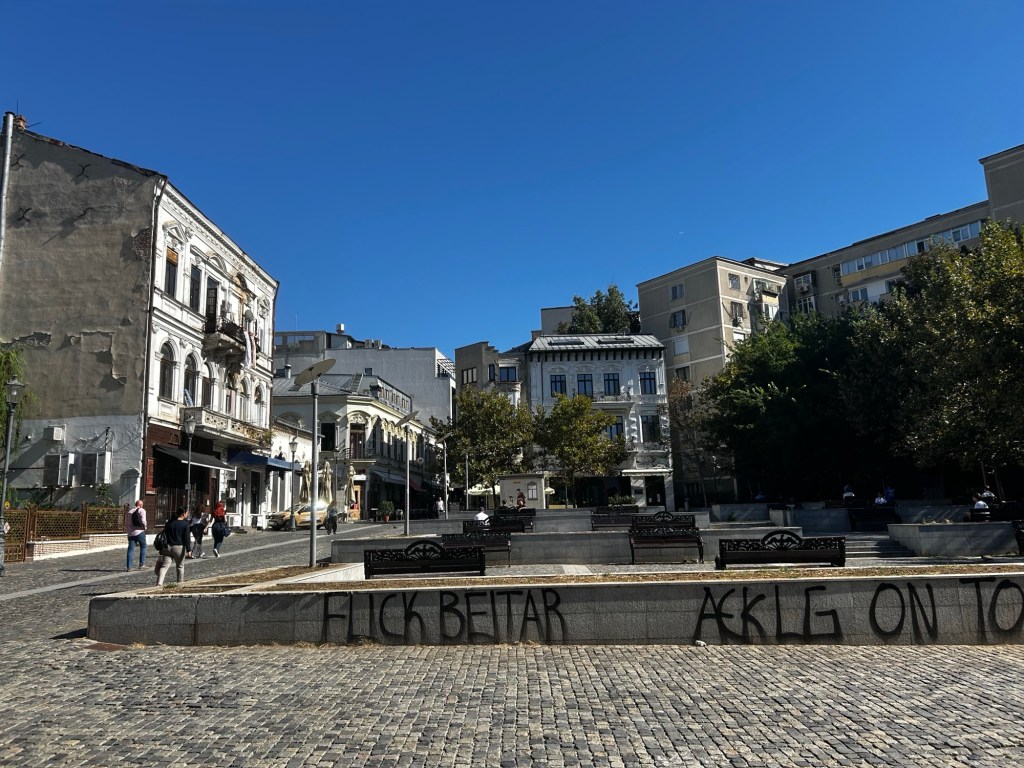
After a brief intro to Romania, we walk a few streets into the Piaţa Sf. Anton (St. Anthony Square) to see what’s left of the old town.
Here we get a flavour of the different architectural styles – each from different periods in Bucharest’s history: the Byzantine style church, some neoclassical style French buildings, and a couple of big brutalist communist-era flats.
From the second century on, the Silk Road connected Constantinople with Xian in China as a major trading route. While Bucharest wasn’t directly on this route, there were other offshoots, and so that connection between Bucharest and Constantinople in modern day turkey brought a lot of Byzantine influence to the city. The Church of Saint Anthony, has the most obvious Byzantine influences in the area.
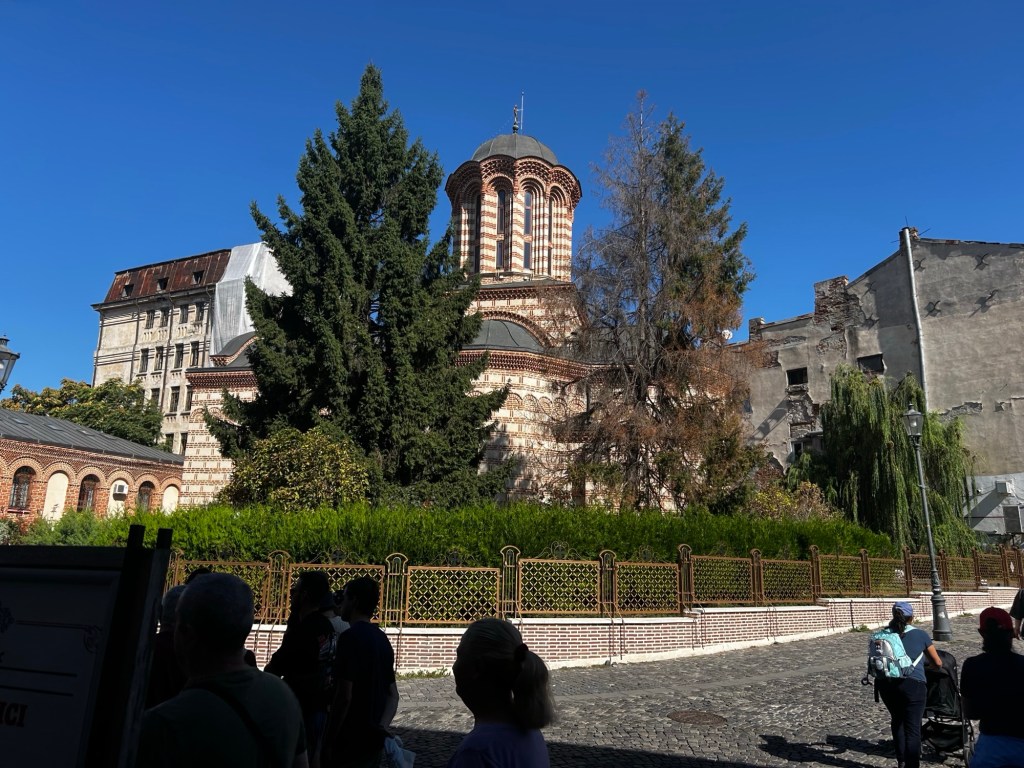
Saint Anthony is said to be the patron saint of helping you find things – particularly finding love or a partner. The guide tells us he must only work on Tuesdays, “that’s the day we celebrate him”. Every Tuesday there’s a big line of people going into the church, each writing their wish on a piece of paper. The priest then reads out the wish. I’d love to know where that’s covered in the Bible.
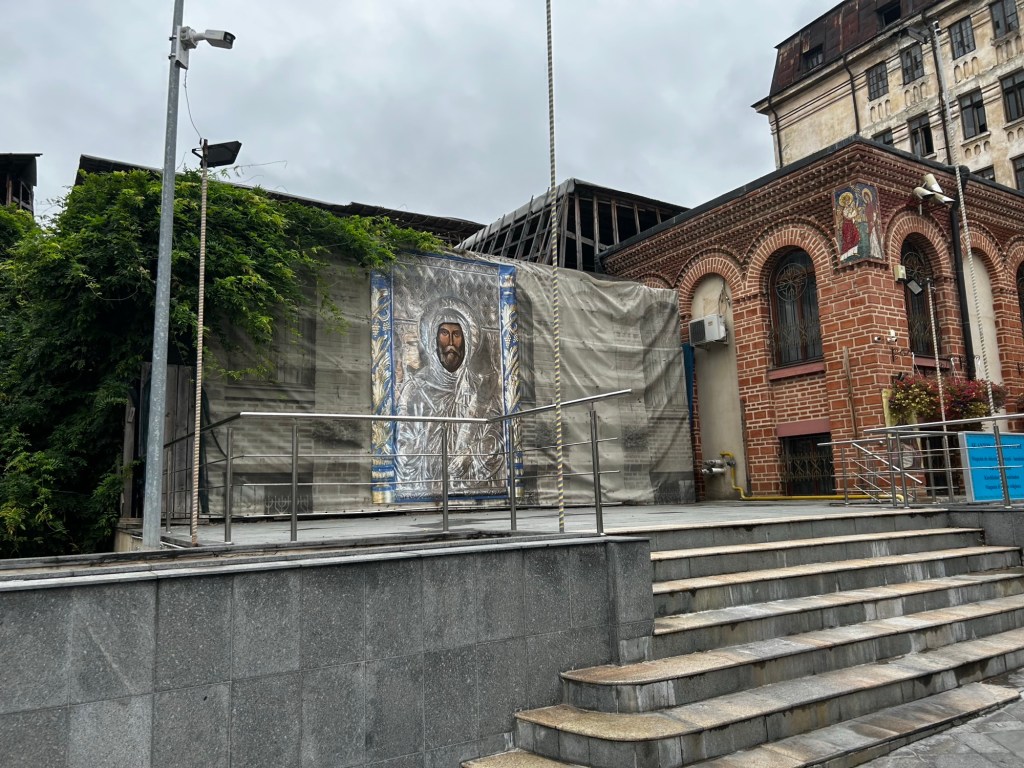
The church is the oldest in Bucharest, and was where kings and queens of Walachia were once crowned. It stood adjacent to the Old Princely Court, (a royal palace) which was destroyed following a fire in 1847. A third of the city was destroyed but miraculously, bar a few charred outer walls, the church remained unscathed. There are some plans to rebuild the Court as it was in the next few years.
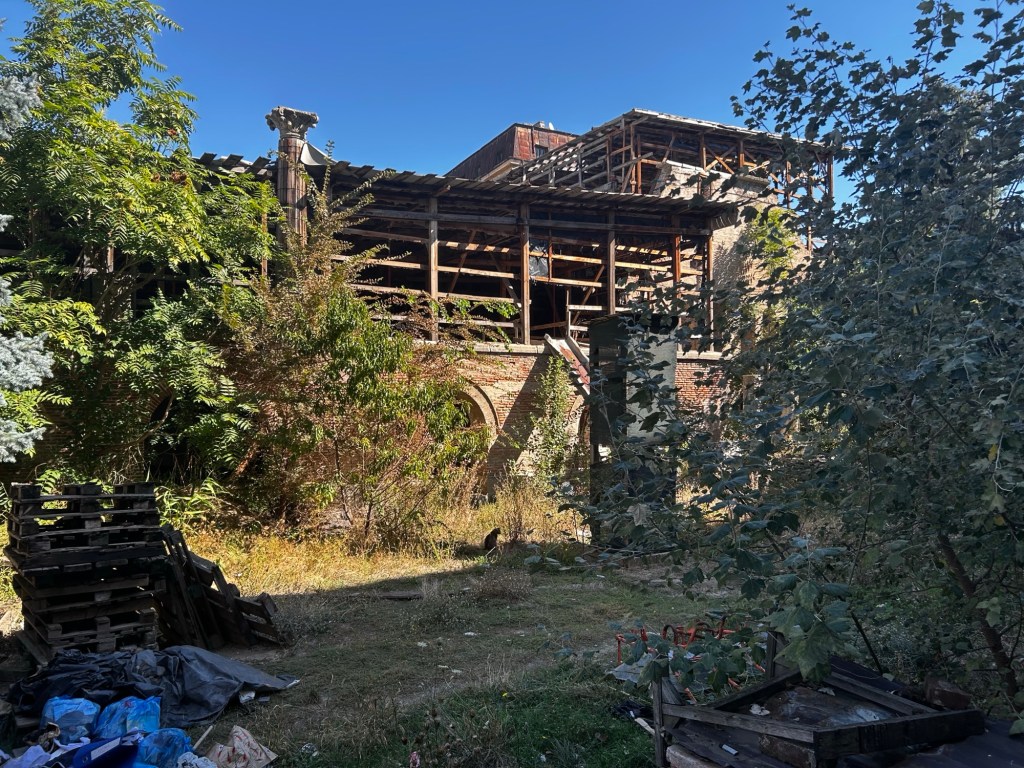
One of its former residents was Vlad Țepeș, better known to us as Vlad the Impaler. Vlad had the nickname Dracula, and his story provided inspiration for the famous novel of the same name by Irish author Bram Stoker. In our short time here, it’s already clear to me just how big a role Dracula has played on local tourism, but Stoker himself never visited Romania. Regardless, Ana chirps in to say that “Bram Stoker did us a great service there!”
We’ll dig a bit more into the stories of Vlad the Impaler and Dracula tomorrow.
I mentioned earlier about the smattering of French style architecture in the old town… There were close ties politically between France and Romania around the 19th century, and a great admiration from the people here. Their respect to the French was reflected in the architecture of their new buildings at the time (belle époque), and many civic buildings bear close resemblance to others in Paris. All of this earned Bucharest the nickname “Little Paris”, or “Paris of the East.”
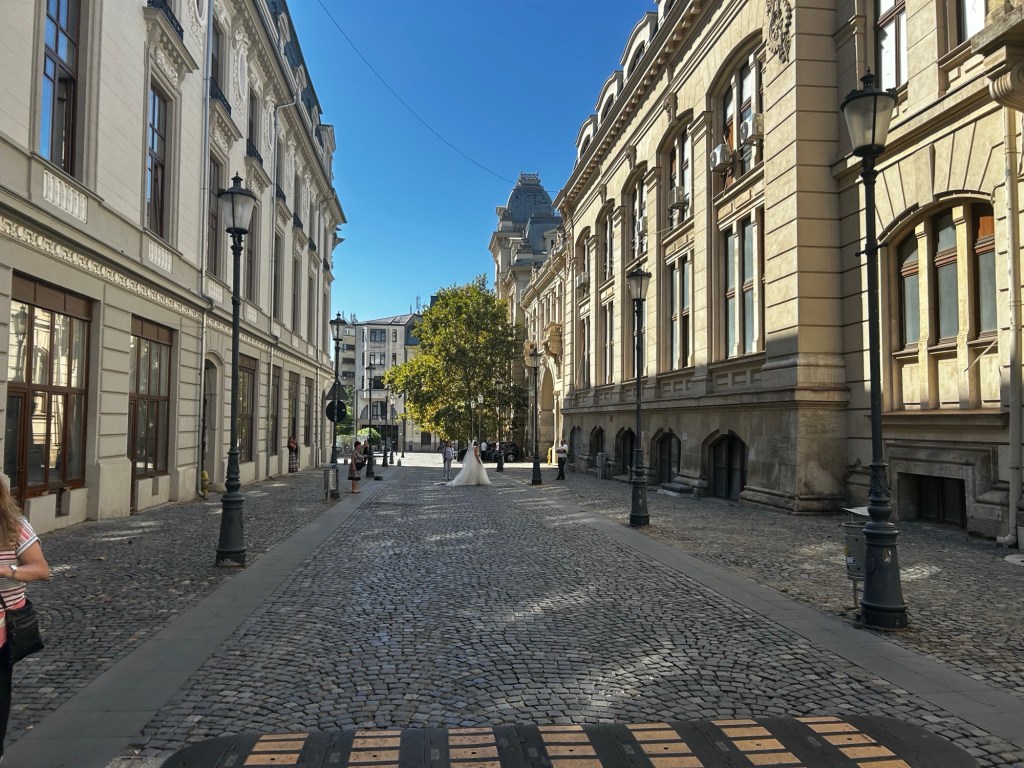
With this in mind, the streets of Bucharest have doubled for Paris in several films, including the Netflix film ‘A Christmas Prince’.
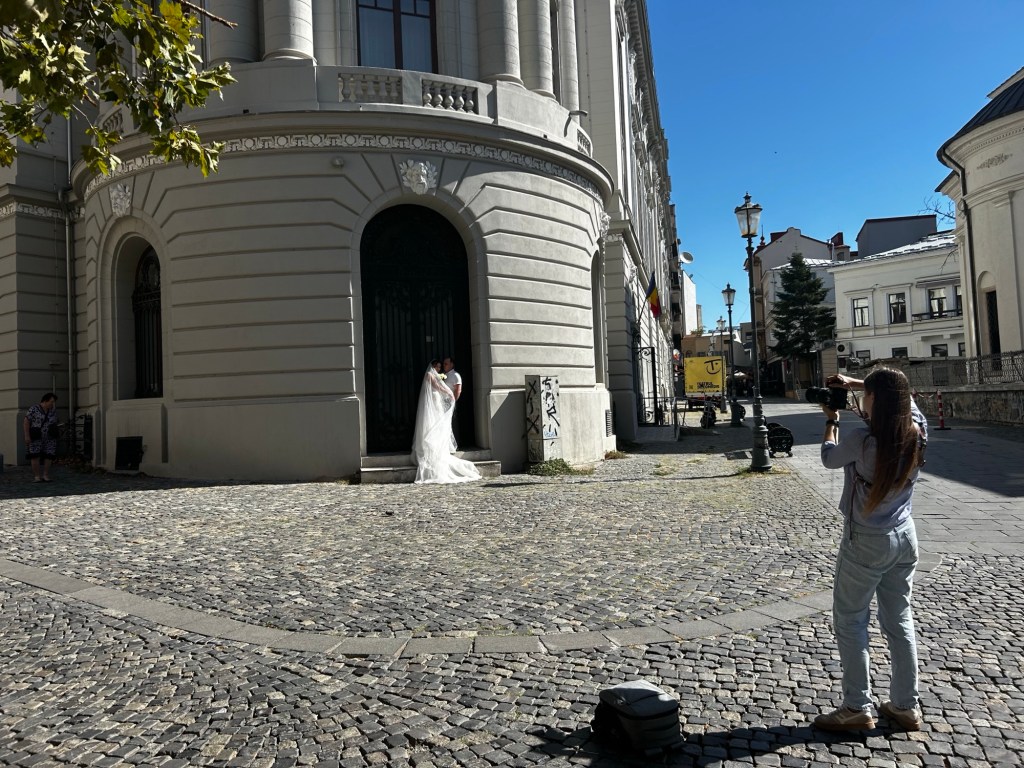
We walk through these streets, and encounter a bride and groom having their photos taken against the large entrance of a building. There are other family members around, so this does look like a wedding shoot rather than just bridal wear photos. I must say, the groom looks absolutely miserable. Terrible to say, but if this is the happiest day of his life, I shudder to think what the rest of them have been like.
A little further up the same street, and I catch the sight of a girl crying behind an iron gate. She’s being consoled by a friend. I soon twig just what’s going on.
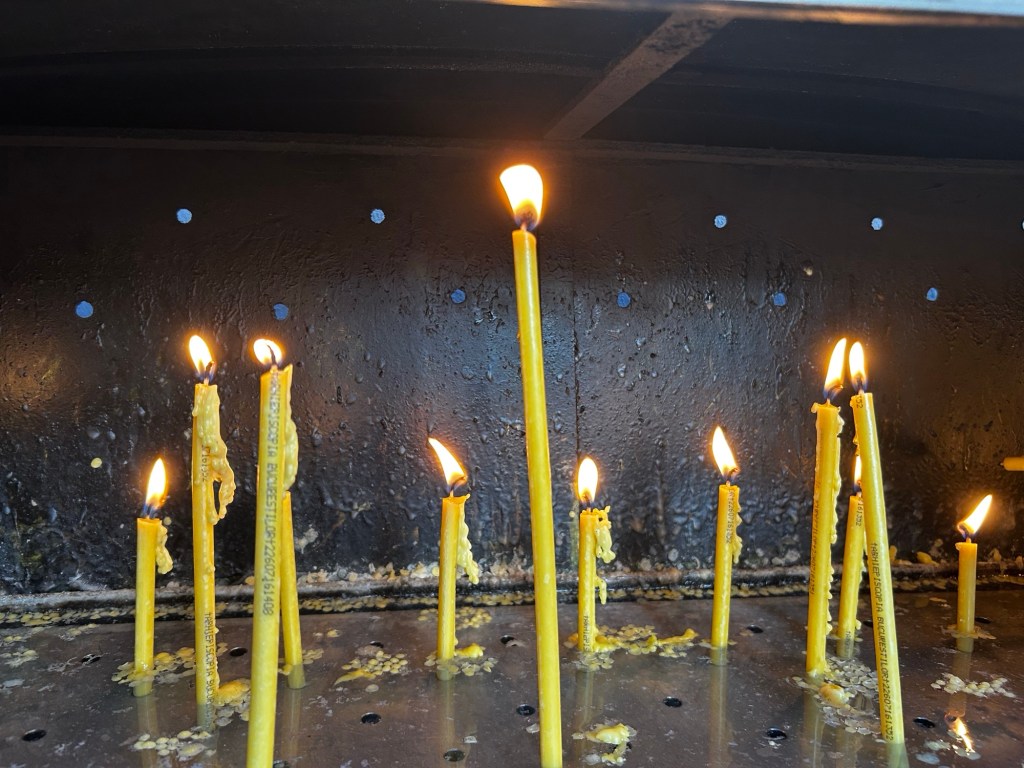
They’re both in the grounds of the Stavropoleos Monastery, where candles are lit to remember loved ones no longer with us in prayer. My heart goes out to this girl and anyone else struggling with loss – may the memories of those we love and lost continue to burn on through us.
This small monastery was built by a Greek monk called Ioanichie. He was an 18th century businessman who owned a nearby inn. As a way of thanking God for the success of the inn, he built the church and later went on to take up God’s calling to become a monk, serving in the city of Stavropoleos in Bulgaria.
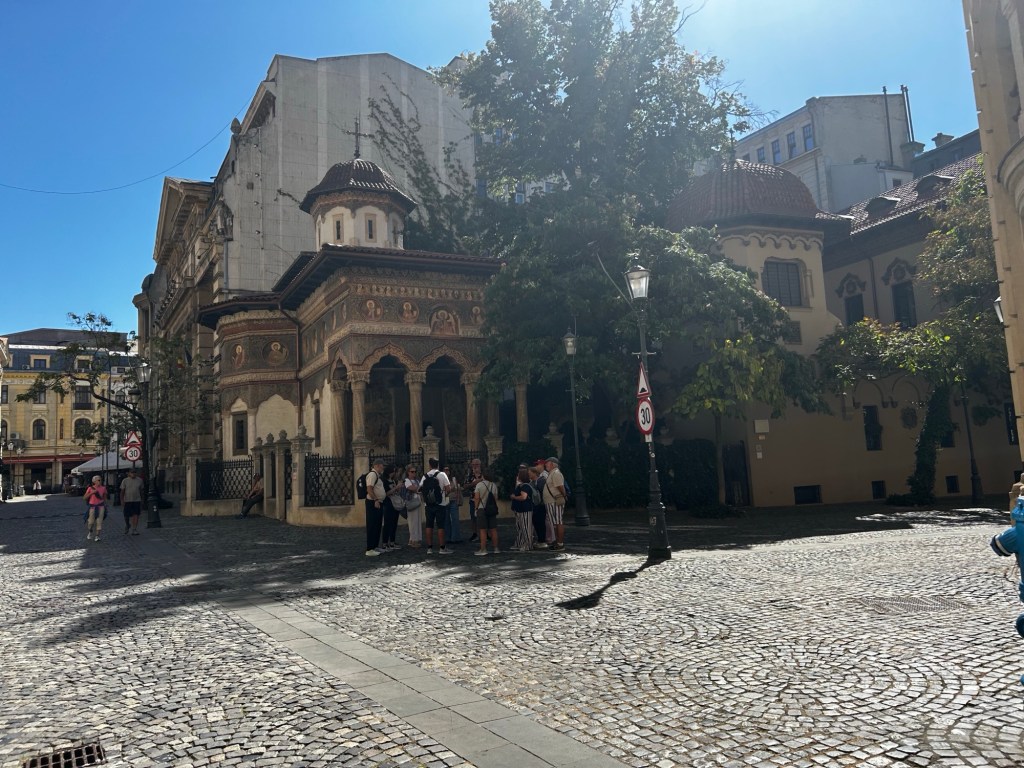
The monastery is very small, but home to 12 nuns. I’m not so sure about the gift shop immediately on your right as you enter the front door, but I suppose it does take money to keep the place running. That said, a brochure, three postcards and candle cost £1.56. I thought it would be nice to take a moment to remember a few people myself.
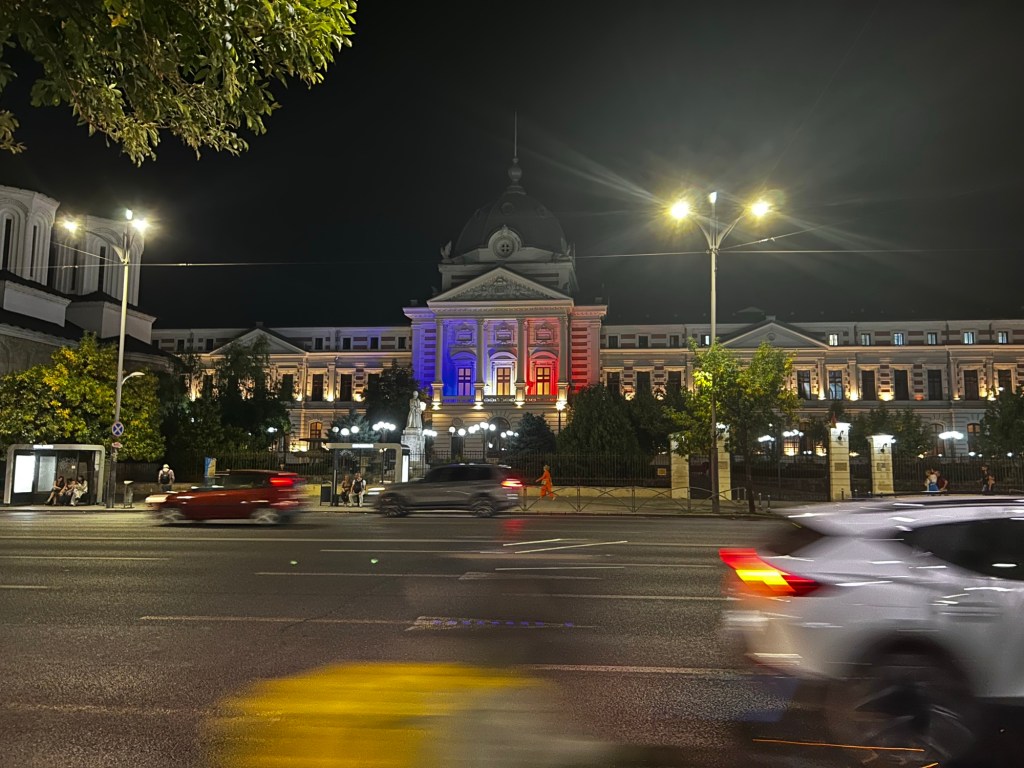
After a brief pause, the tour soon resumes, and we’re led by Ana down to a very grand looking building. It’s the CEC Palace (otherwise known as the Palace of the Deposits and Consignments) – basically the National Savings Bank. It’s based quite heavily on the Petit Palais in Paris – yet another link to the French capital, if it were needed.
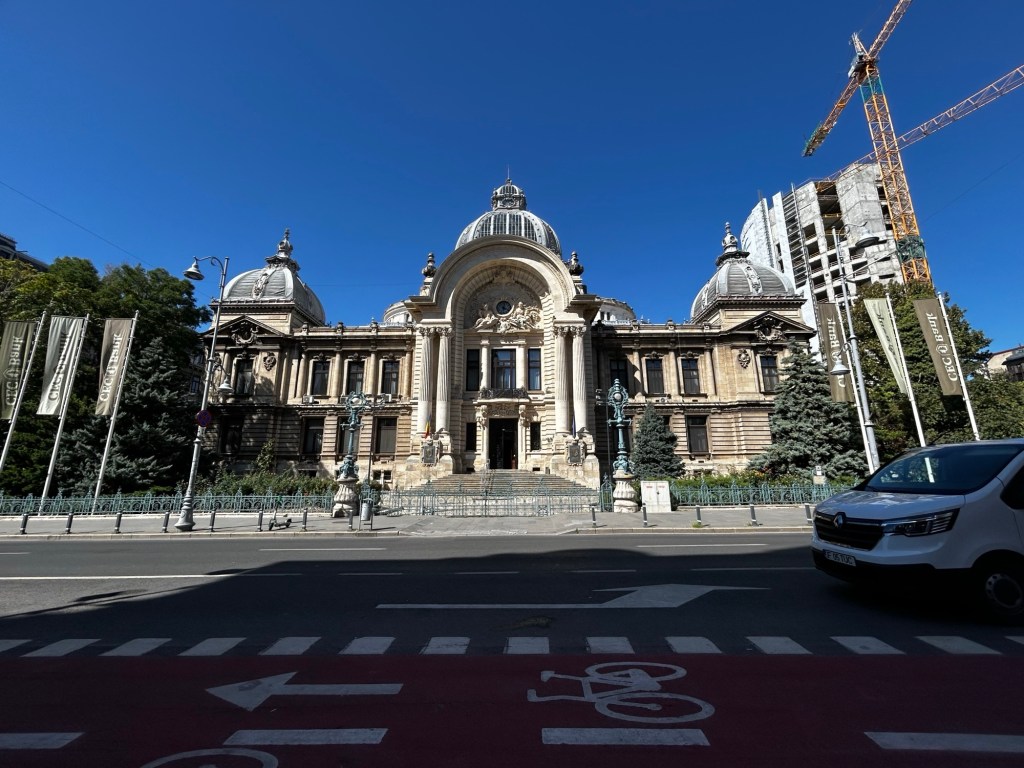
Our guide cuts off the road and into the myriad of backstreets. We approach a grand looking entrance and proceed inside. It’s a covered arcade known as the Macca-Vilacrosse Passage.
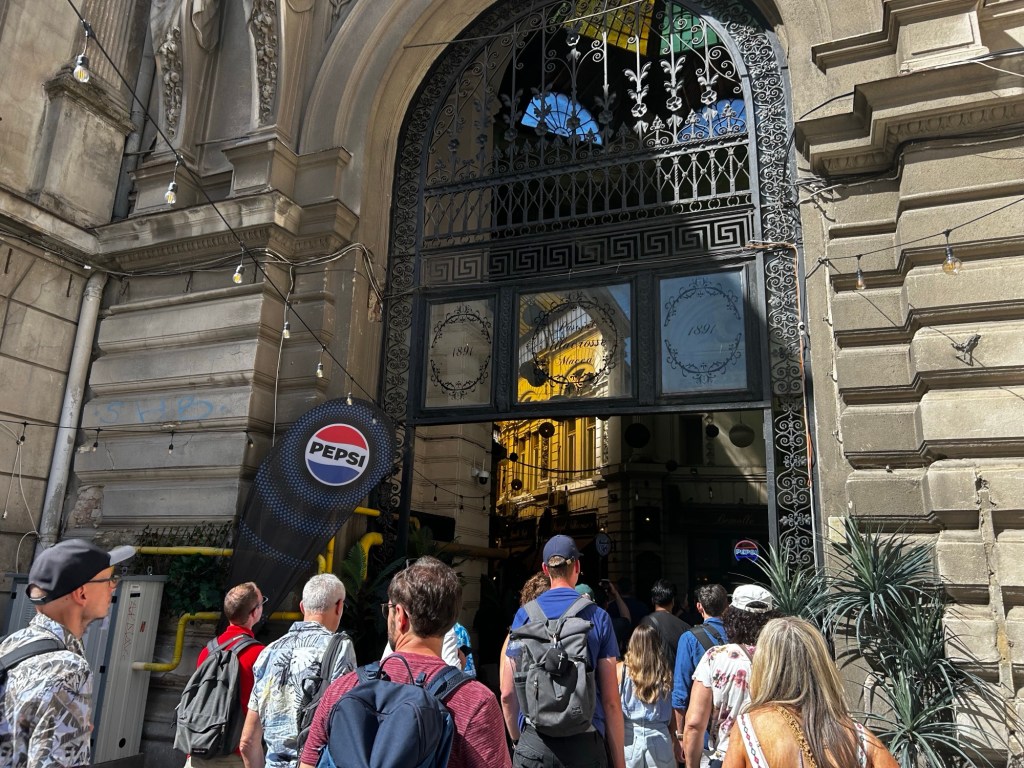
If I could describe it, I’d say it’s a similar idea to the Galleria Vittorio Emanuele II in Milan, or Borough Market in London. It’s just this one is lacking the designer stores and bustling market stalls. In fact, it’s lacking pretty much everything- there’s a couple of seedy looking bars, and that’s pretty much it. Wasted potential if you ask me.
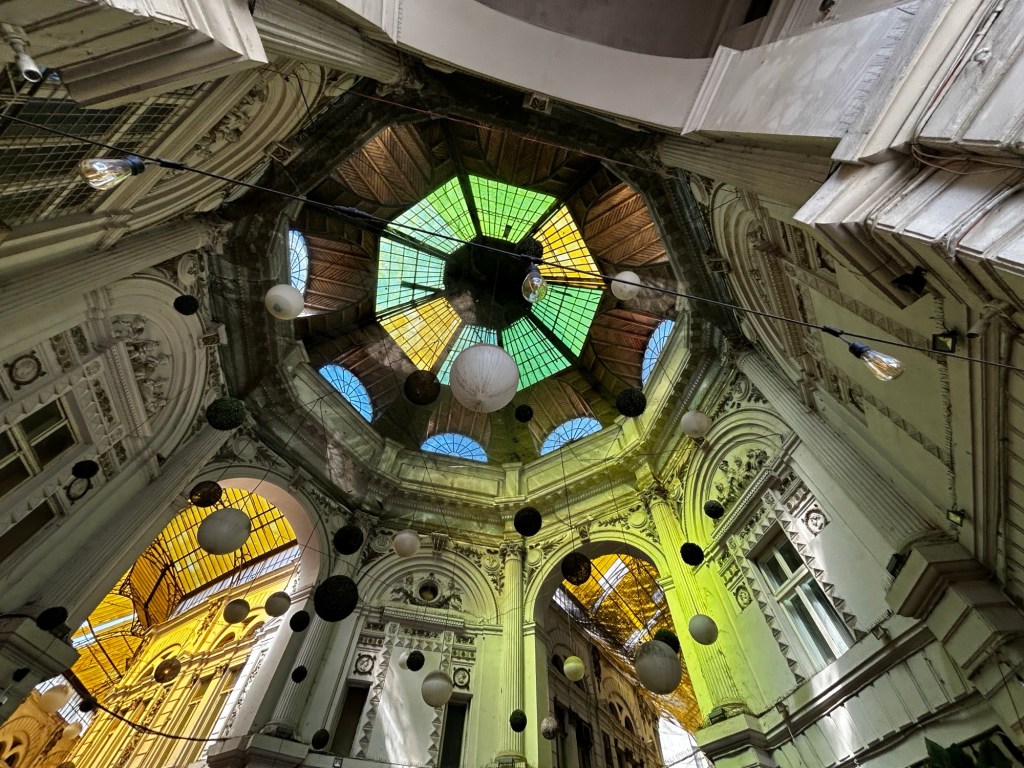
But what the Macca-Vilacrosse Passage lacks in functionality, it makes up for with abundant aesthetics! There’s fairy lights fluttering on nearly every window, and it’s enough to forget just for a brief moment what might go on behind.
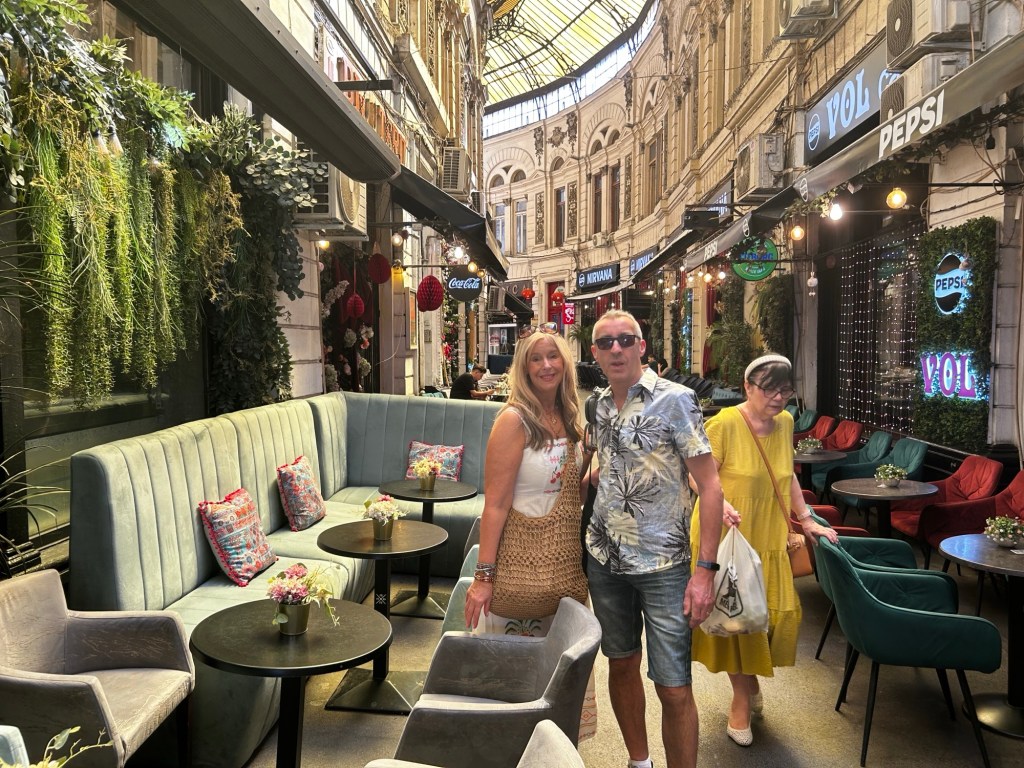
This passageway was formed as a shortcut between the Old Town, and the Calea Victoriei which in the mid-19th century was the main street in Bucharest. In order to make that happen, three families would have to sell their homes.
Further down the Calea Victoriei, we stop off outside a modestly sized high-rise. It’s the Palace of Telephones! Ah that rings a bell!
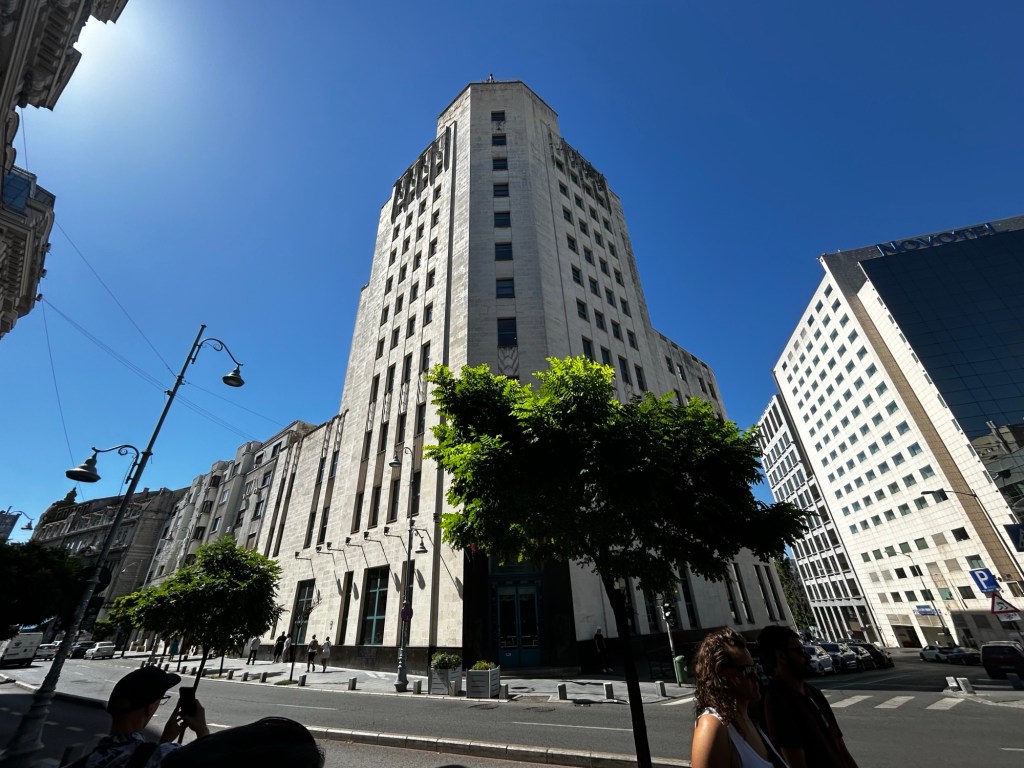
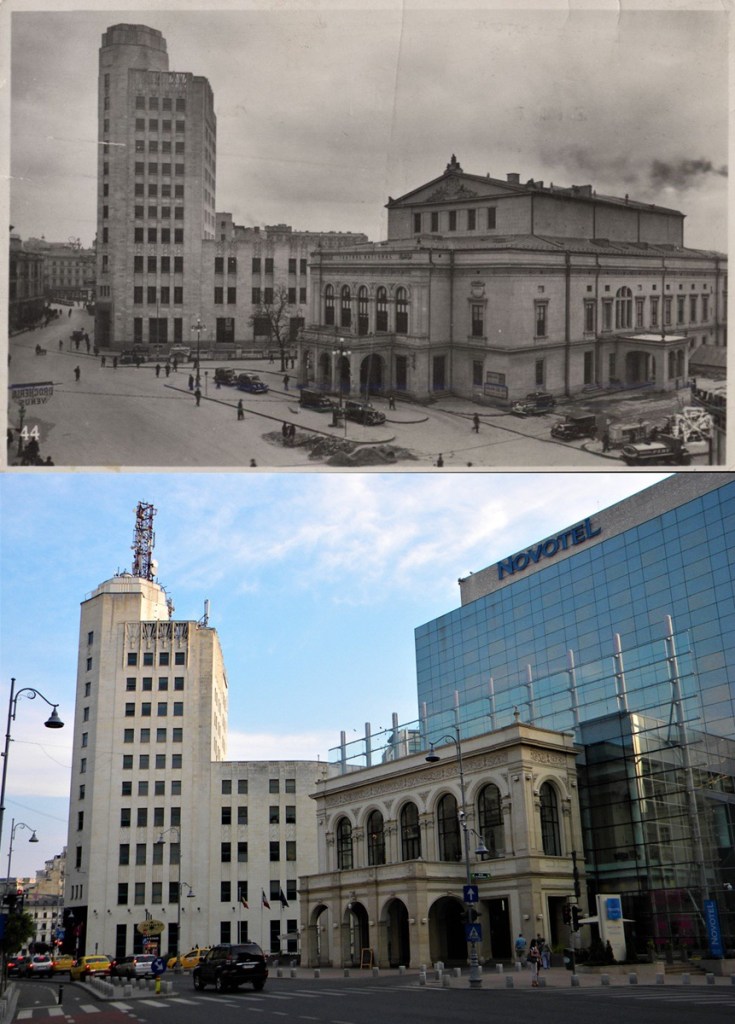
Completed in 1934, this was the tallest building in Bucharest until 1956 at 52.5 metres high. Technically, it was the first skyscraper in the city, and despised by locals at the time.
This building housed Romania’s telephone operations, and as Bucharest was the capital city of a country sided with the Nazis, it thus became a huge target for Allied airforces during World War 2. By wiping this one building out, Romania’s communication infrastructure would be in tatters.
The funny thing is, it wasn’t the Allied forces that came closest to destroying this building, but the Germans. In August 1944, Romania’s 22 year old monarch King Mihai I made the decision to overthrow the pro-German dictator Ion Antonescu as prime minister, and switching allegiances in the war, drew heavy aerial fire from the Luftwaffe. But they missed, and instead took out the adjacent National Theatre.
It’s more or less at this very moment that we hear a bang at the other side of the street. A driver (trying to round a 90 degree corner) has gone too tight to the kerb, and made contact with a square bollard. He slowly reverses back to reveal the damage – the bollard is now at a significant angle.
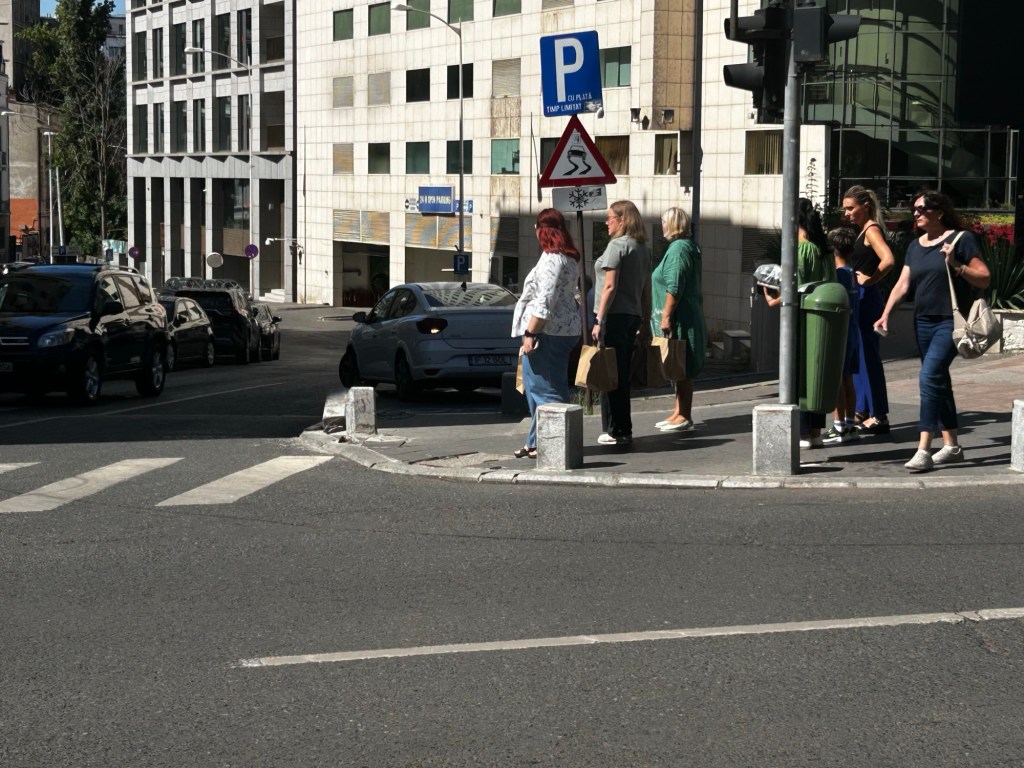
The driver gets out to examine as we all try hard not to watch too obviously.
This coup was ultimately one of the worst things for the people of Romania. Shortly after, the Soviet Red Army invaded the country and forced King Michael to appoint a communist government, and not long after that, he was forced to abdicate at gunpoint.
In 1965, Romania’s first communist leader Gheorghe Gheorghiu-Dej died, and his protege Nicolae Ceaușescu was chosen to lead.
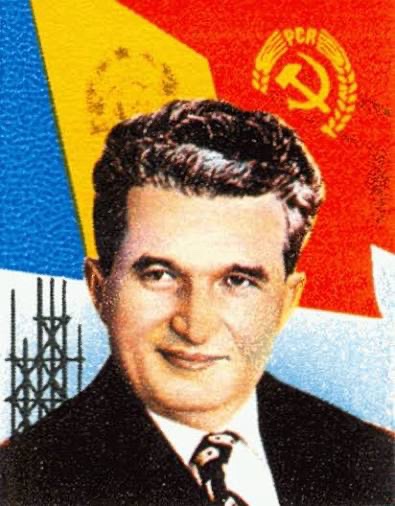
Nicolae and his wife Elena were a power couple – Romania’s answer to Romeo and Juliet. They were very popular with the Romanian peoples and things were going well, until they weren’t.
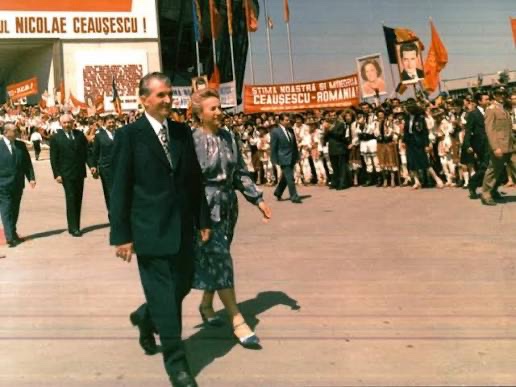
In 1971, Ceaușescu travelled to China & North Korea, two other communist states, and he was very impressed with what he saw.
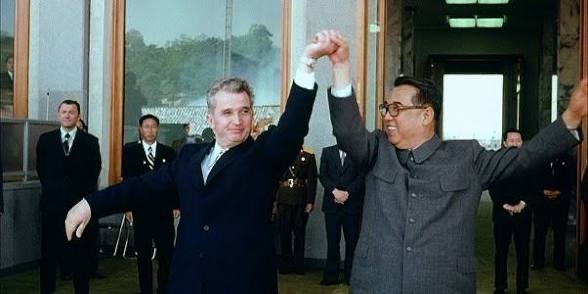
Upon his return, he developed a plan ‘Project Bucharest’ to raze the city centre and rebuild it in the style of Pyongyang. He had a huge Palace built, and this essentially bankrupt the country. Its people, who were already very poor, now had extreme austerity measures to pay back a roughly $11 billion debt. Electricity in the city cut off at 10pm, heat and water was restricted, and food rationed. Every night, huge queues would form in neighbourhoods outside grocery stores, only those at the front of the queue would get food before shelves were empty.
In April 1989, he declared the debt had been repaid, and Romanians hoped this would bring some drastic changes to their fortunes, but this did not materialise and they started to turn on their leader.
In November 1989, the Berlin Wall came down, and protests gathered traction across Eastern Europe, particularly here in Bucharest.
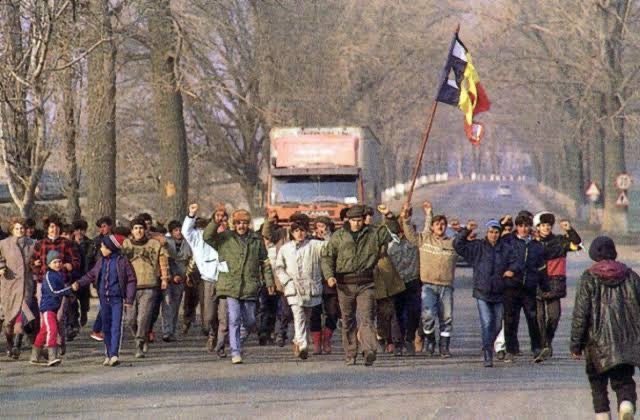
In 21st December 1989, a group of students gathered for a peaceful protest – angered at Ceaușescu’s violent response to earlier protests in Timișoara.
To try and bring order back to proceedings, Ceaușescu headed out onto his balcony to give a speech sarcastically wishing protestors success. Mid speech, a loud explosion could be heard from the crowd, and with Ceaușescu visibly shaken, the camera footage cuts out.
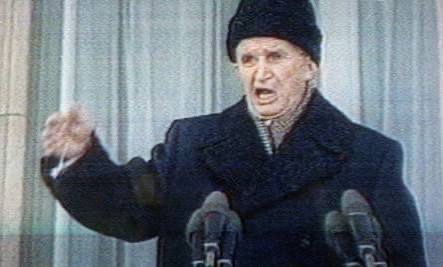
It’s said that the military then opened fire on the crowds. Officially there were 49 casualties, but it’s estimated there were three times as many fatalities, and many more heavily injured. Everything was covered up, and the extent of this tragedy wasn’t reported in Western press.
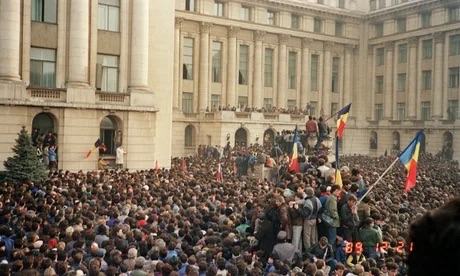
The following day, thousands more marched in protest to Palace Square outside the communist party headquarters, but inside things were already unravelling. The Defence Minister was now dead (whether by suicide or execution, no one is really sure).
By 10am, a state of emergency had been declared, banning groups from gathering, but the genie was already out of the bottle in that regard. As the crowd broke in, Mr and Mrs Ceaușescu loaded themselves into a helicopter and said that’s quite enough of all that thank you very much.
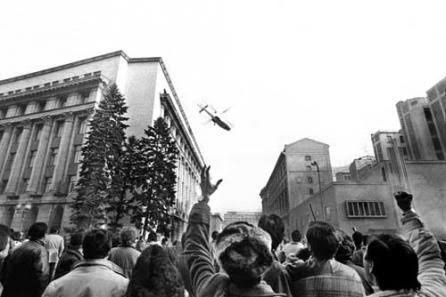
They flew to Snagov, then on to Târgoviște where they were finally caught trying to hitchhike out of Romania. Both were tried for war crimes, and found guilty of genocide, subversion of state power, destruction of public property, undermining the Romanian economy and attempting to flee with $1 billion of public money then sentenced to death by firing squad. They were executed on Christmas Day 1989.
In the aftermath, the hammer and sickle were physically cut out of the middle of the flag, and not long later, it was officially updated removing all emblems, and leaving the three vertical stripes in blue, yellow and red.
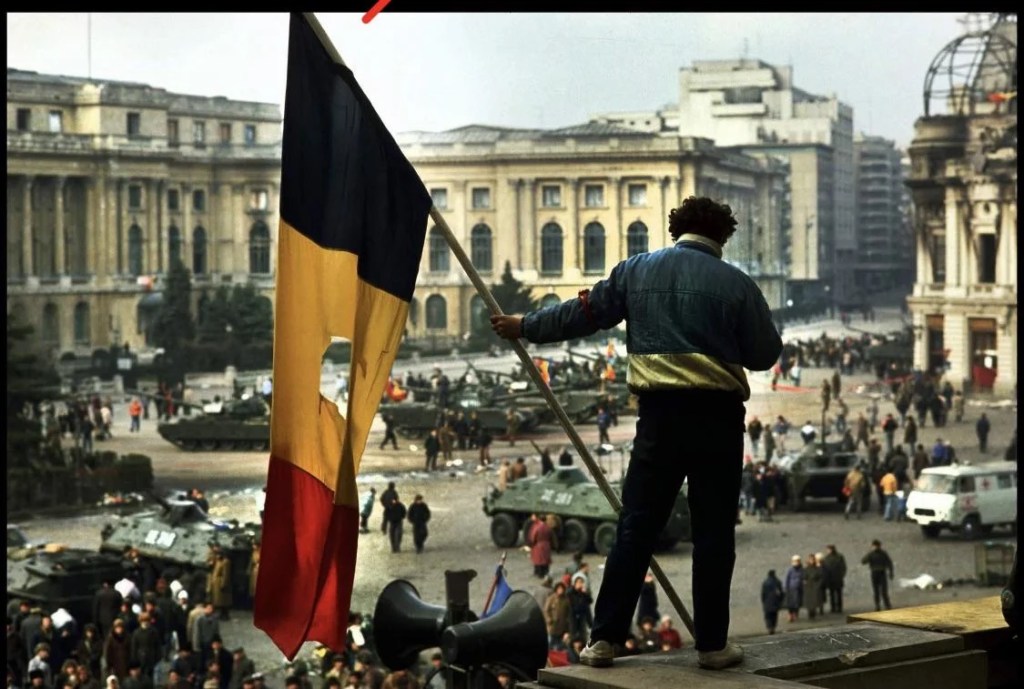
The end of harshest communist regime in Europe didn’t magically make things ok. Thousands paid the price for freedom. The Palace Square where all of that took place was later renamed Revolution Square, and this is the final stop in our walking tour.
Today this square has been turned into a bit of a park, and there is a monument in the middle commemorating the dark events of 1989. It’s been rather cruelly dubbed “The Potato on a Skewer” (although it’s not hard to work out why!)
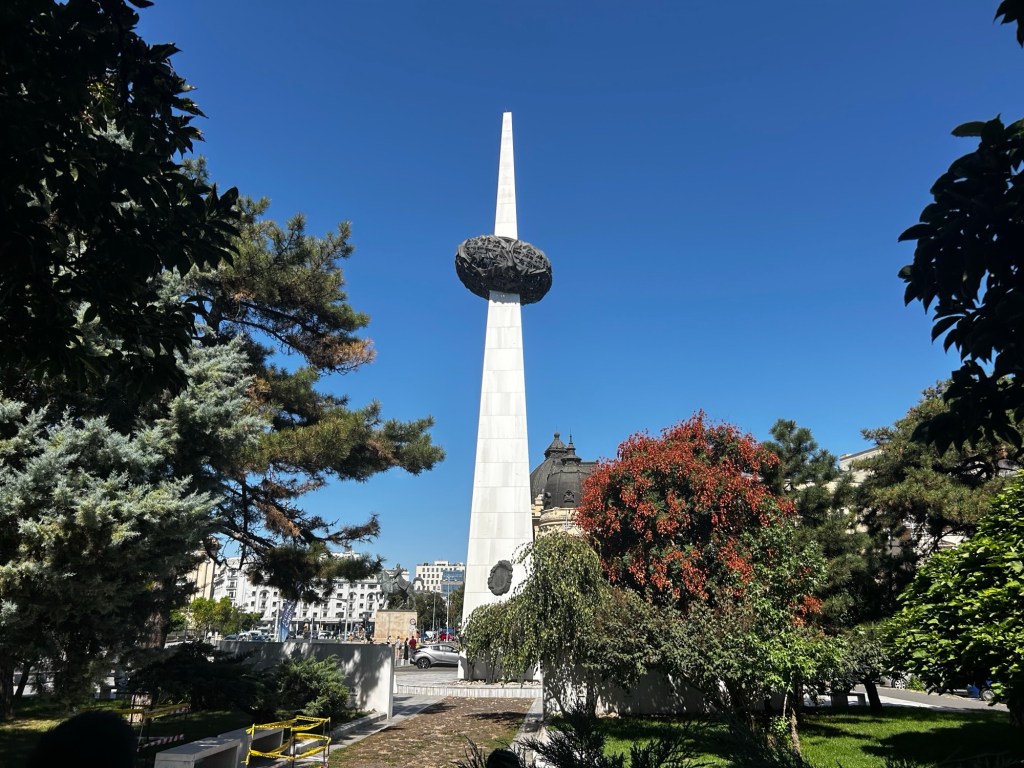
The black potato represents the darkness of communism, and the white spike represents the resilience of the Romanian people in breaking through. Behind the monument is a brass plaque containing the names of all of victims.
The memorial cost around €1.2 million and the hard hearted locals took a lot of convincing. Although you could forgive them given their experience with the Palace of Parliament.
I have to say I love a good walking tour, and Ana was a brilliant guide. These walking tours are free, but the guides rely on voluntary donations to earn their living. 100 Leu each (around £16) each felt appropriate.
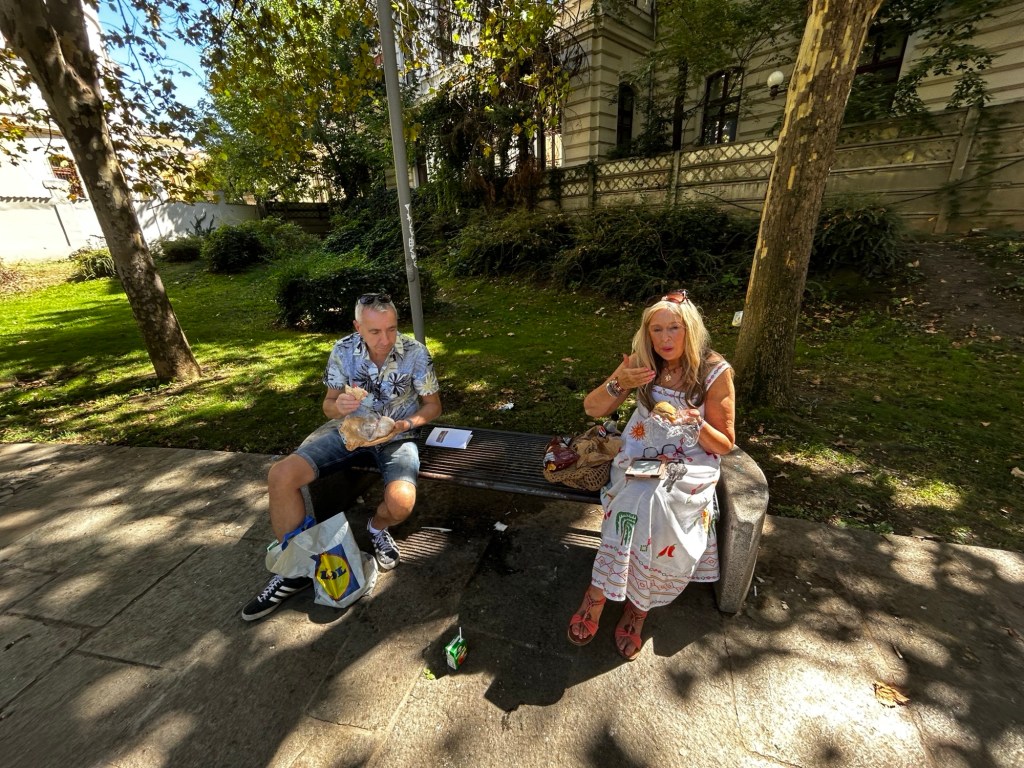
It’s just past 1pm and hunger pangs are setting in. We’ve got a packed lunch prepared, so head back to the car to grab it. There’s a nice wee park just across from University Square, and the trees provide ample shade for us and the birds paroling the grass. We head into the old town in search of coffee and sweets.
The Grand Cafe Van Gogh soon appears on the horizon and fits the bill well. Inside, this place is just extraordinary, with the works of the renowned Dutch artist filling the walls.
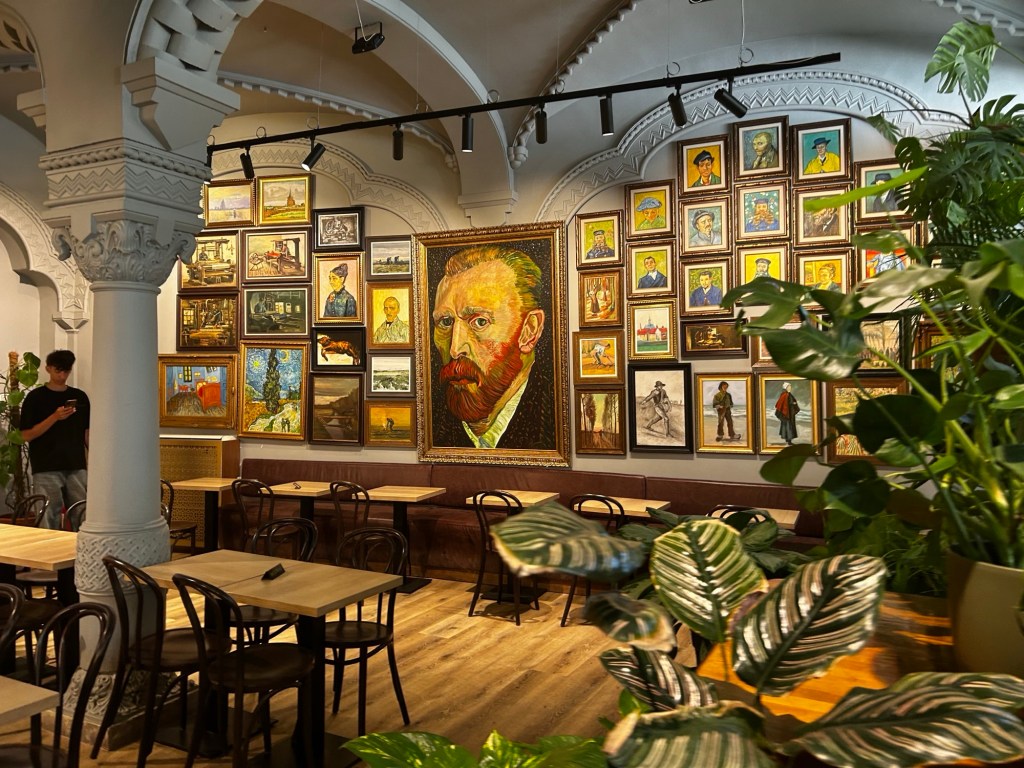
Waiting for drinks to arrive, gives me a great chance to dust off my inner art connoisseur.
I’d read last night that scientists have confirmed that his Starry Night painting is scientifically accurate. Meanwhile some say that the waiter dressed in white in ‘Cafe Terrace at Night’ is actually Jesus. I don’t think my mum and dad were really all that interested!
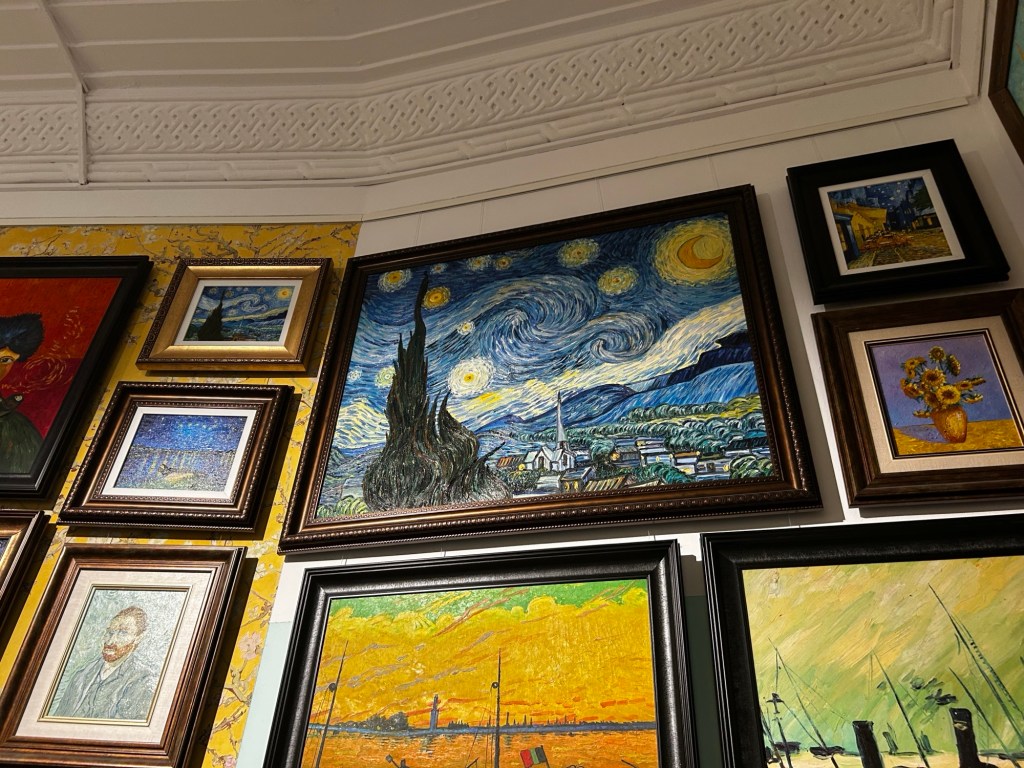
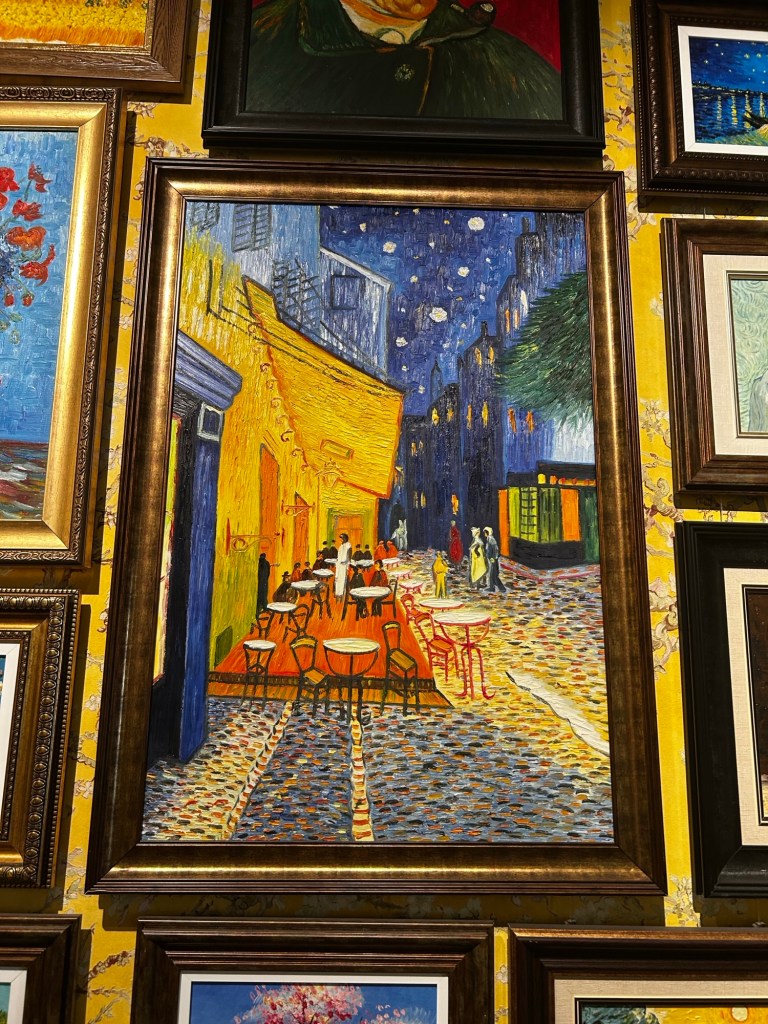
After enjoying the refreshing tastes of a cup of English Breakfast Tea and strawberries coated in Nutella, we get notification that the final two members of our party have arrived into Bucharest Airport, and we set off on our merry way to collect them. It’s my sister and her new fiancé Al.
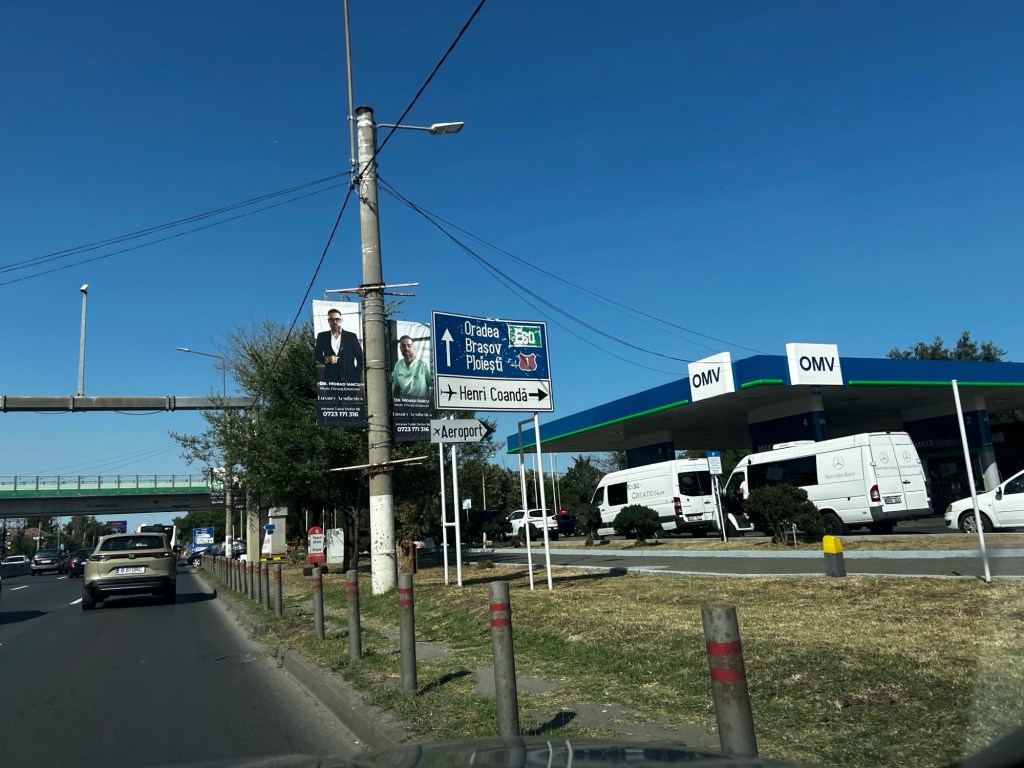
Traffic leaving central Bucharest is much heavier than expected, and what should have been a 25 minute journey, ended up at well over an hour. Even still, it was great to see them when we did finally arrive. I ask if they’ve ever heard of Henri Coandă and the answer is no. I don’t think they found my story about the Coandă effect half as interesting as I did.
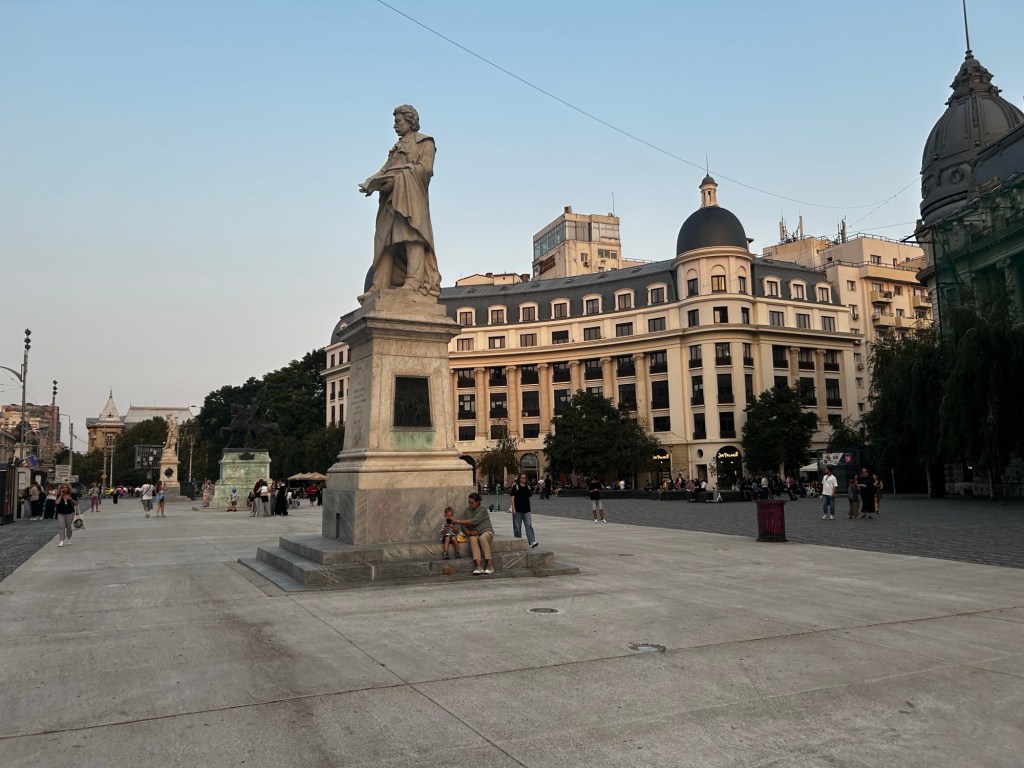
After a brief stop back at our accommodation, we later head back into the city centre for dinner. There’s a beautiful reddish tinge in the sky and a much more vibrant atmosphere in the Old Town than when we walked through this morning. In fact I’d go so far to say that the whole place has just come alive.
One of the food recommendations was a place called Caru’ Cu Bere just down from the Stavropoleos Monastery. Its name means “the beer wagon”, and this harks back to its days as a brewery in the late 19th century.
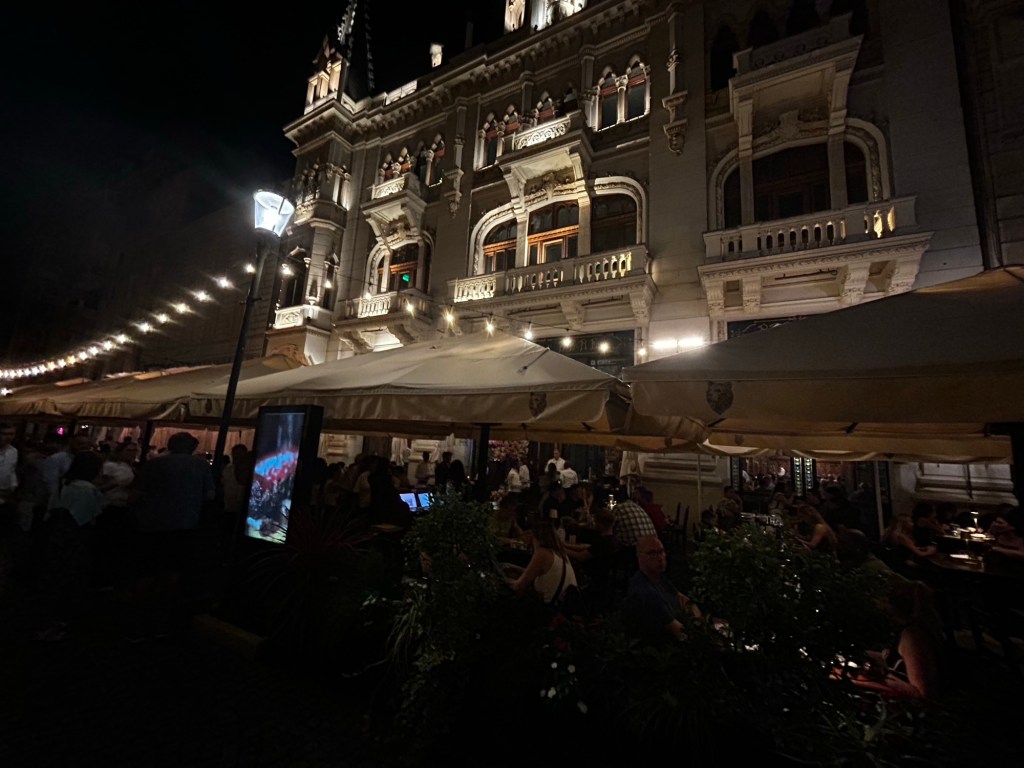
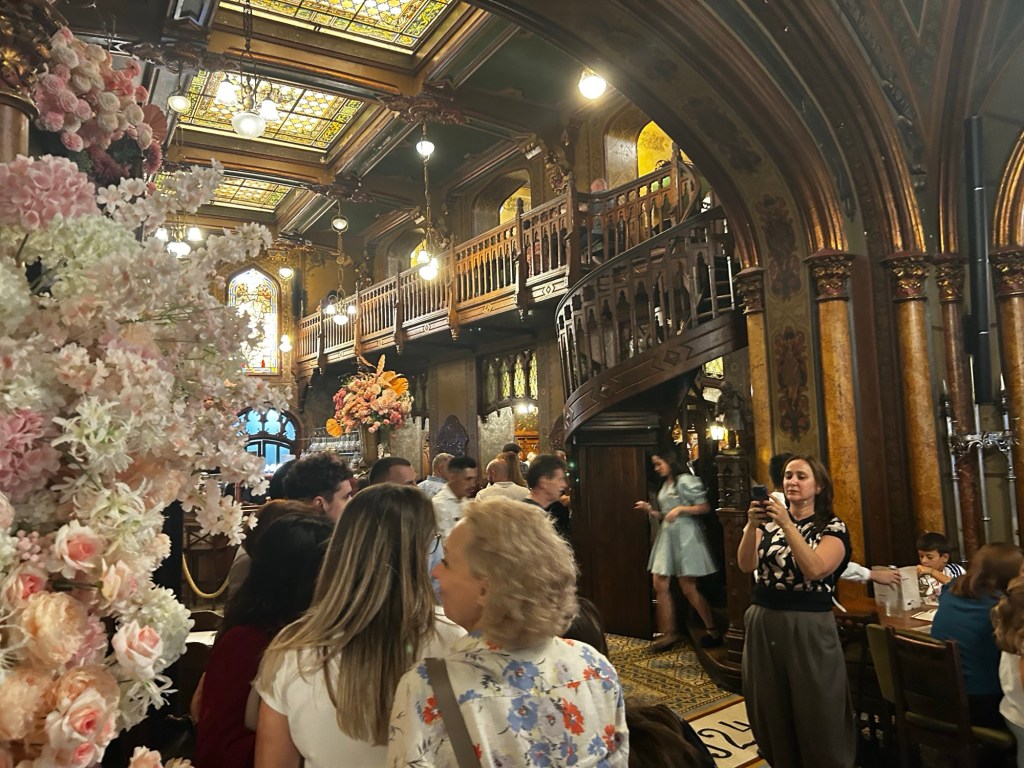
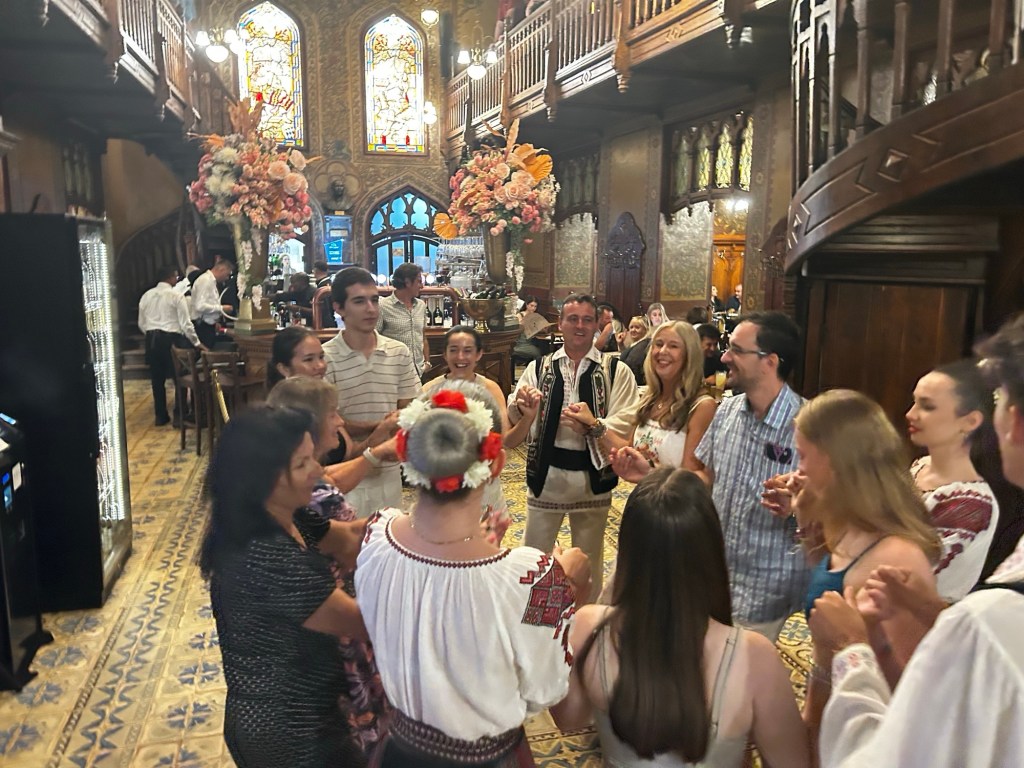
In 1897, this building was sold to the Căbășanu to house their brewery, and open a restaurant. It’s a mix of German gothic revival and art nouveau and absolutely beautiful on the inside. You’d be forgiven for thinking you’re in a church with the stained glass windows and wooden booths resembling confession stalls.
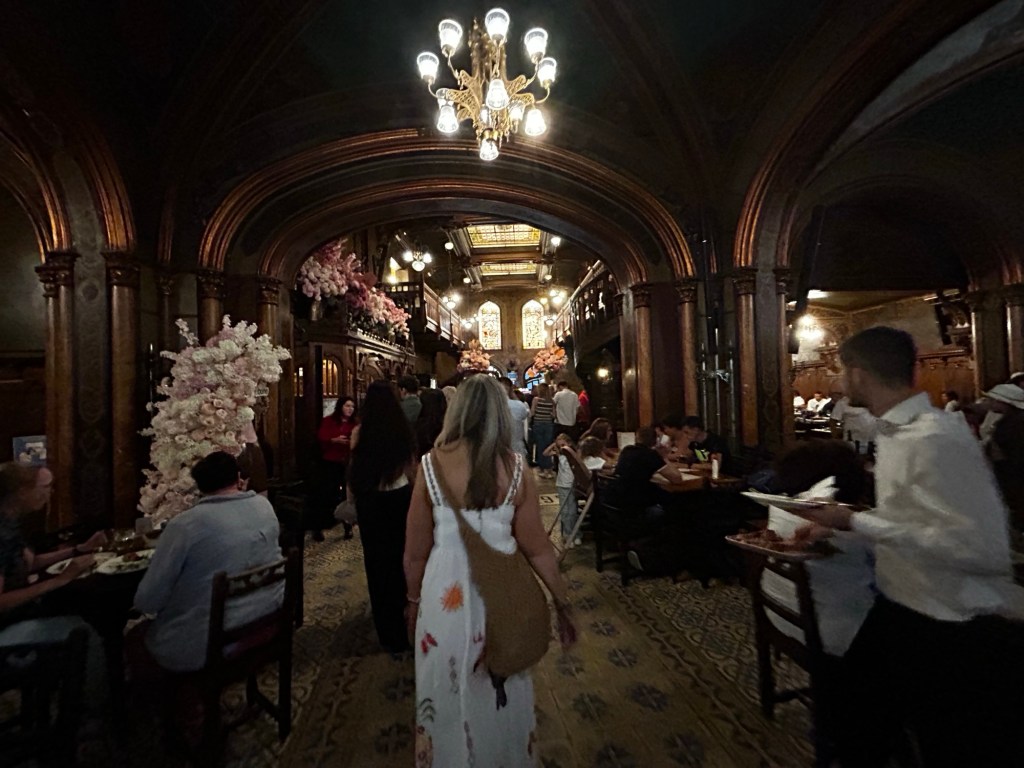
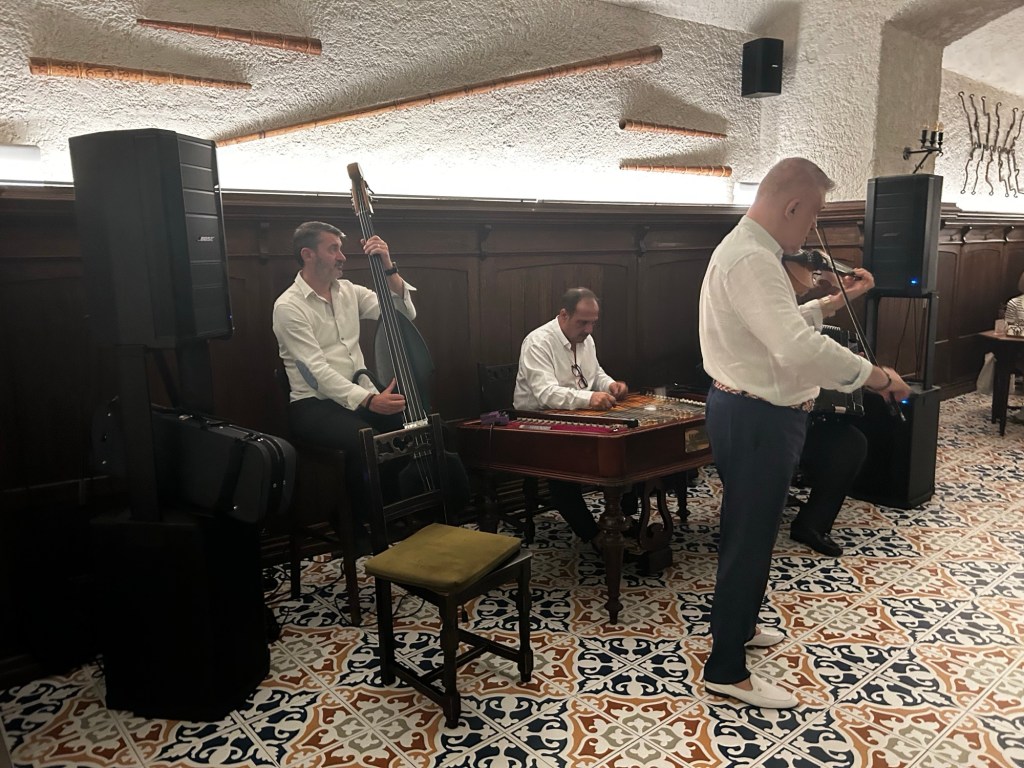
We’re taken to a table down in the beer cellar-cum-basement where a traditional folk band or taraf are playing covers of contemporary pop songs.
Romanian cuisine is predominantly pork based, and this was a clever way of locals circumventing food taxes when the Ottomans had control of Romania – Islamic laws meant they could not touch, tax or confiscate pigs.
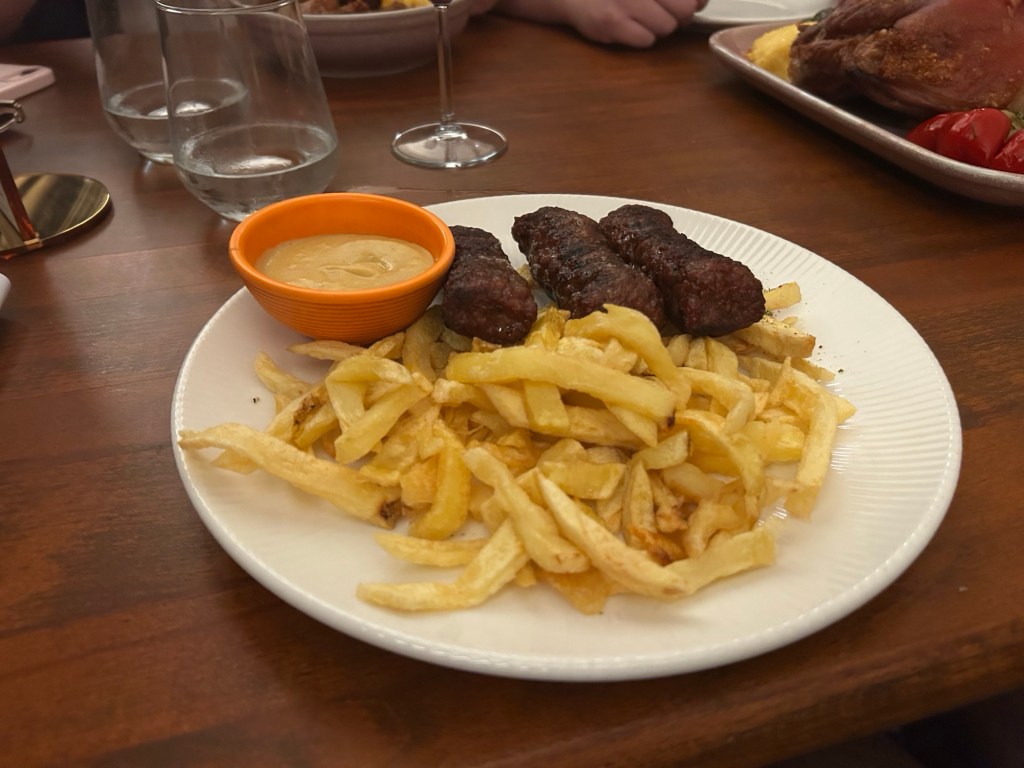
Tonight I’ve decided to go for mici, a form of skinless pork sausage (basically elongated pork meatballs) served with a little bowl of mustard.
I go upstairs to get some photos, and discover a lot of people dancing. I say dancing… more like a glorified version of Ring o’ Roses. My mum and sister get roped into the circle! It sounds like dancing is pretty common here!
The food was absolutely amazing, so much flavour in a pretty straight forward dish.
After dinner we walk back down Lipscani Street to one last place of interest: Cărturești Carusel, described as one of the prettiest bookshops in the world.
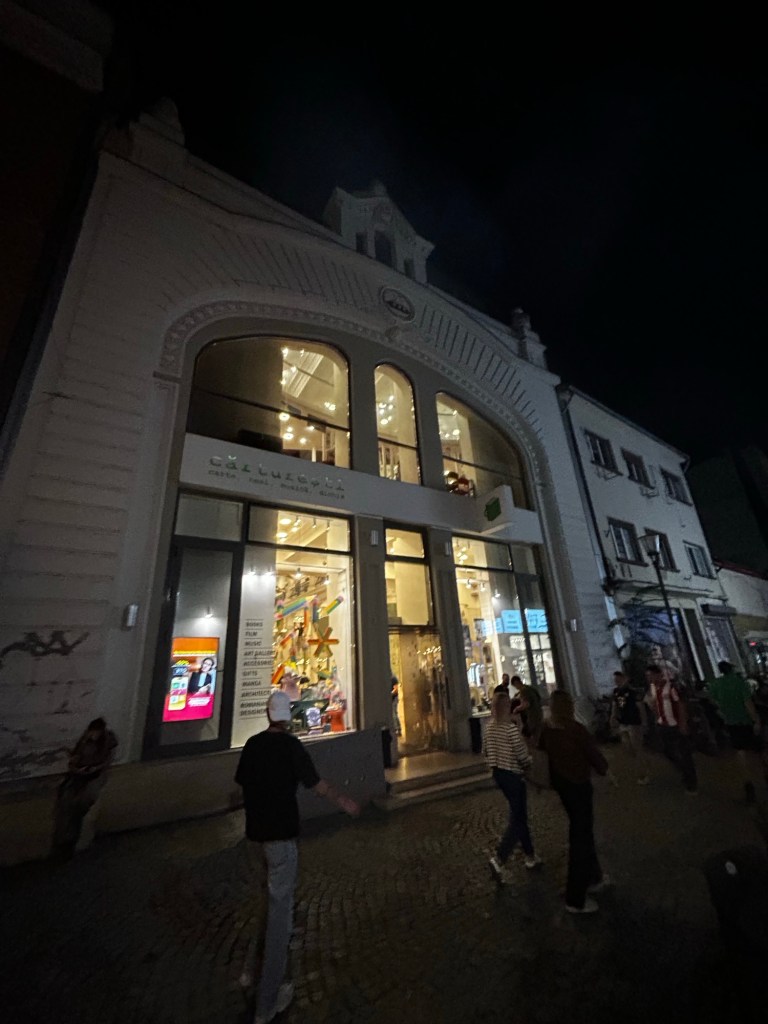
Built in 1903, this was a casualty of Bucharest’s dark communist period, and left in a state of decay until 2007. It was then restored back to former glory and named Cărturești Carusel meaning “carousel of light”. The lights are on, so that’s a good sign!
There are 3 floors with beautiful balconies and spiral staircases. All painted white giving a very obvious sense of that light that the name refers to.
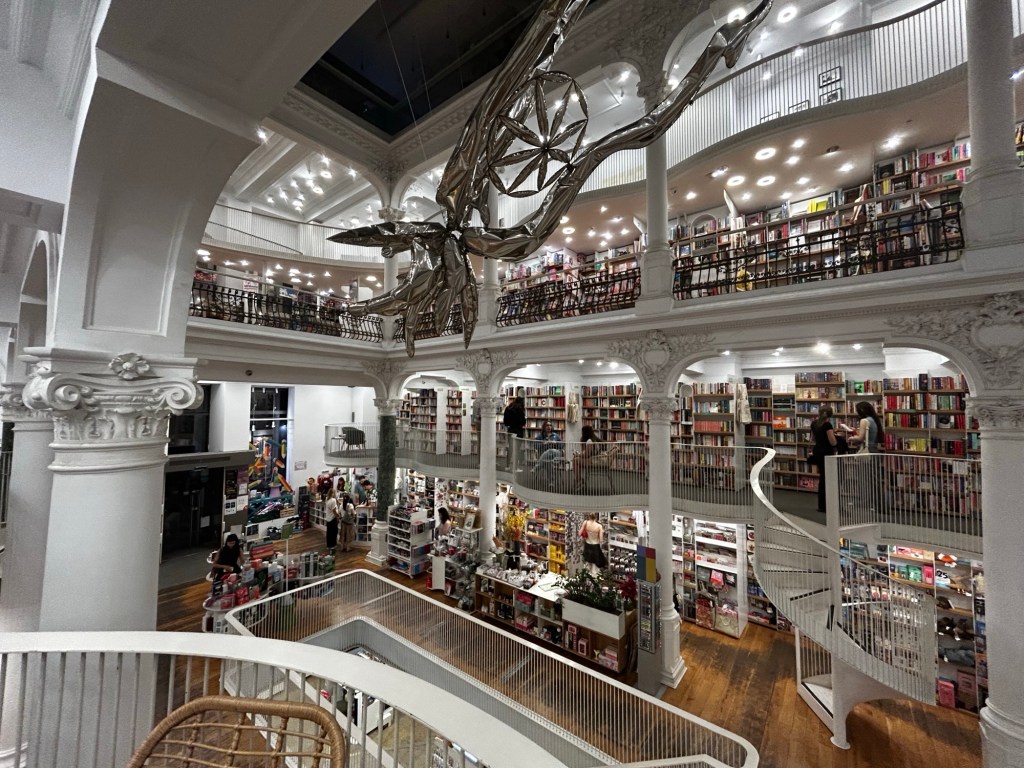
As nice as it is though, I must declare a sense of underwhelmment. We’ve been rather spoilt by having previously visited the Livraria Lello in Porto. I don’t think this one really comes close unfortunately.
After picking up a few souvenirs, we head back home (or at least, our home away from home). It’s been a very full on start to this trip and a brilliant day. I’ve learnt so much already and can’t wait to see what the next week and a half has in store.



Leave a comment