It’s a very exciting day today, as we’re heading to Transylvania on a tour of some of the region’s most famous places.
We’ve booked the tour with Zig Royal Tours through Get Your Guide. It’s a bit of an early start, as we’re told to meet outside the Grand Hotel Bucharest (not to be confused with the Grand Budapest Hotel, which is a film) just before 8am.
There’s a beautiful reddish sunrise as we drive to the meet point in the city centre, but the traffic (like it was yesterday) is proving to be a bit of a nightmare. It’s a Friday and looks just like the regular morning rush.
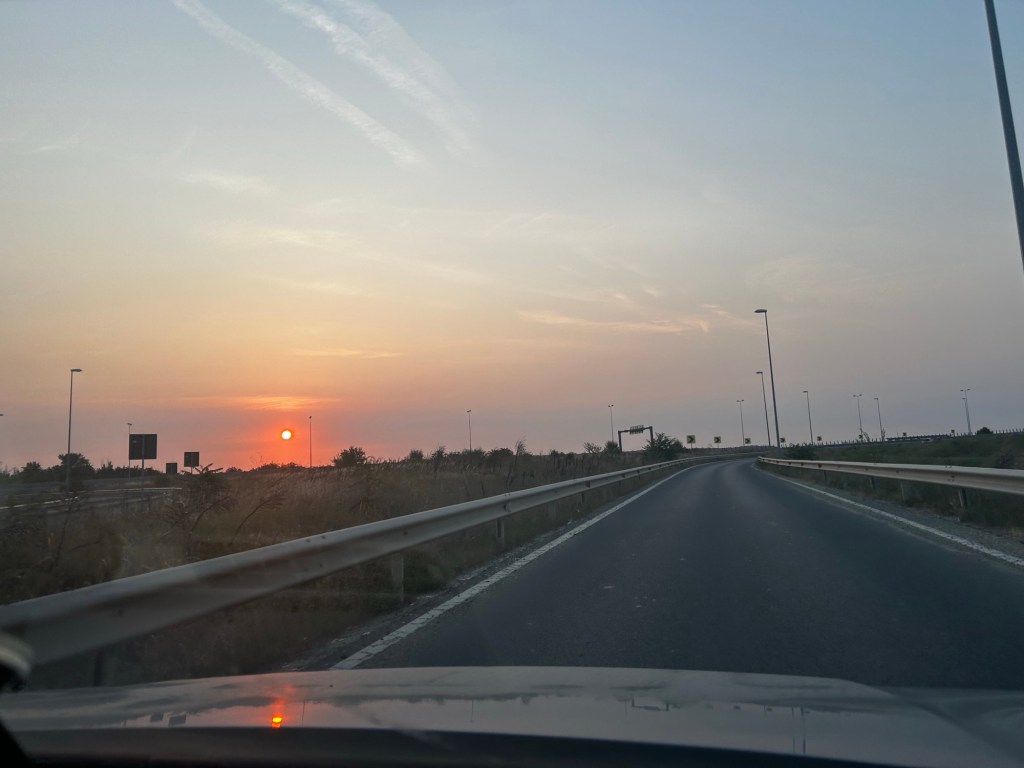
I get rather concerned as our satnav ETA passes 8am, and let our guide know we might be a tad late. She suggests we meet them at the second pickup point at the other side of the city, but this won’t help us at all. We continue on per the original plan and manage to save a few minutes. By the time we arrive into the city centre we have something like 3 minutes to sprint from the car park to the meet point and arrive at 8 am on the dot.
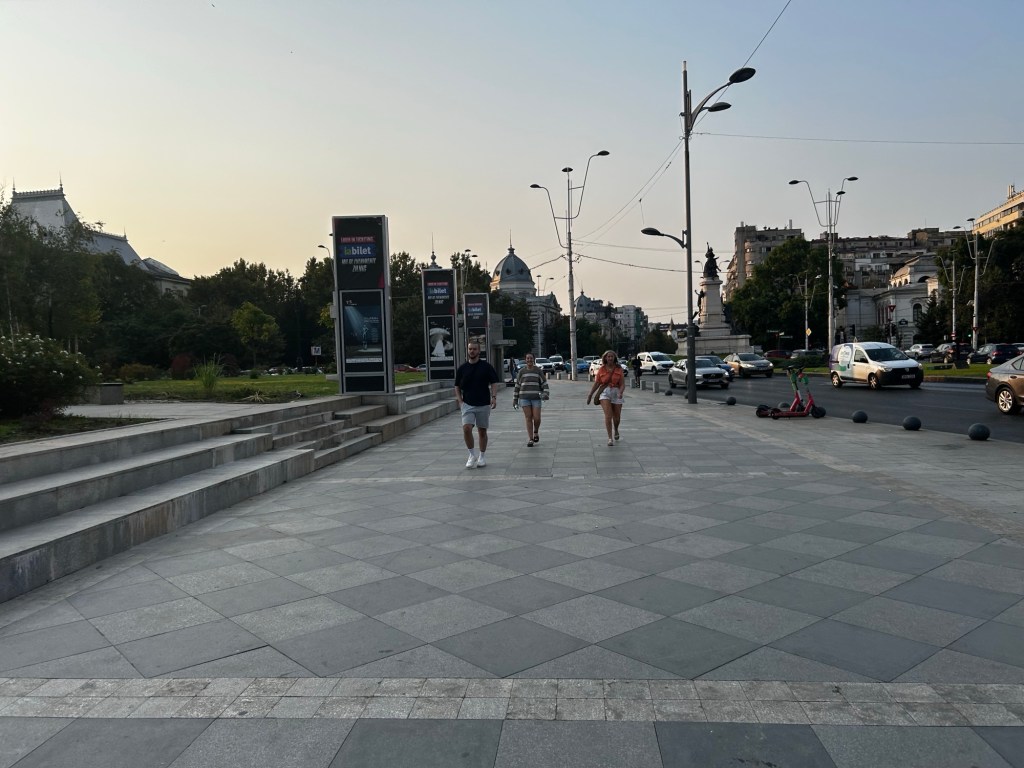
There’s a silver bus waiting for us, with the tour guide anxiously waiting for our arrival. Her name is Ioana, and she speaks English with a very strong Spanish flavour. In fact if I had to guess, I’d say she was Spanish, or at least spent a lot of time there. She introduces the driver as Mr Dan.
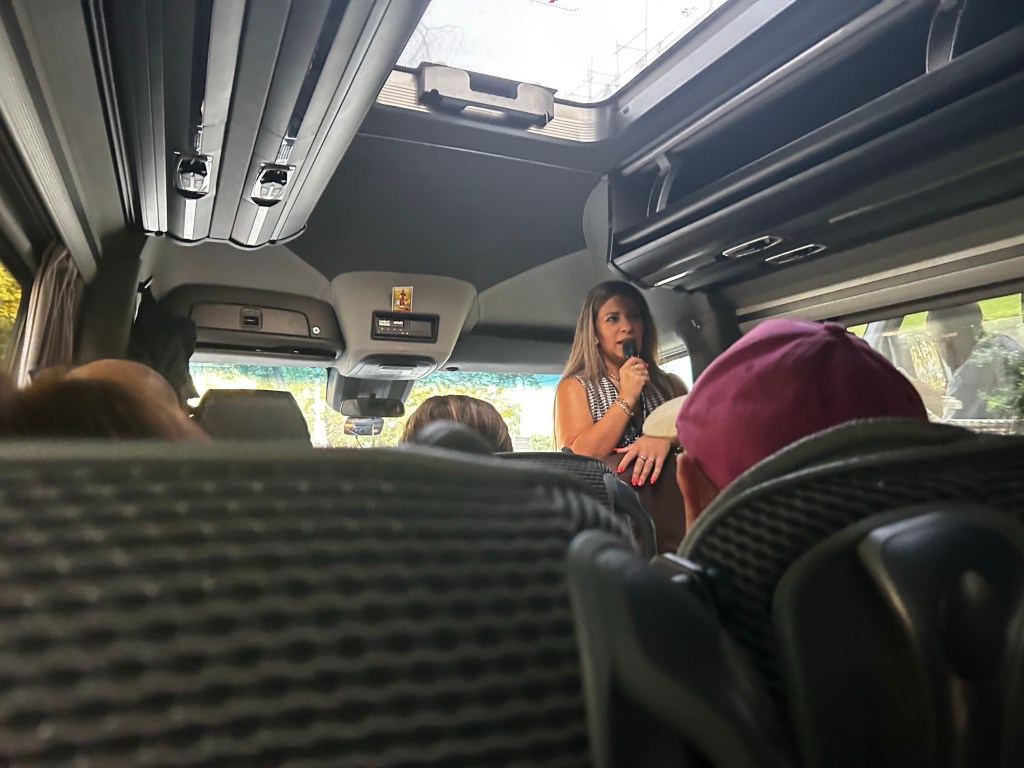
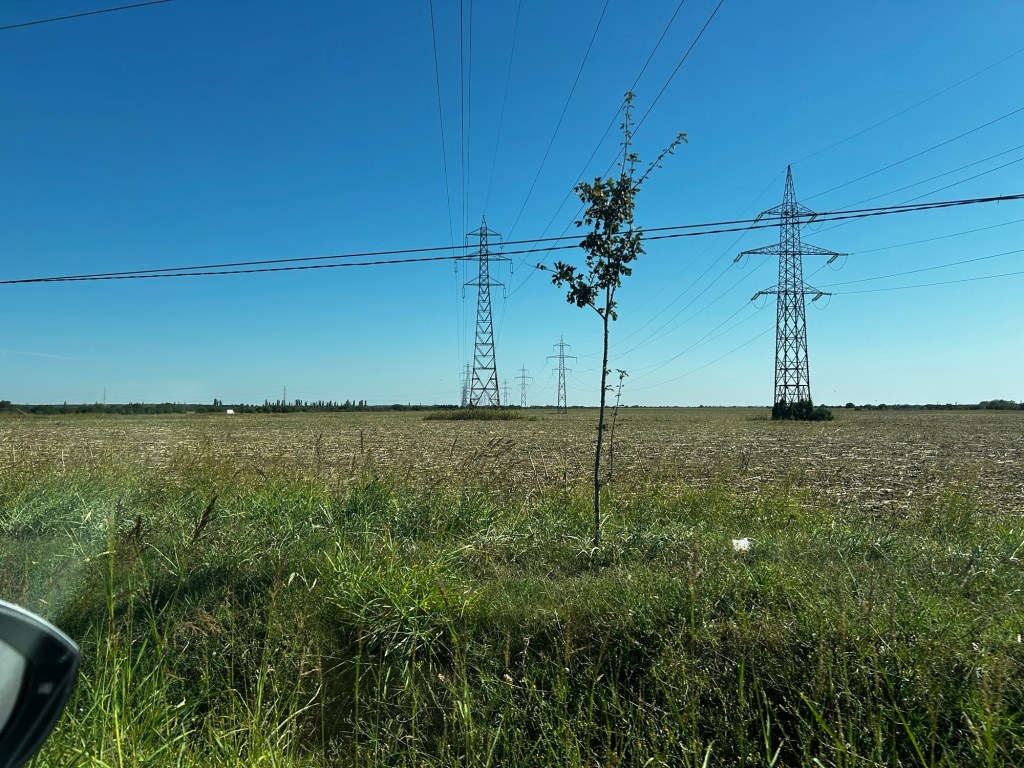
We’ve been told to expect some incredible views on this trip, but that would come much later on – there’s not much to see in the immediate vicinity of Bucharest other than (pretty flat) fields and industrial warehouses.
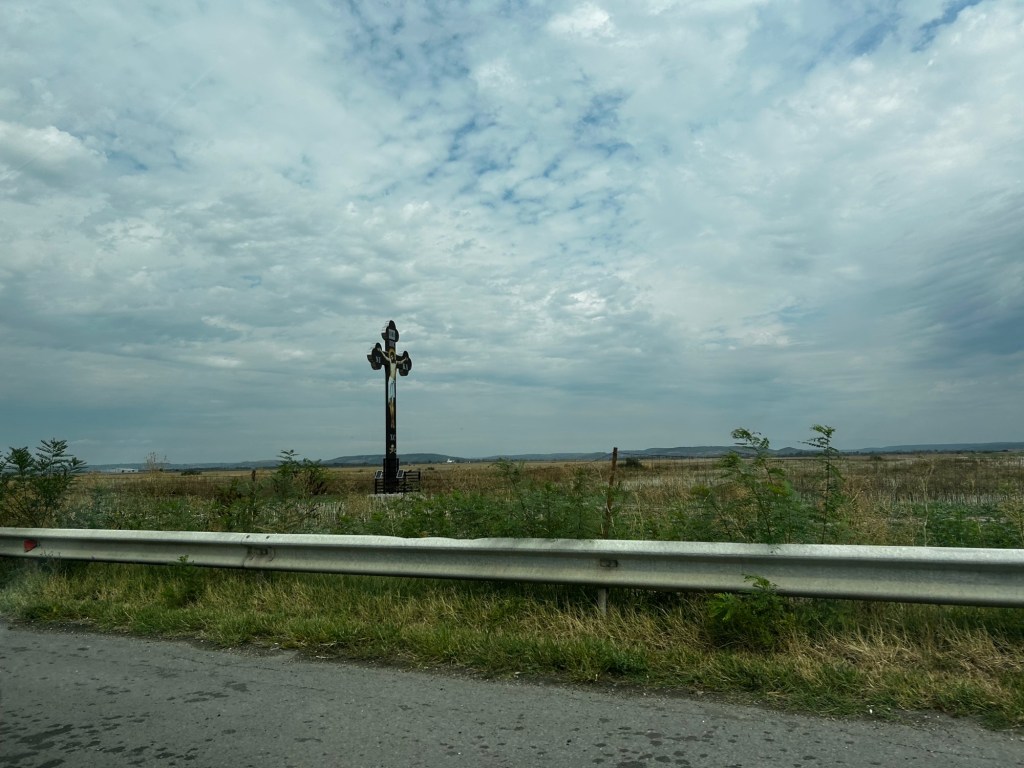
After about two and half hours on the road (including a short rest stop at a motorway service station) we arrive at the town of Sinaia. “Where do you think this name comes from?” Ioana asks. Never missing a trick, Dad jumps straight in with the right answer: “from the Bible!” Correct!
It turns out Sinaia is named after Mount Sinai in Egypt. This is where Moses received the 10 Commandments from God. A few hundred years ago Prince Mihail Cantacuzino was travelling on a pilgrimage there. He came back to Romania and built a monastery, naming it after Sinai (just sticking an extra a on the end to make it sound a bit more Romanian!) He planned to have 12 monks – one for each of the apostles, but over time the number of monks increased. The town grew around the monastery and, well, here we are.
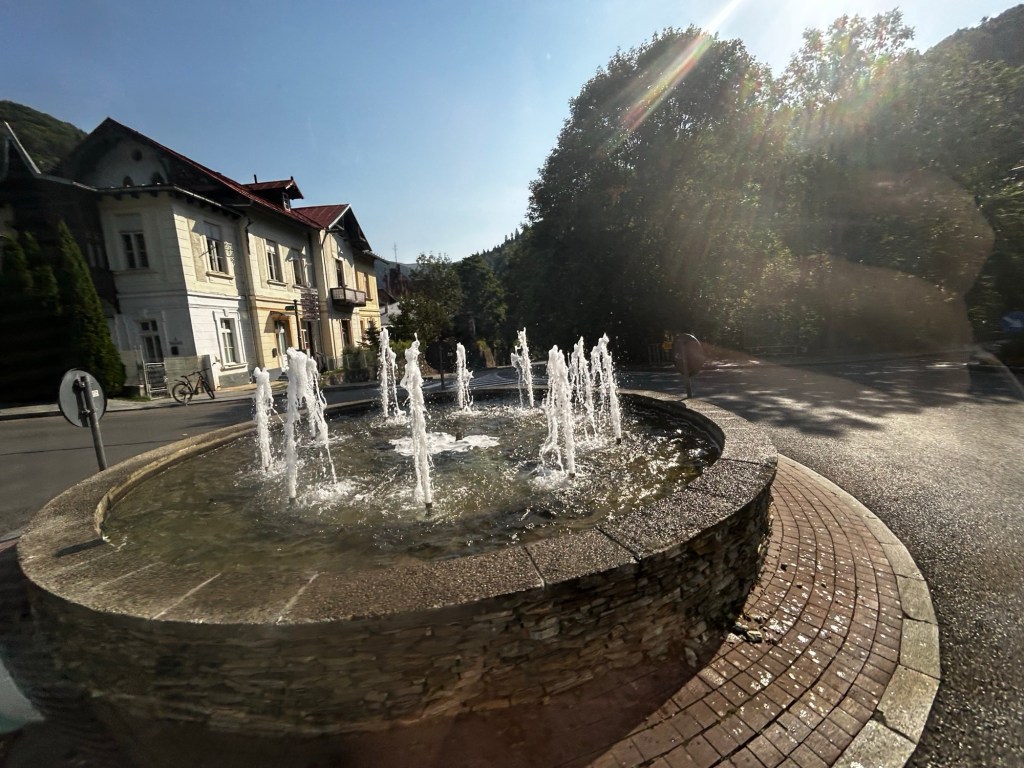
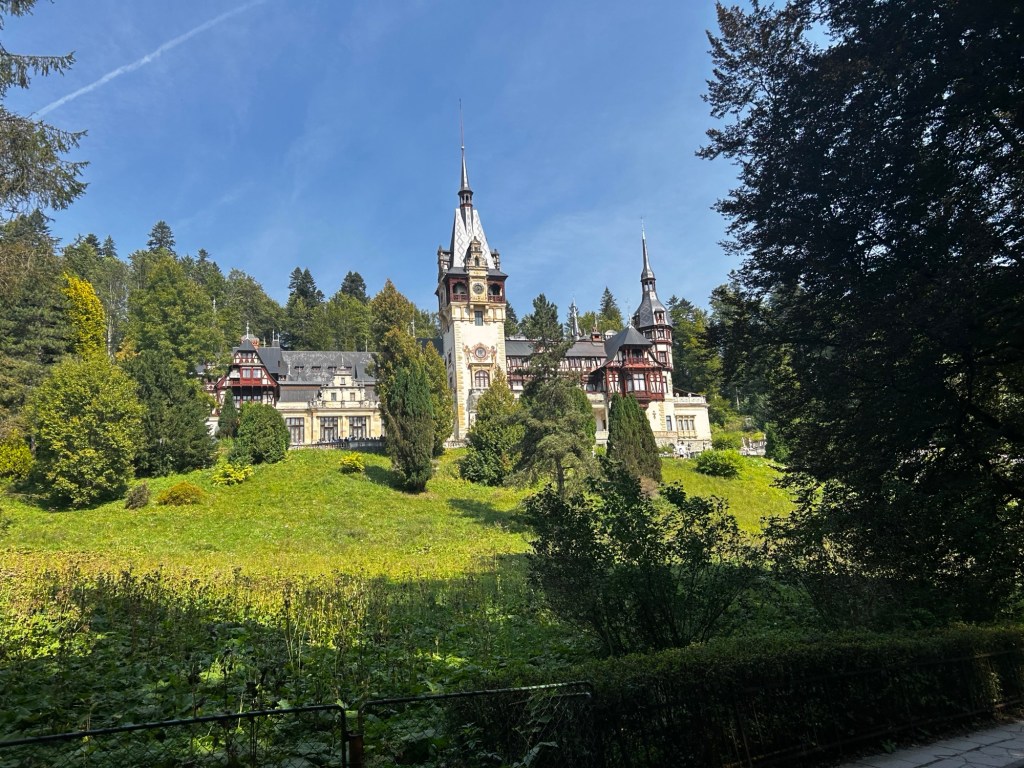
Nowadays, Sinaia is better known for Peles Castle. It’s situated at the foot of the Bucegi mountains (part of the wider Carpathian range). Many consider this to be one of the most stunning castles in Europe, both inside and out, and Ioana emphasises that this is the much better of the two castles we’ll see today (even if the other one is much more famous, and the reason everyone comes here).
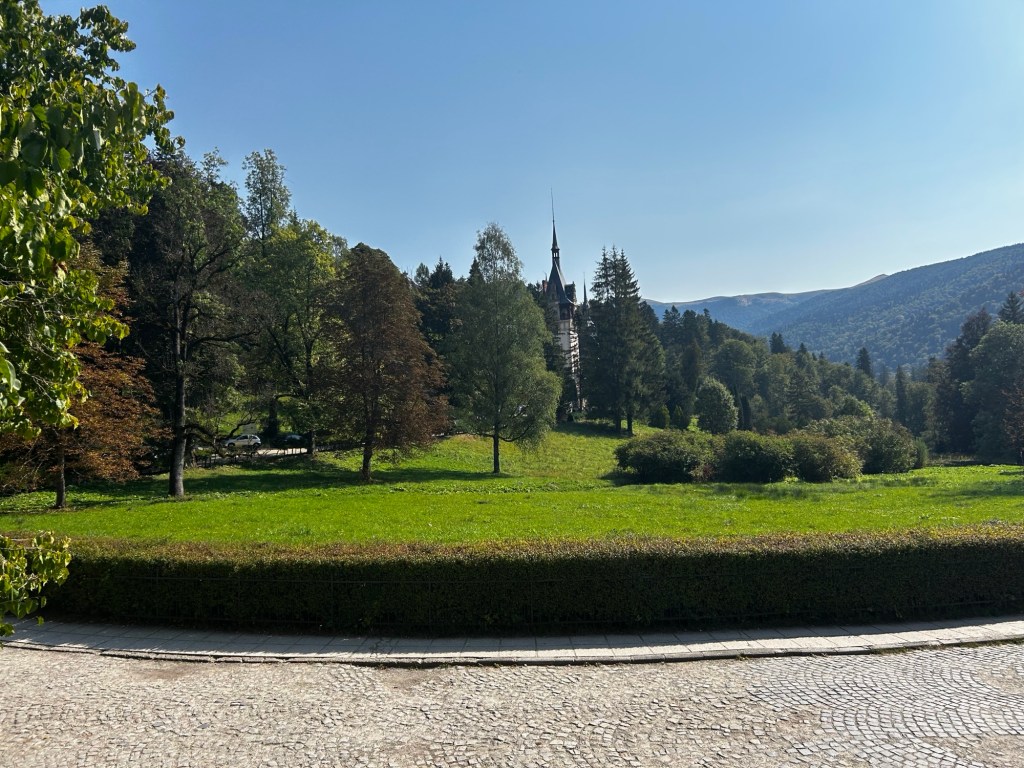
Peles Castle was commissioned by King Carol I in 1873, and completed 10 years later. It was to be the main summer residence of the Romanian royal family, and served in this role up until 1947 when they lost their power.
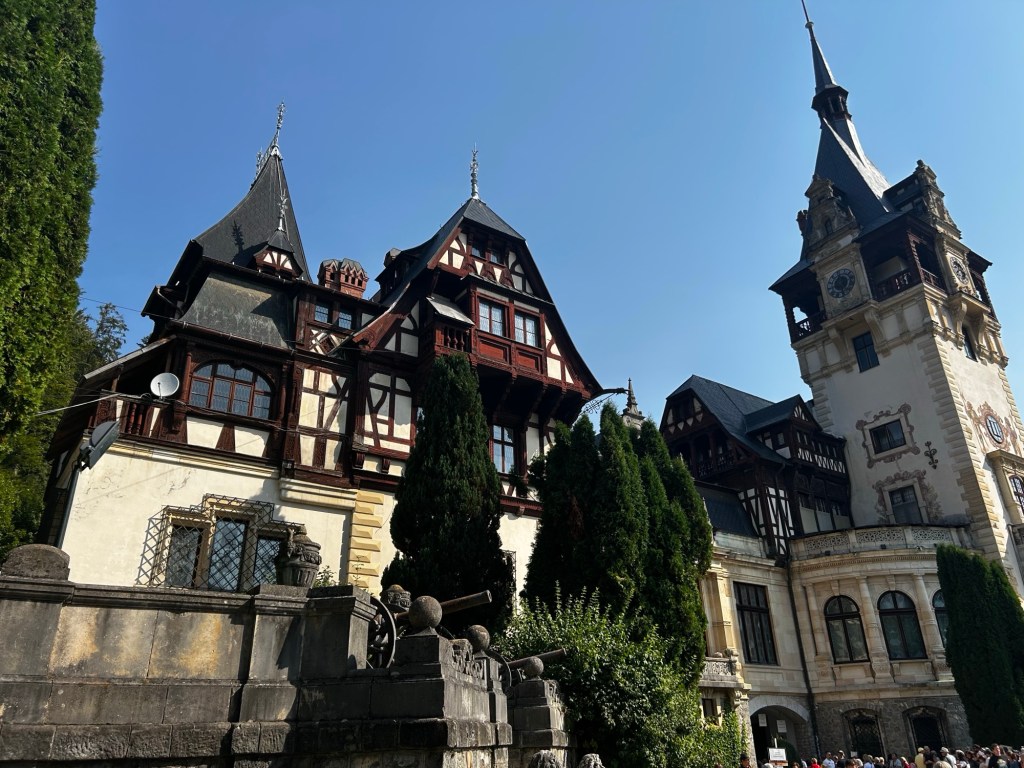
The castle is officially considered to be German neo-Renaissance, but that does it a disservice. There are many more styles to be found inside – most notably Gothic, Moorish and Ottoman.
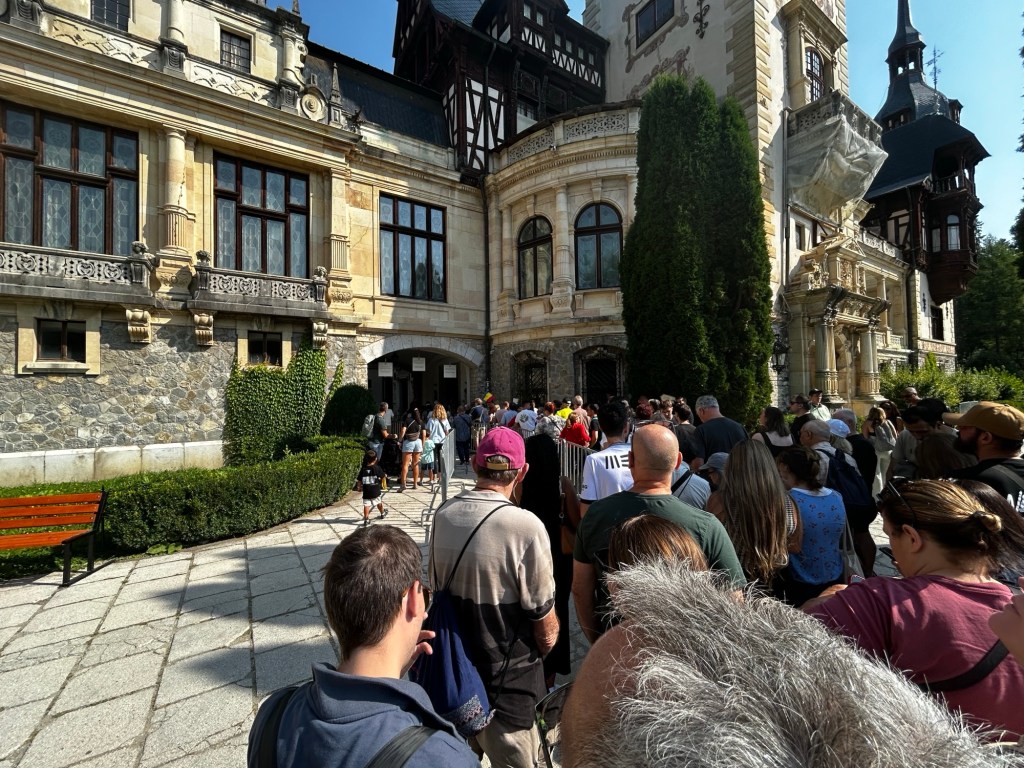
Arriving outside the castle, theres a bit of a queue. It isn’t too bad, but within 10 minutes we’re inside.
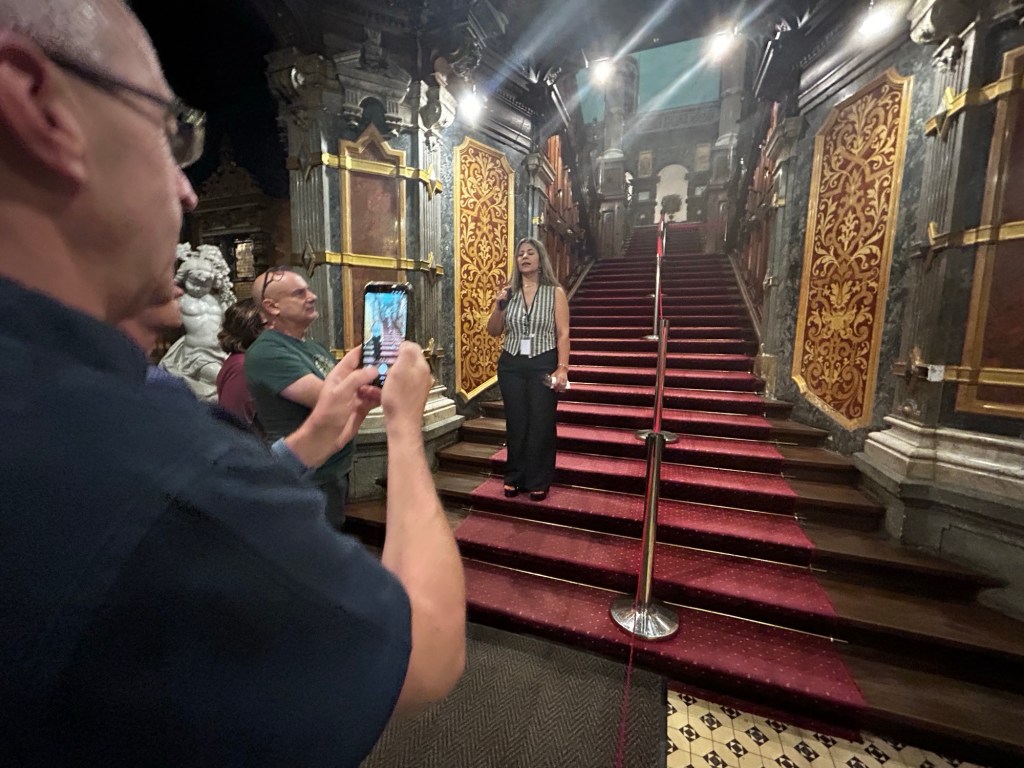
We’re led up a grand wooden staircase with a strip of red carpet running from top to bottom. At the top is a quite marvellous entrance hall with a lot of exquisite detail carved into the wooden walls (walnut wood supposedly). I look up and discover 16 metres up, a glorious square stained glass roof. There’s more to this than meets the eye though.
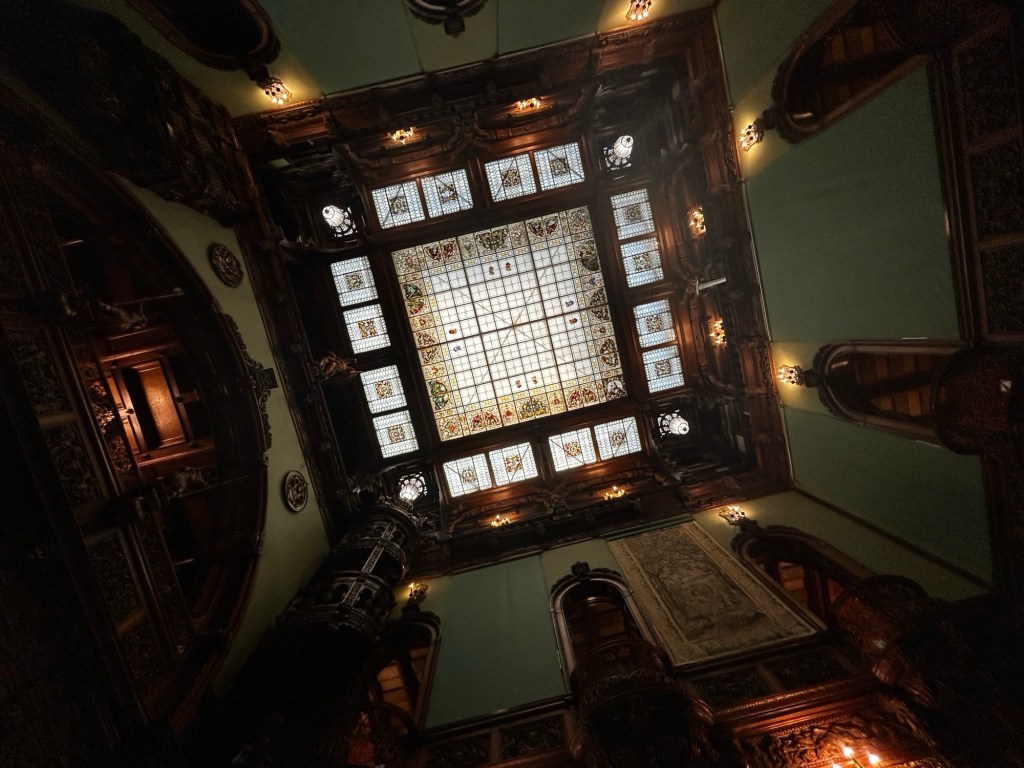
“This is an electrical ceiling”, Ioana proclaims. It takes me a few seconds to actually grasp what she’s telling us. Basically, it’s a mechanical roof – “it can be opened manually or digitally”. When the castle is full of tourists, the staff will open the roof to let some air in. As I stand there, the ceiling is closed, but then again, there are only a couple of dozen of us in the tour, and there aren’t really any others around.
Lining the walls are a handful of framed paintings – each in the same style and sepia tone. They are all castles, but not Romanian castles – they’re German castles
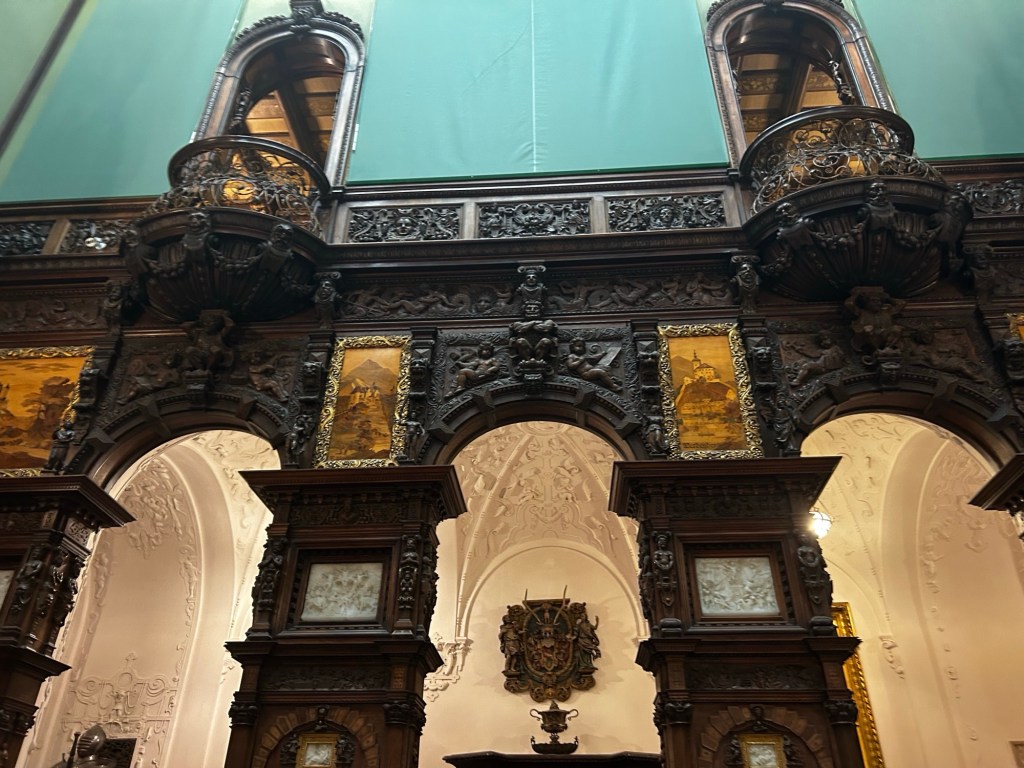
If I understand correctly, this wasn’t down to Carol I, but his successor, King Ferdinand I. Like Caroline, Ferdy was from Germany, so this was probably just his tactic of preventing homesickness, but there’s definitely a touch of the Florentine Renaissance in the art.
Up next in our guided walkthrough of Peles Castle is dubbed by Ioana as the “boom, boom, boom room”. I’ll be honest, a room dedicated to street music is not what I was expecting, and nor should I, because it’s actually where they keep the armoury.
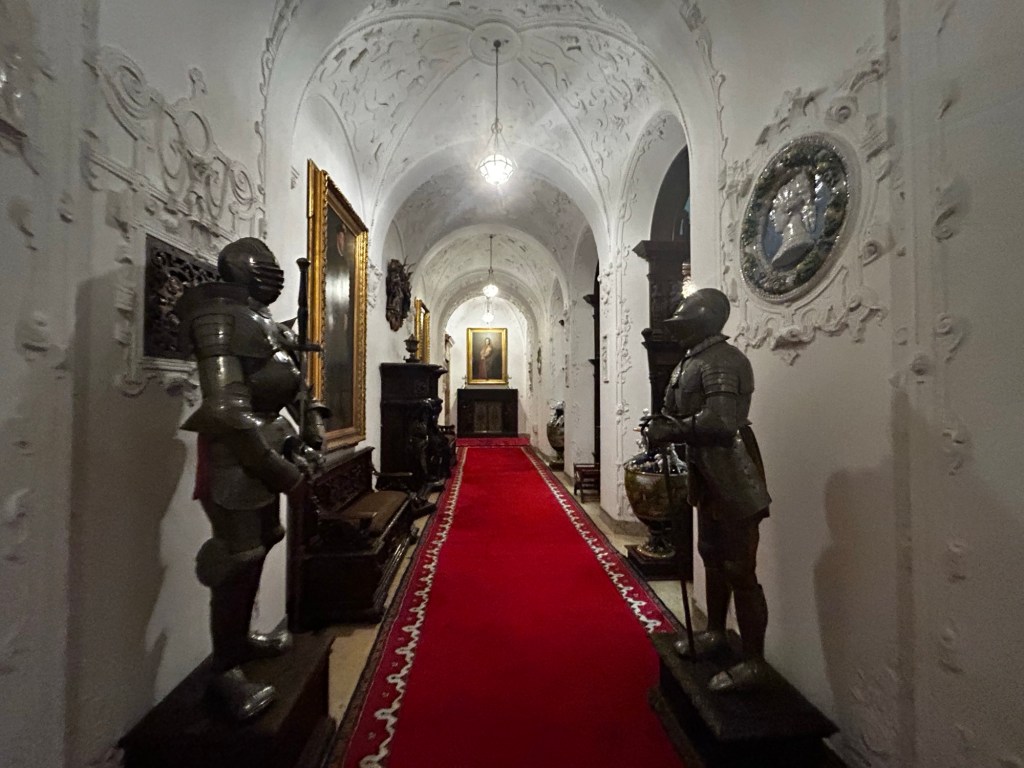
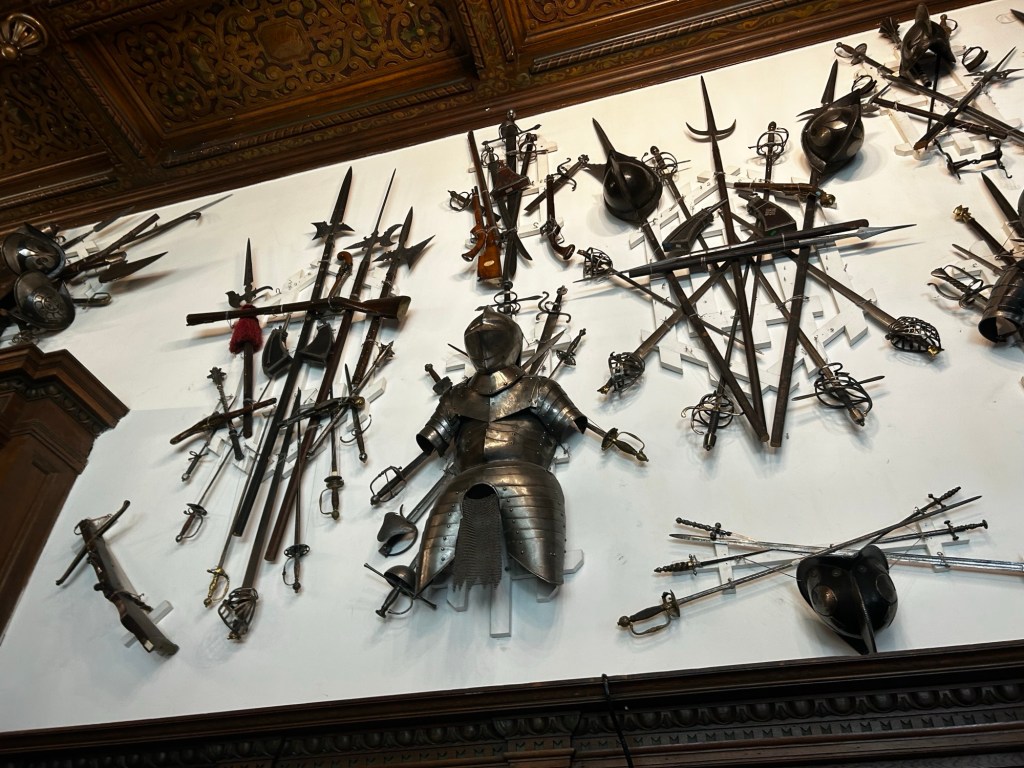
Two knights guard the approach, and in here, we find a horse cosplaying as a soldier. Actually this was common practice for nobility – I guess if you take a soldiers horse out, he’s pretty vulnerable on the battlefield, but I can’t help but feel those legs are pretty exposed!
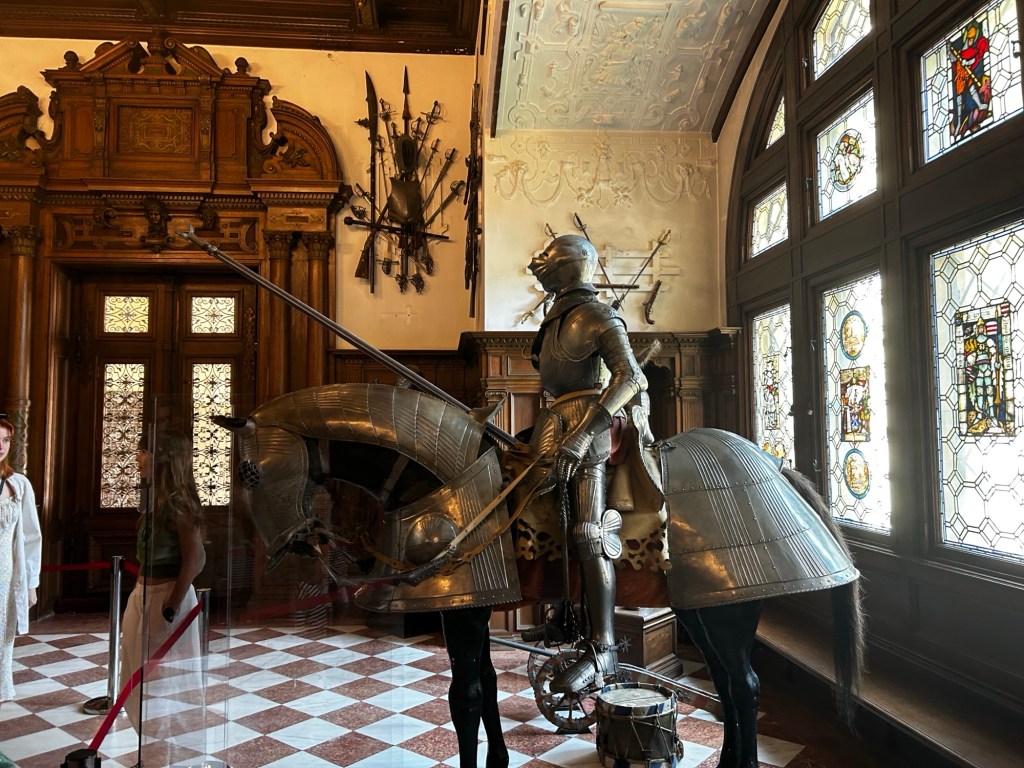
This horse armour weighs a whopping 120 kilos. Like nearly everything else in this castle, it was brought in from Germany.
There’s a sword over the fireplace with an inscription in German:
“Wan ich Das Schwerdt thu auff heben so, Wunch ich Dem armen sunder das Ewege Leben”
This translates as:
“When I raise this sword, I wish this poor sinner will receive eternal life”
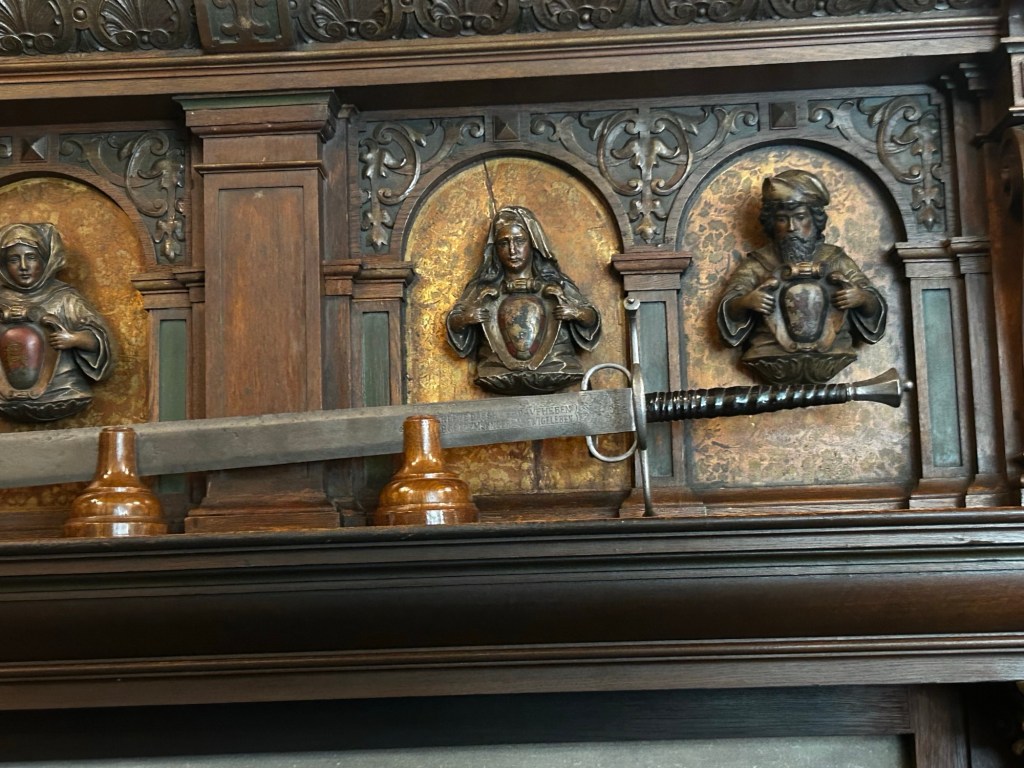
Is it not a bit strange to be wishing someone well in the afterlife but while also sentencing them to death on Earth? I guess soldiers back then must have had fragile egos – anything to make yourself feel a bit better about the situation! 🤷🏻♂️
Next up it’s the King’s study, and there’s not one, but two desks: a large rectangular one for meeting other kings, and a more cazh octagonal table and chairs for meeting the regular folk of Romania. This brings me right back to my school days – I’m pretty sure our headmaster had the same set up. Not sure what he was doing meeting kings in school hours though. Sure, as they say, two desks are better than one!
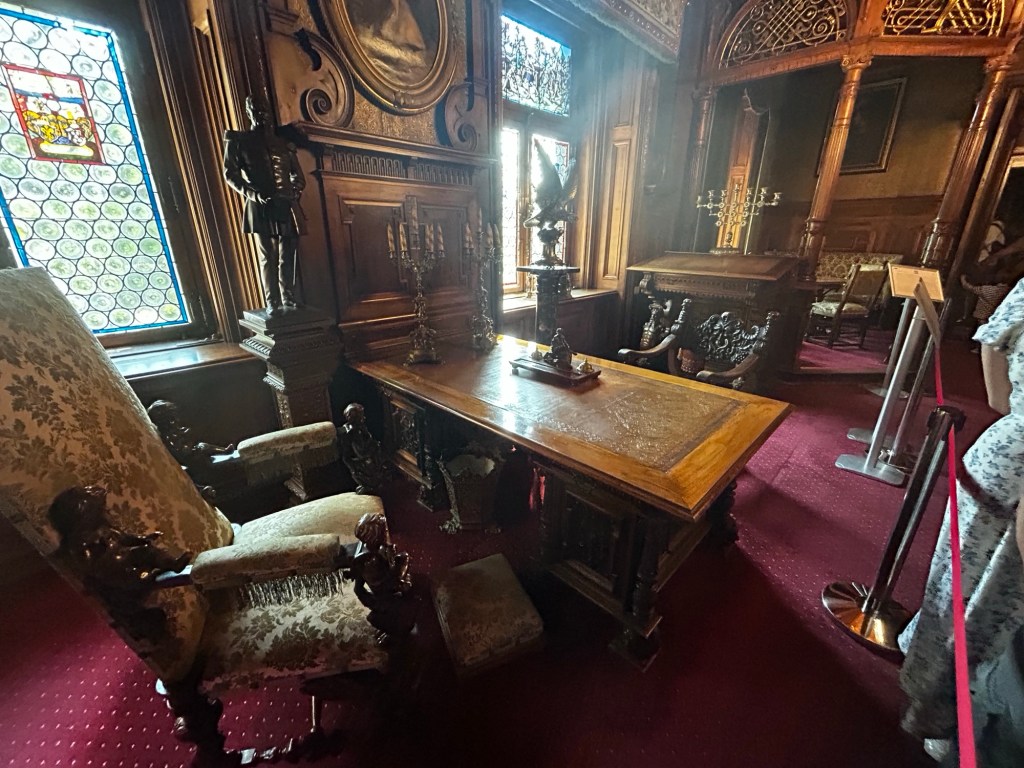
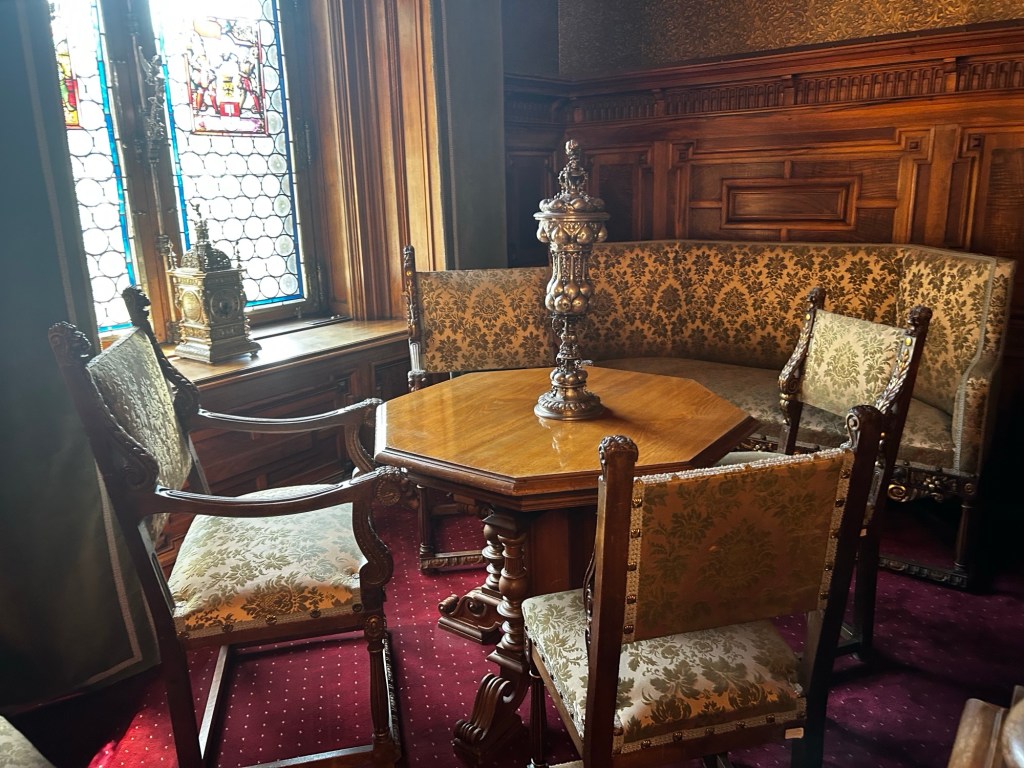
It’s pretty clear this castle is quite technologically advanced (mechanical roofs and all that), and we’re told that the fireplace in this room was electric from the very beginning. This was one of, if not the first, electric castles in Europe. On reflection, I suppose 1873 wasn’t that long ago, and clearly the owners weren’t short a bob or two. There’s also a secret door at the back of the fireplace – wouldn’t be surprised if that leads to Narnia tbh.
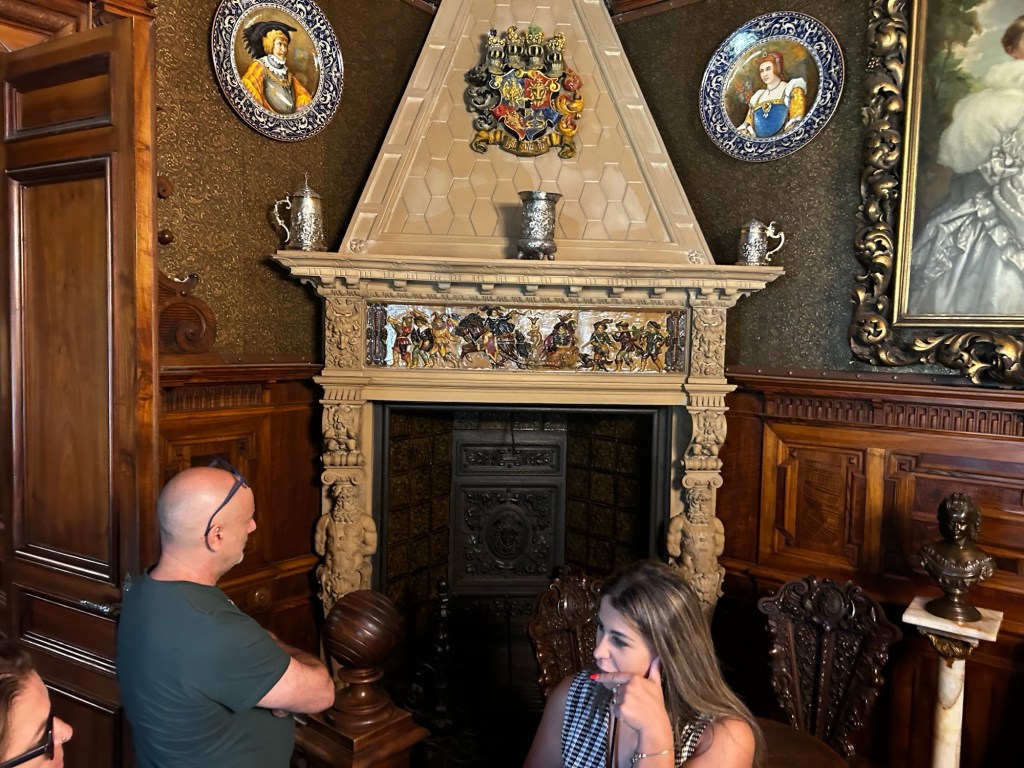
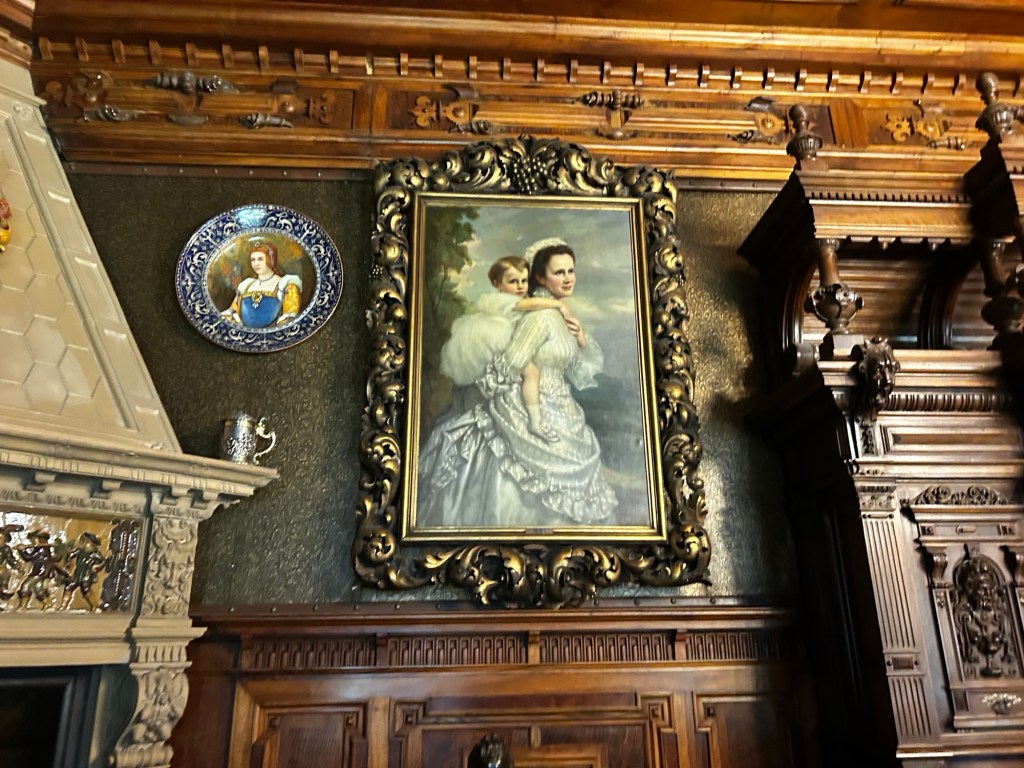
Ok time for a bit of Romanian Royal ‘Who Do You Think You Are?’ We heard about King Carol I (first king of Romania, first owner of Peles Castle, all up great guy)… he was married to Queen Elisabeth (no… not that one). They had one child – Princess Maria, but she died aged three in this very castle. A beautiful painting of Elisabeth and Maria adorns the walls of the study.
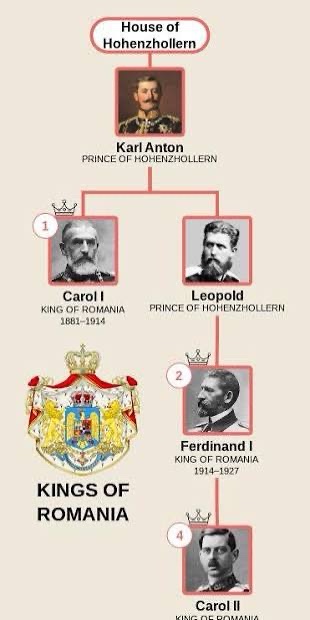
Looking to keep the Royal line going, Carol went shopping for an heir, and a few abdications later, his nephew Ferdinand was appointed / coronated / made king.
There only ever were four different kings of Romania. After Ferdinand came Michael I, then Carol II. It got a bit messy at this point, Carol II was known as the Playboy king – more interested in his own life than the duty of ruling a country. He was overthrown in 1940, and then Michael I was brought back from exile to have another crack (think Donald Trump’s second term, except less democratic if that’s even possible).
Through WW2, and subsequently, communism took hold in Romania, and the government that Michael had once appointed turned on him, overthrowing the monarchy. He went into exile and was banned from entering Romania until 1997 (after the fall of communism). Peles Castle and other estates were returned, and he lived between Switzerland and Romania until his death in 2017. Michael’s daughter Margareta now runs Peles castle today.
Ok that’s a lot of history… you could write a book about it!
Speaking of which, next up is the library.
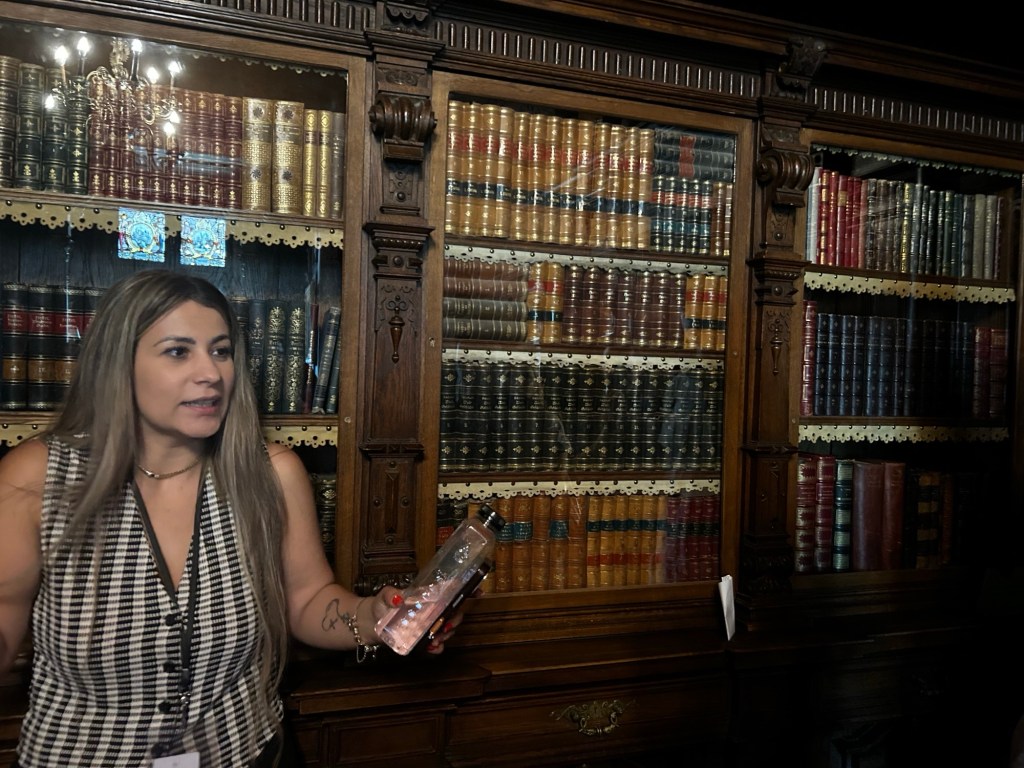
There are some 70,000 books in the Royal collection, and if I understand correctly, 700 are situated here in Peles Castle. Those books are in 7 languages and Queen Elisabeth spoke all 7.
Our guide Ioana tells us that there’s a hidden door somewhere in the library, and promises a box of chocolates to whoever can find it. Immediately my eye is drawn to a fake looking section at the back of the room. But this isn’t the right answer, those are real books! Some other smarty pants in the group jumps in with the right answer – in fairness, Ioana was blocking my view, so I’ll call that a moral win (if not a real one).
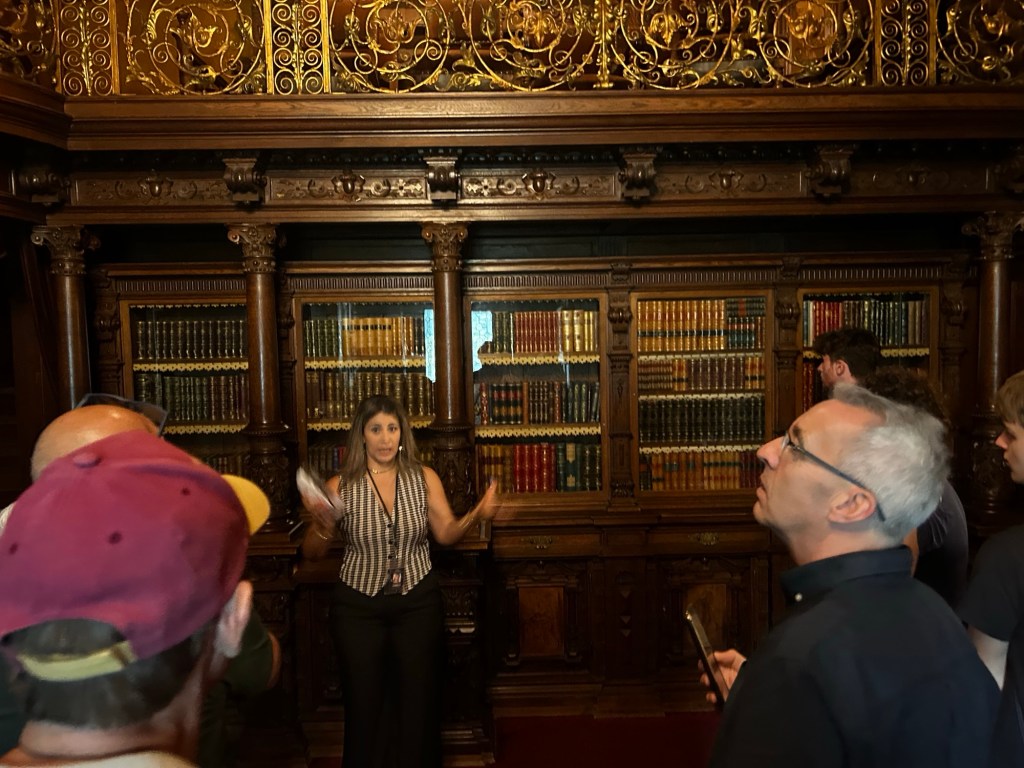
Now she mentions it, the cracks around the door are absolutely gaping, and even passes a piece of paper through, just to rub salt in my already salty wounds all the more. To get in, you move the covers from right to left.
Having a secret room in your home must be so cool – like a wee private place that no one knows about. Then again, Joseph Fritzl had a secret place that no one knew about, and that’s didn’t work out too well for him. Maybe not a good idea after all then!
Queen Elisabeth lived somewhat of a double life. By day, Queen of Romania. By night, a respected writer under the pseudonym Carmen Sylvia.
Her favourite room was the Old Music Room – originally a guest reception, but converted at the Queen’s request to house her piano, harp and violin, and all three instruments are on display for us to see.
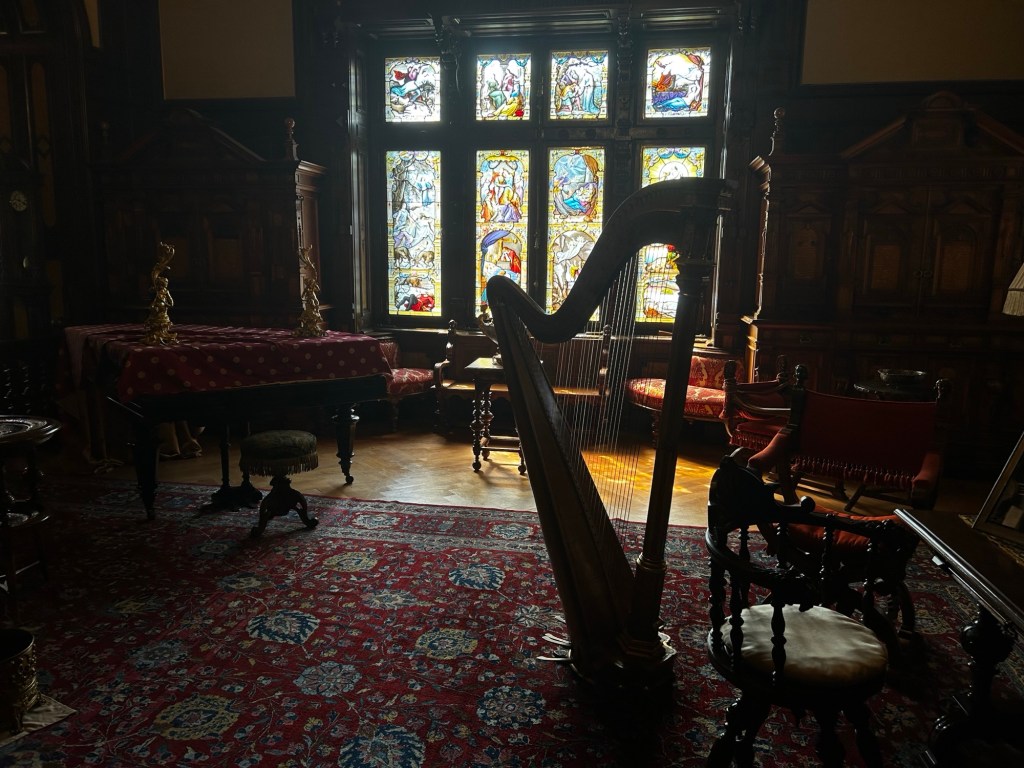
It’s while we are standing here, that I appreciate just how good the climate control is in this castle. There’s great ventilation in most rooms, keeping the place warm in winter and cool in summer. Every now and again, I catch a waft of nice crisp air.
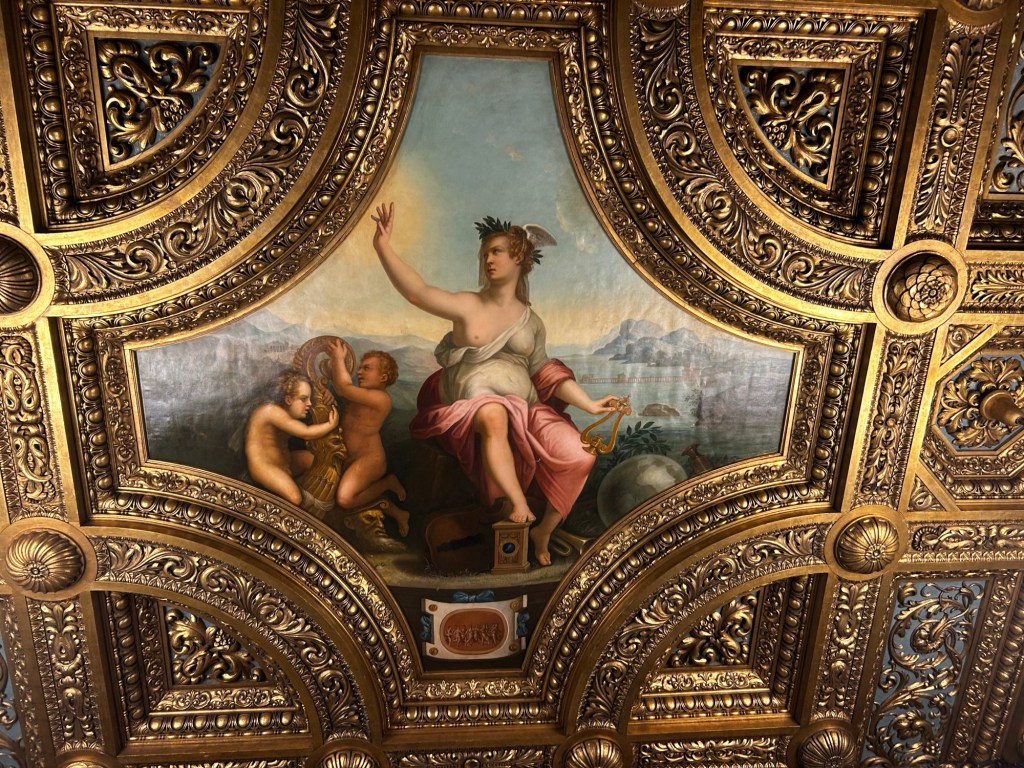
The Italian room is next with a big gold Italian renaissance roof. The room is bedecked with Murano glass / crystal – but not as much as was originally intended. 3 tons of glass was imported from Venice, but most of it smashed on the way here. There was only enough for a few items in a couple of rooms – most notably, the glass chandelier in this room.
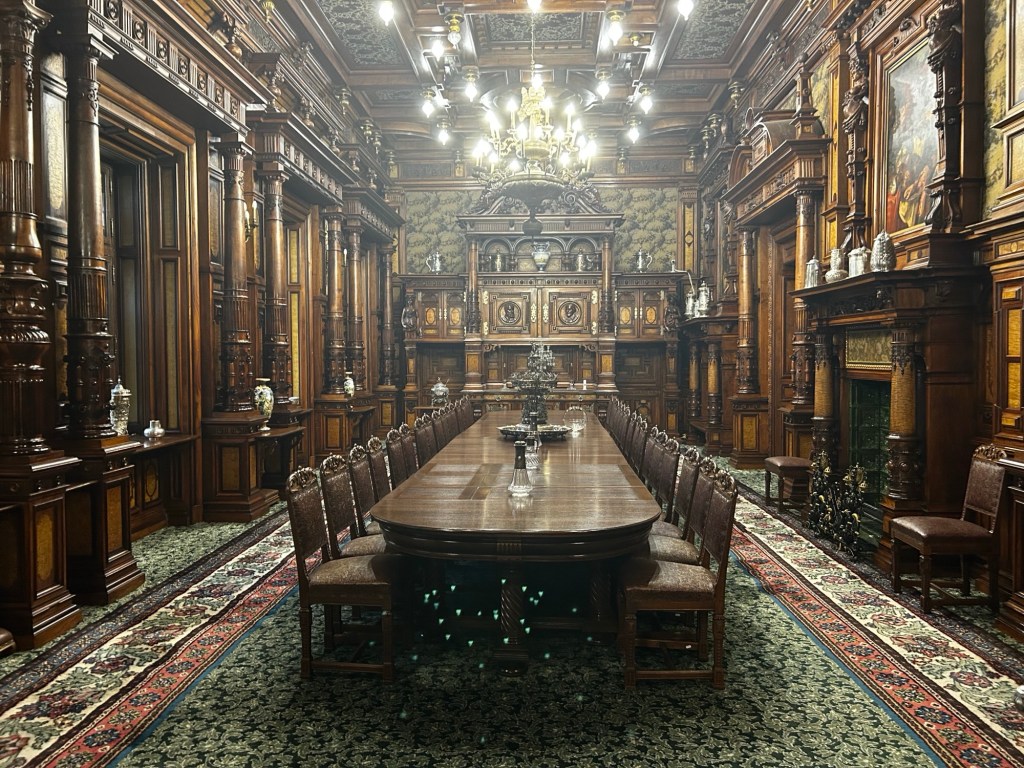
Unfortunately the dining room is cordoned off. That’s a bit of a double whammy – firstly, we clearly can’t be trusted around the expensive bohemian crystal, and secondly, it looks like any prospect of an authentic royal lunch is out the window. Oh well! We’re told about the winch system hidden at the end of the room to lower meals down from the kitchen. That might be my best way in actually!
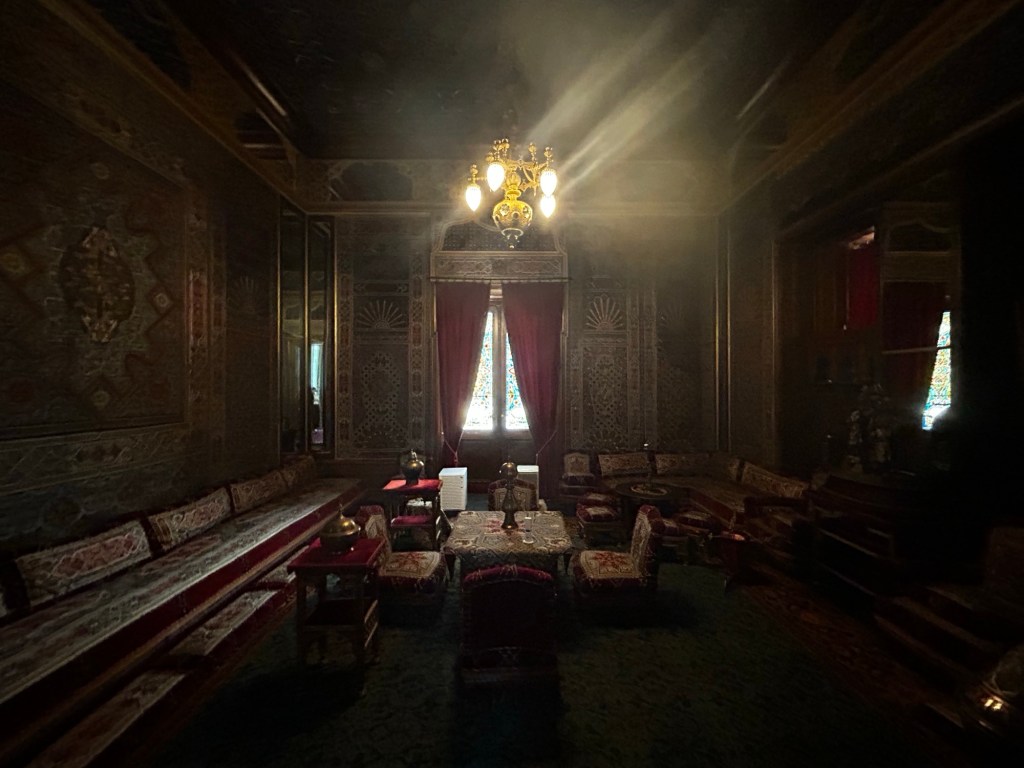
Lunch disappointment now behind me, and our last insight into Peles Castle comes from the Turkish Salon / Smoking Room. This is the most expensive room in the castle, not for any fancy gold or crystal on the walls, but Ismir carpets. My dad’s been to Ismir and he says they don’t shut up about their precious carpets! There’s a very distinct Moorish / Ottoman feel about the place, and as if one big carpet on each wall wasn’t enough, they’ve even got one on the roof as wells. This was where the king came to smoke – it’s a very dark room and I’m sure that’s a consequence of the sooty cigar fumes.
With that, we’ve got 40 minutes to explore, and I head straight to the gift shop. Here we’ve got souvenir paintings, postcards, stamps, coins, pens & pencils and bookmarks. I find it hard to choose, so basically buy one of everything. I’m not even joking… 😏
The gardens of Peles Castle are simply gorgeous. The castle is halfway up a hill, and surrounded by foresty style trees. There are a few restaurants between the castle and the bus, and with time now in short supply, I scarper up the road to an empty looking restaurant and ask for a Fanta to go.
We assemble back at the bus, and set off for our second stop: Brașov – so named when the town was stripped of its brass door handles post World War II. (That’s a joke btw). “Welcome to Transylvania!”
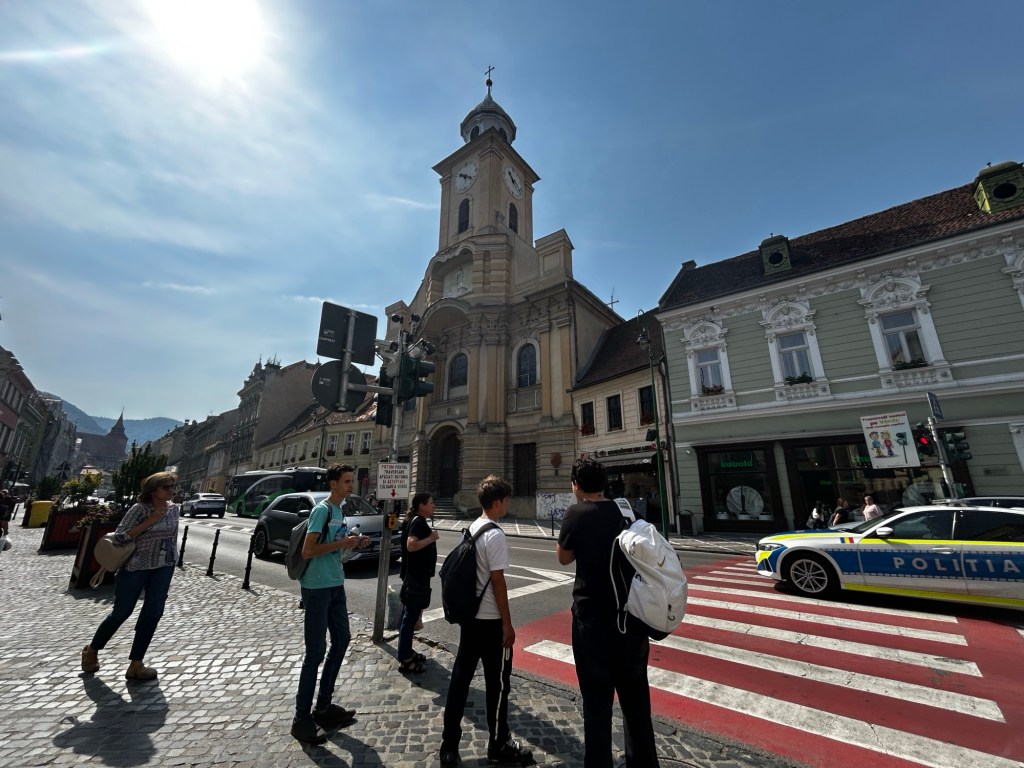
Brașov was originally known as Kronstadt, meaning Crown Town in German. The crown was the symbol of the Saxons. In 1920, Transylvania was united with Romania, and the name was changed to reflect the change in demographics in the area. But there’s still a very Germanic vibe about the place, you won’t find communist era architecture here like Bucharest, it’s mostly gothic.
Brașov have taken a leaf out of Hollywood’s book and put the name of the place on a big sign up the nearby Mount Tâmpa. They’re trying to emulate Hollywood’s status as a major international filming location. ‘Cold Mountain’, ‘Youth Without Youth’, ‘Hatfields and McCoys’, ‘California Dreamin’’ and ‘Wednesday’ are just some of the recent productions using the area.
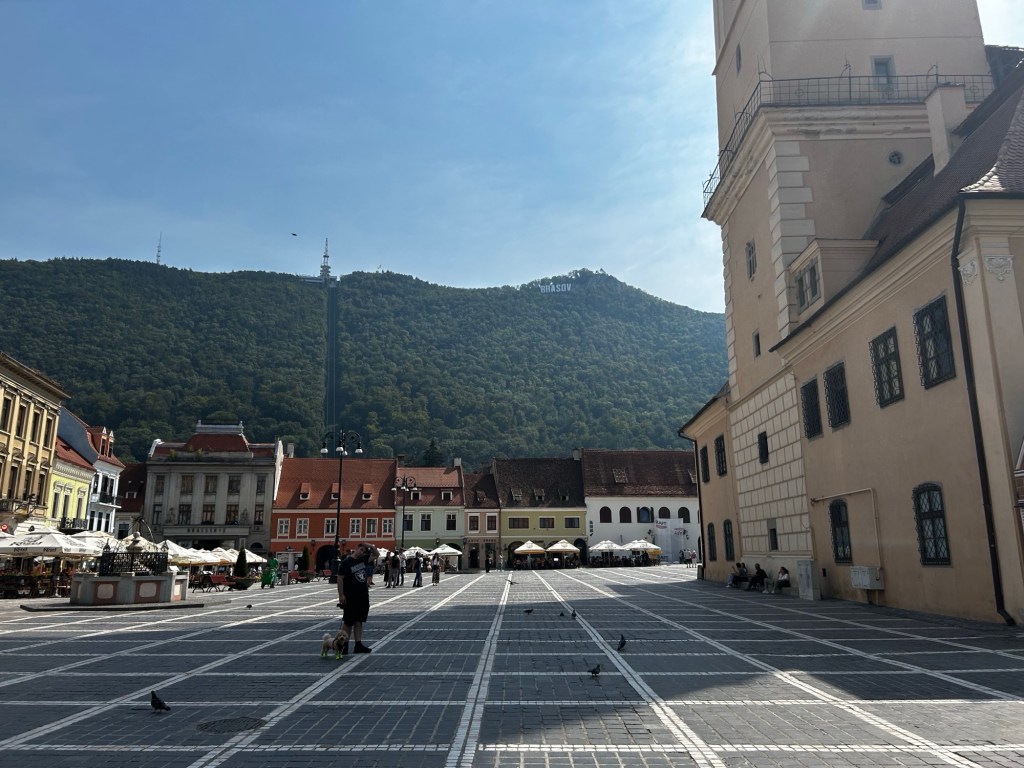
We’re given a few tips for lunch, and with about 90 minutes to eat and sightsee, we head straight to the main square. I drop a pin at the recommended restaurant on Google Maps – what could possibly go wrong?
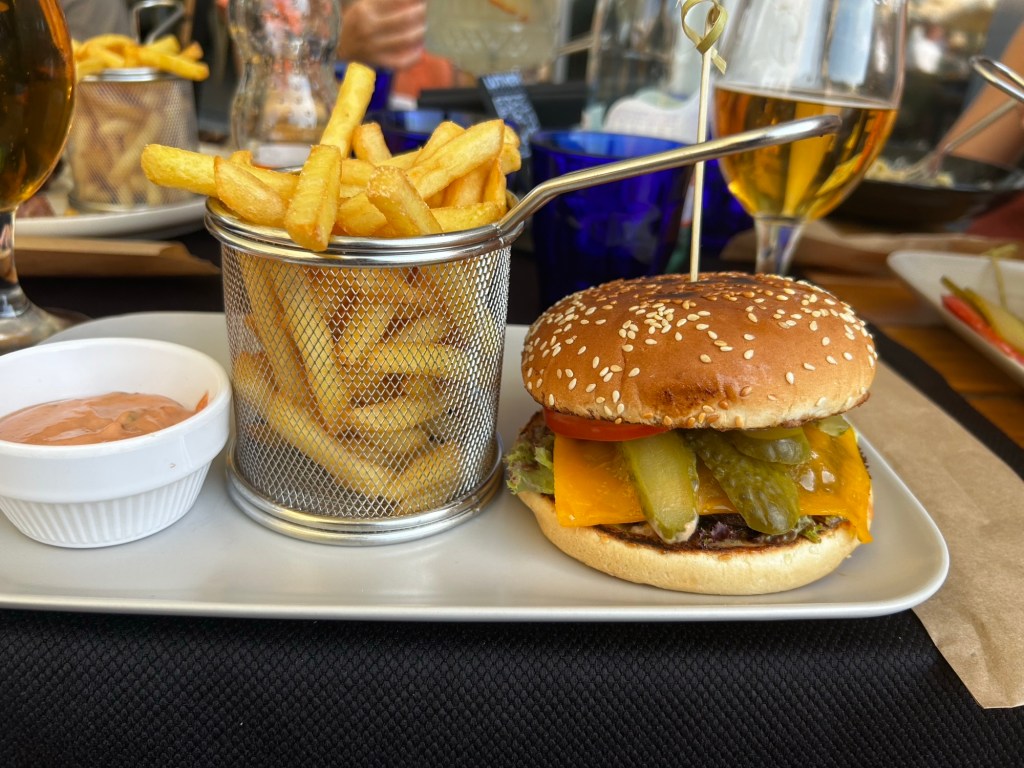
…well eating in the wrong restaurant for one. Turns out the pin I’d dropped was next door. Anyway, was a decent lunch so no complaints from my side.
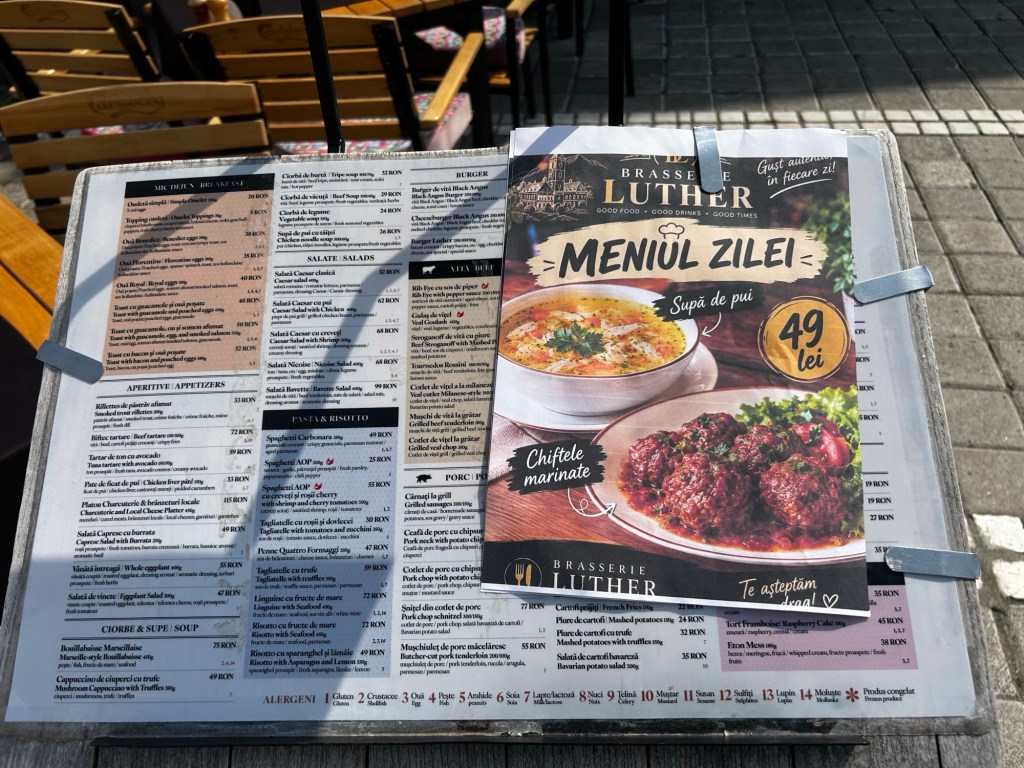
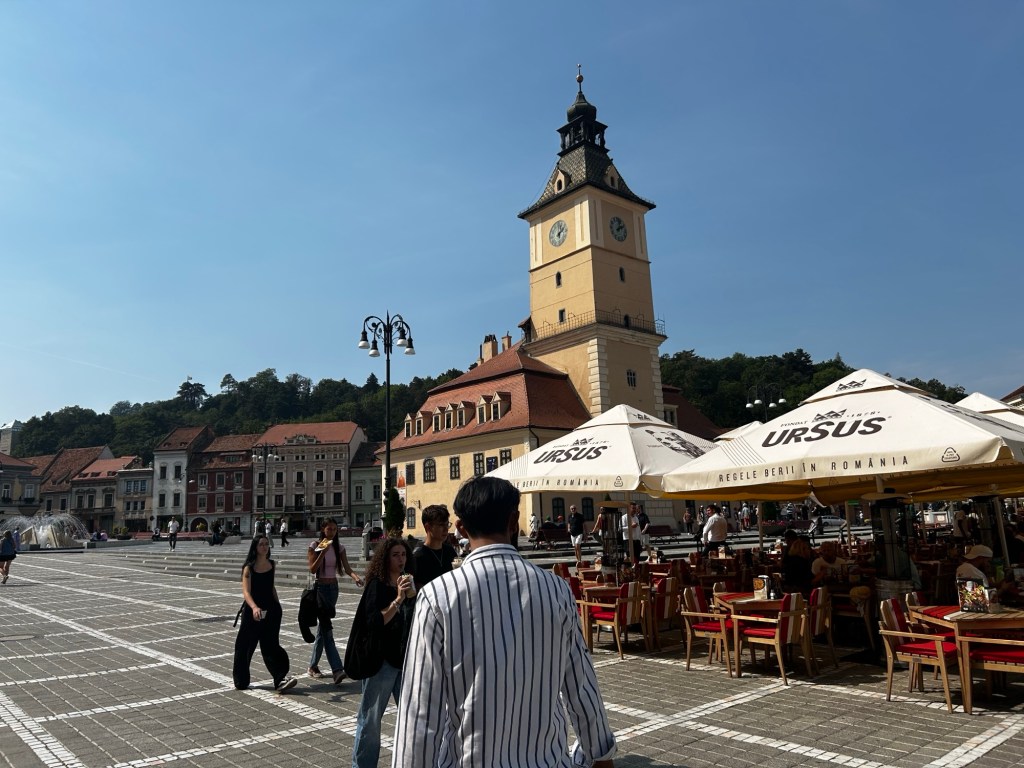
While waiting for the food to arrive, Dad and I set off for a quick bit of tourisming. Starting off in the Council Square itself, which was established as a market place during the 16th century. In the middle of the square is the Old Town Hall / Casa Sfatului, but there’s no way in that I can see.
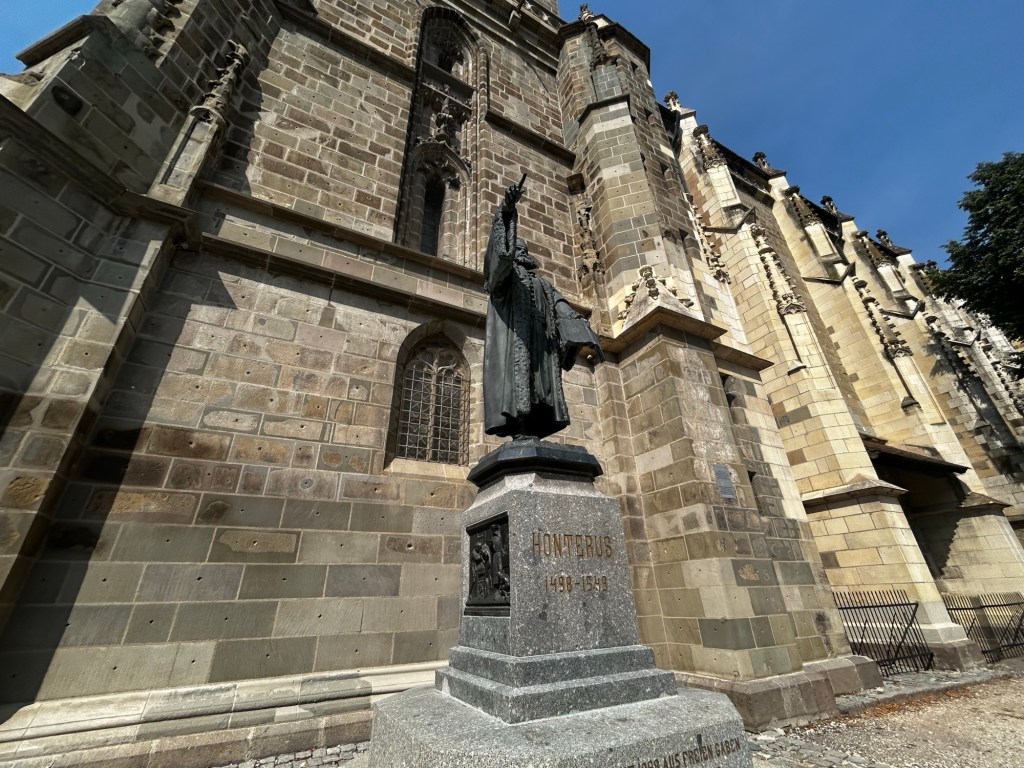
Just off one end of the square is the Black Church / Biserica Neagră. With a single 65-metre high belltower centred above the main entrance, this is a visually imposing landmark. It’s a rare example of Protestantism (particularly the Lutheran denomination), in a country dominated by Orthodox Biserici.
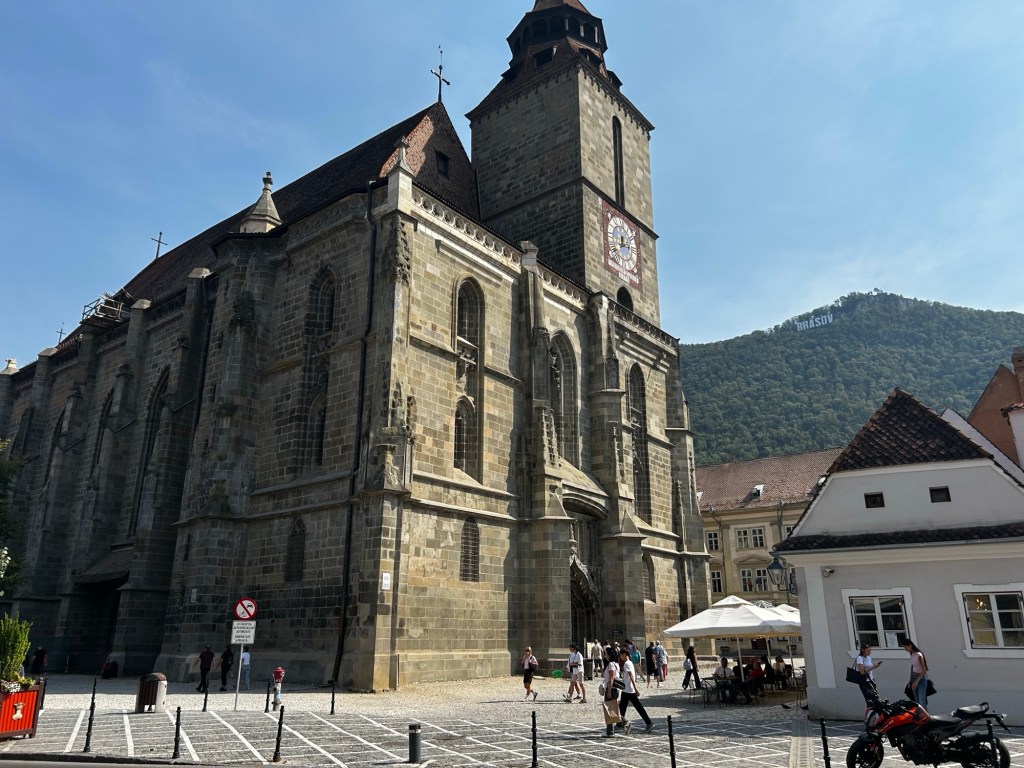
The Black Church took 92 years to build, (from 1385 to 1477), not helped by several large obstacles – not least the Ottoman-Hungarian Wars of the early 15th century that forced building works and resources to be redirected to beefing up city defences.
Inside the church is the largest organ in Europe with some 4,000 pipes. We’re treated to its symphonic sound as we venture inside.
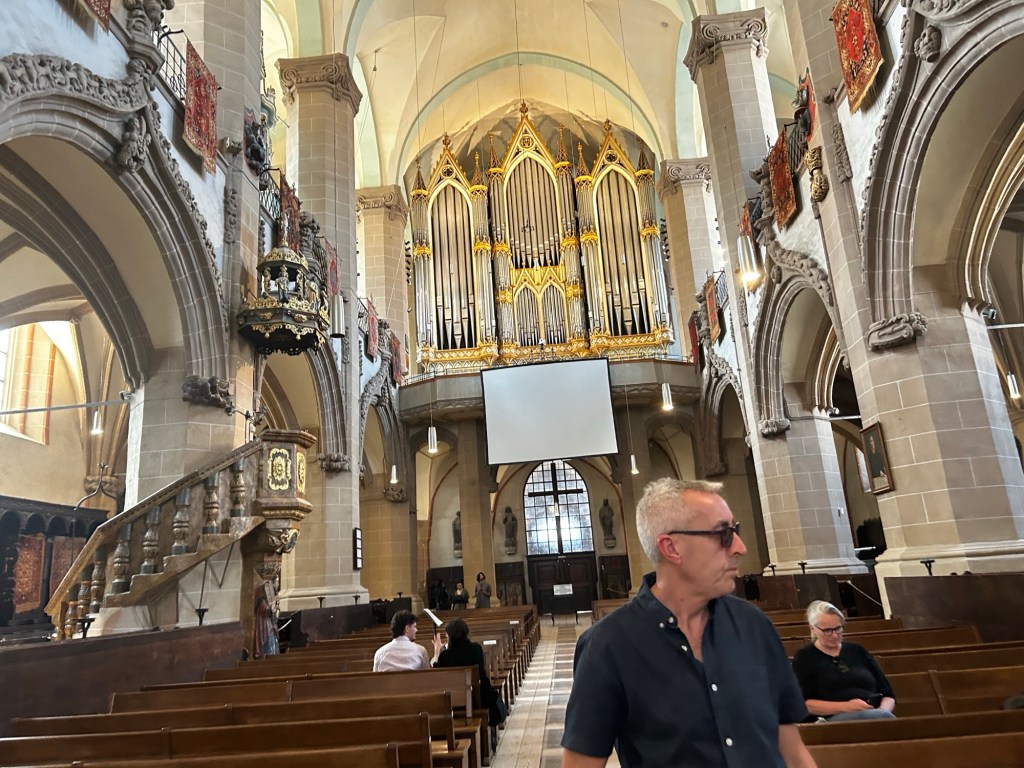
The organ isn’t the other mammoth thing in this church. Up on the bell tower, is a ringer weighing 6000 kgs. Fair play to whoever had to carry that all the way up to the top!
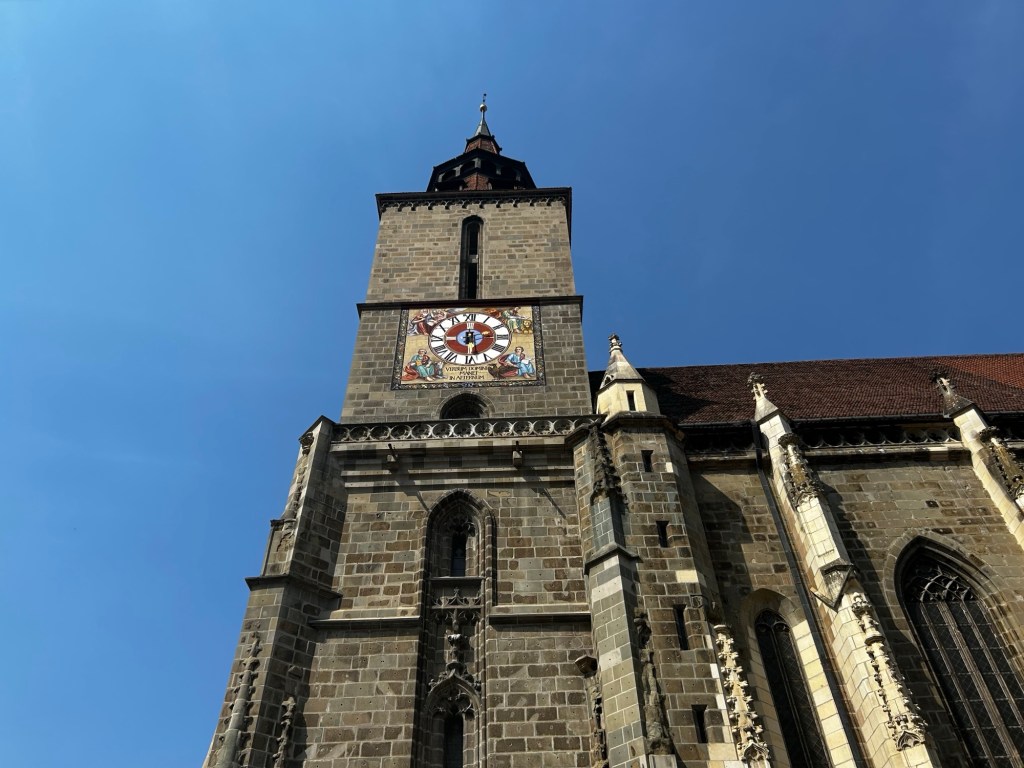
So why is this called the Black Church? It’s to do with the sad events of 1689, when armed conflict sparked a massive fire, destroying most of the city. Fortunately, the fire stopped at the church walls, leaving a black charred appearance outside, and everything intact inside.
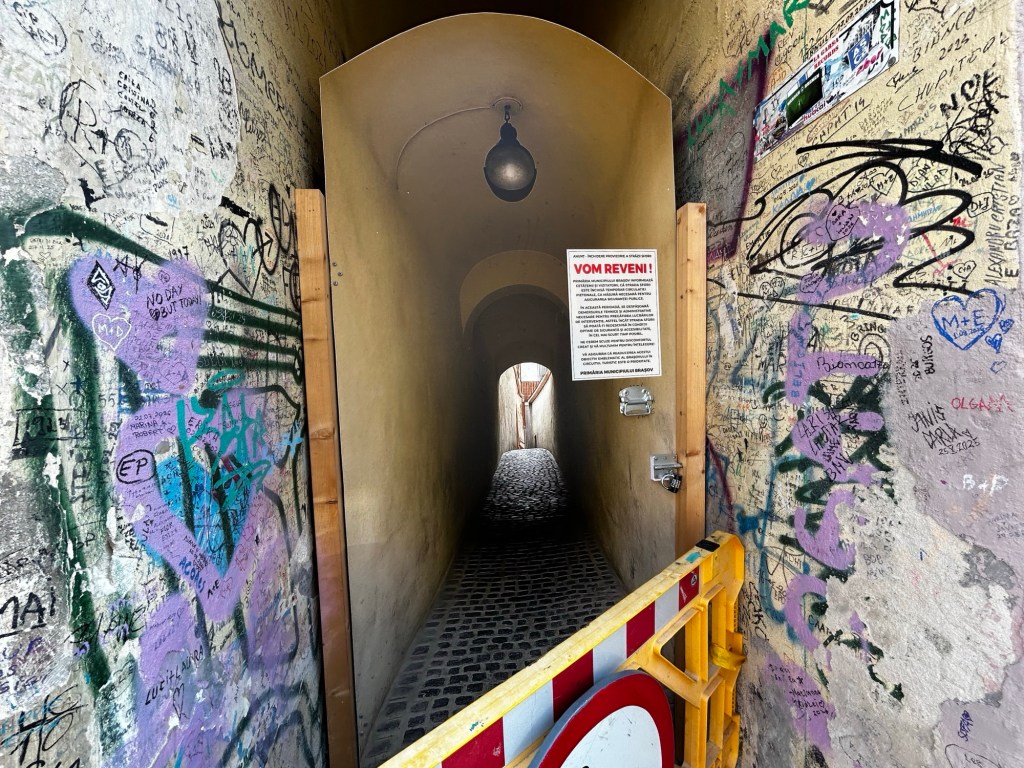
Another celebrated location in Braşov is Rope Street, said to be the narrowest street in Europe at just 111 cm wide. A bit of online research quickly debunks this claim though – there are at least four others that are narrower:
- Spreuerhofstraße in Reutlingen, Germany (31 cm)
- Klančić in Vrbnik, Croatia (40 cm)
- Calle Varisco in Venice, Italy (53 cm)
- Parliament Street in Exeter, England (64 cm)
I also recall a street in Prague (Vinárna Čertovka) which is 50 cm wide, but that’s technically not a street so doesn’t count.
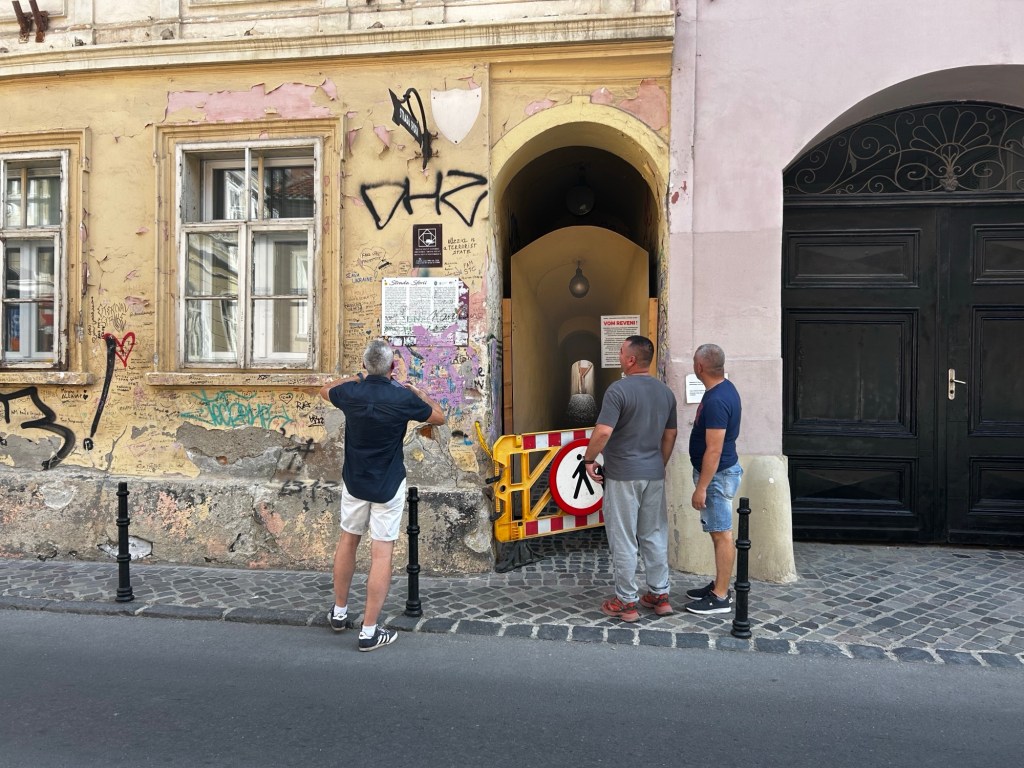
Technicalities aside, back to Braşov and Rope Street… this was built in the 15th century as an alleyway for the local fire brigade. Great to see it served them well when the whole place was burning to the ground, a couple of hundred years later.
Very disappointingly, this street has been completed closed off for repairs, but at least they’ve had the decency to show us what it would look like on the makeshift barrier.
That’s enough sightseeing for now… lunch has now been served.
Post lunch, we return back to the bus and journey 25 km to the final stop of the day – the most famous landmark in the region: Bran Castle.
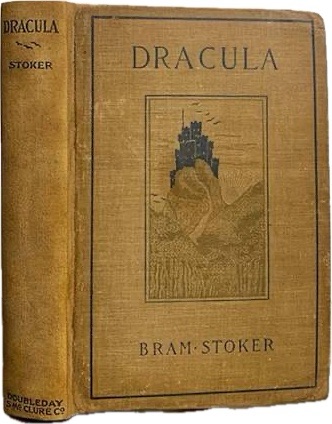
Outside Romania, this is more famously known as Dracula castle, but the link is a bit more tenuous than the local tourism board would have you believe. Bran Castle isn’t mentioned in the book at all – the one Stoker refers to is a fictional castle overlooking the Borgșa Pass, elsewhere in the mountains of Transylvania. The castle’s design on the original book cover bears no resemblance to Bran Castle and the real Dracula never lived here. What’s more, Bram Stoker never even visited Romania. The whole link was just fabricated for tourism in the 70s.
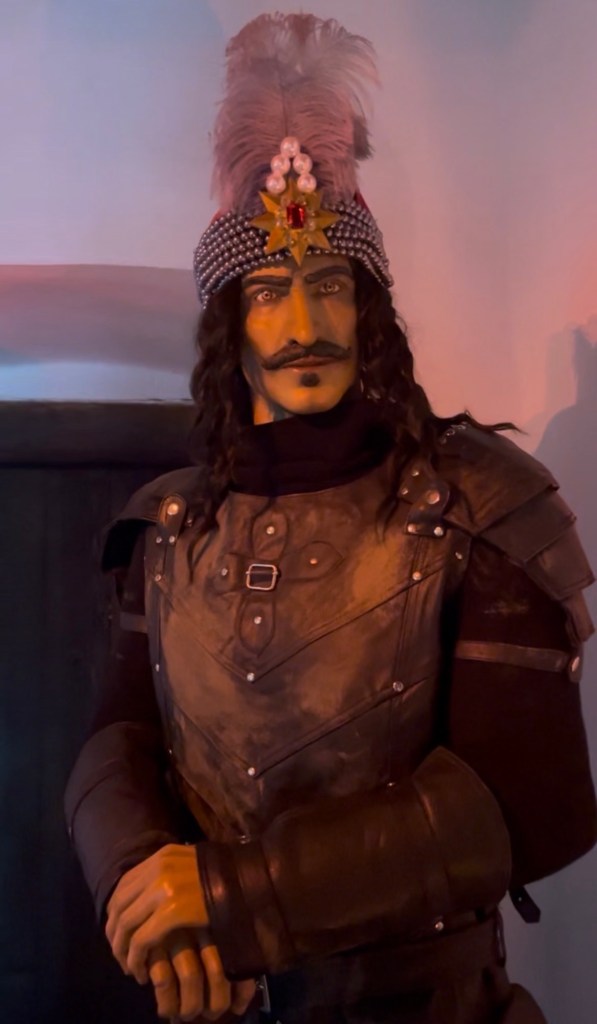
But there is a real life Dracula (sort of), so let me tell you all about him. His name was Vlad III and known to many as Vlad the Impaler. Incidentally, this Vlad is not to be mixed up with his asthmatic brother of the same name – he was Vlad the Inhaler. 😆
No, Vlad didn’t have another brother of the same name, but his father was also called Vlad. The father joined the Order of the Dragon to fight against Ottoman Empire, and he picked up the name “Dracul” meaning “the dragon”. Vlad the Impaler was therefore “Dracula” meaning “son of the dragon”. The real Dracula wasn’t a vampire, and he definitely didn’t suck blood. That bit’s all artistic license on the author’s behalf.
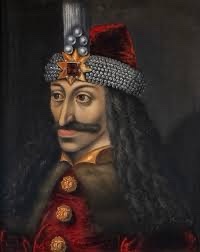
Vlad the Impaler was known as a fair ruler, a very brave warrior, and not corrupt. He fought hard for Wallachian independence against Sultan Mehmed II and the Ottoman Empire. He was so fair, that he gave everyone the same death – death by impalement (basically one long spear to the back). His reasoning was that this would be a strong deterrent, and a good way of keeping his unruly people in lines – a form of psychological warfare, if you will.
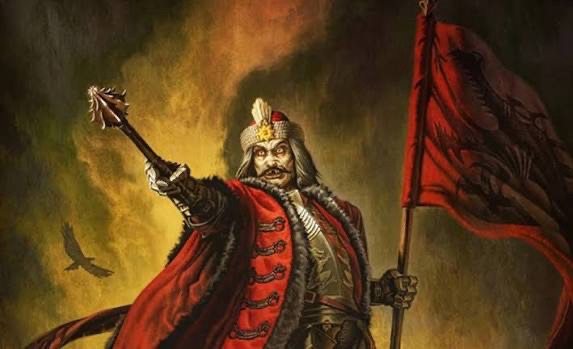
Vlad only ruled for 6 years, but he impaled around 20,000 people in that time. Talk about ruthless efficiency! That said, impalement was pretty commonplace back then, so it’s maybe a tad unfair that he’s picked up the Impaler moniker in later years.
Vlad died in battle in late 1476. His body was cut up in parts and his head displayed on a stake in Constantinople.
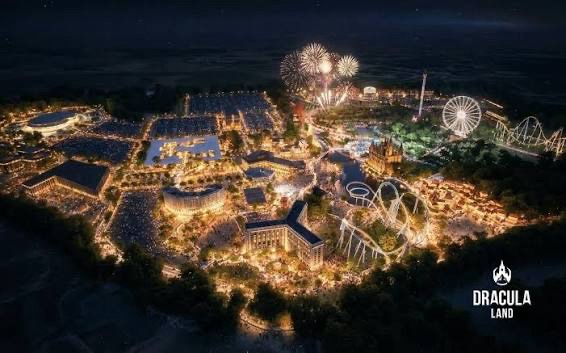
As I mentioned before, the tourism board have really run with the whole Dracula link now, and there’s Dracula merchandise in nearly every souvenir shop. They’re even talking about building a Disneyland style Dracula theme park somewhere in the outskirts of Bucharest. This is scheduled to open next year.
Bran Castle may not have had anything to do with Bram, but it was built by the Saxons in 1377 not as a royal residence, but a stone fortress with the main purpose of protecting the German colonies in Transylvania from wandering armies, and this succeeded!
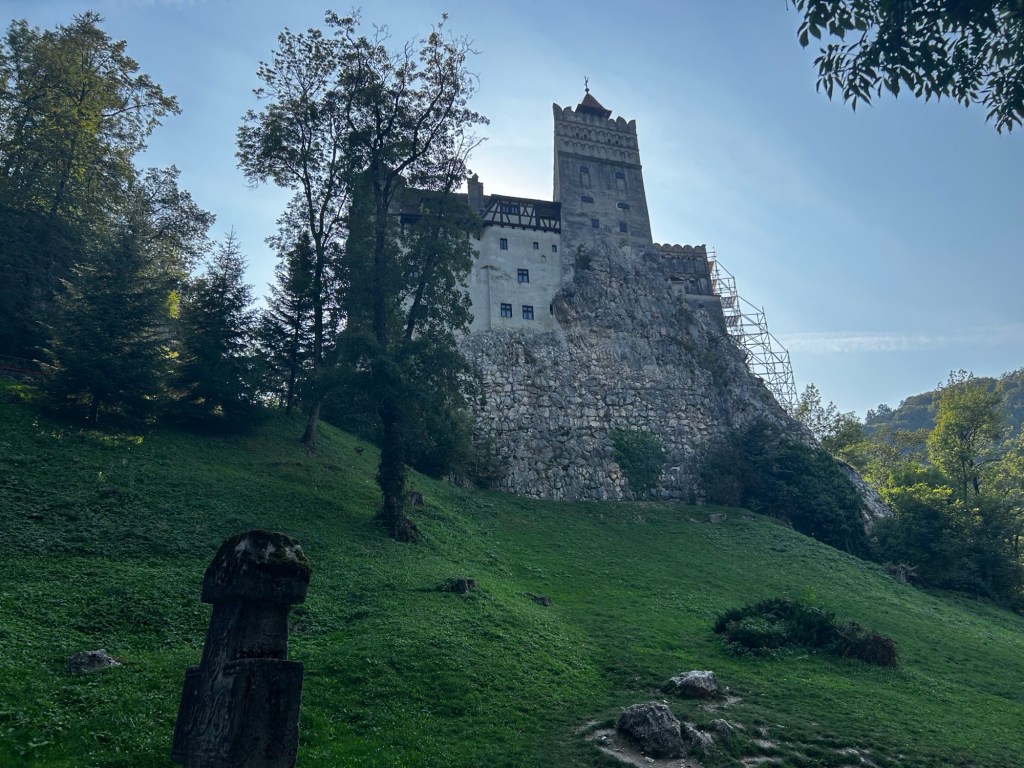
In 1920 Transylvania switched hands from Hungary to the newly unified Kingdom of Romania, and the castle was handed over to the royal family. It was the preferred home of Queen Marie (the wife of King Ferdinand), and she had it extensively renovated. They left the outside pretty much as it was, and the inside took on an art-nouveau feel.
It was seized by the communists in 1948, and like Peleș Castle, was returned to the (former) royal family albeit in 2009 after a drawn out legal process. Later that year, Bran Castle was opened to the public as a museum.
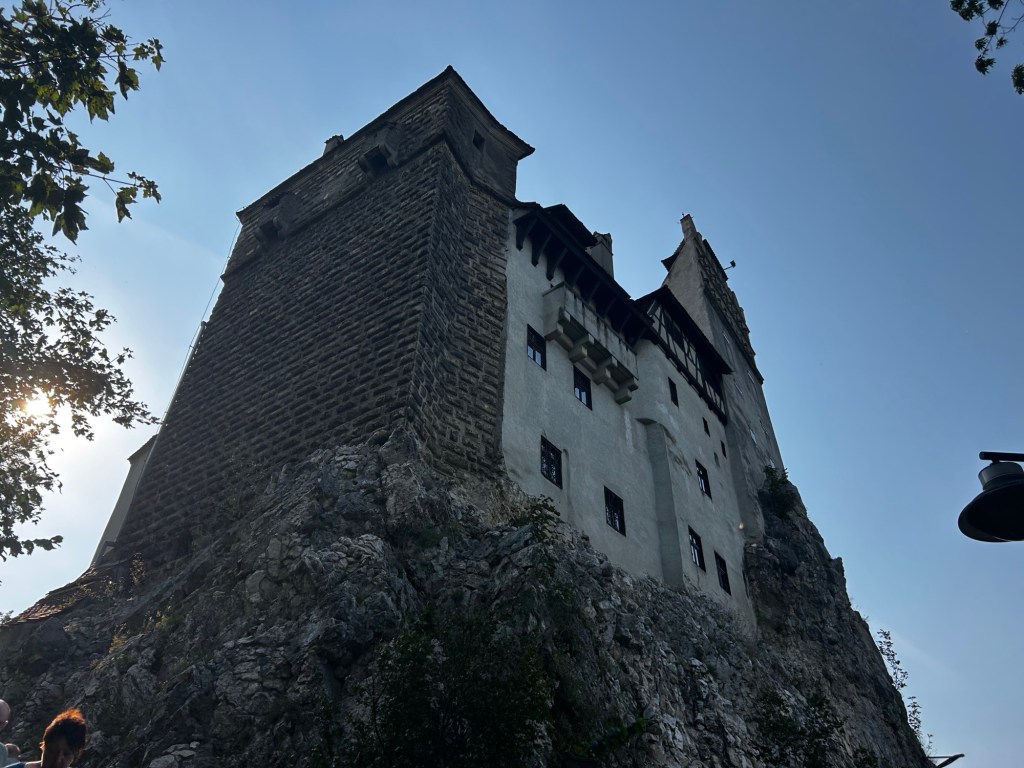
Earlier this year, an 80% stake in the castle was sold to Joel Weinshanke, an American entrepreneur, who also owns Elvis Presley’s estate Graceland. Already ticket prices have risen considerably, and we’ve been told entry to the castle over Halloween will set you back around €600 – yet another shameful example of American corporate greed.
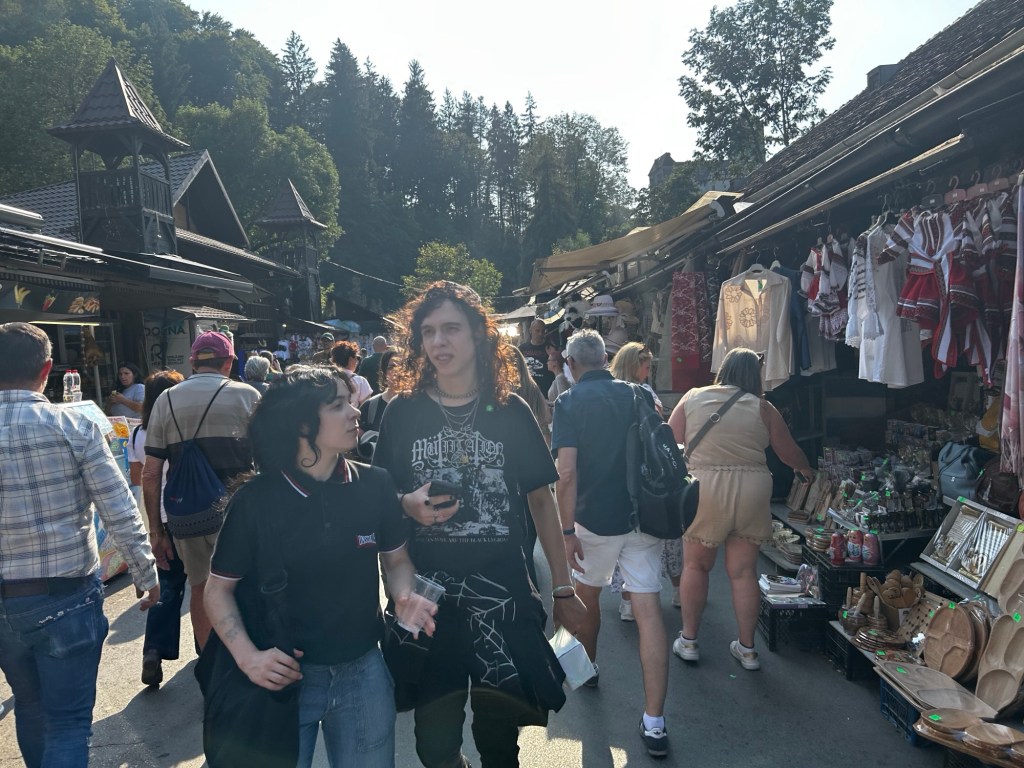
Bran Castle clearly has more going on outside of it. The street leading up to the castle is lined on both sides with market stalls (each more or less selling the same Dracula themed souvenirs). The most basic entry ticket sets us back €20, and frankly without it, you’d struggle to get any view of the castle.
The museum element of Bran Castle is pretty disappointing to be honest. No doubt this will improve over the next year, but there’s one room with a display on local folklore, and another room with a statue of Vlad the Impaler and a few heads on spikes. Nothing special.
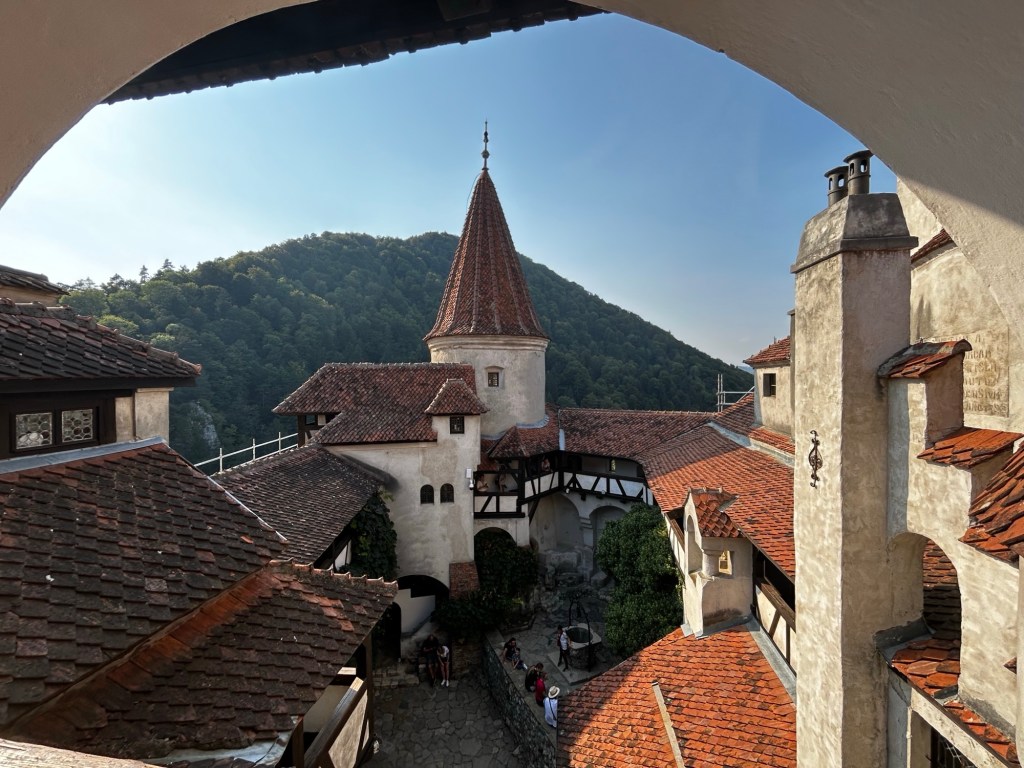
There’s a few other royal artefacts scattered around rooms of the castle, and a nice medieval courtyard, but Bran has nothing on Peleș Castle.
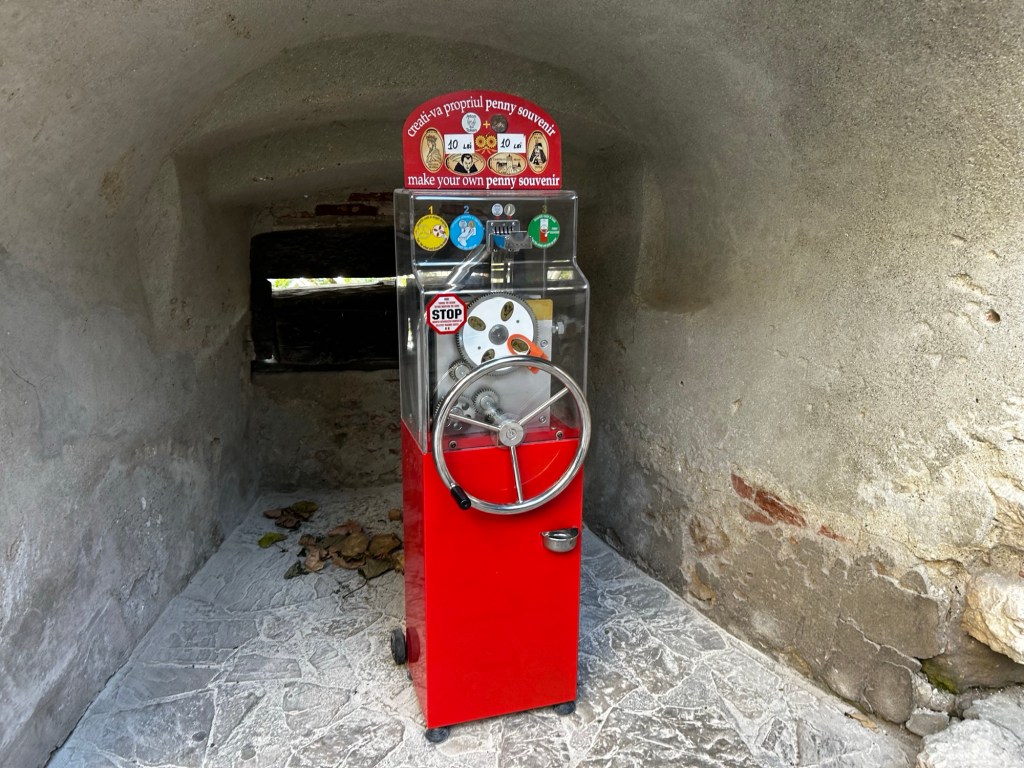
I’m delighted to spot a pressed penny machine by the entrance to the gift shop!
With that, we return back to our bus, but it’s about three and a half hours back to Bucharest – the heavy city traffic adding at least an hour to an already long journey.
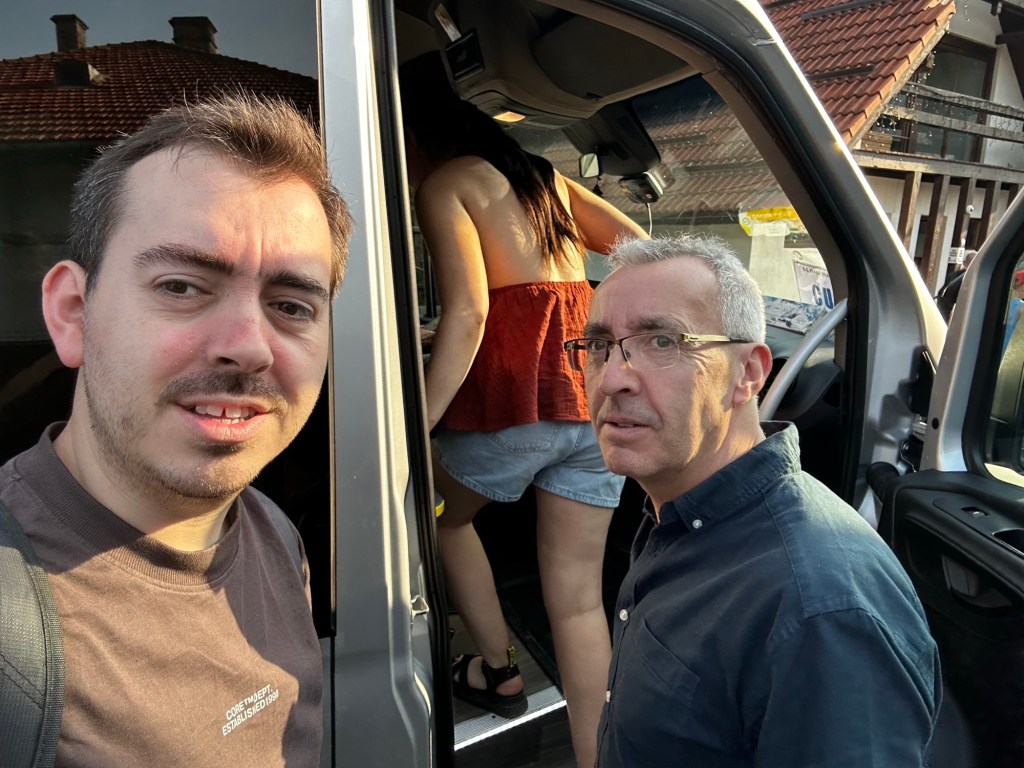
In this time we learn more about our tour guide Ioana’s story. She’s only been doing this job for about a year. Ioana left Romania as a young girl and moved to Italy. She came back last year to provide for her baby boy and found a job as a tour guide to make use of her knowledge of the English, Spanish and Italian languages. After six months as a tour guide, she decided to go solo, and set up a tour company called Zig Royal Tours. They’ve only been operating on Get Your Guide for three and a bit months, but already are the second highest company doing tours of Transylvania. I really must commend Ioana – she is extremely knowledgeable and has a pure enthusiasm about the subject matter. I would strongly recommend this exact tour to anyone contemplating a visit to Romania.
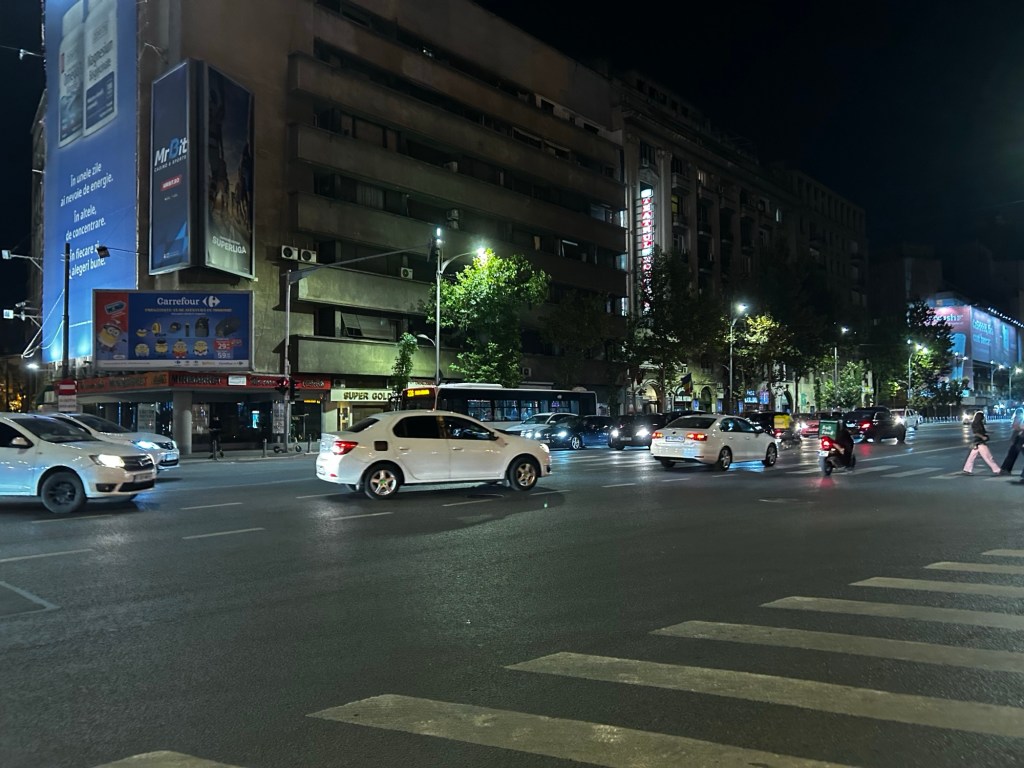
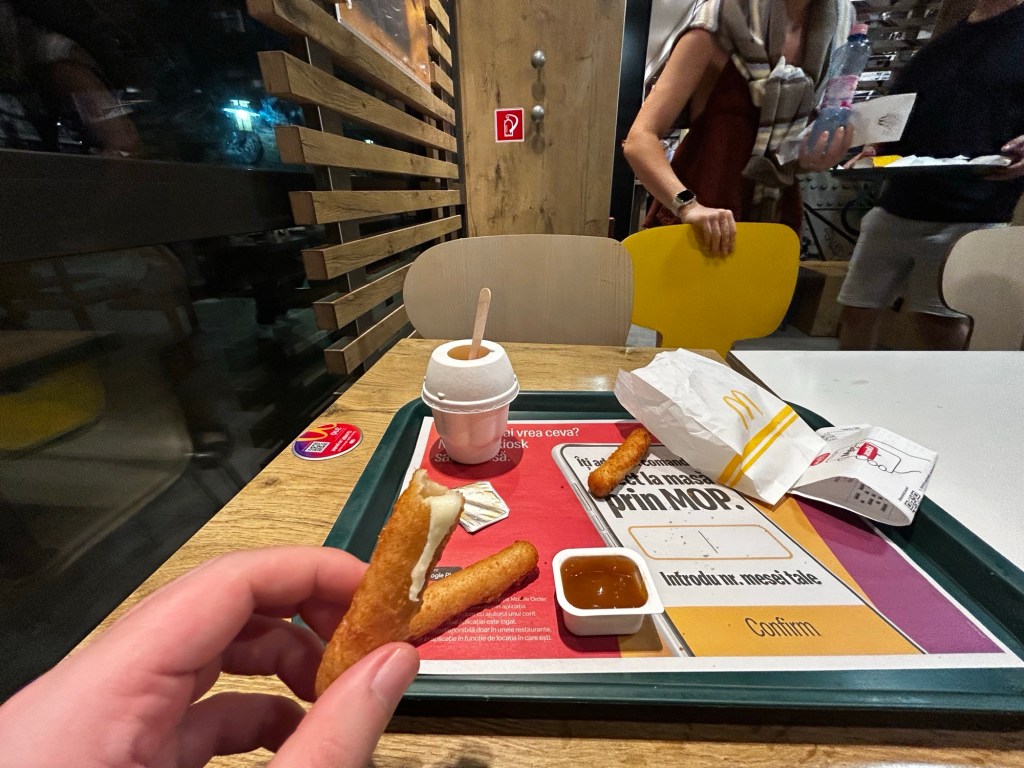
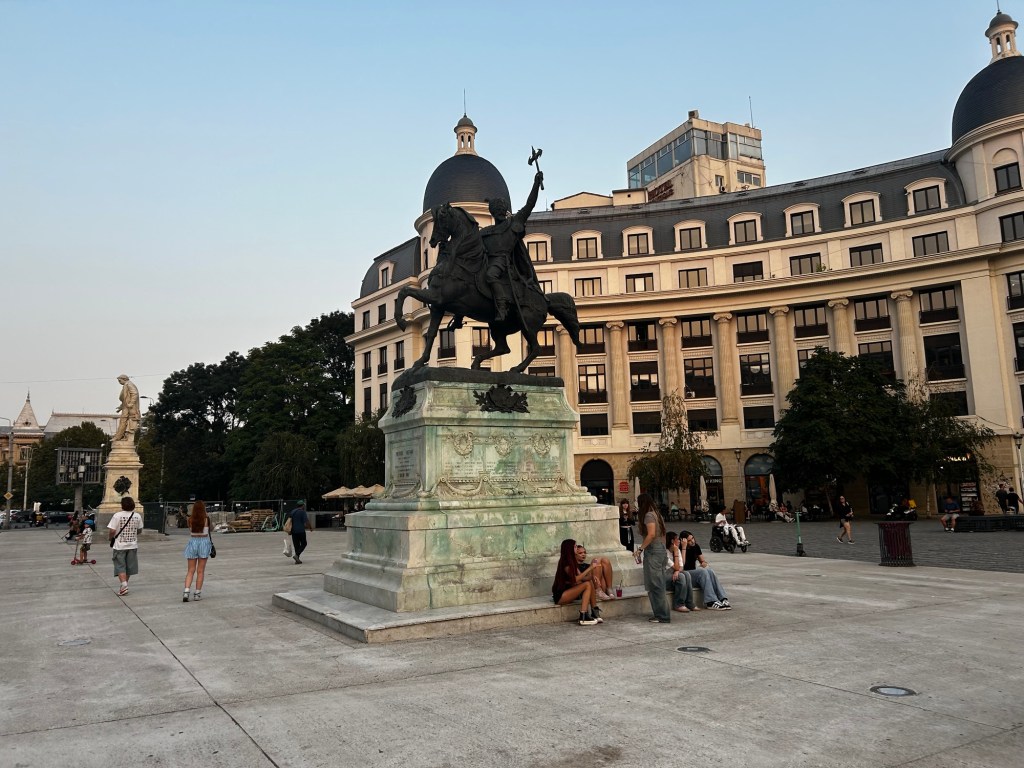
At roughly 9:30pm local time, our bus pulls into University Square in Bucharest, and we walk off into the dark night to find some authentic Romanian cuisine. Our search brings us to a small burger restaurant called McDonalds – you might have heard of it! After that it’s back to our Airbnb for a hearty sleep in preparation for another day of discovery tomorrow. Night, night.



Leave a comment